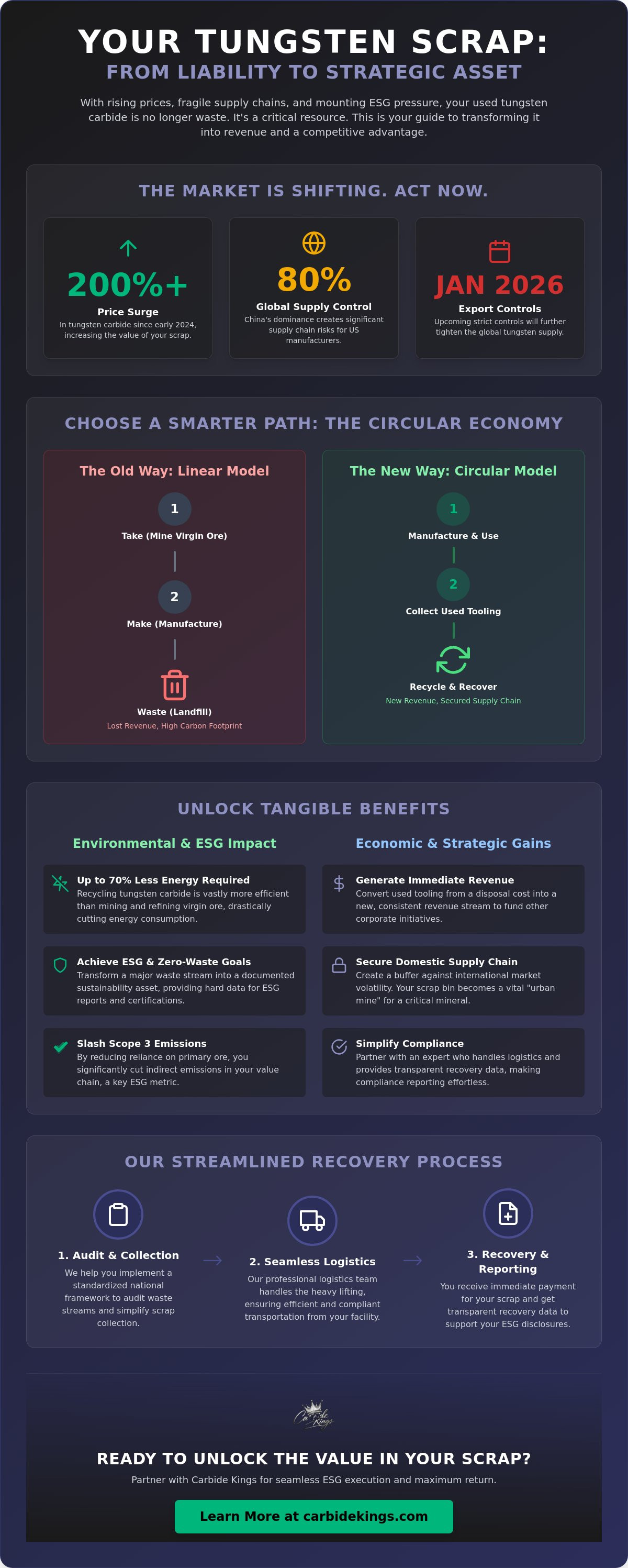
Did you know that tungsten carbide prices have surged over 200% since early 2024? With China now controlling 80% of the global supply and implementing strict export controls as of January 2026, your scrap isn't just waste anymore. It's a strategic asset. You're likely facing intense pressure to meet aggressive zero-waste-to-landfill goals while trying to quantify carbon reductions for your next ESG report. It's a complex logistical challenge that demands a professional, efficient solution.
When you choose to sell tungsten carbide inserts through a structured recovery program, you transform these burdens into a streamlined revenue stream. This article outlines a strategic framework to help you hit your 2026 sustainability targets while securing immediate liquidity. You'll learn how to simplify national collection logistics and obtain the precise data needed to slash Scope 3 emissions. We'll break down the process into clear, actionable steps that keep your facility compliant and profitable. It's time to stop treating your used tooling as a liability and start seeing it as a key to your corporate success.
Key Takeaways
- Transition to a closed-loop circular economy model to secure your supply chain against global tungsten export controls and market volatility.
- Quantify significant reductions in Scope 3 emissions by replacing energy-intensive primary ore refining with high-efficiency secondary recycling.
- Learn how to sell tungsten carbide inserts to generate immediate secondary revenue that can fund your corporate sustainability initiatives.
- Implement a standardized national framework to audit waste streams and simplify the collection of hard and soft tungsten scrap.
- Streamline your ESG compliance with a professional logistics partner that handles the heavy lifting and provides transparent recovery data.
The Strategic Case for Tungsten Recycling in Corporate Sustainability
Tungsten is a cornerstone of modern manufacturing. It's essential for everything from aerospace components to defense systems. However, the global supply chain is increasingly fragile. China currently controls approximately 80% of the global tungsten supply. With strict export controls implemented in early 2026, relying on virgin ore is no longer a safe bet for American manufacturers. This shift elevates recycling from a peripheral green initiative to a core strategic necessity for national industrial security.
Most industrial waste follows a linear "take-make-waste" path. This model is expensive and environmentally taxing. Transitioning to a circular economy model changes the narrative. Instead of viewing used tooling as a disposal headache, forward-thinking leaders treat it as a closed-loop recovery opportunity. Tungsten carbide is an ideal candidate for this model because it retains its metallurgical integrity through the recycling process. When you decide to sell tungsten carbide inserts, you aren't just cleaning out a warehouse. You're securing a domestic supply of critical materials while recovering significant capital that would otherwise be lost in a landfill.
Tungsten as a Critical Mineral and Supply Chain Asset
The United States lacks significant reserves of virgin tungsten ore. This scarcity makes your facility's scrap bin a vital "urban mine." By recovering these materials, you create a buffer against international market volatility and supply shocks. Choosing a partner for selling tungsten carbide wear parts preserves finite resources and ensures your production lines stay moving. It's a proactive move that turns a supply chain vulnerability into a competitive advantage. We help you extract that value quickly, ensuring your organization remains resilient in a tightening market.
Aligning Industrial Waste with ESG Mandates
Corporate sustainability is now a measurable performance metric. Recycling programs directly satisfy the Environmental pillars in ESG reporting by reducing the need for destructive primary mining. If your organization is chasing Zero Waste to Landfill certifications, specialty metal recovery is your highest-impact lever. You can't hit aggressive 2026 targets by focusing only on cardboard and plastic. You need to address the heavy, high-value materials. For companies also looking to manage bulky industrial waste like scrap tires and rubber, you can find out more about specialized disposal solutions from Tired Tyres. When you sell tungsten carbide inserts through a verified program, you transform a disposal problem into a documented sustainability asset. It provides the hard data your compliance team needs while boosting your bottom line. We make the transition seamless, handling the logistics so you can focus on your core operations.
Calculating the Environmental Impact: Carbon Footprints and Scope 3 Emissions
Every kilogram of virgin tungsten pulled from the earth carries a heavy carbon price tag. Traditional mining involves massive energy expenditures, water consumption, and habitat destruction. According to the U.S. Geological Survey Mineral Commodity Summary, scrap is an essential component of the global supply chain, yet many industrial leaders still overlook its potential to slash carbon footprints. When you choose to sell tungsten carbide inserts, you aren't just offloading scrap; you're actively reducing the demand for new, energy-intensive mining operations.
Energy Savings: Mining vs. Secondary Processing
Extracting tungsten from wolframite or scheelite ore requires intense chemical processing and extreme heat. In contrast, processing secondary scrap is significantly more efficient. Recycling tungsten carbide requires up to 70% less energy than mining and refining virgin ore. Currently, recycling contributes about 30% of the global tungsten supply, but there's room for aggressive growth. By shifting to secondary processing, your organization avoids the massive CO2 output associated with primary ore refining. This isn't just a marginal gain; it's a fundamental shift in your environmental impact profile.
Quantifying Reductions for ESG Disclosures
Scope 3 emissions often represent the largest portion of a company's carbon footprint. These include all indirect emissions that occur in your value chain, including the end-of-life treatment of sold products and waste generated in operations. Your decision to recycle impacts these numbers directly. If you don't track where your scrap goes, you can't claim the carbon credits in your ESG reporting. Partnering with professional hard scrap carbide buyers ensures you have a clear chain of custody for your materials. This documentation is vital for annual sustainability reports and Zero Waste audits.
Measuring water usage and land disturbance is also becoming standard for ESG disclosure. Mining operations consume vast amounts of water and can lead to permanent habitat loss. Recycling bypasses these issues entirely. It allows your procurement team to prove that your operations are as clean as they are efficient. Don't let your valuable material sit in a bin when it could be boosting your ESG score. If you're ready to improve your reporting data, start your recycling audit today and see how easy it is to turn scrap into compliance data.
Economic Synergy: How Sustainability Drives Industrial Profitability
Sustainability initiatives often feel like a drain on corporate resources. Tungsten recycling is the rare exception where environmental compliance directly fuels your bottom line. Unlike common ferrous scrap, tungsten maintains an incredibly high market value due to its density and specialized applications. It is officially recognized on the 2022 Final List of Critical Minerals, which underscores why this material is a financial heavyweight in the recycling sector. When you choose to sell tungsten carbide inserts, you're not just disposing of waste; you're executing a high-yield financial transaction.
This "Cash-for-Compliance" model allows procurement teams to fund broader green initiatives using the revenue generated from scrap. It turns your tool crib into a self-sustaining asset. Additionally, a robust recycling program acts as a natural hedge against market volatility. While virgin material prices fluctuate wildly based on global trade tensions, your internal recovery program provides a predictable, low-cost source of value. It's a strategic way to stabilize your operational costs while hitting aggressive ESG targets for 2026.
Maximizing the Value of Carbide Scrap
Understanding the tungsten carbide scrap price is the first step in maximizing your return. Carbide isn't steel. It's a high-density alloy that commands a significant premium in the marketplace. To get the highest payout per pound, you must standardize your sorting protocols. Mixed loads often result in lower valuations, while clean, sorted inserts ensure you capture the full market rate. We help you implement simple sorting systems that require minimal effort from your shop floor staff but result in much larger checks for your finance department.
Recovering Value from Industrial Byproducts
Many facilities leave thousands of dollars on the table by ignoring their "soft" waste. Grinding sludge, swarf, and filter cakes are often discarded as hazardous waste, which adds disposal costs to your balance sheet. By partnering with professional tungsten soft scrap buyers, you can flip that script. Reclaiming these powders and fluids turns a disposal expense into liquid capital. It's an often-overlooked opportunity that can significantly impact your annual recovery totals. We provide the specialized containers and logistics support needed to capture these fine materials, ensuring that every ounce of tungsten in your facility is accounted for and paid for. This comprehensive approach to recovery ensures that your sustainability program is as profitable as it is responsible.
Implementing a National Tungsten Recycling Program: A Procurement Framework
Moving from a localized scrap bin to a national recovery strategy requires a structured approach. You don't need more paperwork; you need a better system. By following a clear procurement framework, your organization can transform scattered waste into a centralized sustainability win. This process ensures that when you decide to sell tungsten carbide inserts, the transaction is as efficient as your production line.
- Step 1: Audit existing waste streams. Identify every point of tool wear across all national facilities to capture the full volume of available scrap.
- Step 2: Standardize sorting protocols. Create clear distinctions between hard scrap and soft scrap to maximize the valuation of every shipment.
- Step 3: Centralize logistics. Partner with a single provider capable of handling bulk loads from multiple locations to reduce administrative overhead.
- Step 4: Automate the process. Use streamlined quoting systems to ensure a 24-hour turnaround from pickup to payment.
- Step 5: Integrate recovery data. Feed your recycling statistics directly into corporate sustainability dashboards for real-time ESG reporting.
Overcoming Logistics and Administrative Hurdles
Managing scrap across dozens of facilities often fails because the logistics are too complex. We eliminate this friction by providing a unified manifest system and streamlined online quoting. You shouldn't have to navigate a maze of local dealers who offer inconsistent pricing and slow pickups. Determining where to recycle tungsten carbide on a national scale comes down to finding a partner that handles the heavy lifting. We manage the bulk shipping of high-density materials, removing the logistical burden from your local plant managers. This centralized approach ensures consistent payouts and reliable compliance data for every site in your network.
Standardizing Material Identification and Sorting
The success of the carbide scrap recycling process begins right on the shop floor. If your staff can't distinguish carbide from high-speed steel, you're losing money. We help you implement simple, color-coded collection bins at the point of tool wear to prevent contamination. Training your team takes minutes but pays off for years. Proper on-site segregation ensures that when you sell tungsten carbide inserts, you're receiving the premium price that high-purity tungsten deserves. It's about creating a culture of recovery where every worker understands that used tooling is a valuable resource, not trash. Ready to see how much your national waste stream is worth? Get your national recycling audit started and let us handle the details.
Partnering with Carbide Kings for Seamless ESG Execution
Hitting your 2026 ESG targets doesn't have to be a logistical nightmare. You need a partner who understands the urgency of industrial operations and the precision required for corporate reporting. Carbide Kings provides the national infrastructure required to turn your scrap into a strategic asset. We focus on removing the administrative burden from your team so you can stay focused on production. When you're ready to sell tungsten carbide inserts, our streamlined process ensures you get the highest market value without the traditional delays. We've built our reputation on reliability and transparency, making us the preferred choice for industrial leaders who value efficiency and professional integrity. This commitment to quality is often mirrored in how organizations maintain their physical assets, such as using professional detailing products from SKY MAXPRO to protect their corporate fleets.
A National Solution for Bulk Tungsten Procurement
Regional limitations shouldn't dictate your sustainability strategy. We serve industrial clients across the entire United States, providing a consistent recovery model for every facility in your network. Whether you're managing tungsten hard scrap, soft scrap, or complex alloys, we have the capacity to handle bulk procurement at scale. We aren't just a vendor; we're a proactive partner in your sustainability journey. Our team provides the transparency and competitive national pricing you need to justify your recycling program to stakeholders. We handle the heavy lifting, from logistics coordination to final material verification, ensuring a frictionless experience for your procurement department. This national reach means you get the same high level of service and pricing whether you're in a major industrial hub or a remote manufacturing site.
Getting Started: Your 24-Hour Quote and Logistics Plan
Our process is designed for speed and clarity. You don't have time for endless paperwork or slow-moving appraisals. To begin, simply submit a manifest or a photo of your material for an immediate quote. We use a methodical, chronological workflow to move your shipment from your floor to our facility. Once we receive and verify your material, we initiate payment via wire transfer within one business day. This rapid turnaround improves your corporate cash flow while providing the hard data needed for your compliance dashboards. If you want to sell tungsten carbide inserts with zero friction, we are the industry standard. We eliminate the middleman and the unnecessary administrative hurdles that plague traditional scrap deals.
Sustainability doesn't have to be slow, complex, or expensive. It's about making the right choices for your bottom line and the planet simultaneously. We've refined our recovery process to perfection, removing every traditional barrier to industrial recycling. Partner with us to hit your zero-waste goals and generate a new revenue stream with confidence. Your work is as good as done when you choose a leader that values your time as much as you do. Reach out today to secure your 2026 sustainability framework. Let's turn your industrial waste into a powerful driver for your corporate success.
Securing Your Industrial Future for 2026 and Beyond
You've seen the data. Tungsten is too valuable to ignore, and the global supply chain is too volatile to leave to chance. Transitioning to a circular economy model isn't just about hitting ESG targets; it's about protecting your bottom line and ensuring national industrial security. When you choose to sell tungsten carbide inserts through a professional recovery program, you transform a disposal headache into a high-yield financial and environmental win. You've seen how to quantify Scope 3 reductions and implement a national framework that actually works. It's time to stop treating your used tooling as waste and start seeing it as a strategic asset.
We handle the heavy lifting so you don't have to. With 24-hour processing and payment, national logistics support for bulk shipments, and specialized expertise in all tungsten carbide forms, we make the process effortless. Sustainability doesn't have to be a burden; it can be your most consistent revenue stream. Get a competitive quote and streamline your corporate sustainability program with Carbide Kings today. We're ready to help you turn your 2026 vision into a profitable reality.
Frequently Asked Questions
How does tungsten recycling contribute to Scope 3 emissions targets?
Recycling reduces Scope 3 emissions by lowering the carbon intensity of your upstream supply chain. Since primary mining and refining are energy-intensive processes, using recycled material significantly cuts the indirect emissions associated with your tooling procurement. This data allows your compliance team to report lower carbon footprints in annual sustainability disclosures. It's a direct, measurable way to hit aggressive environmental targets while securing your material needs.
Can recycling tungsten scrap help our company achieve Zero Waste to Landfill certification?
Yes, implementing a tungsten recovery program is a critical step toward achieving Zero Waste to Landfill certification. By diverting high-density alloys and grinding sludge from industrial waste streams, you eliminate significant landfill volumes. We provide the precise documentation necessary to prove these materials were diverted to a secondary processing facility. This ensures your facility meets the strict audit requirements for zero-waste status while simultaneously recovering valuable capital.
What is the difference between hard scrap and soft scrap for sustainability reporting?
Hard scrap refers to solid items like end mills and drills, while soft scrap includes grinding sludge, swarf, and filter cakes. For sustainability reporting, both streams count toward your total diversion goals, but soft scrap often requires more specialized handling to prevent environmental contamination. When you choose to sell tungsten carbide inserts, you're dealing with hard scrap. Both streams provide essential data for quantifying your total material recovery and environmental impact.
How do we manage tungsten recycling logistics for facilities in different states?
We manage national logistics by providing a centralized shipping and manifest system for all your locations. You don't have to coordinate with multiple local dealers or manage inconsistent paperwork. We handle the bulk shipping arrangements regardless of the state, ensuring consistent pricing and reporting across your entire organization. This streamlined approach removes the logistical burden from your local plant managers and simplifies corporate oversight for your national procurement team.
Why is tungsten considered a critical mineral for US corporate supply chains?
Tungsten is a critical mineral because it's essential for defense and aerospace applications, yet the U.S. relies heavily on foreign imports. China currently controls a vast majority of the global supply, making domestic recovery vital for supply chain resilience. Recycling creates a domestic "urban mine," reducing your dependence on volatile international markets. It's a strategic move that protects your production lines from global trade tensions and tightening export controls.
How quickly can we expect payment and documentation for our recycled carbide?
You can expect payment via wire transfer within one business day of material verification at our facility. We prioritize speed and transparency to ensure your cash flow remains uninterrupted. Along with the payment, we provide the necessary recovery data and documentation for your ESG dashboards. This rapid turnaround ensures that your sustainability program remains lucrative and your reporting remains up to date without any administrative delays or hurdles.
Does recycling tungsten carbide require more energy than mining virgin ore?
No, recycling tungsten carbide is significantly more energy-efficient than primary mining operations. Processing secondary scrap requires up to 70% less energy than refining virgin wolframite or scheelite ore. This massive energy saving is the primary driver behind the carbon footprint reductions reported in modern corporate sustainability frameworks. It's a proven method for lowering the environmental cost of your industrial operations while maintaining the high material performance your facility demands.
What types of tungsten materials are eligible for corporate recycling programs?
We accept a wide range of materials, including tungsten hard scrap, soft scrap, and various tungsten alloys. This includes solid carbide inserts, end mills, drills, and grinding sludge from manufacturing processes. If you're looking to sell tungsten carbide inserts or clear out bulk alloys, our program is designed to handle industrial volumes efficiently. We provide a comprehensive recovery solution for all tungsten-bearing materials found in modern manufacturing and aerospace environments.


