
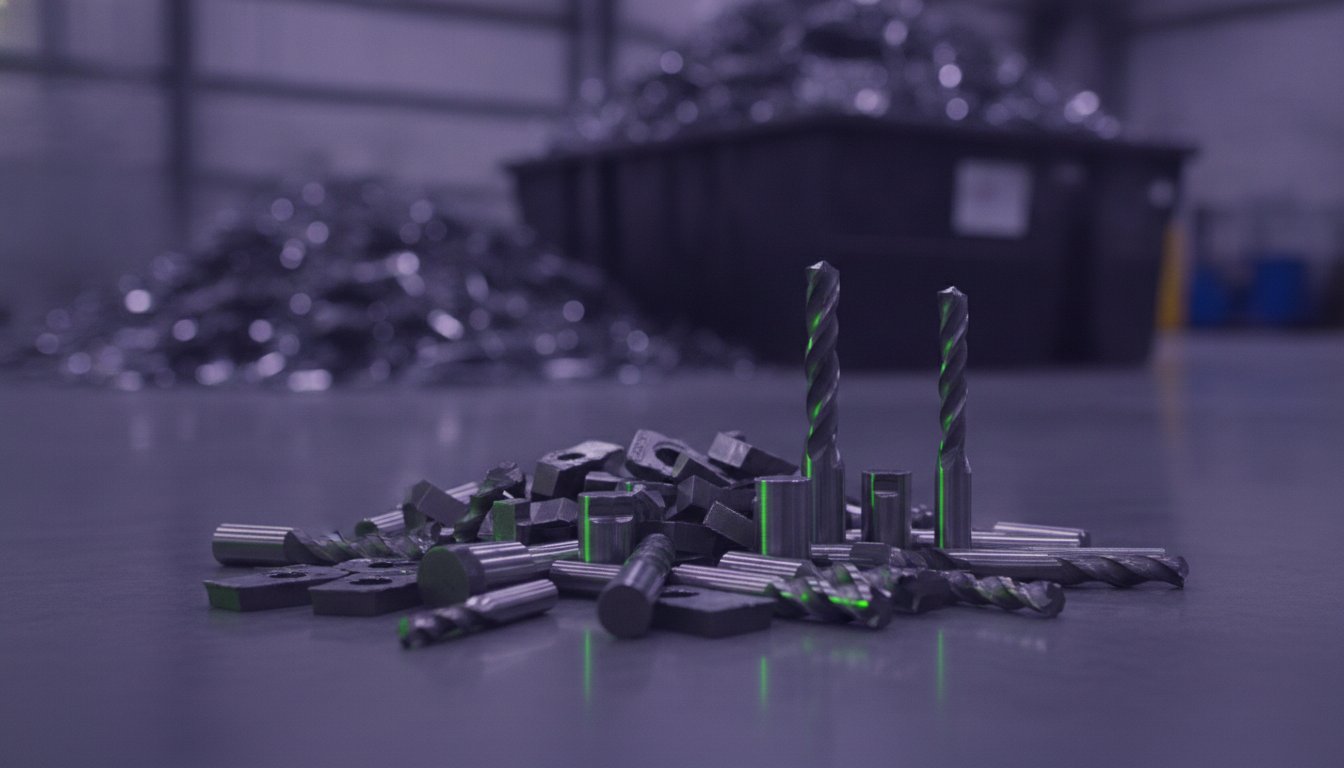
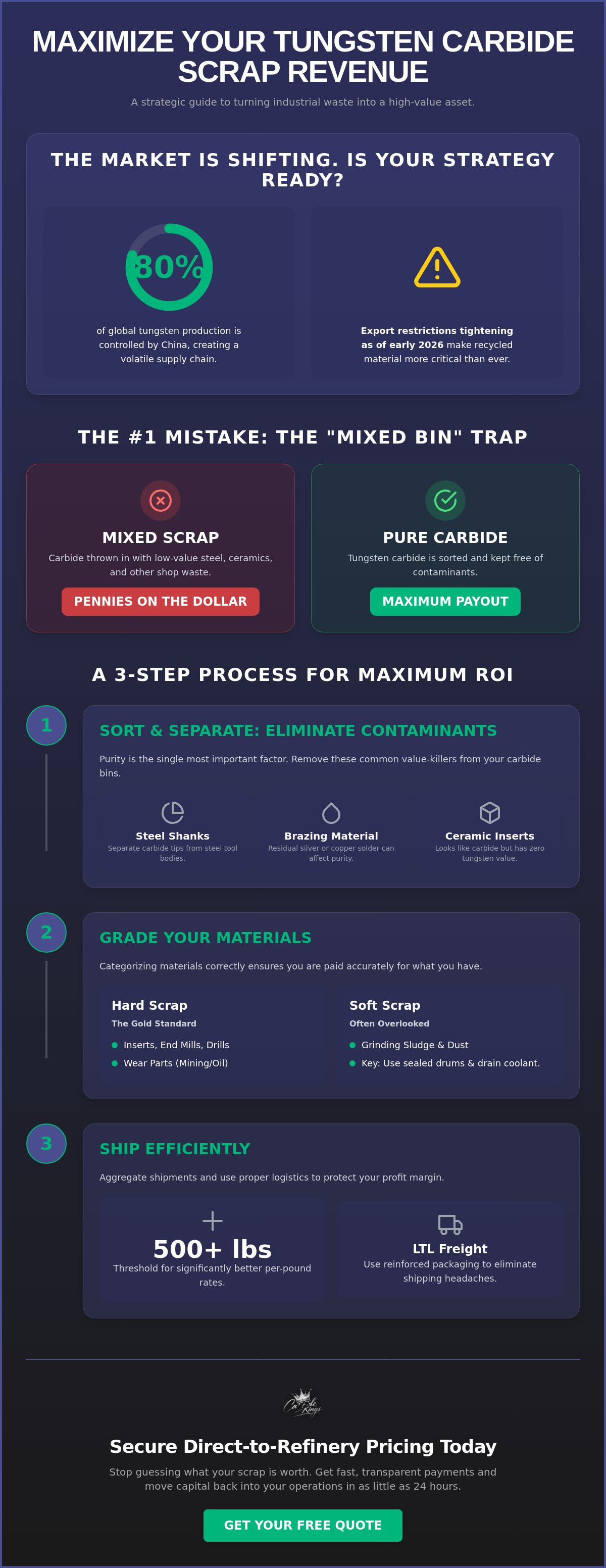
China controls over 80% of global tungsten production. With export restrictions tightening as of early 2026, your shop's waste bin is more valuable than ever. Yet, many facilities still leave money on the table by mixing high-value carbide with low-value steel. Maximizing profit from tungsten carbide scrap requires more than just a trip to a local yard. It requires a professional strategy that accounts for the current global supply squeeze and the specific grading of your materials.
You probably know the frustration of opaque pricing and the logistical headache of moving heavy metal across the country. It's exhausting to handle complex shipping when you need to stay focused on production. This guide reveals the exact sorting, grading, and logistics strategies used by top machine shops to extract the highest possible revenue from their waste. We'll show you a repeatable process for maximizing ROI and securing fast, transparent payments without the administrative hurdles. Let's turn your scrap pile into a streamlined revenue stream.
Key Takeaways
- Learn why separating steel from carbide is the foundation for maximizing profit from tungsten carbide scrap and avoiding the "mixed bin" trap.
- Identify the critical differences between high-value hard scrap and soft scrap materials like grinding sludge to ensure accurate grading.
- Leverage volume by aggregating shipments to hit the 500-pound threshold for significantly better per-pound market rates.
- Streamline your logistics using LTL freight and reinforced packaging to eliminate shipping headaches and prevent material loss.
- Secure direct-to-refinery pricing and 24-hour processing to move your capital back into operations faster.
The Value Gap: Why Most Shops Lose Money on Tungsten Carbide Scrap
Most industrial facilities view scrap as a nuisance rather than an asset. This mindset is the primary reason shops lose thousands of dollars every year. When you treat Tungsten carbide like common industrial steel, you accept pennies for what should be a premium payout. Maximizing profit from tungsten carbide scrap starts with recognizing that carbide is a strategic mineral, not just heavy metal waste.
The 2026 market has changed the math for every machine shop. Global demand for tungsten is currently outpacing primary mining output. China, which controls over 80% of production, implemented strict export controls on carbides in early 2026. These restrictions have tightened the supply chain and made recycled material essential for production continuity. If you aren't capturing the full value of your scrap, you are effectively subsidizing your competitors who do.
Specialized Buyers vs. Local Scrap Yards
General recyclers often lack the equipment to verify the exact composition of your scrap. To protect their margins, they often under-grade tungsten. They pay you a safe, low-end rate to hedge against potential impurities. Specialized buyers operate on a different model. By using direct-to-refinery pricing and precise analysis, specialists remove the guesswork. This transparency ensures you get paid for the actual weight and grade of the material you provide, rather than an arbitrary estimate from a local yard.
The Hidden Cost of Contamination
Purity is the most significant factor in your final payout. A single steel bolt or a few ceramic inserts in a drum of high-grade carbide can trigger a lower pricing tier. Contamination reduces the efficiency of the recycling process, and those costs are passed directly to you. Identifying and removing common contaminants is the fastest way to increase your ROI.
- Steel Shanks: Always separate carbide-tipped tools from solid carbide.
- Brazing Material: Residual silver or copper solder can affect purity levels.
- Ceramic Inserts: These often look like carbide but have zero tungsten value.
Establishing a purity mindset on the shop floor is essential for maximizing profit from tungsten carbide scrap. When your material reaches high purity levels, you unlock the highest possible revenue tiers. Simple habits, like using dedicated, labeled bins for different scrap streams, turn a chaotic waste pile into a high-margin product. It's a straightforward process that yields immediate financial results.
Identifying and Sorting Your Tungsten Materials for Peak Value
Success in maximizing profit from tungsten carbide scrap depends on your ability to categorize materials before they leave your shop floor. You can't rely on a general recycler to do the heavy lifting for you. Hard scrap is the primary driver of value for most operations. This includes indexable inserts, end mills, and drills. These items are the gold standard because they are dense, consistent, and easy to verify. According to U.S. Geological Survey tungsten data, recycling accounts for a significant portion of the domestic tungsten supply. This highlights why your sorted material is so critical to the industrial supply chain.
Grading Your Hard Scrap: From Inserts to Wear Parts
Indexable inserts are your most liquid asset. They are consistent in size and chemical composition, making them easy for refineries to process. While some shops worry about the difference between coated and uncoated carbide, modern recycling processes in 2026 handle both with ease. The coating weight is negligible compared to the tungsten content. Don't overlook wear parts from mining or oil and gas operations. These heavy components often contain high-grade carbide that carries significant weight and value despite their rugged appearance.
Managing Soft Scrap: Sludge and Swarf
Soft scrap is often neglected, but it shouldn't be ignored. Working with specialized tungsten soft scrap buyers allows you to capture value from grinding sludge and dust that others throw away. The biggest threats to your profit here are oxidation and moisture. If sludge sits in open containers, it oxidizes, which complicates the chemical recovery process. Use sealed drums and allow excess coolant to drain before sealing the container. Minimizing moisture weight ensures you aren't paying freight costs to ship water.
Beyond standard tools, you might encounter tungsten alloys like Densalloy or Hevimet. These heavy alloys serve as counterweights or radiation shielding. They have a different chemical profile than carbide but remain highly profitable. Use these quick field tests to verify your materials:
- The Spark Test: Tungsten produces short, orange, and straight sparks. This is distinct from the long, white, branching sparks of steel.
- The Magnet Test: Pure tungsten isn't magnetic. However, the cobalt or nickel binder in carbide often shows a slight magnetic pull.
- Weight Check: Tungsten is nearly twice as heavy as lead. If a small part feels unusually heavy for its size, it's likely a tungsten alloy.
If you want a professional assessment of your current inventory, you can get a quote from an expert buyer to confirm your findings. Proper identification is the final step in maximizing profit from tungsten carbide scrap and ensuring no high-value material is wasted.
Market Timing and Volume: When to Sell Your Carbide Scrap
Volume is your most powerful leverage in the recycling market. Maximizing profit from tungsten carbide scrap relies on hitting specific weight tiers that trigger higher payouts. A 500 lb shipment consistently commands a higher per-pound rate than a 50 lb box. This happens because administrative costs and processing labor are nearly identical for both loads. When you ship in bulk, you allow the buyer to pass those operational efficiencies back to you. It's a simple way to increase your margins without changing your shop's workflow.
Monitoring the global "Wolfram" index provides a window into market health, but don't let it paralyze your decision-making. Global supply shifts, especially with recent export changes, create volatility. Modern sustainable tungsten recycling methods have made processing more efficient, yet many shops still lose money by waiting for a "perfect" price peak. This is a trap. Sitting on inventory ties up capital and occupies valuable floor space. Cash flow is often more valuable than a marginal price increase that might not materialize for months.
The Volume vs. Frequency Debate
Ship more, less often. This is the golden rule for logistical efficiency. Every shipment involves a "break-even" point where freight costs eat into your profit. If you ship small quantities weekly, you pay a premium for logistics. By aggregating your materials into monthly or quarterly batches, you hit tiered pricing structures. These "Price Per Pound" jumps are significant. They turn a standard transaction into a high-margin event. Focus on hitting the 500 lb threshold to see the most dramatic shift in your ROI.
Spot Pricing vs. Long-Term Contracts
Trying to time the market like a commodity trader is risky for most industrial professionals. Your focus should remain on production. A consistent recycling partner provides predictable cash flow and shields you from the most extreme market dips. Consulting a tungsten carbide scrap price guide helps you understand these market drivers without requiring daily index tracking. Look for buyers who follow the 24-hour rule. You want a partner who processes your material and issues payment within one business day of receipt. Speed is a form of profit. It moves your capital back into your operations where it can work for you immediately.
Streamlining Logistics to Protect Your Bottom Line
Logistics is often the "hidden leak" where potential gains vanish. Shipping heavy, high-density metal is fundamentally different from standard parcel delivery. If you aren't optimizing your freight strategy, you're effectively handing back a portion of your revenue to the carrier. Maximizing profit from tungsten carbide scrap requires a lean, industrial approach to transportation that prioritizes weight efficiency and material security. By moving material correctly, you ensure that the value you've captured through sorting and grading actually makes it to your bank account.
The "Door-to-Dock" process should be fast and frictionless. Every day your material sits on a trailer is a day your capital is tied up in transit. Use Less Than Truckload (LTL) shipping for shipments over 500 lbs to secure the best rates. For smaller loads, parcel services work, but only if the packaging is reinforced. High-value shipments also require robust tracking and insurance. You can't afford a "lost" pallet when dealing with strategic minerals. Proactive tracking allows you to verify receipt and trigger the 24-hour payment cycle mentioned earlier in this guide.
Industrial Packaging Standards
Standard cardboard boxes fail under the weight of carbide. These materials are nearly twice as dense as lead; they will punch through single-wall corrugated board during transit. This leads to "spill loss," where small inserts or drills leak out of the package, directly reducing your payout. For LTL shipments, 5-gallon plastic buckets or steel drums are the industry standard. They are durable, stackable, and easy to secure to a pallet. If you must use boxes for smaller quantities, utilize the "Double-Box" method. Place your material in a reinforced inner container, then seal that inside a second, larger box with ample padding. Clear, waterproof labeling ensures your shipment is checked in the moment it hits the dock.
Leveraging Buyer-Provided Logistics
You don't need to be a freight expert to get professional results. Many shops waste hours navigating carrier websites and comparing rates. Partnering with specialists who understand the carbide scrap recycling process removes this administrative burden. We provide the shipping labels and schedule the pickups for you. This "Schedule a Pickup" advantage means your team stays focused on production while we handle the heavy lifting. Digital manifests and automated weighing further reduce paperwork, creating a transparent trail from your shop to our facility.
Stop overpaying for shipping and start keeping more of your revenue. You can request a prepaid shipping label today to see how a streamlined logistics plan impacts your bottom line.
The Carbide Kings Advantage: Speed, Transparency, and Payout
All the strategies discussed in this guide culminate in the final transaction. You've sorted your material, hit your volume targets, and secured your packaging. Now, you need a partner that matches your professional efficiency. Maximizing profit from tungsten carbide scrap is only possible when you remove the middleman. We provide direct-to-refinery pricing that puts more revenue back into your shop's budget. By bypassing local yards that lack specialized analysis equipment, you ensure every ounce of your material is valued at current 2026 market rates.
Speed is a critical component of your ROI. We operate on a 24-hour processing cycle. From the moment your shipment arrives at our dock, our team begins the verification and weighing process. You won't wait weeks for a settlement report. We offer flexible payment terms to fit your accounting needs, including wire transfers, ACH options, and traditional checks. Whether you're a single machine shop or a multi-state industrial operation, our national reach ensures you receive elite service anywhere in the United States.
Our Streamlined Procurement Workflow
We've refined our process to feel as simple as a basic retail transaction. Our workflow is designed to minimize your administrative burden so you can stay focused on core operations. It follows three logical steps:
- Step 1: Get an instant quote based on verified 2026 market data. We provide clarity on your material's value before it ever leaves your floor.
- Step 2: We handle the heavy lifting. Our team assists with all shipping logistics, providing prepaid labels and documentation to ensure a smooth transit.
- Step 3: Rapid verification occurs in our professional facility. We use precision weighing and analysis to confirm your payout, often within one business day.
Why Consistency Matters in Carbide Recycling
Viewing scrap as a strategic asset rather than waste changes your bottom line. Consistency allows you to build a repeatable process for maximizing profit from tungsten carbide scrap. When you treat recycling as a standard part of your procurement cycle, you stabilize your cash flow. One machine shop partner recently saw an 15% increase in annual scrap revenue simply by switching from a local general recycler to our specialized program. They eliminated contamination, optimized their shipping frequency, and secured better pricing tiers.
Your waste bin shouldn't be a source of stress or lost revenue. It should be a predictable, high-margin asset that supports your shop's growth. Take the first step toward a more lucrative recycling program and get your competitive carbide scrap quote today.
Secure Your Industrial Revenue Stream
Your waste bin is a strategic resource, not a nuisance. By implementing a disciplined sorting process and aggregating shipments to hit high-volume tiers, you transform scrap from a logistical burden into a major financial asset. Professional logistics and specialized grading ensure you capture every dollar available in the current market. Maximizing profit from tungsten carbide scrap is ultimately about removing friction from the transaction and working with experts who understand the value of your material.
We handle the heavy lifting with national logistics support and a specialized focus on tungsten carbide only. You don't have to navigate complex global supply shifts alone. Our team provides 24-hour processing and payment to keep your capital moving and your shop floor clear. It's time to stop leaving money on the table and start treating your carbide waste with the respect it deserves. Our direct-to-refinery model ensures you receive the highest possible payout without middleman fees.
Maximize your profit today — Get a Carbide Kings quote
Start turning your shop floor waste into immediate operational capital today. It's a straightforward shift that pays dividends for your bottom line for years to come.
Frequently Asked Questions
How is the price of tungsten carbide scrap determined in 2026?
Prices are based on current global market indices and the percentage of tungsten content in your material. In 2026, export controls have increased market volatility, making direct-to-refinery pricing more essential than ever. We evaluate the grade, volume, and purity of your shipment to ensure you receive a quote that reflects real-time industrial demand rather than a generalized local estimate.
Is it worth sorting carbide inserts from steel tool holders?
Yes, sorting is the most effective way of maximizing profit from tungsten carbide scrap. Steel holders carry significantly lower value than solid carbide. Mixing them devalues your entire drum because it increases processing costs at the refinery. Always remove steel shanks or bolts to secure the highest possible purity tier and avoid the "mixed bin" pricing penalties.
What is the minimum weight required to sell tungsten scrap?
We accept shipments of all sizes, though volume directly impacts your per-pound rate. For industrial clients, we recommend hitting a 500 lb threshold to optimize freight costs and unlock higher pricing tiers. Smaller shipments are welcome, but aggregating your material into larger batches ensures you keep more of the total revenue after logistics are calculated.
How do I distinguish between tungsten carbide and high-speed steel (HSS)?
Use a weight comparison and a spark test to tell them apart. Tungsten carbide is nearly twice as heavy as steel of the same size. When held to a grinder, carbide produces short, straight, orange sparks. High-speed steel produces long, white, branching sparks. If you aren't sure, a magnet often shows a much weaker pull on carbide compared to HSS.
How long does it take to receive payment after shipping my scrap?
Payment is typically issued within 24 hours of material verification at our facility. Once your shipment is weighed and graded, we finalize the settlement report immediately. You can choose between wire transfers, ACH, or traditional checks. This ensures your capital returns to your operations quickly, allowing you to maintain momentum without administrative delays.
Does Carbide Kings buy grinding sludge or only hard scrap?
We buy both hard scrap and soft scrap, including grinding sludge, swarf, and dust. These materials require specific handling to prevent oxidation and moisture buildup, which can devalue the load. We provide clear guidance on collection methods to help you capture value from waste streams that many shops simply discard as industrial trash.
What are the most common high-value tungsten alloys to look for?
Look for heavy tungsten alloys like Densalloy, Hevimet, and Mallory. These materials are often found in radiation shielding, aerospace counterweights, and vibration-dampening boring bars. While they differ chemically from cemented carbide, their high tungsten density makes them incredibly valuable. Identifying these alloys separately from your tool scrap ensures you receive an accurate and fair valuation.
Do you provide shipping containers or drums for industrial clients?
We provide comprehensive logistics support, including guidance on industrial packaging standards to ensure your material arrives safely. While most shops use their own 5-gallon buckets or steel drums, we handle the shipping labels and freight scheduling for you. Contact us to discuss your specific volume requirements, and we'll help you establish a streamlined collection and transit process.


