

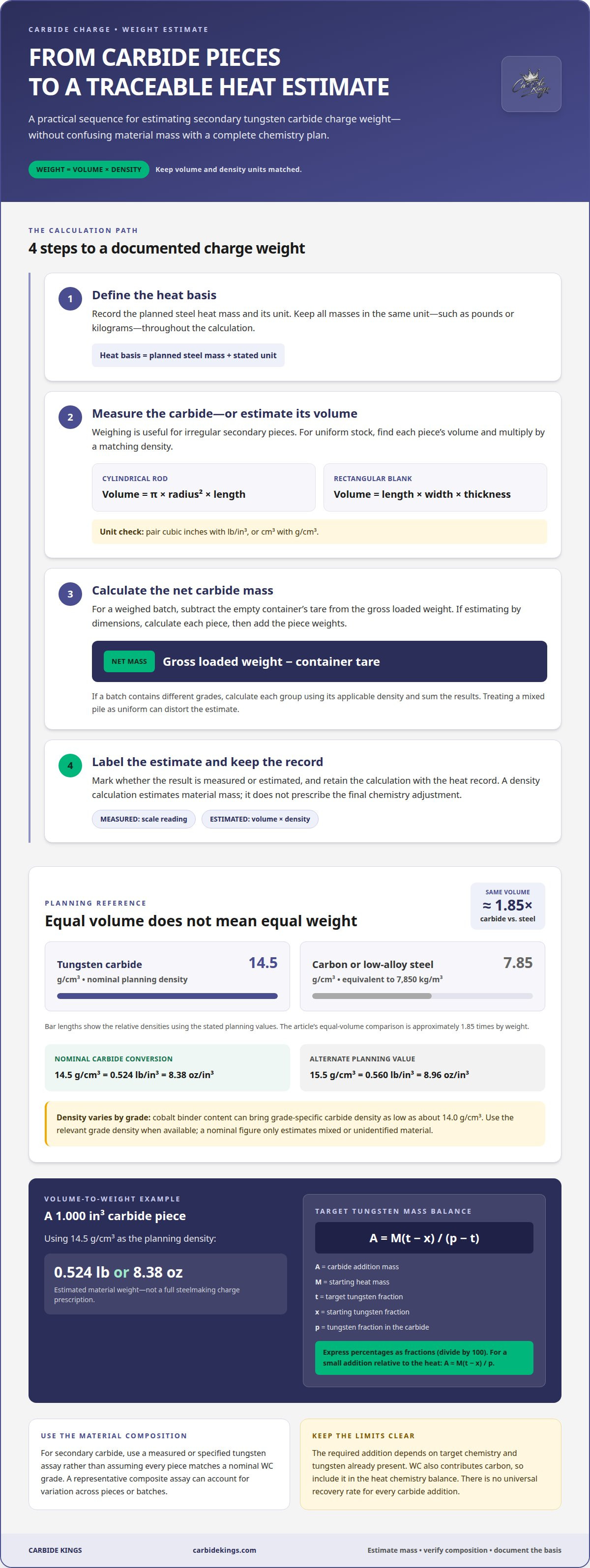
Equal volumes of tungsten carbide and steel do not weigh the same: using planning densities of 14.5 g/cm³ for carbide and 7.85 g/cm³ for steel, carbide weighs about 1.85 times as much. The charge weight calculation formulas for secondary tungsten carbide in steel heats start with one rule: weight equals volume multiplied by density. Keep the units consistent to make the comparison usable.
When estimating material for a steel heat, distinguish a density-based weight comparison from a complete charge plan. The formula calculates the mass of a known volume, but secondary carbide materials are not all identical. This guide gives nominal carbide and steel density values, explains how to convert volume into weight, and shows how to compare equal volumes. Use the calculation to estimate carbide weight relative to steel, while keeping in mind what that comparison can and cannot tell you about the heat charge.
Key Takeaways
- Use consistent volume and density units to estimate carbide charge weight, then compare it with the steel weight on the same basis.
- Convert a target tungsten content into an addition estimate by accounting for the tungsten fraction in the material.
- Adjust the theoretical addition for recovery and oxidation losses so the charge estimate reflects what remains in the melt.
- When sourcing secondary material, Carbide Kings offers carbide scrap alongside tungsten hard scrap, tungsten soft scrap, and tungsten alloys.
Tungsten carbide and steel nominal densities
Nominal density is a planning mass per unit volume. Tungsten carbide at 14.5 g/cm³ is a useful estimate; carbon or low-alloy steel uses 7,850 kg/m³, equivalent to 7.85 g/cm³. At equal volume, carbide weighs about 1.85 times as much as steel using those densities.
Density conversion expresses the same material value in different units. Tungsten carbide at 14.5 g/cm³ corresponds to 0.524 lb/in³ and 8.38 oz/in³. A planning value of 15.5 g/cm³ corresponds to 0.560 lb/in³ and 8.96 oz/in³. Keep volume and density units matched.
Grade-specific density is the mass per volume for a carbide composition. Binder content changes that value: grades with more cobalt binder can have density as low as about 14.0 g/cm³. Use the relevant grade density when available; a nominal figure only estimates mixed or unidentified material.
Weight from volume is calculated by multiplying volume by density. For a 1.000 in³ carbide piece at 14.5 g/cm³, the estimate is 0.524 lb, or 8.38 oz. This is a material-weight calculation, not a full steelmaking charge prescription.
A grade-based calculation uses the carbide composition and its mass. A calculation based on elemental tungsten uses the tungsten fraction measured or specified for the material. The latter directly relates the addition to the target tungsten content, while the WC grade also indicates binder and carbon contributions.
No single density formula sets tungsten limits or charge practice for every steel grade. The calculation estimates mass; the steel grade’s target chemistry and the melt’s existing composition determine the required addition.
Heat weight and target tungsten percentage determine the required tungsten mass through a mass balance. Multiply the heat weight by the target tungsten fraction, then account for tungsten already present and the tungsten content of the addition.
Sample secondary carbide across representative pieces or batches, then assay the composite for tungsten and other relevant constituents. Use the resulting composition in the mass balance instead of assuming every piece matches a nominal WC grade.
WC contributes carbon as well as tungsten. Include that carbon in the heat chemistry balance, and account for decarburization because carbon losses affect the remaining composition and adjustment needs.
There is no universal recovery rate for every carbide addition. Recovery depends on the material composition and melting and charging conditions, so relying on one assumed rate can misstate the required weight.
Charging can create dust exposure during handling. The Agency for Toxic Substances and Disease Registry notes exposure to tungsten-compound or cemented tungsten-carbide dusts and mists during crushing, mixing, and loading or unloading. Control dust during these steps.
How is tungsten carbide charge weight calculated for steel heats?
Charge weight is the net mass of tungsten carbide assigned to a steel heat. Calculate it from a scale reading or from known dimensions and density. Weighing works for irregular secondary pieces; geometry gives an estimate for uniform stock. The charge weight calculation formulas for secondary tungsten carbide in steel heats help organize and compare these inputs.
Net mass is gross loaded weight minus the empty container’s tare weight. Record both readings in the same unit, such as pounds or kilograms. For dimension-based estimates, calculate each piece’s volume, multiply by its matching density, then add the piece weights. For a cylindrical rod, volume = π × radius² × length. For a rectangular blank, volume = length × width × thickness.
Follow these steps for a traceable estimate:
- Define the heat basis, such as planned steel mass, and record its unit.
- Weigh the carbide, or estimate piece volume and use density in matching units.
- Subtract container tare from gross weight, then total the net weights.
- Mark whether the result is measured or estimated, and retain the calculation with the heat record.
Unit consistency prevents conversion errors. Pair cubic inches with pounds per cubic inch, or cubic centimeters with grams per cubic centimeter. If a batch contains different grades, calculate each group separately using its applicable density, then sum the results. Treating a mixed pile as uniform can distort the estimate.
Secondary carbide may include broken pieces and mixed shapes, making dimensions an imperfect measure of solid volume. Use measured net mass when you can weigh the batch. For consistent stock, geometry can provide a practical estimate. These charge weight calculation formulas for secondary tungsten carbide in steel heats estimate material mass, not the final chemistry adjustment. Keep that distinction clear in the heat record.
What formulas convert target tungsten content into tungsten carbide addition weight?
Target tungsten content is the desired tungsten mass fraction in the finished heat. For a precise mass balance, use A = M(t − x) / (p − t). Here, A is carbide addition mass, M is starting heat mass, t is target tungsten fraction, x is starting tungsten fraction, and p is tungsten fraction in the carbide. Express percentages as fractions by dividing by 100.
Tungsten assay fraction is the measured or specified share of an addition’s mass that is tungsten. Use the assay for secondary carbide rather than assuming all the material is pure tungsten carbide. Convert a percentage reported by the assay into a fraction for p. Keep all masses in the same unit, such as kilograms, throughout the calculation.
The mass-balance formula accounts for the added carbide becoming part of the finished heat. If the addition is small relative to the heat, a simpler estimate is A ≈ M(t − x) / p. This approximation treats the final heat mass as nearly unchanged. Use the full equation when the addition materially changes that mass.
- Convert the starting and target tungsten percentages into fractions, assigning them to x and t.
- Use the carbide’s tungsten assay fraction for p, then enter the starting heat mass as M.
- Calculate A with the full mass balance, or use the approximation when appropriate.
- Check that p exceeds t; otherwise, the addition cannot reach the target.
Grade-based calculation uses the tungsten fraction specified for a carbide grade. Elemental-content calculation uses the actual tungsten assay, which better represents variable secondary material. Both formulas calculate theoretical addition weight before process recovery adjustments. Keep those adjustments separate so the mass balance stays transparent and can be updated when the heat’s starting chemistry or material assay changes.
How do recovery yield and oxidation losses change the required tungsten carbide charge?
Recovery yield is the fraction of charged tungsten that remains available in the steel. It converts a theoretical addition into a practical charge estimate. If the mass-balance calculation gives a theoretical addition of A, and expected recovery is R as a fraction, calculate the adjusted charge as A ÷ R. A lower recovery fraction increases the required input mass.
Oxidation loss is tungsten lost from the intended steel chemistry through oxidation during processing. Where oxidation is the only recovery loss, represent the retained fraction as R = 1 − L, with L as the loss fraction. If other process losses also apply, use an effective recovery value that includes them instead of adding the same loss twice.
Keep the target calculation and recovery adjustment separate. First determine the theoretical tungsten carbide addition from the heat mass, starting tungsten content, target content, and material assay. Then divide that result by the effective recovery fraction. This sequence shows whether a change comes from chemistry requirements or process performance.
- Calculate theoretical addition using the target tungsten mass balance.
- Express the applicable recovery yield as a fraction, not a percentage.
- Divide theoretical addition by that fraction to estimate charged material.
- Record the assumed yield and its basis alongside the heat calculation.
Use an observed, process-specific yield when available. One assumed recovery rate can misstate the charge if the material condition or furnace practice changes. Track charged mass against the resulting steel chemistry across comparable heats. Keep the carbide assay, charge record, and final analysis together to help distinguish oxidation effects from differences in secondary material composition.
Do not apply an oxidation adjustment twice. If a measured recovery figure already includes oxidation and other losses, use it once as R. If you track losses separately, combine them only through a defined mass balance. This keeps the estimate transparent and prevents overlapping corrections from inflating the charge.
For secondary carbide planning, review carbide material options and keep the material assay distinct from the recovery assumption.
Carbide Kings
Carbide Kings supplies industrial tungsten and carbide scrap for manufacturing and metallurgical use, including Tungsten Hard Scrap, Tungsten Soft Scrap, carbide scrap, and tungsten alloys. Select the material category that fits your intended input, then use the relevant assay and recovery assumptions in your heat calculation. The formula estimates charge weight; material composition and melt performance remain key inputs to the final plan. Contact Carbide Kings to discuss sourcing material for your planned charge.
Put the Calculation to Work in Your Next Heat
Use the charge weight calculation formulas for secondary tungsten carbide in steel heats as a planning tool, and record the assumptions in your heat record. Keeping the material assay, target chemistry, and recovery basis together makes the calculation easier to review and refine for future heats. A clear record also helps your team distinguish a change in material composition from a change in melt practice.
The next step is to match your material requirement with a suitable tungsten or carbide scrap input. Carbide Kings offers Tungsten Hard Scrap, Tungsten Soft Scrap, and carbide scrap for industrial use. Share what material you’re looking to source and how it relates to your planned charge.
Contact Carbide Kings about your charge to discuss the material you need. A well-documented estimate gives your team a practical starting point for the next decision.
Frequently Asked Questions
How do tungsten carbide purity and tungsten assay affect charge calculations?
A tungsten assay shows how much tungsten the material contributes by mass, while a purity label may describe nominal carbide composition. Use the assay value for the tungsten fraction in the calculation. For example, binder or other constituents reduce the tungsten supplied by each pound of material, so relying on a nominal grade alone can understate the required addition. Keep the assay tied to the specific lot being charged.
How do carbon contribution and decarburization affect tungsten carbide additions to steel?
Tungsten carbide adds carbon as well as tungsten, so include its carbon contribution in the heat chemistry balance. Account for decarburization because carbon losses change the remaining composition and may affect adjustment needs.


