

The rod-versus-wire decision for plasma arc melting is about more than shape. In secondary tungsten rod scrap vs wire scrap for plasma arc melting, form affects how the material is sorted, handled, and prepared, while the scrap’s composition and condition still matter. Rod is rigid stock; wire is slender and flexible, and neither form alone proves tungsten grade or purity.
It’s reasonable to expect one form to melt more easily, but the right choice depends on the feedstock and melting setup. Plasma arc welding, for example, starts with a pilot arc between the electrode and plasma nozzle before transferring to the workpiece. Plasma and shielding gases also shape operating conditions, so include gas selection in the melting decision from the start.
This guide explains how to distinguish and sort rod and wire scrap, what to assess before melting, and how plasma and shielding gases can affect preparation. You’ll get a practical basis for separating material by form without treating appearance as a substitute for composition.
Key Takeaways
- Distinguish rod scrap from wire scrap by form, then use that distinction as a starting point for sorting rather than proof of composition.
- Identify the key differences between rigid rod stock and flexible wire, and see why those differences matter for handling and melting.
- Understand which preparation and cleaning considerations help keep scrap suitable for plasma arc melting.
- See how scrap dimensions, plasma conditions, and shielding gases influence feed decisions and recovery.
What is secondary tungsten rod scrap and how is it produced?
Secondary tungsten rod scrap is recovered tungsten in a rigid, elongated form. “Secondary” describes its route back into material use, not a guaranteed grade or purity. It may include production offcuts, rejected rod stock, or used components collected for recovery. A straight, solid piece can be sorted as rod scrap, but appearance alone cannot establish its composition.
Scrap can arise at several stages. Cutting rod stock to length may leave usable end pieces. Machining can produce short sections or turnings, while inspection may remove stock that fails a required dimension or finish. In industrial use, worn or damaged rod components may also leave the operating stream. These are possible sources, not a single required production route.
The key distinction is between the original manufacturing process and the scrap’s later recovery. Tungsten rod is commonly made from powder-based material and consolidated into solid stock. Scrap can then result from cutting, machining, rejection, or retirement. Previous use may affect surface condition: coolant residue, oxidation, attached material, or mixed-metal pieces can change how a lot is prepared for melting.
For plasma arc work, rod shape matters because the process uses a tungsten electrode and a constricted arc. A pilot arc forms between the electrode and plasma nozzle before transferring to the workpiece. This equipment detail does not make every tungsten rod suitable as an electrode or melt feed. Keep scrap identity separate from process requirements, and distinguish loose rod offcuts from complete electrode assemblies.
Sort rod scrap by recognizable form and condition before assuming its composition. Keep clean, solid rod lengths apart from turnings, coated pieces, and mixed assemblies. Record where each group came from, such as a machining cutoff or retired component. This separation preserves useful information for later assessment. In the secondary tungsten rod scrap vs wire scrap for plasma arc melting comparison, rod describes the material’s form, not a confirmed chemical analysis.
What is tungsten wire scrap and how does it differ from rod scrap?
Tungsten wire scrap is discarded tungsten in a slender, flexible strand form. It can come from wire-drawing operations, cutoffs, damaged coils, or retired components. A loose coil, tangled bundle, or short straight length may all be wire scrap. These forms describe shape and handling, not tungsten purity or composition.
Rod scrap is generally rigid and holds its shape; wire bends, loops, or coils. That difference is useful when sorting. For example, keep straight, solid rod offcuts apart from fine wire ends and tangled bundles. A short piece can be difficult to classify by length alone, so check its flexibility and how it was stored.
Wire production typically draws tungsten through progressively smaller dies to form a continuous strand. Cutting and handling can create short ends, while damaged or rejected material may leave the production stream. Rod stock has a different form: it remains solid and rigid rather than winding into a coil. Neither manufacturing route identifies a scrap lot’s grade on its own.
For plasma arc melting, wire’s smaller, flexible form can affect how material is gathered and introduced compared with rigid rod pieces. Coiled wire may need separating or arranging before processing to ensure consistent handling. Rod cutoffs are easier to keep as distinct pieces, while thin wire can tangle with other material. These are feed-preparation differences, not a guarantee of different recovery.
Sort by form first, then separate clean strands from coated pieces, attached components, and mixed-metal bundles. Record the source when known, such as wire-drawing cutoff or a retired component. Keep rod and wire groups distinct until their identity and condition are assessed. For a broader view of industrial recovery categories, see tungsten scrap materials.
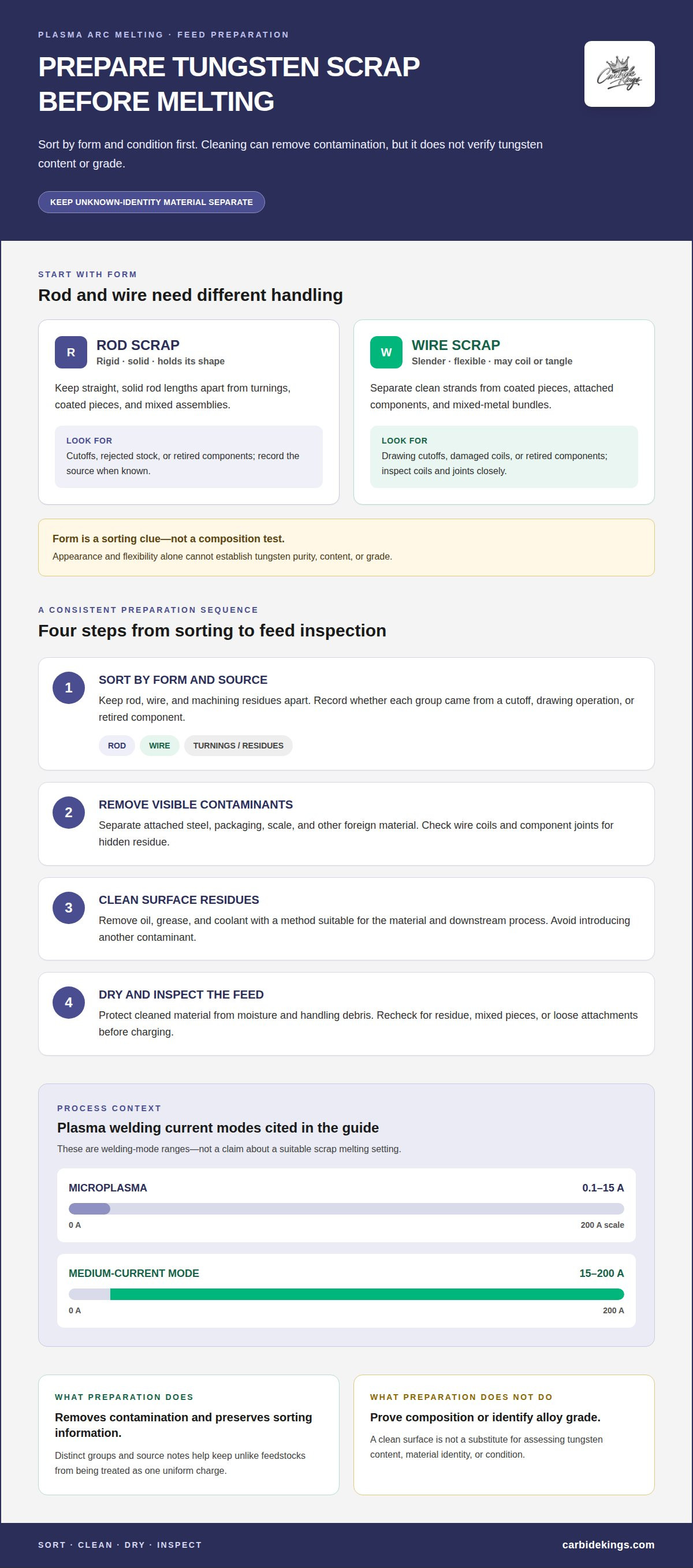
Plasma arc welding's medium-current mode operates from 15 to 200 A, while its microplasma mode operates from 0.1 to 15 A.
What tungsten scrap preparation and cleaning steps are required before plasma arc melting?
Start preparation by keeping each feedstock group distinct. Separate rod pieces, wire, turnings, and mixed assemblies before cleaning. A coolant-coated rod cutoff needs different handling from a clean wire strand. Remove attached non-tungsten parts where practical, and isolate material with a different or unknown identity or condition. This prevents unlike scrap from being treated as one uniform melt charge.
Use a consistent sequence so inspection findings remain useful:
- Sort by form and source. Keep rod, wire, and machining residues apart. Record whether a group came from a cutoff, drawing operation, or retired component.
- Remove visible contaminants. Separate attached steel, packaging, scale, and other foreign material. Look closely at wire coils and component joints, where residue can remain hidden.
- Clean surface residues. Remove oil, grease, and coolant using a method suitable for the material and downstream process. Cleaning should not introduce another contaminant.
- Dry and inspect the feed. Keep cleaned material protected from moisture and handling debris. Recheck for residue, mixed pieces, or loose attachments before charging.
Do not treat a clean surface as proof of composition. Cleaning addresses contamination; it does not identify tungsten content or distinguish alloy grades. Keep material of unknown origin separate from known production cutoffs. This preserves traceability and helps prevent an uncertain piece from changing the character of a prepared batch.
Plasma conditions also matter. Plasma welding commonly uses argon with 2 to 5% hydrogen as its shielding-gas mixture. That is a welding reference, not a universal recipe for plasma arc melting. The actual gas arrangement depends on the melting equipment and process. Keep gas selection separate from scrap cleaning, and avoid assuming a welding mixture automatically suits a melt operation.
Before charging, ensure the prepared lot has a clear form, a known source where available, and visibly clean surfaces. For example, keep a dry rod cutoff and cleaned wire bundle separate until the process calls for a specific feed. This gives operators a controlled starting point for plasma arc melting and keeps material condition distinct from gas and equipment decisions.
How do rod and wire dimensions affect plasma arc melting feed rates and recovery
Dimensions affect how consistently scrap reaches a plasma arc, but they do not determine recovery on their own. A long, thick rod carries more mass per piece than a short, thin wire segment. If both enter at the same piece rate, their mass feed rates differ. Compare feed by mass over time, not by counting pieces or judging bundle size.
Rod diameter and length affect how pieces sit in a feed system and meet the melt zone. A rigid cutoff may advance as a stable piece, while thin wire can bend, overlap, or tangle. These differences can interrupt steady delivery. Wire bundles also contain gaps, so their apparent volume does not reliably indicate the tungsten mass inside.
Consistent dimensions make feed control easier. Separate short rod offcuts from long stock, and keep fine wire apart from heavier strands. A charge with similar-sized pieces is easier to meter than one mixing long rods, tiny fragments, and coils. Operators can then adjust the feed pattern to the equipment and observe how the melt responds.
Recovery depends on the material that enters the process and the metal retained afterward. Dimensions influence handling and heating, but they do not prove composition or guarantee a recovery level. Surface contamination, attached non-tungsten parts, and mixed material can affect the melt independently of rod diameter or wire thickness. Compare incoming and recovered material by mass and composition instead of assuming larger pieces yield more.
For example, a thin wire coil may feed unevenly despite containing substantial tungsten. A compact rod charge may move steadily but still include surface residue. Keep dimensions and condition as separate sorting details. This gives plasma operators clearer information for adjusting feed and evaluating recovery across batches. Explore tungsten scrap options for industrial material needs.
Carbide Kings
Carbide Kings supplies industrial scrap materials for manufacturers and metallurgical operations. If your plasma arc melting plans involve sourcing tungsten or related feedstock, its material categories offer a practical next step after comparing rod and wire scrap. Offerings include Tungsten Hard Scrap, Tungsten Soft Scrap, carbide scrap, and Tungsten Alloys.
Use the distinctions in this guide to describe the material you need, including its form and intended application. This gives your sourcing discussion a clearer starting point without treating shape as proof of composition. Carbide Kings is a fit when your operation needs industrial tungsten or carbide scrap materials, rather than welding equipment or melting services.
For questions about sourcing these materials, contact Carbide Kings.
Plan Your Next Material Decision
Use the secondary tungsten rod scrap vs wire scrap for plasma arc melting decision to shape your next sourcing plan. Start with your operation’s feed system, then define the material form and condition it requires. A clear specification makes sourcing conversations more focused and helps keep purchasing decisions aligned with your process.
Carbide Kings offers industrial scrap materials for manufacturing and metallurgical use. If you’re ready to discuss what your operation needs, contact Carbide Kings about tungsten scrap. Bring your intended application and material priorities to the conversation, then move forward with a clearer sourcing direction.
Frequently Asked Questions
Can tungsten rod and wire scrap be used as feedstock for plasma arc melting?
Yes, rod and wire scrap can serve as feedstock when the material and equipment suit the melting process. A clean rod cutoff and a wire bundle may need different feeding arrangements, even when both contain tungsten. Keep assemblies with attached components separate from loose scrap. Operators can then assess whether each material group fits the charge and feed method.
How do rod and wire scrap compare in purity, composition, and contamination risk?
Rod and wire form alone do not establish purity or composition. A rod cutoff from one production lot may differ chemically from wire used in another application. Contamination depends more on prior use, surface residues, coatings, and attached materials than on shape. For example, keep lubricant-bearing wire separate from clean, unused offcuts so each batch’s history remains clear during evaluation.
How does tungsten scrap grade and assay affect its value for remelting?
Grade and assay help determine the tungsten content and other elements in a scrap lot, which affect its suitability as remelt feed. A consistent batch with known composition gives the remelting operation clearer input data than a mixed lot of uncertain origin. Cleanliness and material form also affect handling. Assess these factors together: appearance alone cannot establish an assay or remelt value.


