
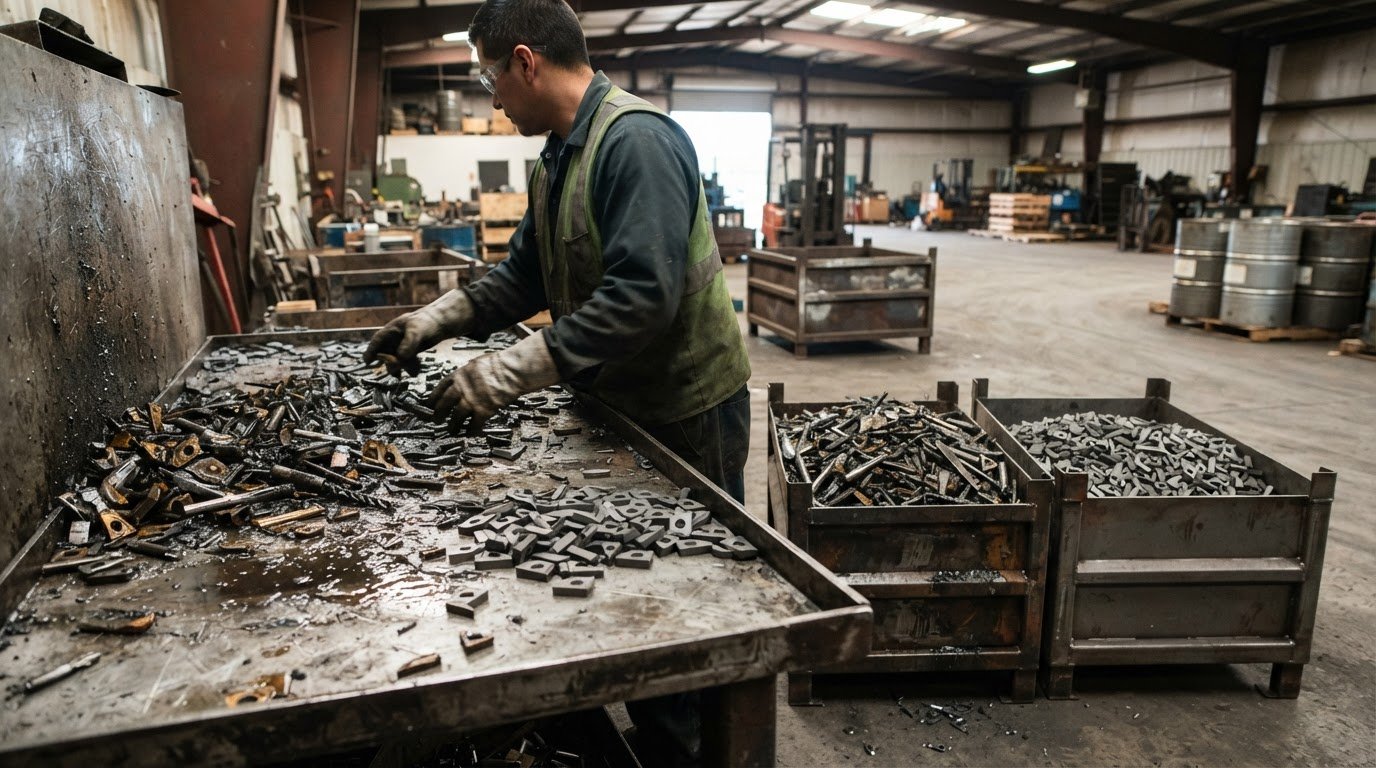
The cheaper-looking route can carry the higher total cost. Comparing in-house scrap sortation costs with buying prequalified secondary tungsten grades means weighing usable recovery against sorting, handling, processing, and qualification work. Processing scrap can make sense when the recovered material meets production requirements efficiently; buying prequalified grades may suit operations where internal sorting and qualification consume more resources than they save.
It’s reasonable to focus on material price, but price alone doesn’t show what each route demands from your operation. This comparison explains how recovery yield, contamination, purity requirements, qualification, and market shifts affect the decision. You’ll see which costs to include, why scrap form and condition matter, and how to assess the trade-offs without assuming one approach is always cheaper. Use these factors to build a clear comparison around your production needs and the usable tungsten each option can deliver.
Key Takeaways
- Compare usable, specification-ready tungsten recovery with the full effort of sorting, processing, and qualifying scrap.
- Keep material streams separated and account for moisture and contaminants, which can affect payable recovery and grade suitability.
- Factor in price shifts and scrap form when weighing in-house processing against buying prequalified grades.
- With the United States having no commercial tungsten mining since 2015, according to the U.S. Geological Survey, recovered material is an important part of domestic supply.
Scrap sorting, recovery, and product qualification
Sorting determines which material can enter a recovery stream and whether its composition suits a customer’s specification. In the United States, tungsten has not been commercially mined since 2015, according to the U.S. Geological Survey, making effective scrap recovery an important supply consideration.
Sorting and Grading Tungsten Scrap
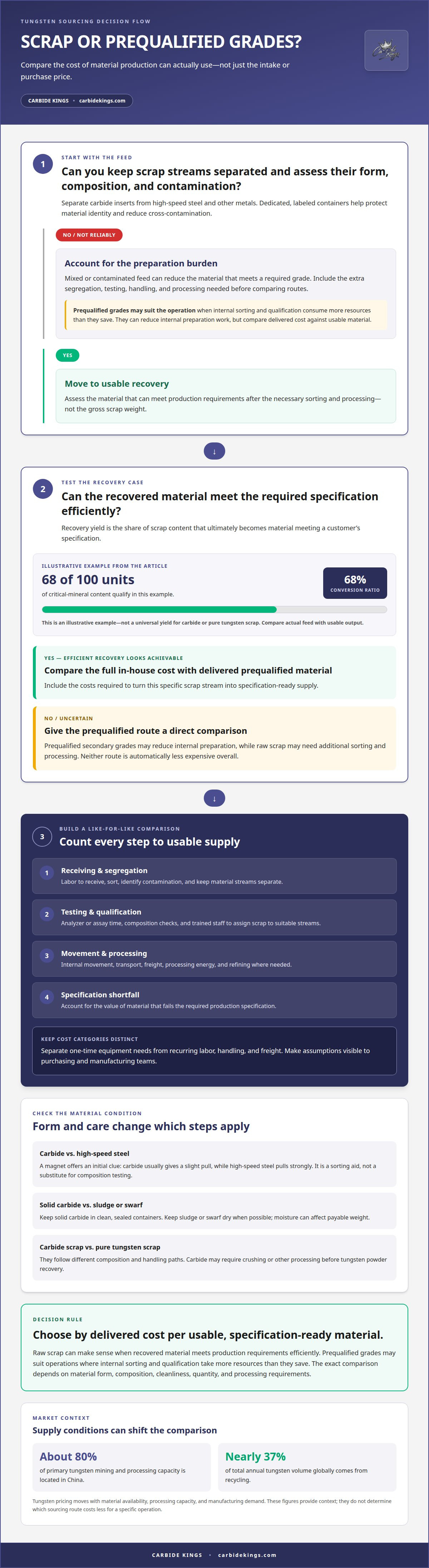
Sorting and grading separate tungsten-bearing material by form, composition, and contamination so each batch can be assessed for recovery and qualification. Keep carbide inserts apart from high-speed steel and other metals; dedicated, labeled containers help prevent cross-contamination. A magnet offers an initial clue: carbide usually gives a slight pull, while high-speed steel pulls strongly. This separation matters because mixed or contaminated feed can reduce the material that meets a required grade.
Recovery Yields and Processing Costs
Recovery yield is the share of scrap content that ultimately becomes material meeting a customer’s specification. In an illustrative example, 68 of 100 units of critical-mineral content qualify, a 68% conversion ratio. That example is not a universal yield for either carbide or pure tungsten scrap. Carbide may require crushing or other processing before tungsten powder recovery; costs also build through sorting, transport, refining, and processing. Pure tungsten scrap follows a different composition and handling path, so compare actual feed and usable output rather than assuming equal yields.
Equipment and Labor for In-House Qualification
In-house qualification combines physical segregation, composition testing, and trained labor to assign scrap to suitable streams. A metal analyzer can determine carbide and tungsten composition, while staff separate material by form, identify contamination, and label containers. A magnet test can help distinguish carbide from strongly magnetic high-speed steel, but it is only an initial sorting aid. The equipment and labor burden matters because every test and handling step adds work before the material is ready for processing or customer review.
Storage, Transport, and Processing Requirements
U.S. requirements for storing, transporting, and processing tungsten-bearing scrap depend on the material and the activity involved. Keep solid carbide in clean, sealed containers, and keep sludge or swarf dry when possible; moisture can affect payable weight. Separate and label each stream before shipment to reduce contamination and avoid mixing materials with different compositions. Sorting, transport, and refining all affect the economics, so preserve material identity and condition from storage through processing.
Costs and constraints in converting scrap into usable supply
Raw scrap becomes usable supply only after the necessary handling and preparation. For a useful in-house scrap sortation costs vs buying prequalified secondary tungsten grades comparison, map every cost to the material production can actually use. Include labor for receiving and segregation, analyzer or testing time, internal movement, processing energy, freight, and the value of material that fails the required specification. A batch’s form and condition determine which steps apply.
Prequalified secondary grades may reduce internal preparation work, while raw scrap may require additional sorting and processing before use. Neither route is automatically less expensive overall. Compare the delivered cost of usable material, not just the purchase or intake figure. For example, a team with available testing capacity may account for assay work differently from a plant that must dedicate staff and equipment to a one-off batch. Those operational constraints affect the in-house scrap sortation costs vs buying prequalified secondary tungsten grades decision.
Build a consistent comparison for each sourcing cycle. Separate one-time equipment needs from recurring labor, handling, and freight, then estimate what share of incoming material can meet production requirements. Keep assumptions visible to purchasing and manufacturing teams. This makes changes in staffing, processing capacity, or the scrap stream easier to account for, without mistaking gross material weight for usable output.
The exact price depends on material form, composition, cleanliness, quantity, and processing requirements. Request a quote for the specific material, then compare the quoted terms with your internal cost model before choosing a route.
If you’re assessing tungsten material categories for an upcoming sourcing decision, review tungsten material categories alongside your production requirements.
There is no fixed cost comparison: prequalified grades may reduce internal preparation, while raw scrap may need more sorting and processing. Neither route is automatically less expensive overall. Compare the delivered cost of usable material for each option.
Market demand and price fluctuations
Tungsten pricing moves with material availability, processing capacity, and demand from manufacturing applications. About 80% of primary tungsten mining and processing capacity is located in China, so changes affecting that supply source can influence market conditions elsewhere. Recycling contributes another supply stream, accounting for nearly 37% of total annual tungsten volume globally. These figures explain why buyers weigh both primary supply and recovered material when planning purchases.
Demand also reflects tungsten’s role in hard, wear-resistant applications. Manufacturers use tungsten carbide in cutting tools, drill bits, and industrial wear parts, where its hardness supports demanding work. Carbide commonly combines tungsten with cobalt or nickel to improve toughness and durability. When customers need specific forms or compositions, demand for suitable material can differ from demand for mixed scrap. That distinction affects how readily a batch can match a buyer’s intended use.
Price shifts matter differently to scrap holders and material buyers. A scrap holder’s return depends on composition, cleanliness, form, and the available recovery route. A buyer of prequalified grades pays for material that already meets defined requirements, rather than taking on the same sorting and qualification burden. Compare each option against the amount of usable tungsten it can provide, not simply its quoted weight or a headline market reference.
Use a practical review before committing: identify the required grade and form, estimate how much material can meet that specification, then account for processing and delivery. For example, clean solid carbide and contaminated road-milling bits are not equivalent feed, even if both contain carbide. Shifts in supply or demand can change the relative appeal of processing in-house versus buying prepared grades, so revisit the comparison as purchasing needs and available scrap streams change.
Purity and tungsten content
Purity determines how much recovered material can serve an industrial application. Tungsten carbide scrap often contains 70-97% tungsten, while contamination and moisture can reduce usable recovery.
Assay, Sampling, and Contamination
An assay estimates a scrap batch’s composition, while sampling provides material for that assessment. Both affect how accurately a grade reflects the full lot and how useful it is for resale or manufacturing. A representative sample matters because a mixed load may contain clean carbide alongside steel, dirt, or moisture.
Moisture and dry tungsten content can affect the payable amount from soft scrap. The gross weight alone would overstate usable material. Assay results, sample quality, and contamination therefore shape the grade assigned and the amount buyers can recover.
Misclassification and Quality Variation
Misclassification occurs when a secondary grade is assigned to the wrong material category or composition. Quality can also vary within a batch, even when its overall label appears consistent. These differences matter when a manufacturing process requires specific tungsten content or an impurity profile. A grade that does not match the application may need additional testing, blending, or processing before use.
Clean tungsten carbide scrap typically contains 70% or more tungsten, while hard tungsten carbide scrap assets contain 70% to 95% tungsten carbide by weight. Those measures describe different material properties, so they should not be treated as interchangeable. Compare the stated grade with the production specification and the assay basis. That distinction helps keep purchasing decisions tied to usable material rather than a label alone.
For a grade-sensitive application, align composition requirements with the material form before choosing a supply route. Discuss tungsten material requirements for your production needs.
Road-milling bits contain small amounts of carbide and high levels of contaminants. Carbide sludge has lower scrap value because of moisture and contaminants.
Carbide Kings
Carbide Kings helps industrial buyers evaluate tungsten and carbide material options when internal sorting, recovery, or qualification affects the supply decision. Its offerings include Tungsten Hard Scrap, Tungsten Soft Scrap, Carbide scrap, and Tungsten Alloys. These categories provide a practical starting point for matching material streams with manufacturing needs and considering how form and composition affect handling.
Turn to Carbide Kings when you’re assessing tungsten-related materials as part of a broader sourcing decision. Share the material category and intended application so the discussion can focus on relevant options. Contact Carbide Kings to discuss your material needs.
Make the Next Supply Decision Deliberate
Use the next purchasing cycle to make this comparison a repeatable decision. Set a clear production requirement, then assess whether your operation is better positioned to prepare scrap internally or source material suited to its intended use. The right choice can shift as your feedstock, processing capacity, and manufacturing needs change.
Keep the evaluation practical. Record the assumptions behind each route, including which steps your team can handle and where purchased material can simplify procurement. This gives purchasing and production teams a shared basis for future decisions rather than relying on a single market snapshot. The comparison of in-house scrap sortation costs versus buying prequalified secondary tungsten grades should support a sourcing plan that fits your actual workflow.
When you’re ready to discuss the material needs behind that plan, talk with Carbide Kings about tungsten grades. Take the next step with a clearer view of your requirements and keep your sourcing decision moving forward.
Frequently Asked Questions
What are typical in-house tungsten scrap sorting and processing costs per ton?
In-house costs depend on the scrap stream and the work required to make it usable, so a single per-ton figure won’t fit every operation. Account for staff time, sorting space, testing equipment, handling, processing energy, and material that fails qualification. For example, clean, separated solids may need fewer steps than mixed or wet material. Track these costs against recovered, usable output.
What are the costs of outsourcing tungsten scrap sorting and qualification to a recycler?
Outsourcing costs depend on the material’s form, composition, contamination, lot size, transport, and processing route. Request a quote for the specific material, then compare its terms with your internal labor, equipment, and handling costs. Also consider whether the resulting grade suits your production requirements. A lower processing burden can matter as much as the recycler’s charge.
How do freight, minimum lot sizes, and regional recycler availability affect tungsten scrap economics?
Freight can change the economics because transportation costs are weighed against the amount of usable material shipped. Minimum lot requirements can also affect whether a smaller accumulation can move economically or needs to be consolidated. Regional recycler availability influences distance and transport options, but the impact depends on the route and material. Compare shipments by net usable output, not gross weight alone.


