

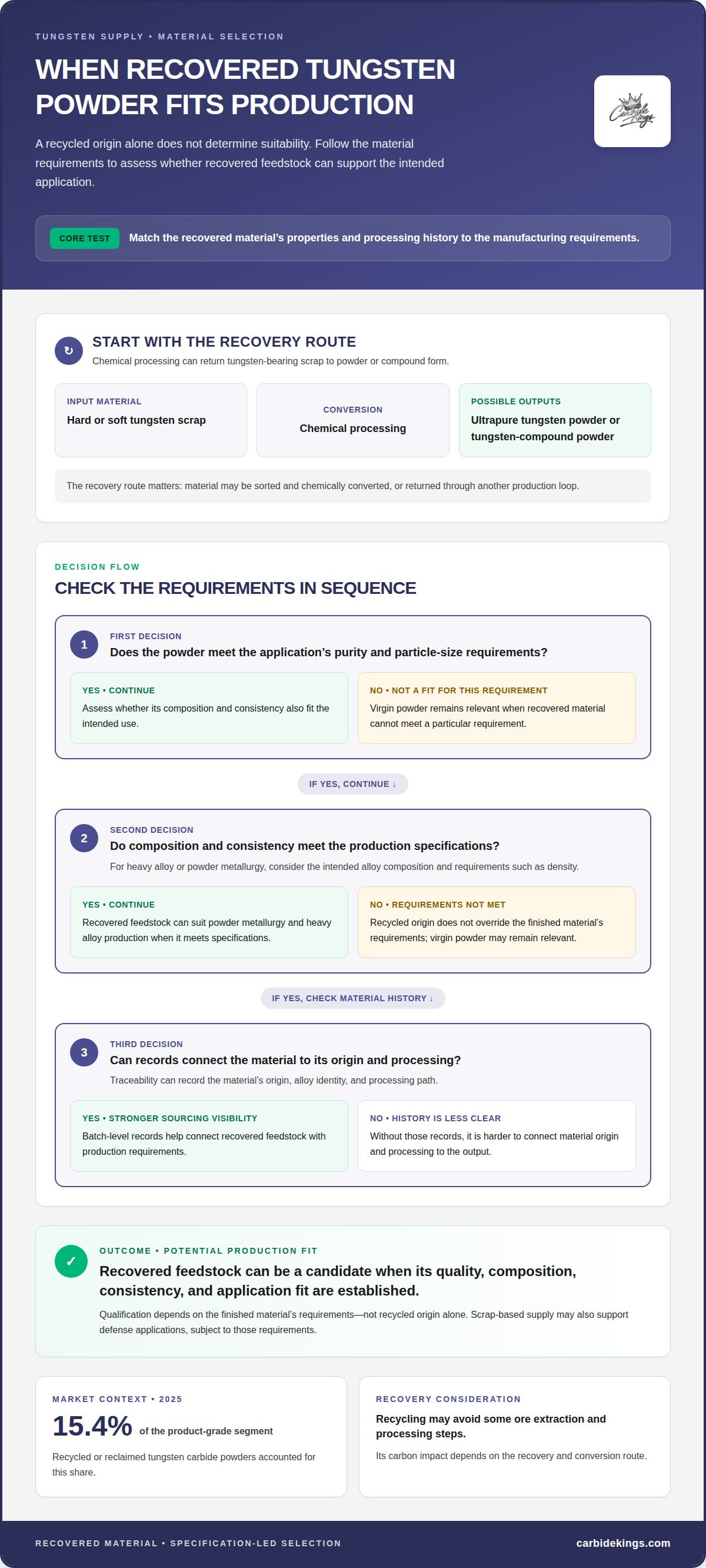
Offshore virgin powder isn’t the only route to tungsten supply. Chemical processing can convert hard and soft tungsten scrap into ultrapure tungsten powder or tungsten-compound powder, making domestic secondary material a potential complement to virgin imports. Recovered scrap and virgin powder are not automatically interchangeable, though: the material’s properties and the manufacturing requirements determine which route fits.
For buyers comparing domestic secondary tungsten alloy supply with offshore virgin powder reliance, the key question is how each source supports production, continuity, and material recovery. Virgin powder can be a useful manufacturing feedstock, while scrap may offer tungsten that can be recovered and reused.
This article compares domestic powder conversion and recycling with offshore virgin supply, then explains how tungsten heavy alloy manufacturing fits into the picture. It outlines where recovery can strengthen a supply strategy, why powder specifications matter, and how domestic tungsten hard scrap, soft scrap, and alloys fit into the material cycle.
Key Takeaways
- Assess secondary tungsten by its material form and how it fits your production requirements, not simply by whether it is recycled.
- Factor supply concentration into sourcing decisions: according to the U.S. Geological Survey, China mined 67,000 metric tons of tungsten in 2025, out of 85,000 metric tons produced worldwide.
- Understand how powder metallurgy shapes heavy alloy manufacturing and why consistent feedstock matters to the process.
- Identify which hard scrap, soft scrap, alloys, or carbide materials could fit your recovery and supply needs.
North American powder conversion and recycling
Secondary feedstock can re-enter tungsten production through chemical conversion, helping reduce reliance on virgin material. Its suitability depends on recovery, powder quality, and the intended application.
Closed-Loop Recycling and Feedstock Security
Closed-loop recycling returns production scrap to usable tungsten material. Traceability records its origin, alloy identity, and processing path, helping buyers connect recovered feedstock with production requirements and improve sourcing visibility. Chemical methods can convert hard and soft scrap into ultrapure tungsten powder or compound powder. Recycling may also avoid some steps involved in extracting and processing ore, although the carbon impact depends on the recovery and conversion route.
Recycled Powder Market Share and Benchmarks
Recycled powder market share measures how much product-grade material comes from reclaimed feedstock. Recycled or reclaimed tungsten carbide powders accounted for 15.4% of the product-grade segment in 2025. The European Critical Raw Materials Act entered into force in May 2024 and sets a 25% recycling benchmark and a 40% processing benchmark for strategic raw materials by 2030. These EU benchmarks do not set U.S. requirements, but show how regulation can shape regional investment and supply positioning.
Recycled and Virgin Material Performance
Recycled and virgin tungsten can both support demanding production when the powder meets the application’s purity and particle-size requirements. Chemical conversion can produce ultrapure powder from scrap, while controlled particle size and distribution help match powder to its intended use. Recovered feedstock can suit powder metallurgy and heavy alloy production when its composition and consistency meet specifications. Virgin powder remains relevant when recovered material cannot meet a particular requirement. Scrap-based supply may also support defense applications, but qualification depends on the finished material’s requirements, not recycled origin alone.
North American Recycling and Powder Facilities
U.S. supply includes chemical conversion and recycling operations that process tungsten-bearing scrap into powder or compounds. Buyers should focus on the recovery route: scrap may be sorted and chemically converted, or recovered material may return through another production loop. Batch-level records can connect material origin and processing to the output, supporting traceability and helping determine whether recovered tungsten suits production requirements, including density or alloy composition.
China export controls and tungsten supply concentration
China’s mining position creates a major concentration point for the tungsten supply chain. According to the U.S. Geological Survey, China mined 67,000 metric tons of tungsten in 2025, out of 85,000 metric tons produced worldwide. The United States has mined zero tungsten every year since 2015, while U.S. net import reliance for tungsten has remained above 50% of consumption annually since at least 2021, according to the U.S. Geological Survey.
Import origin matters alongside total reliance. China, including Hong Kong, accounted for 26% of U.S. tungsten imports from 2021 to 2024. That share indicates exposure to a concentrated source, but it is not a tonnage figure for virgin powder or tungsten alloys. Buyers should distinguish ore, concentrate, powder, and finished alloy when assessing where material enters a supply chain and which applications depend on it.
Trade measures add another sourcing consideration. Trade measures can affect the sourcing of tungsten products from China, so buyers should consider product form and origin when planning supply. China introduced export controls on selected tungsten items in February 2025. These measures can affect the movement of covered products and complicate supply planning; the impact depends on product form and origin, not simply the word “tungsten” on a specification.
Defense procurement has a separate rule timeline. Through the end of 2026, DFARS 252.225-7052 prohibits delivery under covered contracts of covered material melted or produced in China, Russia, Iran, or North Korea. Starting January 1, 2027, the DFARS tungsten restriction extends to the mine or ore stage and explicitly includes recycled and scrap material. The Department of Defense rule makes material origin relevant beyond the final processing step.
U.S. tungsten procurement remains exposed to import reliance, making supply conditions relevant to planning. For procurement teams, tracking form, origin, and processing stage helps machine plans around changing import exposure and defense requirements.
Domestic tungsten heavy alloy manufacturing
Domestic manufacturing can turn powder into tungsten heavy alloy components, but the location of fabrication does not establish where the feedstock originated. A mineral’s origin, whether in Russia or elsewhere, is separate from where powder metallurgy takes place. Buyers should distinguish material sourcing from manufacturing when assessing a supply chain.
Powder metallurgy is a widely used route for producing tungsten heavy alloy. These alloys commonly combine tungsten with nickel and iron, or nickel and copper. The binder metals help form a workable alloy; tungsten alloys can contain up to ten percent of a combination of nickel and iron or copper. Pure tungsten and tungsten heavy alloy are different feedstocks, so manufacturing plans depend on the target composition and component requirements.
The process starts by preparing and blending suitable powders. Manufacturers press the blend into cakes or fragile bars, then heat it until the particles adhere. Cold isostatic compaction can apply pressure of up to 2000 bar. Sintering heats the pressed powder so its particles bond. Each step links powder characteristics and alloy formulation to the shape and properties needed in the finished part.
This manufacturing route serves applications such as counterweights, inertial masses, radiation shielding, and ordnance products. Recovered material can support production when its composition and condition fit the required alloy blend. It does not automatically replace every virgin powder input: the key question is whether the feedstock meets the formulation and manufacturing requirements. Scrap traceability can keep material identity connected to its next use, while sourcing plans can account for both recovered feedstock and powder purchases. This distinction helps buyers understand how domestic production, imported powder, and secondary material fit into one manufacturing strategy.
Domestic recovery and secondary tungsten supply
Domestic recovery treats tungsten-bearing scrap as potential raw material, not simply waste. Its value depends on composition, separation, and suitability for reuse. The domestic secondary tungsten alloy supply vs offshore virgin powder reliance decision is not an either-or choice. A national supply strategy can combine secondary feedstock with imported powder, using each where it suits production needs.
The workflow begins with collection and sorting. Separate identifiable alloy forms and keep unlike materials apart to limit contamination. Processors assess the feedstock’s composition and condition before selecting a recovery route. Chemical methods can convert hard and soft scrap into tungsten powder or compound powder. Recovered metal powder can return to production when it meets the intended material requirements.
Recovery supports a broader supply loop, but not every scrap lot becomes a finished alloy. Material may need processing before it can re-enter manufacturing. Ammonium paratungstate is an intermediate used in tungsten processing, while scrap recovery routes can produce powder or compounds. A domestic secondary tungsten alloy supply vs offshore virgin powder reliance comparison should account for these different material forms and conversion needs.
Collection, sorting, processing, and documentation are distinct cost factors. Costs depend on the material, with alloy identity, condition, handling, quantity, and processing needs all affecting the quote. Recycling alone does not certify material for a particular application. Records should match buyer requirements and document material identity and processing history to preserve traceability.
For a practical next step, discuss tungsten scrap and alloy materials for your supply needs.
Collect and separate identifiable alloy forms, assess their composition and condition, and select a suitable recovery route; chemical processing can turn scrap into tungsten powder or compound powder. Costs vary with alloy identity, condition, handling, quantity, and processing needs and are provided after a quote request; recycling does not itself certify material for an application, so records should match buyer requirements and document material identity and processing history.
Carbide Kings: Tungsten Alloys
Carbide Kings supplies tungsten alloys and industrial tungsten-bearing materials, including Tungsten Hard Scrap, Tungsten Soft Scrap, and carbide scrap. These materials are relevant when assessing alloy sourcing, considering secondary feedstock, or managing scrap from industrial production.
The right category depends on what you need to source or move into recovery. Tungsten alloys support material sourcing needs, while hard scrap, soft scrap, and carbide scrap are distinct categories for industrial buyers. Keep the material type central to your decision so your next step aligns with production or recovery requirements.
For tungsten alloys or scrap, contact Carbide Kings.
Turn your sourcing decision into a clear material plan
Use the choice between domestic secondary tungsten alloy supply and offshore virgin powder reliance to set a practical sourcing direction, not an all-or-nothing rule. Map each material need to its specification, sourcing requirements, and intended use. Then decide where recovered material belongs in your purchasing plan and where virgin powder remains the right fit. This gives procurement and production teams a shared basis for planning supply and handling surplus material.
For industrial material needs, Carbide Kings supplies Tungsten Hard Scrap, Tungsten Soft Scrap, and carbide scrap. These categories can support decisions about sourcing or moving tungsten-bearing materials into the next stage of use. Keep the material type and intended outcome central to your sourcing plan.
Contact Carbide Kings about tungsten sourcing to discuss your material needs and take the next step with a clearer plan.
Frequently Asked Questions
What is the U.S. domestic supply of secondary tungsten alloys from scrap recycling?
Secondary supply can include tungsten-bearing scrap collected for reuse and material recovered and converted into forms such as powder or compounds. These are different supply stages: scrap available to buyers is not the same as finished secondary powder ready for production. For a sourcing decision, distinguish the material form you can obtain from the form your manufacturing process requires.
How much tungsten alloy scrap is generated and recycled annually in the United States?
Annual generation and recycling are separate measures, and the amounts depend on scrap type and recovery route. Manufacturing residues, worn components, and other tungsten-bearing materials do not automatically become usable feedstock; sorting and processing determine what can re-enter production. For planning, distinguish scrap collected from material actually recovered, then assess whether its form suits the intended application.
How vulnerable is U.S. tungsten supply to overseas disruptions, export controls, and geopolitical risks?
Supply exposure matters because domestic mining is absent and U.S. buyers rely on imported tungsten, while supply is concentrated in major producing countries. Export controls or trade measures can affect different material forms in different ways. A practical sourcing plan accounts for product origin and processing stage and considers whether qualified secondary material can complement imported virgin powder in suitable applications.
What are the steps and costs for collecting, sorting, processing, and certifying secondary tungsten alloys?
Collect and sort scrap, keep unlike and identifiable alloy forms separate to limit contamination, then assess composition and condition before choosing a recovery route. Chemical processing can convert hard and soft scrap into powder or compound powder, and batch-level records can support traceability. No cost or certification steps are provided.


