
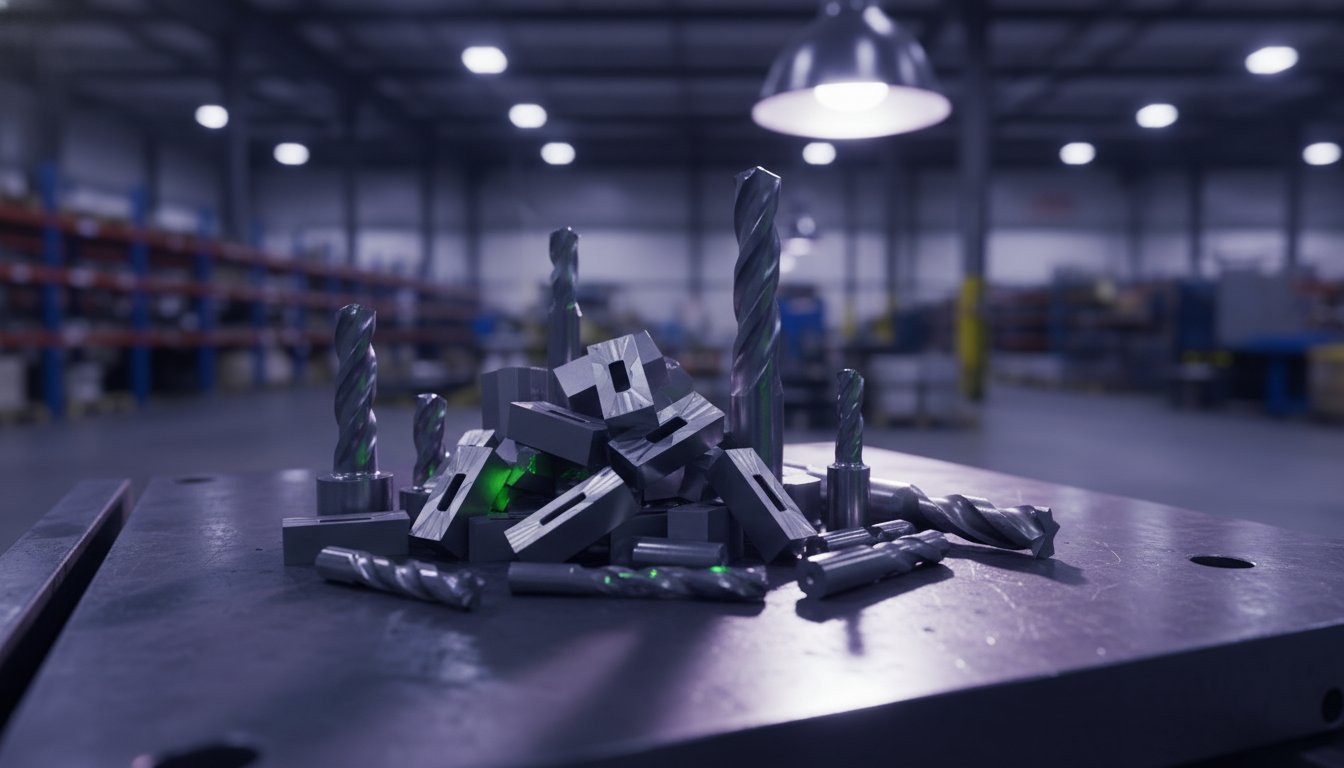
China now controls over 80% of the global tungsten supply; their January 2026 export controls have completely rewritten the rules for industrial recycling. You've likely noticed that local scrap yards offer opaque pricing that fails to reflect the true market value of your carbide inserts or alloys. It's frustrating when high shipping costs eat into your profits, especially when you're unsure if you're holding pure tungsten or a complex carbide alloy. Understanding the current tungsten carbide scrap price requires more than a quick look at a ticker; it demands an eye for metallurgical purity and logistics efficiency.
You deserve a transparent partner who values your time and your material. We agree that the traditional scrap process is often cluttered with unnecessary administrative hurdles and confusing grading. This guide will help you master the market drivers of 2026, including the June 1 price increases from major manufacturers like Mitsubishi Materials and Sumitomo Electric. You'll learn exactly how to sort your tungsten hard scrap, soft scrap, and alloys to command the highest possible rates. We're going to outline a clear strategy to increase your scrap value and connect you with a reliable national buyer for your bulk loads. Let's turn your industrial waste into a streamlined revenue stream.
Key Takeaways
- Identify how the ratio of tungsten carbide to binder materials like cobalt directly influences the market value of your industrial waste.
- Discover why the scarcity and energy-intensive production of tungsten allow it to consistently outperform common metals in valuation.
- Learn to distinguish between hard scrap, soft scrap, and alloys to accurately estimate your current tungsten carbide scrap price.
- Implement professional sorting frameworks like the spark and weight tests to separate carbide from high-speed steel and maximize your return.
- Streamline your recycling logistics by partnering with a national buyer that prioritizes transparency and rapid 24-hour processing.
Understanding the Factors Behind Tungsten Carbide Scrap Prices
Many industrial professionals treat their scrap bin like a catch-all for heavy metals. This is a mistake that costs you money. Tungsten carbide isn't a pure element found on the periodic table; it's a "cemented" composite of tungsten and carbon. This unique structure makes it significantly more valuable than common ferrous or non-ferrous metals like iron or aluminum. While a general scrap yard might eyeball your load and offer a flat rate, specialized buyers look at the chemistry. They understand that the tungsten carbide scrap price is tied to the metallurgical makeup of the material, not just the gross weight on the scale.
The binder material plays a critical role in this valuation. Most carbide tools use cobalt or nickel to "cement" the particles together. Since cobalt itself is a high-value strategic metal, its presence influences the final offer. General yards often lack the specialized testing equipment to identify these nuances. This usually leads them to provide "safe" quotes that protect their margins at your expense. By working with a dedicated recycler, you ensure that every pound of binder and carbide is accounted for in your payout. Density matters; purity dictates profit.
The Difference Between Pure Tungsten and Carbide Scrap
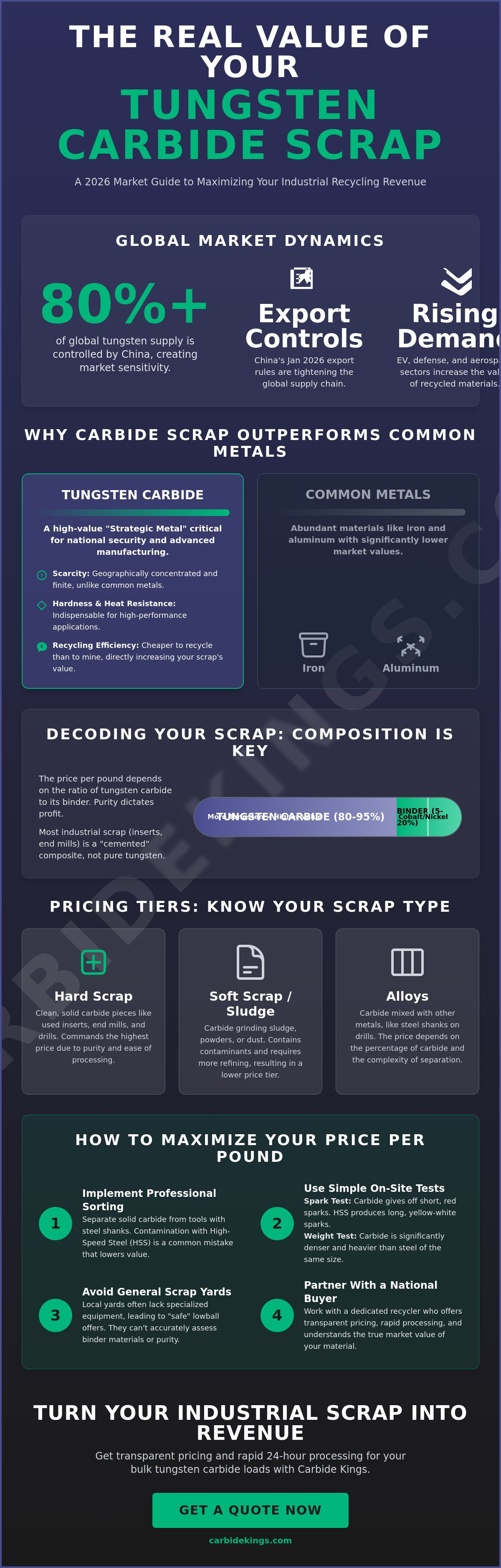
Don't confuse pure tungsten with carbide scrap. Most industrial tools, such as inserts and end mills, are 80% to 95% tungsten by weight. The remaining percentage consists of the binder and other alloying elements. Because pure tungsten has a different melting point and industrial application, it commands a different price tier. Your per-pound offer depends heavily on this concentration. If your scrap is highly concentrated with tungsten, your revenue increases. It's a simple equation where purity equals profit. We define tungsten carbide as a cemented alloy of tungsten and carbon, and that distinction is exactly what drives its premium over standard tool steels.
Global Market Drivers and the LME Influence
The tungsten carbide scrap price doesn't exist in a vacuum. It's heavily influenced by the London Metal Exchange (LME) and international trade dynamics. In 2026, the market is particularly tight due to China's activation of strict export controls on dual-use items in January. Since China controls over 80% of global production, any shift in their export policy sends ripples through US markets. Additionally, surging demand in the EV and defense sectors is keeping the supply chain under pressure. When mining output slows or trade barriers rise, the value of your recycled material climbs. We track these shifts daily to ensure your industrial scrap reflects real-time global demand and manufacturing shifts.
Why Carbide Scrap Prices Outperform Common Industrial Metals
Iron and aluminum are everywhere. Tungsten isn't. This fundamental scarcity is the primary reason the tungsten carbide scrap price dwarfs that of common industrial metals. While iron ore is abundant, tungsten is finite and geographically concentrated. This makes it a "strategic metal," a classification used by the U.S. Department of Defense to highlight materials critical to national security. According to the Tungsten Statistics and Information provided by the USGS, the supply chain is highly sensitive to geopolitical shifts. Its extreme hardness and heat resistance make it indispensable for armor-piercing rounds, jet engine turbines, and high-precision drilling. You aren't just selling old tools; you're providing the raw materials for the next generation of aerospace technology.
The Cost Efficiency of Recycling vs. Mining
Mining new tungsten is an energy nightmare. It requires massive excavation, chemical processing, and intense heat. In contrast, recycling used carbide is significantly more efficient. Refineries prefer processed scrap because it skips the most expensive stages of the extraction process. This efficiency creates a direct financial benefit for you. Because it's cheaper for a refinery to process your worn inserts than to mine raw ore, they can afford to offer higher premiums. This "circular economy" ensures that your industrial waste remains a high-value asset. If you're ready to see what your inventory is worth, it's time to get a quote for your tungsten alloys.
Industrial Demand in High-Growth Sectors
In 2026, demand is surging across high-growth sectors. The transition to electric vehicles (EVs) requires specialized carbide tooling for battery housings and motor components. Similarly, precision medical manufacturing and aerospace industries are expanding rapidly. Federal infrastructure projects launched this year have also increased the need for wear-resistant carbide parts in heavy machinery. Many machine shops are sitting on a hidden goldmine of scrap without realizing its true market potential. These shops often let valuable material collect dust because they don't see the connection between their waste bin and the global manufacturing curve. Don't let your profits sit on the floor. The current tungsten carbide scrap price reflects a structural shift in global demand that favors those who recycle early and often.
Pricing Tiers: Hard Scrap vs. Soft Scrap and Sludge
The scrap in your bin isn't a monolith. To get the best return on your industrial waste, you have to understand the three primary pricing tiers: Hard Scrap, Soft Scrap, and Alloys. Each category represents a different level of metallurgical purity and processing difficulty. While the tungsten carbide scrap price for solids is consistently the highest, your sludge and alloys still hold significant value if handled correctly. Local yards often group these together to simplify their own books, but this approach leaves your money on the table. We categorize your materials precisely to ensure you're paid for the exact chemistry you provide.
High-Value Hard Scrap: Inserts, End Mills, and Drills
Hard scrap is the gold standard of the industry. This category includes solid carbide tooling like CNC inserts, end mills, and drills that have reached the end of their service life. Because these items are solid, they're the easiest to assay and value. There's no guesswork involved. You're selling a high-density material with a known concentration of tungsten and binder. Refineries love this material because it requires minimal preparation before melting. For a deeper dive into this category, check out The Complete Guide to Tungsten Hard Scrap Recycling in 2026. Clean, sorted solids always command the highest market premiums because they offer the most direct path back into the manufacturing supply chain.
Soft Scrap and Sludge: The Complex Valuation
Soft scrap, often called grinding sludge or swarf, is more difficult to price than solids. It's a byproduct of the tool-making and sharpening process. When you grind a carbide tool, the resulting dust mixes with coolant, oil, and debris from the grinding wheel. This creates a wet, heavy paste. To determine a fair price, we use a "yield percentage" calculation. This measures how much usable tungsten remains after we remove the liquids and contaminants. According to U.S. Geological Survey tungsten data, secondary recovery from these complex streams is vital for supply stability, but it requires specialized chemical processing that general scrap yards simply can't perform.
Contamination is the biggest threat to your payout in this tier. If your sludge is mixed with floor sweepings, trash, or steel shavings, the processing costs skyrocket. You should store your sludge in sealed, labeled drums to prevent further contamination from shop debris. Keep your soft scrap separate from your hard scrap. Mixing them only complicates the assaying process and can lead to a lower average price for your entire load. Efficiency in your shop leads directly to efficiency in your wallet. By maintaining clean collection streams, you ensure that your tungsten carbide scrap price stays at the top of the market range.
How to Maximize the Price Per Pound for Your Carbide
Maximizing your return starts on the shop floor, not at the scale. Don't treat your scrap bin like a waste container. To secure the highest tungsten carbide scrap price, you must implement a rigorous sorting process. High-speed steel (HSS) is the most common contaminant in industrial loads. It looks nearly identical to carbide but lacks the density and metallurgical value. If your load is mixed, a buyer must account for the risk of contamination. This usually results in a quote graded at the lower HSS rate. This simple sorting mistake can slash your payout by over 70%.
Use the spark test for immediate identification. Touch the tool to a grinder and watch the trail. Carbide emits short, reddish-orange sparks that stay close to the wheel. In contrast, HSS produces long, bright yellow, bushy sparks that fly much further. You can also rely on the weight test. Carbide is nearly twice as heavy as steel. If a small tool feels surprisingly dense for its size, it's likely carbide. Removing steel shanks from carbide-tipped drills is another high-impact strategy. By cutting off the low-value steel, you ensure every ounce of your shipment is high-purity material that commands top-tier rates.
Sorting and Decontamination Strategies
Floor managers should implement a systematic approach to material handling. Use this checklist to optimize your shop's scrap value:
- Separate carbide from HSS and other tool steels at the point of failure.
- Use a bandsaw to remove steel shanks from large carbide-tipped cutters.
- Keep different grades, such as C2 and C6, in separate, labeled containers if your volume allows.
- Eliminate floor sweepings, oil-soaked rags, and general trash from the collection bins.
Keeping your streams clean isn't just about tidiness; it's about transparency. When a buyer can clearly see the quality of your load, they can offer more aggressive pricing. If you're ready to turn your sorted inventory into capital, request a quote for your tungsten hard scrap today.
The Impact of Volume on Shipping and Logistics
Logistics efficiency is the final piece of the profit puzzle. Shipping small loads frequently is a profit killer because freight costs stay relatively static regardless of the weight. The more material you ship at once, the lower your cost-per-pound for transportation. Most national buyers look for a threshold weight of at least 50 pounds to make national shipping profitable for the seller. Larger shipments often qualify for preferred freight rates and bulk-load premiums. For more on these trends, read our Tungsten Carbide Scrap Price Per Pound 2026: Market Trends & Seller’s Guide. Consolidating your material into one large shipment ensures you capture the full tungsten carbide scrap price without losing your margin to the carrier.
Turning Your Industrial Scrap Into Revenue with Carbide Kings
Stop settling for the opaque pricing and slow service of local scrap yards. Most general recyclers aren't equipped to handle high-volume industrial loads. They treat your carbide like common copper pipe, which results in lower payouts and administrative headaches. Carbide Kings is the streamlined, national alternative designed specifically for machine shops and industrial manufacturers. We focus exclusively on high-purity materials like tungsten hard scrap, soft scrap, and tungsten alloys. Our process removes the traditional barriers to recycling, allowing you to convert your shop's waste into working capital without the typical friction of the scrap industry. We handle the heavy lifting so you can stay focused on your core production operations.
Transparency is the foundation of our business. Every load we receive undergoes a rigorous weighing and assaying process to determine its exact metallurgical value. You won't have to guess if you're getting a fair tungsten carbide scrap price. We provide clear, data-driven valuations based on the current market drivers discussed throughout this guide. Our team treats every transaction with professional efficiency, ensuring that your industrial procurement standards are met at every step. Reliability isn't just a goal; it's our standard operating procedure.
Streamlined 24-Hour Processing and Payment
Your cash shouldn't be tied up in a slow-moving administrative loop. We've refined our workflow to move as fast as your shop does. The journey from scrap to revenue follows a logical, chronological path. Once you receive your initial quote and ship your material, our team takes over. From the moment your shipment hits our dock, the clock starts. We complete the weighing and chemical assaying of your tungsten hard scrap or alloys immediately. Within a 24-hour window of receipt, we finalize your payout. You can choose from fast payment options like a physical check or a direct wire transfer. This no-nonsense approach to procurement ensures your revenue is back in your account before the next production cycle begins. Success is a fast transaction.
National Logistics and Shipping Support
Distance is never a barrier to securing the best tungsten carbide scrap price. We provide comprehensive logistics support to industrial clients across the United States. Whether you're shipping a single drum or a full freight load, we assist with the coordination to keep your costs low. You don't need to worry about the complexities of national shipping. We provide the guidance necessary to move your material safely and efficiently from your floor to our facility. This proactive partnership ensures that shipping costs don't eat into your margins. You deserve a recycler that acts as a supportive partner rather than a distant service provider. It's time to experience a better way to recycle. Get a competitive carbide scrap quote today and see how simple industrial recycling can be.
Secure Your Industrial Recycling Profits Today
Structural shifts in the 2026 market have transformed your scrap bin into a high-value asset. Between China's export controls and surging demand from the defense sector, your material is more critical than ever. You've learned that metallurgical purity and smart sorting are the keys to a higher payout. By separating your tungsten hard scrap from soft scrap and eliminating high-speed steel contamination, you position your shop for success. Securing a premium tungsten carbide scrap price isn't just about weight anymore; it's about transparency and logistics efficiency.
Carbide Kings is ready to handle the heavy lifting for you. We eliminate the administrative hurdles of traditional yards and replace them with professional efficiency. Our team provides national logistics support and 24-hour material processing from the moment your load hits our dock. You'll receive competitive wire transfer payments that reflect the true value of your inventory. Don't let your profits collect dust on the shop floor. Take the final step toward a more lucrative recycling process right now.
Get an Instant Carbide Scrap Quote from Carbide Kings
We're here to help you turn your industrial waste into a streamlined revenue stream. Let's get started today.
Frequently Asked Questions
How is the tungsten carbide scrap price per pound calculated?
Your payout is determined by the current market value of tungsten and its binder metals, such as cobalt or nickel, adjusted for the purity of your specific material. We use metallurgical assaying to find the exact percentage of tungsten carbide within your load. This percentage is then multiplied by the daily market rate. This ensures you receive a fair tungsten carbide scrap price that reflects real-time global demand rather than a rough estimate.
What is the difference between carbide hard scrap and soft scrap pricing?
Hard scrap, like solid inserts and end mills, commands a higher price because it has a high yield and requires less processing. Soft scrap, such as grinding sludge or dust, contains contaminants like oil and coolant that must be removed. Because refineries must perform additional chemical extraction to recover the tungsten from sludge, the net price per pound is lower than that of solid pieces. Purity dictates the processing cost.
Can I sell carbide inserts that are still attached to steel shanks?
You can sell carbide-tipped tools with the shanks attached, but it will reduce your overall return. We must separate the low-value steel from the high-value carbide during processing. If you ship the tools as-is, the weight of the steel is factored out of the final carbide payout. Removing the shanks yourself before shipping is the best way to ensure your entire load is valued at the premium carbide rate.
Why do specialized carbide buyers pay more than local scrap yards?
Specialized buyers have direct relationships with tungsten refineries and use advanced XRF analysis to verify material chemistry. Local scrap yards often lack the equipment to distinguish between different carbide grades or high-speed steel. To protect their margins, they offer lower, "all-in" rates. We provide precise valuations based on the actual metallurgical content of your tungsten alloys, ensuring you aren't underpaid for high-purity material.
How much tungsten carbide scrap do I need to ship for it to be profitable?
We recommend shipping at least 50 pounds of material to ensure your profit margin isn't consumed by freight costs. While we accept smaller loads, the logistics of national shipping become significantly more cost-effective as your volume increases. Consolidating your shop's waste into larger, infrequent shipments allows you to capture the maximum tungsten carbide scrap price while minimizing transportation overhead. Efficiency in shipping preserves your profit.
What is the fastest way to get paid for my carbide scrap?
The most efficient path to payment begins with an accurate digital quote followed by immediate shipping. Once your material arrives at our facility, we complete the weighing and assaying process within 24 hours. Choosing a wire transfer instead of a physical check is the fastest way to receive your funds. This streamlined workflow ensures your capital is back in your business account just days after you send your shipment.
Does the price of cobalt affect the value of my carbide scrap?
Cobalt is a high-value strategic metal used as a binder in most carbide tools, and its market price directly impacts your total payout. When cobalt prices rise, the value of your carbide scrap increases accordingly. Our assay process identifies the exact cobalt content in your tungsten hard scrap and alloys, ensuring that you profit from the value of every metal present in the composite. We track all binder metal values.
Is there a difference in price between domestic and foreign carbide scrap?
Market value is driven by metallurgical purity and chemistry rather than the country of origin. However, domestic scrap is often easier to verify and cheaper to transport, which can lead to a higher net return for the seller. Whether your scrap was manufactured domestically or abroad, our focus remains on the tungsten concentration and the absence of contaminants like steel or trash. Quality is the only metric that truly matters.


