

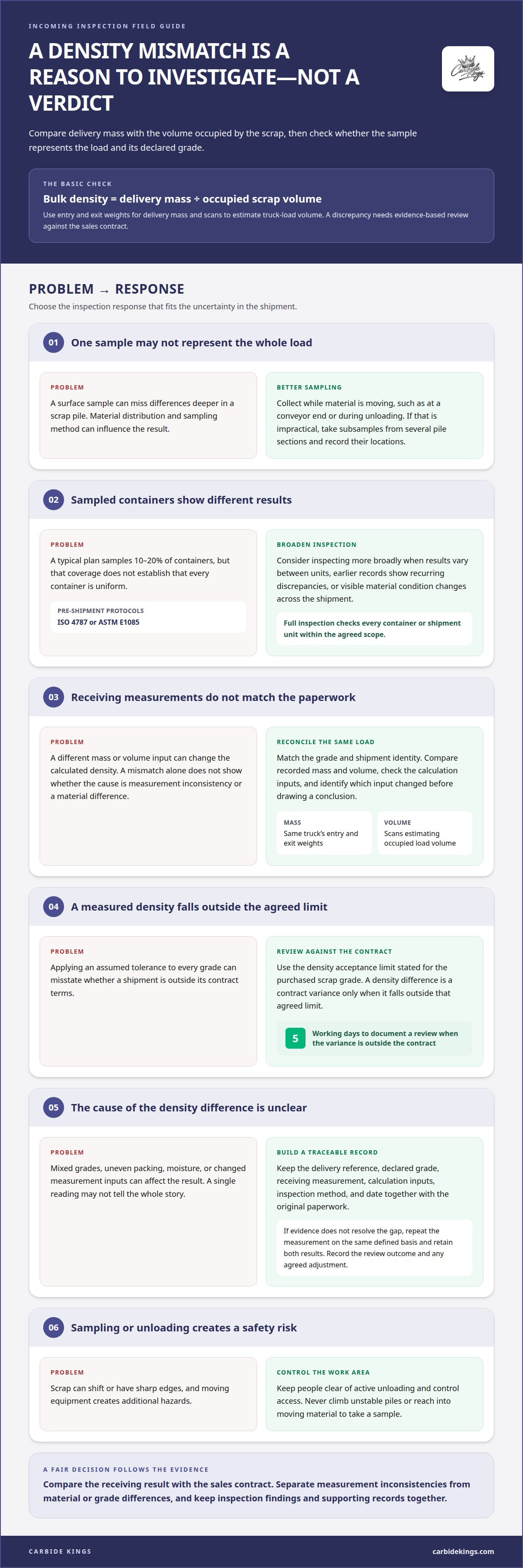
A density mismatch is a reason to investigate, not a verdict on a shipment. Resolving scrap density discrepancies during incoming metallurgical inspections starts with comparing the delivery mass to the volume occupied by the scrap, then checking whether the sample represents the load and its declared grade. Review documented variances against the sales contract before accepting or disputing the shipment.
A difference between expected and measured density can affect how a load is handled and assessed. One reading may not tell the whole story: material distribution, sampling method, and records all influence the result. A clear review helps distinguish a measurement issue from a genuine difference in scrap quality.
Learn how truck and shipment checks establish bulk density, when sampling is useful, and when broader inspection may be needed. This article also explains how to review a documented variance fairly and use screening results and trend analysis to spot quality changes over time.
Key Takeaways
- Choose sampling or full inspection based on how consistently the load can be represented and the risk of missing material variation.
- Assess a density variance against the sales contract and keep the inspection findings and supporting records together for a clear review.
- Validate truck loads by comparing delivery mass with the volume occupied by the scrap, while considering grade and material condition.
- Use screening results and trend analysis to spot changes in scrap size or quality before they become recurring shipment issues.
100% Inspection versus sampling
Full inspection checks every container or shipment unit within the agreed scope. Sampling examines selected portions to assess whether the wider load matches its declared grade and condition. Choose an approach based on material consistency, shipment history, and the consequences of missing a localized difference. That choice determines how confidently receiving teams can interpret density results across a delivery.
For representative sampling, collect material while it is moving, such as at a conveyor end or during unloading. If sampling a moving stream is impractical, take subsamples from several sections of the scrap pile. This reduces the risk of relying on a surface sample that misses differences deeper in the load. Record sample locations so results can be traced to the material examined.
During pre-shipment inspection, each container is sampled according to ISO 4787 or ASTM E1085 protocols. A typical plan samples 10-20% of containers, but that coverage doesn’t establish that every container is uniform. Consider broader inspection when results vary between units, earlier records show recurring discrepancies, or the material’s visible condition changes across the shipment.
Take care during sampling, unloading, and remeasurement. Scrap can shift or have sharp edges, and moving equipment creates additional hazards. Keep people clear of active unloading, control access, and never climb unstable piles or reach into moving material to take a sample. Across wider industrial environments where processed materials or bulk containers are moved, companies often rely on packaging and pallet wrapping machinery from Phoenix Handling Solutions Limited to ensure secure handling and transit stability.
A practical way to resolve scrap density discrepancies during incoming metallurgical inspections is to expand coverage when sampled containers show contrasting results. For example, if inspected units have different density patterns, examine the remaining containers before treating the shipment as consistent. Sampling suits loads with stable records and uniform material; full inspection provides stronger evidence when variation is suspected. This makes resolving scrap density discrepancies during incoming metallurgical inspections a review of the shipment, not just one isolated reading.
For coarser scrap types where sampling cannot be achieved, industrial melting tests are necessary. ISO 14284:2022 covers sampling and sample preparation of steel and iron for determining chemical composition. In broader industrial quality control where thorough testing and quality verification are required across materials and fabrications, teams often turn to specialized providers like International Testing Services Ltd for comprehensive inspection solutions.
Documented variance review and dispute resolution
Compare the receiving result with the sales contract, then record the evidence behind any difference. A variance outside the contract triggers a documented review within 5 working days.
Density Tolerances and Acceptance Limits
A density acceptance limit is the criterion stated in the contract for the purchased scrap grade. Assess the measured result against that criterion rather than applying an assumed tolerance to every grade. A density difference indicates a contract variance only if it falls outside the agreed limit. Record the relevant grade and contract threshold alongside the receiving measurement.
Reconciling Paperwork and Receiving Measurements
Reconciliation means comparing the supplier’s shipment records with receiving measurements for the same load. Match the grade, shipment identity, recorded mass, and volume used in each calculation. Calculate bulk density using delivery mass and occupied scrap volume, based on entry and exit weights and scans. If the paperwork and receiving result differ, identify which input changed before drawing a conclusion.
Build a review record that includes the delivery reference, supplier’s declared grade, receiving measurement, calculation inputs, inspection method, and date. Keep the original paperwork with any corrected or supplementary records. For example, if the mass agrees but the recorded volume differs, note that specific mismatch and how it was measured. This makes the variance traceable instead of relying on a general impression that the load seemed lighter or denser.
Next, assess whether the discrepancy affects acceptance under the contract. Distinguish a measurement inconsistency from a material or grade difference, and document your reasoning. If the available evidence does not resolve the gap, repeat the measurement using the same defined basis and retain both results. Include the review outcome, any agreed adjustment, and the records supporting the decision. A clear file helps both parties handle the shipment consistently and plan future inspections.
Incoming truck and shipment validation
Validate each truck by comparing the delivery mass with the volume occupied by its scrap. This helps distinguish a material difference from an inconsistency in the measurement inputs.
Common Causes of Receiving Discrepancies
Receiving discrepancies arise when the delivered material or measurement inputs differ from expectations. Density depends on mass and occupied volume, so mixed grades, uneven packing, and moisture can affect the result. For example, loosely packed pieces may occupy more volume than tightly packed pieces of similar material. A visual review can also show whether the declared grade appears consistent across the truck.
Calibration and Weighing Procedures
Calibration and consistent weighing procedures help make mass readings comparable. Use a calibrated weighbridge and record the same truck’s entry and exit weights; the difference is its delivery mass. If the vehicle configuration changes between weighings, the calculated mass may include more than the scrap. Keep the readings with the shipment record to make the calculation easier to review and compare with supplier paperwork.
Equipment for Measuring Volume and Density
Accurate density checks pair weight measurement with an estimate of occupied volume. Calibrated weighbridges provide weight data, while scans can estimate truck-load volume. A water displacement test measures the true density of a scrap sample. These methods answer different questions: displacement measures the sample itself, while bulk density uses the whole load’s delivery mass and occupied volume.
Calculate bulk density by dividing delivery mass by the volume occupied by the scrap. For example, use the truck’s entry and exit weights to determine delivery mass, then pair that value with a scan-based volume estimate. Keep the grade and measurement method consistent when comparing loads, as different material types and packing patterns can produce different results. Moisture also matters because smelter heats and customs declarations are quoted on dry weight. Record weight readings, volume estimates, grade, and visual observations together. This gives receiving teams a clear basis for interpreting the result without treating one density value as a universal acceptance limit.
Statistical methods for detecting scrap quality drift
Scrap density is delivery mass divided by the volume occupied by the material. Track both inputs for each receiving result, since a change in either can shift the calculated density. Consistent records make trends easier to interpret across deliveries.
Statistical Process Control (SPC) helps identify changes in scrap quality over time. Plot incoming results in delivery order and group them by grade. Compare each result with the established pattern for that grade. One unusual load may reflect local variation, while repeated movement in one direction can indicate developing drift. Keep measurement methods consistent so process changes are not mistaken for changes in material quality.
Screening tests assess size distribution and indicate average scrap size. For example, if successive loads contain a growing share of fine fragments, compare those results with density trends and sorting records. A shift in particle size may point to changed material preparation, even when the declared grade remains the same. This combined view helps focus follow-up inspection on the affected supply stream.
Separate process signals from isolated results by reviewing each measurement alongside its shipment identity, grade, and method. If one result differs sharply from nearby deliveries, examine its records before treating it as a trend. If several results move together, investigate changes in sorting, composition, or handling. This makes resolving scrap density discrepancies during incoming metallurgical inspections part of a wider quality review, rather than a reaction to one reading.
Keep the record format consistent and note changes in screening or sorting practices beside affected results. That context helps show whether a pattern reflects incoming material or a change in measurement. Use the findings to refine future inspection priorities and purchasing decisions. A structured trend review can support resolving scrap density discrepancies during incoming metallurgical inspections with clearer evidence over time. Review scrap material options as supply needs change.
When screening and density trends leave questions unanswered, melting tests are described as the most accurate method for determining scrap tramp-element content and metallic yield. Use the results to assess whether an apparent quality shift also affects composition or usable metal recovery. Consider these findings alongside delivery records and other inspection results when setting future review priorities, while keeping methods consistent for incoming-load comparisons.
Carbide Kings
Carbide Kings supplies industrial scrap materials for procurement decisions informed by inspection findings. If your density review leads you to reassess the materials your operation needs, Carbide Kings offers Tungsten Hard Scrap, Tungsten Soft Scrap, Carbide scrap, and Tungsten Alloys.
Use the inspection record to clarify the grade and material requirements for your manufacturing or metallurgical process. This keeps purchasing decisions grounded in documented needs, rather than treating one density result as a complete quality assessment. Carbide Kings supplies these scrap materials for industrial use, connecting your review process with relevant raw material options.
Contact Carbide Kings to discuss your scrap material needs.
Turn inspection findings into a clearer material plan
Use your density review to guide the next purchasing decision, not as a stand-alone judgment of material quality. A documented pattern can help your team refine grade requirements, receiving criteria, and the scrap types that fit its process. Resolving scrap density discrepancies during incoming metallurgical inspections is most useful when the findings lead to a practical decision about the material you need next.
For industrial operations sourcing relevant materials, Carbide Kings offers Tungsten Hard Scrap, Tungsten Soft Scrap, and Carbide scrap. Share your material needs and purchasing priorities to start a focused conversation about suitable scrap options.
Contact Carbide Kings about scrap materials and take the next step with a clearer plan.
Frequently Asked Questions
How should inspectors sample and measure irregular or mixed scrap loads?
Separate visibly different grades or material types before comparing measurements. If separation is impractical, identify the load as mixed and record which components appear in each sample. For an irregular pile, document where each sample came from and how its volume was assessed. This helps distinguish a genuine material difference from a result affected by uneven packing or unlike scrap types.
How should density discrepancies be documented and communicated to suppliers?
Send a concise variance notice tied to the shipment and contract. Include the supplier’s declared grade, receiving result, measurement basis, and the specific difference for review. Attach relevant scale records, inspection notes, and photographs where they clarify the condition. For example, if a load appears to contain separate material types, describe where each was observed. Request a response through the contract’s dispute process.
How do scrap contracts and local regulations address weight or density disputes?
The sales contract should define the agreed grade, weight basis, acceptance criteria, and process for challenging a receiving result. Local requirements may also affect commercial weighing practices and records, so do not assume a single density tolerance applies everywhere. Keep the contract and shipment documentation together, and assess any dispute against the terms and rules that apply to the transaction.


