
Preventing crucible bottom skull formation from oversized tungsten scrap blocks starts with controlling charge size, placement, cooling, and furnace atmosphere. In a cold crucible, metal freezing against the wall can form a protective skull, but unwanted buildup at the bottom can interfere with melting and crucible performance. Keep the two outcomes distinct: support the intended process while avoiding scrap that settles or melts unevenly.
If you’re focused on extending crucible life, the charge is only part of the picture. Careful handling, controlled cooling, and suitable temperature and atmosphere conditions also matter. This guide explains how oversized blocks can affect melting and what to consider when preparing and loading tungsten scrap. It also covers how heat and atmosphere control can help limit bottom accumulation, giving you a clearer framework for consistent melting and crucible performance.
Key Takeaways
- Crucible material and manufacturing method affect how it handles heat and loading, so match handling practices to the crucible design.
- Control temperature and atmosphere to support tungsten melting while limiting oxidation and thermal stress.
- Understand how cold-crucible design promotes a protective skull, and how uneven melting can contribute to unwanted buildup at the bottom.
- There is no universal scrap-block size for reliable melting; assess each block against the crucible dimensions and the furnace’s melting conditions.
How can I improve my crucible life and performance?
Match crucible construction, support, and charge handling to the melting process. Tungsten crucibles are commonly made by sintering, stamping, or spinning, using materials such as pure tungsten plates, sheets, or rods. Each method produces a different structure, so loading and heating practices should suit the crucible design.
Use a stand sized as recommended for the crucible, and made from the same material. A mismatched stand can leave the bottom unevenly supported. Preheat the crucible according to its manufacturer’s recommendations. When loading, position scrap deliberately rather than dropping heavy blocks against the wall or base.
Material composition matters. Pure tungsten offers the material properties needed for tungsten processing, while foundry crucibles may use different compositions. For example, foundry crucibles typically contain 30-50% flake graphite by weight and 10-50% silicon carbide, depending on desired properties. These are foundry materials, not tungsten-crucible recipes. Don’t apply their composition figures to tungsten vessels.
No single crucible type or bottom geometry prevents every tungsten skull. Cold-crucible designs use vertical slits to let magnetic fields penetrate. Metal can then freeze against the wall and form a protective skull. The aim is to prevent unwanted bottom accumulation, not to eliminate the intended wall skull.
For induction melting, coil coupling and charge placement affect where energy enters the load. Where the system supports stirring, melt circulation can distribute heat and help reduce persistent cold zones. Scrap sizing also involves handling, cutting equipment, labor, and energy. The balance depends on block hardness, available equipment, and the furnace’s loading method. Oversized blocks may reduce preparation work but make uniform melting harder. Choose a size that fits the crucible and process, then control loading and heating to protect the bottom.
Tungsten crucible temperature and atmosphere requirements
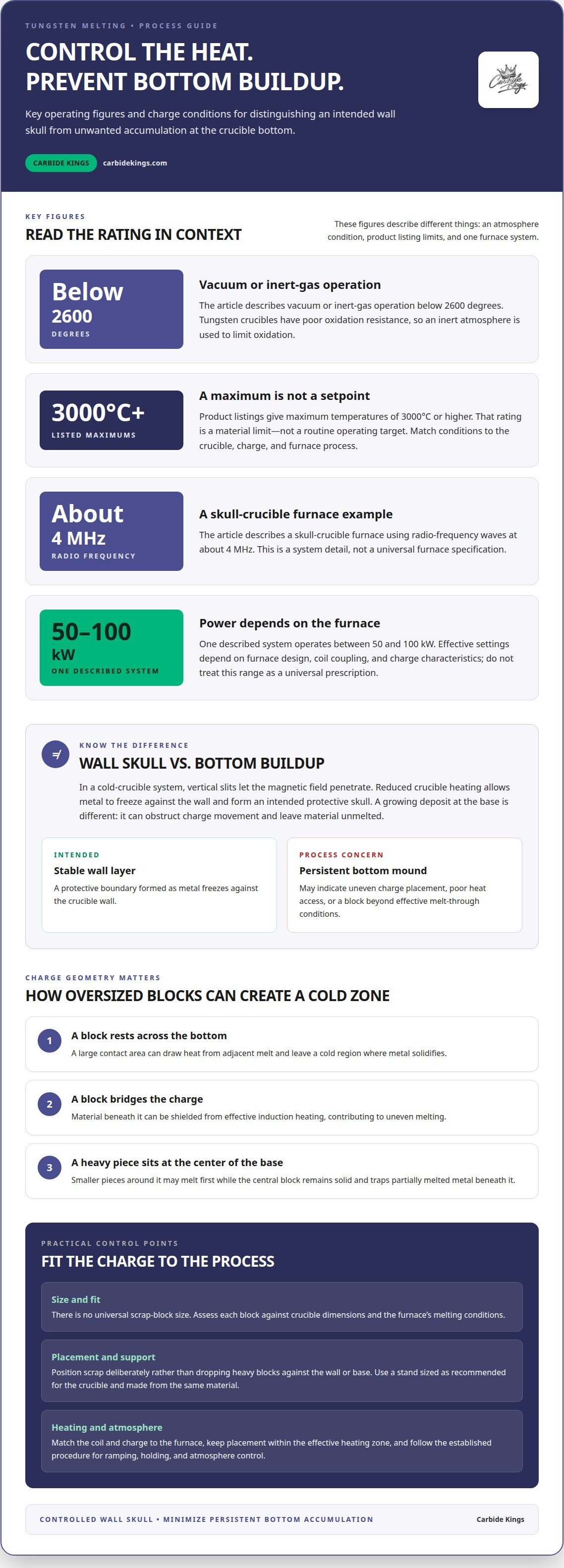
Temperature control and atmosphere work together in tungsten melting. Tungsten crucibles have poor oxidation resistance, so use an inert gas atmosphere to limit oxidation. Vacuum or inert-gas operation is described below 2600 degrees. Product listings also give maximum temperatures of 3000°C or higher, but a listed maximum is not a routine operating target. Match heating conditions to the crucible, charge, and furnace process.
A crucible’s maximum temperature is a material limit, not necessarily the right production setpoint. The operating temperature also depends on the load and heating method. A tungsten block may heat unevenly if its size or position prevents consistent energy transfer. Follow the furnace’s operating procedure for ramping and holding. Don’t treat a maximum-temperature rating as a universal setting for every scrap shape.
Induction melting can support tungsten scrap melt-through when the coil and charge are matched to the furnace. A skull-crucible furnace uses radio-frequency waves at about 4 MHz. One described system operates between 50 and 100 kW. These values describe that system, not a universal power prescription; the effective setting depends on furnace design, coil coupling, and charge characteristics.
At the charge level, stable placement helps keep blocks within the coil’s effective heating zone. Uneven energy input can leave colder regions that melt more slowly. A controlled temperature profile gives heat time to move through the load, while an inert atmosphere limits oxidation during extreme-temperature production. Maintain atmosphere control through the stages specified for the process.
For practical planning, consider scrap size alongside the furnace’s heating capacity and handling method. A consistent feed can make charge placement more predictable; tungsten hard scrap is one material category to consider when planning a tungsten charge. Don’t increase power blindly to compensate for oversized blocks. Align block geometry, coil response, and atmosphere control, then use the furnace’s established operating procedure to manage melt-through.
What causes skull formation at the bottom of a tungsten melting crucible?
A skull is solidified metal attached to a crucible surface. In a cold-crucible system, a protective wall skull is intentional. Vertical slits break electrical continuity and allow the magnetic field to penetrate the crucible. This reduces crucible heating, so molten metal can freeze against the wall. Bottom buildup is different: it can obstruct charge movement and leave material unmelted.
Block geometry affects where the charge settles and how heat reaches it. An oversized tungsten block resting across the crucible bottom creates a large contact area, which can draw heat from the adjacent melt and leave a cold region where metal solidifies. A block bridging the charge can also shield material beneath it from effective induction heating. The result is uneven melting, not simply a larger protective wall skull.
Loading position matters as much as block size. A heavy piece placed at the center of the base may remain in contact with the cooler crucible surface. Smaller pieces around it can melt first, while the central block stays solid and traps partially melted metal beneath it. More material may then freeze against the cold zone, adding to the bottom deposit.
Distinguish intended skull formation from process trouble by checking where solid metal accumulates. A stable wall layer is part of cold-crucible operation. A growing mound at the base can point to uneven charge placement, poor heat access, or a block that exceeds the furnace’s effective melt-through conditions. Review block orientation, its contact area, and melt circulation together. A skull alone does not prove the crucible has failed. In induction skull melting, cooling and field penetration maintain a protective boundary. The practical target is a controlled wall layer without persistent bottom buildup restricting the next charge.
After heating, avoid placing a tungsten crucible immediately on a cold metal table; rapid cooling can cause it to break. Optimizing induction skull melting system structure can increase energy-utilization efficiency from approximately 27.1% to over 38.3%.
What is the maximum tungsten scrap block size for reliable melting?
There is no universal maximum block size for reliable melting. The workable limit depends on the crucible’s internal dimensions, the induction system’s heating pattern, and charge placement. A block must fit without wedging against the wall or covering a large part of the base. Shape matters as much as the longest dimension.
Assess each piece against the actual furnace setup. Compare its width and height with the loading space, then consider whether it can sit securely with room for surrounding charge. A long, narrow block may fit where a shorter, bulkier piece cannot. Preventing crucible bottom skull formation from oversized tungsten scrap blocks starts with accounting for how each piece will rest inside the crucible.
Next, consider heat access. Induction energy must couple effectively with the charge. A dense block with a broad contact area can heat unevenly if its placement limits exposure to the field or obstructs nearby material. Coil position, power delivery, charge arrangement, and the expected melt sequence all influence the workable block size. Reducing a block’s dimensions can improve placement options, but processing requires suitable equipment and handling.
Use a practical acceptance test: can the block be loaded safely, positioned without being forced against the crucible, and exposed to the furnace’s intended heating pattern? If not, revise the charge plan or size the material for a better fit. This can help prevent crucible bottom skull formation from oversized tungsten scrap blocks by improving placement and heat access. Apply the same test to irregular pieces, since projecting edges can prevent stable positioning.
For charge planning that includes available tungsten material, review tungsten scrap options and match the feed to your furnace’s loading and melting requirements.
Reduce oversized blocks to dimensions that fit the crucible without wedging against its walls. Each piece should sit securely with room for surrounding charge. Use suitable equipment and handling, then check that the prepared pieces can be exposed to the furnace’s intended heating pattern.
Carbide Kings
Carbide Kings supplies industrial scrap materials for manufacturing and metallurgical processes. If your operation needs suitable feedstock, its offerings include Tungsten Hard Scrap, Tungsten Soft Scrap, carbide scrap, and Tungsten Alloys. These material categories can support charge planning alongside the crucible and furnace considerations covered above. Match the scrap type and form to your process requirements, handling setup, and intended use. For teams evaluating tungsten scrap inputs, Carbide Kings provides a direct next step for sourcing material without confusing scrap supply with furnace design or operating guidance. Contact Carbide Kings to discuss your scrap material needs.
Put a More Consistent Melt Plan Into Practice
Use your next melt as a process check. Record how each block sits in the charge, whether it melts through evenly, and where solid material remains. Use those observations to refine feed preparation and loading for later runs. A repeatable approach to preventing crucible bottom skull formation from oversized tungsten scrap blocks treats each result as useful information, rather than changing settings without a clear reason.
When material sourcing is part of that plan, Carbide Kings can help you consider scrap options that fit your operation’s needs. Share what type of material you’re sourcing and how it supports your production process. Contact Carbide Kings for advice as you plan your next step. A measured approach keeps the focus on practical decisions and gives your team a clear path forward.
Frequently Asked Questions
What temperature and hold time are needed to melt tungsten scrap completely?
There is no single temperature and hold time for every tungsten scrap charge. The cycle depends on the furnace, block dimensions, charge arrangement, and how evenly heat reaches the material. Follow the operating procedure for the specific furnace, and check for remaining solid pieces before ending the cycle. A displayed maximum temperature alone does not establish the correct setpoint or holding period.
What crucible types and bottom geometries reduce tungsten skull formation?
No crucible type or bottom geometry prevents every tungsten skull. Cold-crucible designs intentionally form a protective wall skull. Avoiding unwanted bottom buildup depends on charge fit, placement, and heat access.
What equipment and processing costs are involved in sizing tungsten scrap before melting?
Sizing can require cutting equipment, labor, and energy. The tradeoff depends on block hardness, available equipment, and the furnace’s loading method.
How can operators inspect for and remove a tungsten crucible skull?
Inspect where solid metal accumulates: a stable wall layer is intentional, while a growing mound at the base can indicate poor placement or limited heat access. Review block orientation, its contact area, and melt circulation. No removal method is provided.


