

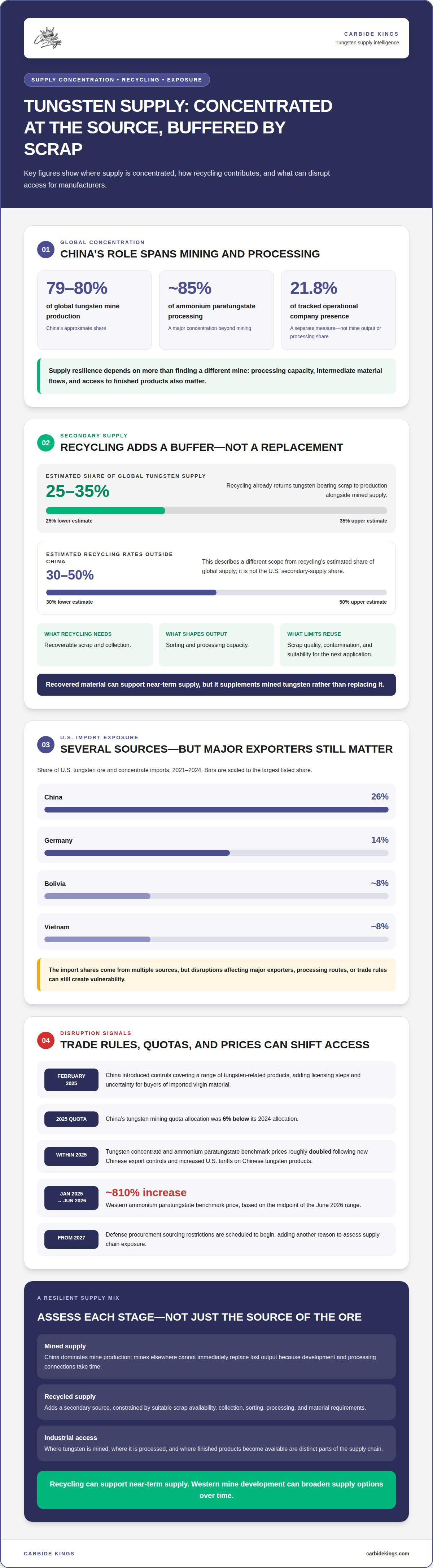
China accounts for approximately 79-80% of global tungsten mine production and around 85% of ammonium paratungstate processing. This concentration puts critical mineral supply chain disruptions and the balance between secondary tungsten and imported virgin metal firmly in focus. Recycling already supplies an estimated 25-35% of global tungsten supply, giving manufacturers another source when imported material is constrained.
Dependence on imports can expose buyers to export controls, trade disruptions, and tight availability. Understanding critical mineral supply chain disruptions means assessing how recycling can reduce that exposure while recognizing that recovered material supplements mined supply rather than replacing it.
This article explains how concentrated tungsten supply is, how recycled material can help buffer disruptions, and why developing Western mines matters for long-term diversification. You’ll see what each source can contribute, where its limits lie, and how scrap can support a more resilient supply chain.
Key Takeaways
- Separate global production concentration from U.S. import exposure: according to the U.S. International Trade Commission, China accounted for 26% of U.S. tungsten ore and concentrate imports from 2021 to 2024.
- Assess recycled tungsten as a secondary supply source, while recognizing that its contribution depends on recoverable scrap and the material’s suitability for reuse.
- Consider recycling and Western mine development together: recovered material can support near-term supply, while new mines can broaden supply options over time.
- Match the material stream to your industrial needs by understanding the differences among hard scrap, soft scrap, carbide scrap and tungsten alloys.
How Concentrated Is Tungsten Supply, Really?
Tungsten supply is concentrated at both mining and processing stages. China accounts for approximately 79-80% of global mine production and around 85% of ammonium paratungstate processing.
Export Controls and Supply Restrictions
Export controls and licensing requirements can limit or delay the movement of tungsten products across borders. China introduced controls covering a range of tungsten-related products in February 2025, adding a new constraint for buyers who depend on imported virgin material. The effect can reach beyond shipments directly stopped: added licensing steps and uncertainty can complicate procurement planning. China’s 2025 tungsten mining quota allocation was 6% below its 2024 allocation, another factor shaping available supply.
Trade Changes and Price Volatility
Quota changes and tariffs can move prices by changing how much material reaches buyers and what it costs to trade. Tungsten concentrate and ammonium paratungstate benchmark prices roughly doubled within 2025 following new Chinese export controls and increased U.S. tariffs on Chinese tungsten products. The Western benchmark price for ammonium paratungstate increased approximately 810% from January 2025 to June 2026, based on the midpoint of the June 2026 range. For manufacturers, these swings can make imported virgin metal harder to budget and schedule reliably.
U.S. Exposure to Supply Disruptions
U.S. defense, metalworking, mining, and manufacturing operations are exposed where their production relies on tungsten-bearing materials. Regional exposure follows the location of those operations and their suppliers, rather than a single state or region. According to the U.S. International Trade Commission, China accounted for 26% of U.S. tungsten ore and concentrate imports from 2021 to 2024. Germany supplied 14% over that period, while Bolivia and Vietnam each accounted for about 8%. This spread shows that imports come from several sources, but supply remains vulnerable to disruptions affecting major exporters, processing routes, or trade rules. For defense procurement, sourcing restrictions scheduled to begin in 2027 add another reason to assess supply-chain exposure.
China's role in critical mineral supply chains
China’s influence extends beyond tungsten mining to processing and trade. For industrial buyers, this can shape sourcing options and material availability.
China’s Share of Mined Tungsten
China is the dominant source of mined tungsten, so decisions about domestic production can have an outsized effect on global supply. Mines elsewhere cannot immediately replace lost output: new production must be developed and connected to processing routes. A disruption at the mining stage can therefore tighten availability before alternative sources are ready to meet industrial demand.
China’s Dominance in Tungsten Supply
China’s influence also extends through intermediate materials and finished products. It has maintained dominance in trade of tungsten final products since 2011, linking its role in the supply chain to buyers who need processed inputs, not just ore. If trade flows change, manufacturers may face pressure across several stages, from sourcing material to securing inputs that meet production requirements.
Tracked operational tungsten company presence offers another view of the sector’s geography: China accounts for 21.8% of that presence globally. This measure is not the same as mine output or processing share, but it shows how strongly tungsten activity remains centered there. For U.S. buyers, national supply resilience depends on more than finding a different mine. Processing capacity, intermediate material flows, and dependable access to finished products also matter.
This distinction helps frame the search for alternatives. Domestic or allied sources can broaden sourcing options, but their value depends on whether material can move through the full supply chain and become usable industrial input. Buyers assessing exposure can ask three separate questions: where is tungsten mined, where is it processed, and where does the final product become available? This approach makes supply concentration easier to evaluate without treating every source as interchangeable.
Tungsten recycling as a secondary supply buffer
Recycling returns tungsten-bearing scrap to production, adding a secondary source alongside imported virgin material. Its contribution depends on the available scrap, sorting and processing capacity, and the quality required for the next application.
Recycled Tungsten’s Supply Role
Recycling supplies an estimated 25-35% of global tungsten supply, while estimated recycling rates outside China are 30-50%. These figures describe different scopes, not the U.S. share: U.S. secondary supply depends on recoverable scrap and domestic processing. Scrap availability also varies by product life cycles and collection, while contamination can complicate sorting or limit the material’s suitable use.
Recycled tungsten’s cost, quality, and carbon footprint depend on the scrap grade, processing required, and boundaries used for comparison. Material with a known composition may be easier to direct into production, while mixed or contaminated scrap can require extra processing. Recycling recovers existing tungsten, but no single cost or emissions comparison applies to every feedstock and process.
Cost, Quality, and Carbon Comparisons
Neither route has a universal lead-time advantage. Recycling depends on scrap collection, sorting, and processing capacity; imports depend on shipment schedules, trade conditions, and product availability. Recycling output is constrained when suitable scrap is scarce or facilities are committed, while imported virgin material is exposed to export controls and disrupted trade flows.
Recycling Lead Times and Capacity
The U.S. share of tungsten supply from recycling cannot be represented by the global estimate: it depends on domestic scrap recovery and processing. Commercial recyclers can supply secondary material; the United States has had no active tungsten mine and has not produced tungsten domestically since 2015, leaving virgin supply dependent on imports.
Import and Recycling Policy
Trade policy affects imports through tariffs, export controls, and defense procurement restrictions. Recycling is shaped by scrap classification and applicable regulatory requirements; an exemption should not be assumed to apply to every material or transaction. U.S. defense procurement rules are scheduled to restrict sourcing tungsten metal powder and heavy alloys from China and other designated countries starting in 2027. These measures make material form and intended use important when assessing sourcing options.
Western mine development and supply diversification
New mines and allied supply routes can broaden sourcing beyond concentrated production. Their contribution depends on development, processing, and the ability to deliver usable tungsten.
The United States has pursued broader critical-mineral cooperation with Australia. The countries signed a supply framework in October 2025, with each committing at least $1 billion in project financing. Their partnership identified an approximately $8.5 billion pipeline of prospective critical-mineral projects across both countries. These figures describe a broad minerals initiative, not tungsten production alone.
Australia offers a substantial base for wider mineral development: it has geological potential to supply 36 commodities on the U.S. critical minerals list and already produces 29. Australia has also identified approximately 680 aligned deposits, about 90% available for investment and development by U.S. firms. This project base can support supplier diversification, but deposits still require development and connections to processing and manufacturing.
Allied mining can also change over time. South Korea’s Sangdong mine resumed production in late 2025, creating another source of mined tungsten outside China. Canada’s influence in tungsten ore trade declined after mine closures following 2016. These examples show why a country’s past role does not guarantee future availability: operating mines, investment, and processing links shape supply.
For U.S. buyers, diversification involves more than a mine’s location. A dependable source must connect production with processing and deliver material suited to industrial demand. Government partnerships can help advance projects, but development timelines and supply-chain capacity remain practical challenges. A balanced sourcing strategy can combine existing imports, allied production, and recovered material instead of relying on a single route.
To include recovered material in your sourcing mix, review tungsten sourcing options.
Carbide Kings
Carbide Kings supplies industrial buyers considering secondary tungsten as part of a broader sourcing strategy. Its offerings include Tungsten Hard Scrap, Tungsten Soft Scrap, carbide scrap, and Tungsten Alloys. Buyers can evaluate these material categories alongside imported virgin tungsten according to their manufacturing needs and supply plans.
Recycling cannot remove every supply-chain risk, but scrap can add another sourcing route. The right fit depends on the material your process requires and how it supports production. If you’re assessing ways to diversify tungsten sourcing, contact Carbide Kings to discuss your material needs.
Make your tungsten sourcing plan more flexible
Use your next procurement review to identify where recovered material fits your production needs. A practical response to critical mineral supply chain disruptions is to assess secondary tungsten alongside imported virgin metal, considering how each source supports supply continuity. This comparison can help shape a sourcing plan around your operation’s material requirements.
Carbide Kings supplies Tungsten Hard Scrap, Tungsten Soft Scrap, and carbide scrap for industrial buyers considering secondary material. For businesses planning around critical mineral supply chain disruptions, these materials are options to evaluate within a broader tungsten sourcing strategy.
Contact Carbide Kings to discuss tungsten and take a clear next step toward a more flexible sourcing plan.
Frequently Asked Questions
Where does the United States source its critical minerals?
The United States gets critical minerals from domestic production, recovered materials, and imports from trading partners. Dependence varies by mineral: in 2025, the country was 100 percent import-dependent for twelve minerals classified as critical and more than 50 percent import-dependent for twenty-eight others. For tungsten, the United States has had no active mine and no domestic production since 2015, making imports and recycling important supply routes.
What are the main global sources and supply-chain concentration risks for virgin tungsten?
China is the leading source of mined tungsten and a major processing hub, so a disruption there can affect both ore supply and intermediate products. The risk extends beyond mining: processing constraints or trade controls can also interrupt availability. Other producing countries offer alternatives, but expanding their role depends on mining output, processing access, and the ability to supply material that meets industrial requirements.
How much tungsten does the United States import, and from which countries?
Import shares show which countries supplied U.S. tungsten ore and concentrate from 2021 to 2024. According to the U.S. International Trade Commission, China accounted for 26% and Germany for 14%; Bolivia and Vietnam each supplied about 8%. These figures describe shares of ore and concentrate imports, not total tungsten consumption or imports of every tungsten product.
Which tungsten scrap types can be recycled, and what recovery rates and processing steps are typical?
Tungsten-bearing hard scrap, soft scrap, carbide scrap, and alloys can enter recycling streams. Globally, recycling supplies an estimated 25-35% of tungsten supply; outside China, estimated recycling rates are 30-50%. These figures describe supply and recycling rates, not the recovery yield of a particular batch. Scrap is generally sorted by material type and condition before suitable feedstock is processed for reuse.
What U.S. recycling companies and domestic tungsten producers can supply secondary or virgin material?
Commercial recyclers can supply secondary material. The United States has had no active tungsten mine and has not produced tungsten domestically since 2015.


