
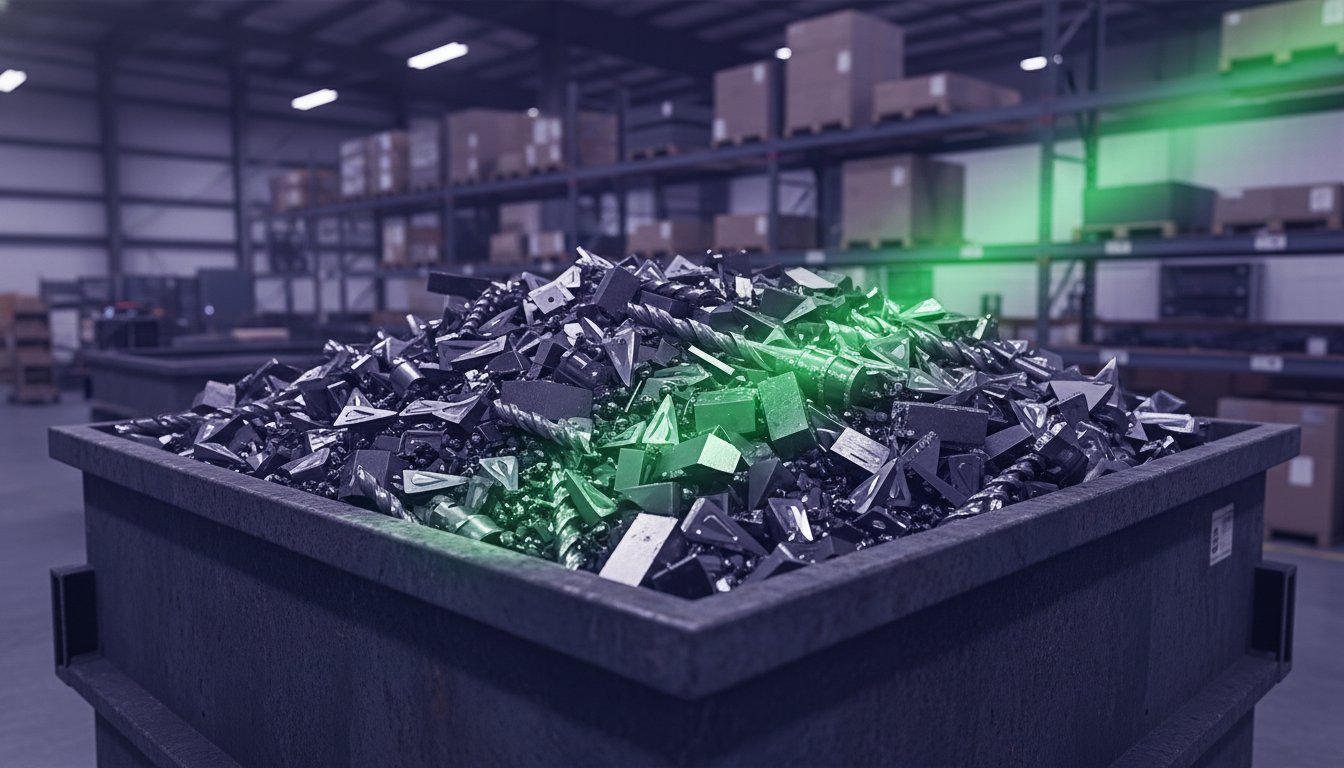
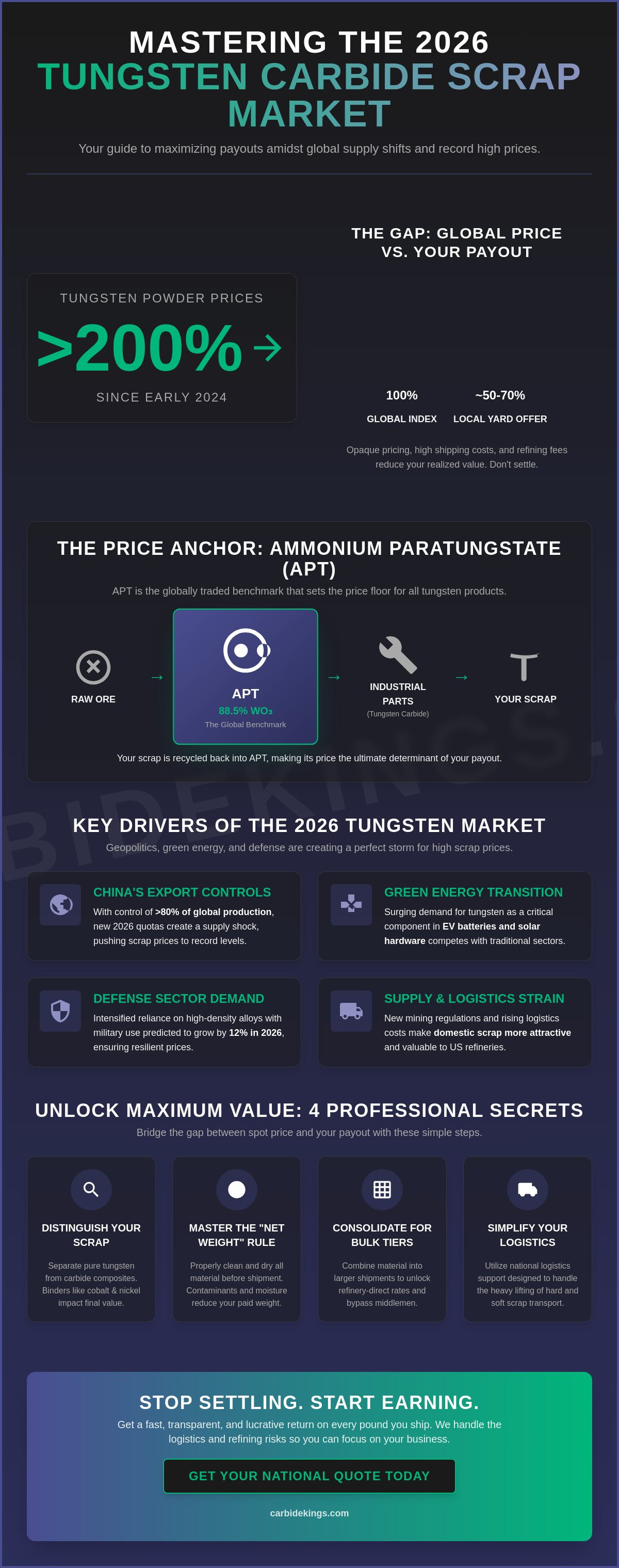
Tungsten powder prices have surged over 200% since early 2024, yet many industrial professionals still struggle to get a fair quote at the scale. It's frustrating when the tungsten carbide scrap price per pound you see on a global index doesn't match the low-ball offer from a local yard. You know your material is a strategic resource, especially with China's 2026 export controls tightening the global supply. You shouldn't have to settle for opaque pricing or lose your margins to high shipping costs.
We understand that your time is valuable and your scrap is an asset, not an afterthought. This guide will help you master the 2026 market drivers and learn the professional sorting secrets that bridge the gap between APT spot prices and your maximum payout. We'll show you how to identify high-value Tungsten Hard Scrap, Soft Scrap, and alloys while streamlining your logistics. We're breaking down the complex market shifts to ensure you receive a fast, transparent, and lucrative return on every pound you ship.
Key Takeaways
- Decode the 2026 market drivers and see how global APT benchmarks determine the actual tungsten carbide scrap price per pound you receive at the scale.
- Distinguish between pure tungsten and carbide composites to understand how binder materials like cobalt and nickel impact your final scrap value.
- Master the "Net Weight" rule to increase your payout by properly cleaning and drying your industrial scrap before shipment.
- Learn how to consolidate your material into bulk tiers to unlock refinery-direct rates and bypass local scrap yard middlemen.
- Simplify your operations by utilizing national logistics support designed to handle the heavy lifting of hard and soft scrap transport.
Understanding the 2026 Tungsten Price Per Pound Benchmarks
In the industrial sector, the tungsten price per pound isn't just a number on a spreadsheet; it's a dynamic global commodity benchmark. For 2026, this benchmark has become increasingly sensitive to China's strict export controls implemented in January. These policy shifts mean that raw ore prices now exert a stronger, more immediate pull on scrap valuations than in previous decades. Professional sellers monitor the tungsten carbide scrap price per pound to ensure they aren't leaving money on the table when local yards offer generic "mixed metal" rates. If you're holding a pile of used inserts or wear parts, you're essentially holding a strategic mineral asset. Tracking these benchmarks helps you time your sales for maximum ROI.
The Price Anchor: Ammonium Paratungstate (APT)
To understand your payout, you must understand Ammonium Paratungstate (APT). APT is the critical intermediate product used in nearly all tungsten manufacturing. The industry uses a standard of 88.5% WO3 (tungsten trioxide) content to set the global price floor. Most industrial tools and components are made of tungsten carbide, a compound that requires significant processing to reach this APT benchmark. Because APT is the primary form traded on international exchanges, its price dictates the ceiling for all downstream products. APT serves as the price foundation for the entire 2026 recycling chain, providing the baseline from which all scrap quotes are calculated.
Spot Price vs. Realized Scrap Payout
Don't expect to receive 100% of the global spot price for your scrap. Refining is a complex, energy-intensive process that involves chemical baths, heat, and filtration to remove binders like cobalt or nickel. Every buyer must account for these processing costs and the yield loss that occurs during recycling. In 2026, the tungsten carbide scrap price per pound is also heavily influenced by purity levels. Pure tungsten scrap often commands a different rate than carbide composites because the extraction path is distinct.
Daily market volatility in 2026 has added a layer of complexity to these quotes. Price fluctuations can happen in hours, driven by trade policy updates or sudden demand spikes from the aerospace and defense sectors. A professional buyer bridges this gap by offering stability. They handle the logistical heavy lifting and the refining risk. This allows you to convert your industrial waste into liquid capital without tracking every minor tick in the commodity markets. Remember, the realized value is what hits your bank account after shipping and processing, not the raw number on a London or Shanghai exchange.
Key Drivers of Tungsten Market Trends in 2026
China's implementation of strict export controls in January 2026 has fundamentally reshaped the industrial landscape. Because China controls over 80% of global production, these quotas created an immediate supply shock. This geopolitical tightening is the primary force pushing the tungsten carbide scrap price per pound to record levels this year. As primary mining output struggles to meet global needs, the industry has pivoted toward "secondary raw materials." Recycling is no longer just an environmental choice; it's a strategic necessity for maintaining US manufacturing stability.
The "Green Energy" transition is another massive catalyst. Tungsten is now a critical component in EV battery anodes and solar hardware, driving a surge in demand that competes with traditional tooling sectors. Simultaneously, the defense sector's reliance on high-density alloys has intensified. Military use of tungsten is predicted to grow by 12% in 2026, ensuring that prices remain resilient even during broader economic shifts. According to USGS tungsten market data, the structural tightness in the market is expected to persist as new mine supplies remain years away from production.
Supply Chain Vulnerabilities and Mining Shifts
New mining regulations introduced in early 2026 have reduced global output quotas, further squeezing the market. Shipping logistics also play a larger role now. Rising fuel surcharges and port delays have increased "landed" prices for raw materials, making domestic scrap more attractive to American refineries. Many governments are also engaged in strategic stockpiling to protect national security interests. These reserves act as a buffer, but they also remove significant volume from the commercial market, which keeps the tungsten carbide scrap price per pound elevated for private sellers.
Technological Demand in the Semiconductor Sector
Advanced microchips and 5G infrastructure now require higher concentrations of tungsten for precision layering. This high-tech demand means that specialized carbide tooling used in semiconductor fabrication is seeing higher premiums than standard construction-grade scrap. Many US manufacturers are responding by adopting sustainable "closed-loop" recycling programs to secure their own supply chains. If you want to capitalize on these high-demand trends, you can request a quote for your tungsten alloys to see how today's market shifts affect your specific inventory. Converting your idle scrap into capital is the most efficient way to navigate these supply constraints while supporting domestic industrial growth.
Pure Tungsten vs. Tungsten Carbide: Why Prices Differ
Don't assume every heavy, gray metal piece in your shop carries the same value. Pure tungsten and tungsten carbide are distinct materials with different industrial roles and recycling paths. Pure tungsten (99.9%+) is prized for its extreme melting point and density, typically found in TIG electrodes, vacuum furnace parts, or specialized laboratory equipment. In contrast, tungsten carbide is a composite material where tungsten is bonded with carbon. Most industrial cutting tools are actually composites containing 85% to 95% tungsten. The remaining percentage consists of metallic binders like cobalt or nickel. These binders are essential for tool toughness, but they also complicate the recycling process. When you're calculating your expected tungsten carbide scrap price per pound, you must account for this dilution of the pure element.
The physical form of your material also dictates the final quote. Solid inserts, drills, and wear parts are categorized as Hard Scrap. These are highly desirable because they're easy to sort and refine. Conversely, grinding sludge, filter cake, and dust are Soft Scrap. This material requires extensive chemical processing to separate the tungsten from coolants and contaminants, which naturally lowers the payout per pound. High-volume shops often find that keeping these streams separate is the fastest way to increase their total ROI. Mixing high-purity solids with contaminated sludge only serves to lower the average value of your entire inventory.
Tungsten Carbide (WC) Pricing Dynamics
Carbide is almost never pure. The presence of cobalt is a major factor in your quote. In 2026, cobalt price volatility has a direct secondary effect on carbide valuations. According to U.S. Geological Survey tungsten data, the demand for these binder metals in EV batteries often competes with tool manufacturing. Hard scrap tools are significantly cheaper to reprocess than soft scrap residues. This efficiency makes solid carbide the preferred choice for refineries looking to maintain high throughput. It's why solid tools consistently command a premium over powders or swarf.
Specialty Alloys and Their Market Value
Not all tungsten-based materials follow the standard carbide pricing model. Specialty alloys like Heavy Metal (W-Ni-Fe) and Elkonite (W-Cu) serve niche roles in aerospace and electronics. Densalloy and other high-density materials are used for radiation shielding and vibration dampening. Aerospace-grade alloys often fetch the highest tungsten carbide scrap price per pound in 2026 because of their extreme purity and critical application. Identifying these requires professional material analysis. You can't rely on visual inspection alone; a spectrometer reading is often the only way to distinguish a standard carbide insert from a high-value tungsten-copper heat sink.
How to Maximize Your Realized Scrap Value Per Pound
Clean your material before it hits the scale. The "Net Weight" rule is the most critical factor in determining your final payout. Refineries pay for the actual metal content, not the industrial grime attached to it. If your scrap is soaked in cutting fluids, oils, or heavy moisture, the buyer will apply a percentage deduction to account for that weight. Drying your tungsten carbide scrap price per pound by ensuring your material is free of debris and liquids immediately increases your yield. It's a simple step that turns industrial waste into a high-margin asset.
Volume tiers are another powerful lever for increasing ROI. Size matters in industrial recycling. Most local yards act as middlemen, but shipping in bulk allows you to bypass these intermediaries. Aim for shipments of 500 pounds or more to unlock refinery-direct pricing tiers. These bulk rates significantly boost the tungsten carbide scrap price per pound compared to small, fragmented lots. If you haven't reached that weight yet, consolidate your inventory until you hit the threshold. It's more efficient for logistics and far more lucrative for your bottom line.
Sorting for Success: The Magnet Test
Don't let steel contamination eat your profits. Use a magnet to separate steel-shanked tools from solid carbide heads. Many industrial drills and end mills feature a carbide tip brazed onto a steel body. If you ship these as a mixed load, the buyer will price the entire lot at the lowest common denominator. A simple magnet test can prevent hundreds of dollars in sorting downgrades by ensuring steel-contaminated pieces don't lower the average grade of your entire load. Keep your solid Hard Scrap in one bin and your brazed tools in another to maintain the integrity of your high-value material.
The Professional Quote Process
Get a certified weight quote to protect your margins. A "ballpark estimate" over the phone is not a guarantee. To secure a firm price, provide the buyer with accurate weights, the specific form of the material, and clear photos of the inventory. Speed is your ally here. Market volatility in 2026 means prices can shift overnight. Once you receive a quote, look for a 24-hour processing window that includes a price lock. This ensures that even if the global market dips while your shipment is in transit, your rate remains secure. When you're ready to move your inventory for the best possible return, get a quote for your tungsten carbide scrap from a partner that prioritizes transparency and fast processing.
Selling Your Carbide Scrap to Carbide Kings: The National Advantage
Local scrap yards often lack the specialization to offer a competitive tungsten carbide scrap price per pound. They typically treat your high-value alloys as generic heavy metal. We cut out the middleman. By selling directly to us, you access refinery-direct rates that maximize your ROI. We provide professional-grade material analysis and use certified scales to ensure every ounce of your inventory is accounted for. You get a clear, honest breakdown of your material's value without the guesswork or opaque pricing common in the local market. Transparency is the foundation of every transaction we handle.
Logistics shouldn't be a barrier to your profit. We handle the heavy lifting of industrial shipping through our comprehensive national logistics network. Whether you're moving Tungsten Hard Scrap, Soft Scrap, or complex alloys, we streamline the transport process from your facility to our intake center. Once your shipment arrives, we verify the contents and process payments via wire transfer or check within 24 hours of receipt. Speed and reliability are the pillars of our service. We understand that industrial professionals value time as much as capital, so we've refined our process to be as fast as it is lucrative.
Our Streamlined Procurement Timeline
Our workflow is designed for frictionless efficiency. It starts with a digital quote based on your photos and estimated weights. We manage the transition from the shop floor to the refinery with precision. We handle everything from large-scale industrial accounts to specialized machine shop loads with the same level of professional care. For a deeper look at how we manage these materials, read The Complete Guide to Tungsten Hard Scrap Recycling in 2026. This resource explains how we categorize your inventory to ensure you receive the best possible return on your investment.
The Carbide Kings Commitment to Manufacturers
We eliminate the administrative hurdles that typically slow down industrial recycling. There's no unnecessary paperwork or hidden delays in our system. Our goal is to make recycling a seamless, automated part of your operation. By choosing us, you also fulfill a critical environmental responsibility. Your waste becomes a primary industrial resource for the next generation of American manufacturing. It's a strategic move for your balance sheet and a win for the domestic supply chain. Get your custom 2026 tungsten scrap quote today and experience a faster, more transparent way to secure the best tungsten carbide scrap price per pound.
Maximize Your Industrial Scrap ROI in 2026
The 2026 market offers a unique opportunity for shops and manufacturers to turn idle inventory into significant capital. You've seen how global supply shifts and high-tech demand have made your scrap more valuable than ever. By focusing on material purity and utilizing the "Net Weight" rule, you ensure every shipment delivers its full potential. Don't let your margins disappear at a local yard that doesn't understand the complexities of the tungsten carbide scrap price per pound. Moving past middleman pricing is the fastest way to secure the return your business deserves.
Partnering with an expert allows you to focus on your core operations while we handle the heavy lifting. We provide competitive direct-to-refinery rates, national shipping assistance, and 24-hour payment processing. This streamlined approach removes the traditional barriers of industrial recycling, providing you with a fast and transparent transaction. Stop sitting on your hard scrap, soft scrap, and alloys. Get a Fast Quote on Your Tungsten Scrap Now and clear your floor space with confidence. Your material is ready to be a primary resource again, and it's time you were paid fairly for it.
Frequently Asked Questions
Why does the tungsten price per pound change every day?
Daily fluctuations are driven by global commodity exchanges and geopolitical shifts. In 2026, China's export quotas and surges in demand from the aerospace and defense sectors create constant movement in the market. Local demand and refinery capacity also play a role in these daily adjustments. We monitor these benchmarks in real-time to provide quotes that reflect the most current industrial reality.
What is the difference between pure tungsten and tungsten carbide scrap?
Pure tungsten is a single element used in high-heat applications, while tungsten carbide is a compound mixed with carbon and metallic binders. Most industrial tools are carbide composites containing cobalt or nickel. Because the refining processes for these materials differ, the tungsten carbide scrap price per pound is calculated based on the specific tungsten content and the binder type used in the tool's manufacturing.
How much tungsten scrap do I need to sell for it to be worth shipping?
Shipments of 50 pounds or more are generally the most cost-effective for industrial sellers. To unlock the most competitive pricing tiers and maximize your ROI, aim for bulk shipments of 500 pounds or more. Larger volumes allow us to provide national shipping assistance that offsets freight costs. Consolidating your material ensures you get the most value out of every pound you ship.
How do I know if my scrap is tungsten carbide or just heavy steel?
Density and magnetic properties are your best indicators. Tungsten carbide is nearly twice as heavy as steel and is generally non-magnetic or only weakly magnetic. If a piece feels surprisingly heavy for its size and doesn't stick strongly to a magnet, it's likely a high-value tungsten alloy or carbide. For large loads, we use professional-grade analysis to verify the exact composition of your inventory.
Do you buy tungsten grinding sludge or just solid hard scrap?
We buy both Tungsten Hard Scrap and Tungsten Soft Scrap, which includes grinding sludge, filter cake, and powders. Solid tools like inserts and end mills are categorized as hard scrap and are easier to process. Soft scrap requires additional chemical refining to remove coolants and contaminants. This extra processing is factored into the quote, but both forms remain highly valuable industrial resources.
What is the fastest way to get paid for my carbide scrap?
The quickest path is to provide clear photos and accurate weights for a digital quote, then ship your material using our logistics support. Once we receive and verify your load at our facility, we process payments via wire transfer or check within 24 hours. Our streamlined workflow eliminates administrative hurdles to get capital back into your business as quickly as possible.
Can I get a higher price per pound if I have over 1,000 pounds of material?
Yes, bulk volume tiers often unlock higher pricing. Refineries prefer large, consolidated loads because they are more efficient to process than small, fragmented lots. If you have over 1,000 pounds of material, you can bypass local yard rates and secure a more lucrative tungsten carbide scrap price per pound through our direct-to-refinery procurement program. Bulk shipping is the most effective way to boost your bottom line.
Does the price of cobalt affect my carbide scrap value?
Cobalt prices have a secondary impact on your total scrap valuation. Since most carbide tools contain 5% to 15% cobalt as a binder, a surge in cobalt demand can influence the overall quote. This is particularly true in 2026 as the EV battery sector competes for these binder metals. We monitor all constituent metal prices to ensure your offer reflects the true, comprehensive market value of your scrap.


