
The price of tungsten has surged by as much as 300% over the last year, yet many industrial shops are still settling for inconsistent quotes from local dealers. You know that your tungsten hard scrap and alloys are valuable assets, but pricing often feels like a moving target. It's frustrating to watch global benchmarks climb while your actual payout stays stagnant or gets eaten by high shipping fees. You deserve a transparent process that turns your high-grade inserts into predictable revenue.
This guide clarifies the specific factors affecting tungsten scrap prices in 2026 so you can secure the fair market value your material deserves. We will break down the impact of China's strict export controls and the US defense procurement mandates taking effect soon. You will also learn how material grading influences your return and how to simplify your logistics for maximum profit. From understanding APT benchmarks to mastering material consolidation, we provide the clarity you need to move your material with confidence and professional efficiency.
Key Takeaways
- Master the global benchmarks, including APT standards and export quotas, which serve as the primary factors affecting tungsten scrap prices.
- Categorize your inventory into hard scrap, soft scrap, or alloys to accurately predict your per-pound return based on material purity.
- Learn why the 500 pound shipping threshold is the "sweet spot" for maximizing your revenue by offsetting freight overhead.
- Account for secondary metals like cobalt in your scrap to ensure every ounce of your material is valued at its true market worth.
- Discover how to streamline your recycling workflow with real-time market data and professional processing that eliminates administrative hurdles.
Global Market Dynamics and the APT Benchmark
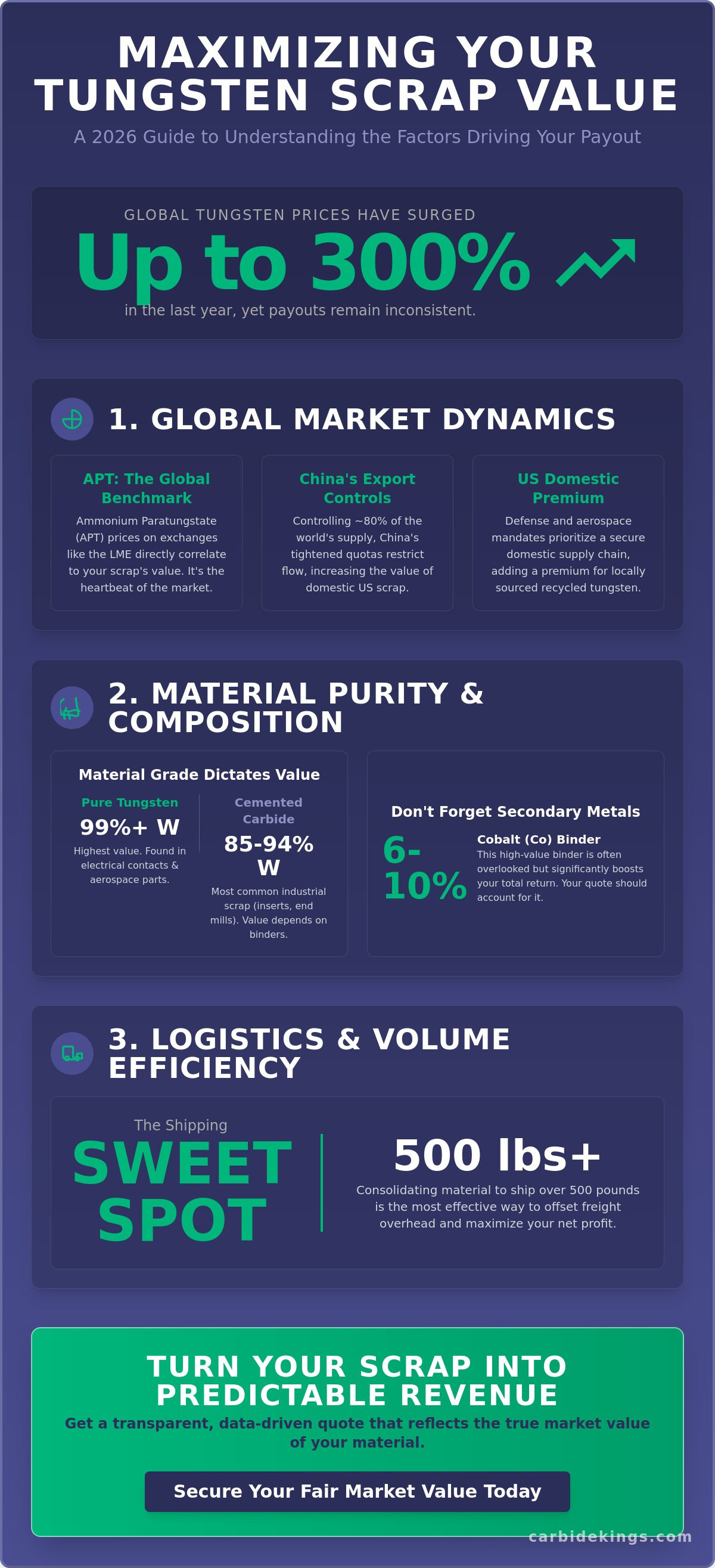
Ammonium Paratungstate, or APT, is the heartbeat of the tungsten market. If you want to understand your payout, you have to start here. APT serves as the global pricing benchmark for the entire industry. When APT prices climb on the London Metal Exchange (LME), your scrap value follows. It's a direct correlation that dictates the baseline for every transaction. Understanding these global market dynamics is one of the most critical factors affecting tungsten scrap prices today. Every quote you receive is essentially a reflection of this international trade data filtered through local demand.
Tungsten isn't just another metal; it's a critical mineral essential for modern infrastructure. Its extreme density and heat resistance make it indispensable for everything from heavy machinery to high-tech electronics. You can explore more about Tungsten properties and applications to see why its demand remains so high across the globe. Because it's difficult to mine and process, recycled material has become a vital lifeline for manufacturers who cannot afford production delays. This scarcity drives a competitive market where high-grade scrap is always in demand.
The Influence of Chinese Production Quotas
China currently controls approximately 80% of the world's tungsten supply. This dominance means that their internal policy changes ripple through the US market instantly. In 2026, China has tightened export quotas and enforced stricter environmental regulations on its mining operations. These moves have restricted the flow of raw ore and APT into the global market. When overseas supply drops, the value of your domestic tungsten hard scrap and alloys rises. You're holding a resource that is increasingly hard to source from traditional mining. This makes your secondary material more lucrative than ever as buyers scramble to fill the supply gap.
Domestic Supply Chain Security in 2026
The US manufacturing sector has shifted its focus toward supply chain resilience. This "circular economy" approach prioritizes the recovery and reuse of materials already within our borders. Aerospace and defense contractors are leading this charge. These industries face strict mandates to reduce reliance on foreign entities for critical minerals. Because of this, there is a distinct price premium for domestically processed tungsten. Your shop's scrap isn't just waste; it's a strategic asset that supports national security and industrial independence. By recycling your tungsten soft scrap and hard inserts, you're feeding a high-priority domestic loop. This system values speed and reliability over unstable international shipments, ensuring your material moves fast and pays well.
Chemical Composition and Material Purity
Your payout depends on what's inside the metal. While many dealers look only at weight, the chemical makeup is what truly determines the market value. The percentage of tungsten content is one of the most direct factors affecting tungsten scrap prices. Higher purity means less processing for the refiner, which translates to more money in your pocket. However, savvy professionals know that the tungsten isn't the only valuable component in the mix. Your quote should reflect the entire metallurgical profile of your material.
Standard cemented carbide typically contains 6% to 10% cobalt. Many scrap yards overlook this binder, but cobalt remains a high-value industrial metal in its own right. When you sell tungsten alloys, ensuring your buyer accounts for the cobalt content can significantly boost your total ROI. Specialty additives like tantalum and titanium are also common in high-performance tools. These elements change how the material is refined; sometimes they add value, and other times they require more complex separation processes. Knowing exactly what you have is the first step toward a fair transaction.
Cemented Carbide vs. Pure Tungsten
Pure tungsten sits at the top of the pricing ladder. It is often found in electrical contacts or specialized aerospace parts and boasts purity levels of 99% or higher. Most industrial shops, however, deal in cemented carbide. This material is a composite of tungsten carbide grains and a metallic binder. Understanding the grade of your CNC inserts or end mills is essential for an accurate quote. The USGS Mineral Commodity Summary highlights how global demand for these specific grades remains robust due to limited primary production. Identifying your high-value refractory alloys before selling ensures you don't leave money on the table.
The Role of Trace Elements
Not all binders are equal. While cobalt is the industry standard, some alloys use nickel binders to improve corrosion resistance. Nickel is generally less valuable than cobalt and can change the recyclability of the lot. You also need to watch for "poison" elements that complicate the refining process and lead to price deductions. Common contaminants include:
- Steel shanks or casings
- Brazing material and silver solder
- Ceramic or plastic attachments
Taking the time to sort your material can lead to a 15-20% higher payout compared to selling mixed loads. If you're unsure about your material's grade, you can get a professional evaluation to maximize your return. Sorting is the simplest way to turn a standard load into a premium transaction. It removes the guesswork and guarantees that you're paid for the actual quality of your scrap.
Physical Form: Hard Scrap vs. Soft Scrap
The physical state of your material is one of the most practical factors affecting tungsten scrap prices. Refiners prioritize ease of processing. Solid pieces, known as hard scrap, move through the recycling loop with minimal resistance. In contrast, soft scrap like grinding sludge or powders requires intensive chemical reclamation. This difference in labor and energy consumption creates a price gap between the two categories. If you want the highest return, you must understand how your material's form dictates the buyer's bottom line.
Solid carbide is significantly cheaper to refine than sludge. Hard scrap can often be processed through the zinc process, which recovers the carbide grains directly. Soft scrap usually undergoes a full chemical conversion back into APT. This longer, more expensive route is why powders and swarf fetch lower per-pound rates. Geopolitical shifts in 2026 have made domestic processing capacity even more valuable. You can read this Fastmarkets tungsten market analysis to see how trade tensions are currently influencing these processing trends. When supply chains tighten, the efficiency of your scrap's physical form becomes a major leverage point during negotiations.
Maximizing Value for Carbide Inserts
Indexable inserts are the gold standard for scrap buyers. They are dense, uniform, and easy to grade. To get the best price, you must remove all "attachments" before shipping. Steel shanks, screws, and braze material are considered contaminants that force the buyer to perform extra manual labor. Coated inserts, whether they use CVD or PVD treatments, are generally accepted at the same rate as uncoated ones, provided the underlying carbide is high-grade. Separating your solid end mills and drills from mixed steel bins is the fastest way to protect your margins.
Managing Grinding Sludge and Powders
Soft scrap presents unique challenges that can lead to heavy price penalties if not managed correctly. Grinding swarf often contains high levels of moisture, oil, and coolant. Buyers will deduct weight for this "tramp" liquid, so it's vital to decant or dry your sludge before weighing. Assay testing is the only way to determine the true value of soft scrap. This process identifies the exact tungsten units present in the sludge. You should also store your powders in sealed, airtight containers. Exposure to air can cause oxidation, which complicates the chemical recovery process and reduces your final payout. Handling your soft scrap with the same care as your hard inserts ensures you don't lose value to simple environmental factors.
Logistics, Volume, and Freight Efficiency
Shipping isn't just a chore; it's a math problem. If you don't account for freight, you aren't seeing your true profit. High logistics costs are among the most overlooked factors affecting tungsten scrap prices. Every dollar spent on a carrier is a dollar removed from your payout. Professional sellers focus on density and volume to minimize this overhead. By streamlining your shipping process, you ensure the majority of the market value stays in your bank account instead of the logistics provider's pocket.
Aim for the 500 pound threshold. This is the "sweet spot" for national freight. Below this weight, you're often paying a flat minimum fee that makes the per-pound cost prohibitively high. Once you cross 500 pounds, you qualify for better LTL (Less Than Truckload) rates. This volume allows you to offset current fuel surcharges that continue to fluctuate in the 2026 energy market. Professional logistics support handles the carrier scheduling and paperwork for you. This removes the administrative burden and ensures your material moves from your dock to the refinery without friction.
Consolidation Strategies for Small Shops
Small shops often make the mistake of selling too frequently. Instead of monthly sales, move to a quarterly cycle to build weight. Set up a dedicated carbide bin specifically for your tungsten hard scrap and alloys. Use heavy-duty, 5-gallon pails to collect material as it's generated. These pails are easy to stack on a pallet once they're full. Secure your pallet with heavy-duty banding and stretch wrap to prevent transit loss. A single, well-packed pallet is much safer and cheaper to ship than several loose boxes sent through standard parcel services.
National vs. Local Buyer Advantages
Local scrap yards are great for residential aluminum or copper, but they aren't experts in refractory metals. They often underpay for tungsten because they don't have the direct refinery connections to move it. They act as middlemen, taking a cut of your profit. Specialized national buyers focus exclusively on tungsten soft scrap and hard carbide. This specialization allows for 24-hour material grading and verification. You get a quote based on real-time market data rather than a generic metal price. It's a faster, more transparent way to handle your industrial assets.
Don't let shipping costs eat your margins. Request a quote from Carbide Kings and let our logistics experts handle the heavy lifting for your next shipment.
The Carbide Kings Advantage: Transparency and Speed
Understanding the global and material-specific factors affecting tungsten scrap prices is only half the battle. To truly maximize your ROI, you need a partner who executes with speed and total transparency. We don't rely on outdated price sheets or vague estimates. Our quotes are built on real-time 2026 market data to ensure you receive the most accurate value for your tungsten hard scrap, soft scrap, and alloys. By eliminating the guesswork, we provide the certainty industrial professionals need to manage their overhead effectively.
Speed is a core component of our service model. We offer a 24-hour processing guarantee once your material arrives at our facility. While competitors might take weeks to verify and pay, we move your inventory through grading and analysis in a single business day. Your cash shouldn't be tied up in a warehouse. We offer flexible payment options including wire transfers, traditional checks, and instant credits to suit your business's cash flow requirements. This direct approach turns a complex logistical hurdle into a simple, lucrative transaction.
Our team understands that your time is valuable. We provide national logistics assistance to simplify your shipping workflow from start to finish. We handle the carrier scheduling and documentation so you can stay focused on your core operations. This proactive support removes the traditional barriers to recycling, making it easier than ever to clear out your warehouse and boost your bottom line.
A Streamlined Process for Industrial Sellers
Our workflow is designed to be as hands-off for the client as possible. The journey begins with a direct quote based on your material type and estimated volume. Once you're ready to move, we coordinate the pickup and transit. When the material hits our floor, we use advanced analysis tools to grade complex alloy shipments. This ensures that even specialty tools with trace elements are valued correctly. We prioritize transparency in weighing, providing detailed reports that show exactly how your payout was calculated. This no-nonsense method is why we've built long-term partnerships with shops across the country.
Ready to Turn Your Scrap into Revenue?
Recycling your material isn't just about the immediate payout; it's about industrial sustainability. Choosing a specialized recycler reduces the environmental impact of mining and supports a more resilient domestic supply chain. We invite you to leverage our high value carbide scrap expertise to see the difference a professional partner makes. Don't let your valuable inserts sit in a bin collecting dust. Request a quote today and experience a faster, more transparent way to handle your tungsten recycling. The process is straightforward, the rates are competitive, and the work is as good as done.
Maximize Your Industrial ROI in 2026
Mastering the diverse factors affecting tungsten scrap prices turns your warehouse waste into a strategic financial asset. You now understand how global APT benchmarks and material purity dictate your bottom line. By prioritizing high-grade hard scrap and consolidating your loads to optimize freight efficiency, you protect your margins against market volatility. The transition from industrial byproduct to liquid capital should be seamless and transparent.
We're here to remove the traditional barriers to recycling. Our team provides nationwide shipping logistics support and expert material grading to ensure you receive a fair, market-accurate payout. With our 24-hour processing guarantee, you don't have to wait weeks for your funds. We handle the analysis and the heavy lifting so you can stay focused on your core production goals. It's time to stop settling for inconsistent local quotes and start working with a partner who values your time and your material.
Ready to see the difference professional efficiency makes? Get a Real-Time Carbide Scrap Quote Today and secure the return your high-grade tungsten deserves. Your next successful transaction is just one step away.
Frequently Asked Questions
How is the scrap tungsten price per pound calculated?
Your per-pound price is calculated by applying the current global APT benchmark to the actual tungsten units found in your material. Refiners subtract the cost of chemical processing and transportation to arrive at a net offer for your lot. This calculation ensures that your quote reflects real-time market fluctuations and the specific purity of your tungsten hard scrap or alloys.
Does the presence of steel attachments lower my carbide price?
Steel shanks, screws, and casings act as contaminants that lower your final payout. These attachments increase the manual labor required for processing and add non-tungsten weight to the shipment. Removing these items before shipping is one of the most effective ways to influence the factors affecting tungsten scrap prices in your favor.
Is there a minimum weight requirement to sell tungsten scrap?
We generally recommend a minimum of 50 pounds for small parcel shipments to ensure the shipping costs don't outweigh the material value. For larger industrial lots, reaching the 500 pound mark is the ideal goal for freight efficiency. This volume allows you to access better LTL rates and maximize the net revenue from your hard scrap or alloys.
Why are carbide prices so much higher than steel or aluminum scrap?
Tungsten is a critical mineral with extreme density and heat resistance, making it much rarer and harder to source than common metals. Unlike steel or aluminum, tungsten carbide is difficult to mine and refine, which creates a high baseline value. The limited global supply and specialized refining process ensure that tungsten remains one of the most valuable industrial materials to recycle in 2026.
How often do tungsten scrap prices fluctuate?
Market values change every business day as global trade data and APT benchmarks are updated on international exchanges. While minor daily shifts are common, significant price movements often follow major geopolitical announcements or changes in export quotas from primary producers. We use real-time market data to ensure your quote is accurate at the moment of your transaction.
What is the most valuable type of tungsten scrap to sell?
Pure tungsten scrap, often found in electrical contacts or aerospace components, commands the highest price tier because it requires the least amount of refining. Clean, indexable carbide inserts are the next most valuable form because they are easy to grade and process. Keeping these materials separate from tungsten soft scrap, such as grinding sludge, protects their premium market value.
How do I know if my scrap is actually tungsten carbide?
Tungsten carbide is nearly twice as heavy as steel and is generally non-magnetic unless it contains a high nickel or cobalt binder. You can also perform a spark test; carbide produces short, orange sparks compared to the long, white sparks of high-speed steel. If you're still unsure, our team uses professional analysis tools to verify the chemical composition of your material upon arrival.
How long does it take to receive payment after shipping my scrap?
You will receive your final verification and payment processing within 24 hours of your shipment's arrival at our facility. We prioritize speed to ensure your cash flow remains uninterrupted and your transaction is completed without delay. Once the material is graded, you can choose from several flexible payment options, including wire transfers or checks, to finalize the deal.


