

Tungsten recovery is shaped before the melt is poured. In vacuum induction melting, electromagnetic induction heats and melts metal in a controlled vacuum. Optimizing tungsten recovery yield in vacuum induction melting furnaces means managing the entire process, not relying on furnace heat alone.
Control matters because alloy behavior, the heating profile, and pouring can all affect how much tungsten reaches the intended product. Induction melting can process alloys containing elements with different boiling points, making melt control especially important when the charge combines materials with different properties.
This article explains how vacuum induction melting works and where recovery can be affected. You’ll learn how heating and alloy behavior influence the melt, why pouring, slag filtering, and residual metal matter, and which process decisions can help reduce tungsten losses. The practical focus is tracing where tungsten can go during melting and refining, then understanding how each stage affects final recovery.
Key Takeaways
- Trace where tungsten moves during melting and pouring to identify process stages that can affect recovery.
- Consider how differences in alloy elements’ boiling points influence melt control and the final composition.
- Use a consistent mass-balance approach to calculate recovery and make results easier to compare between melts.
- Understand how tungsten hard scrap, soft scrap, carbide scrap, and tungsten alloys fit into industrial material needs.
Electromagnetic induction heating
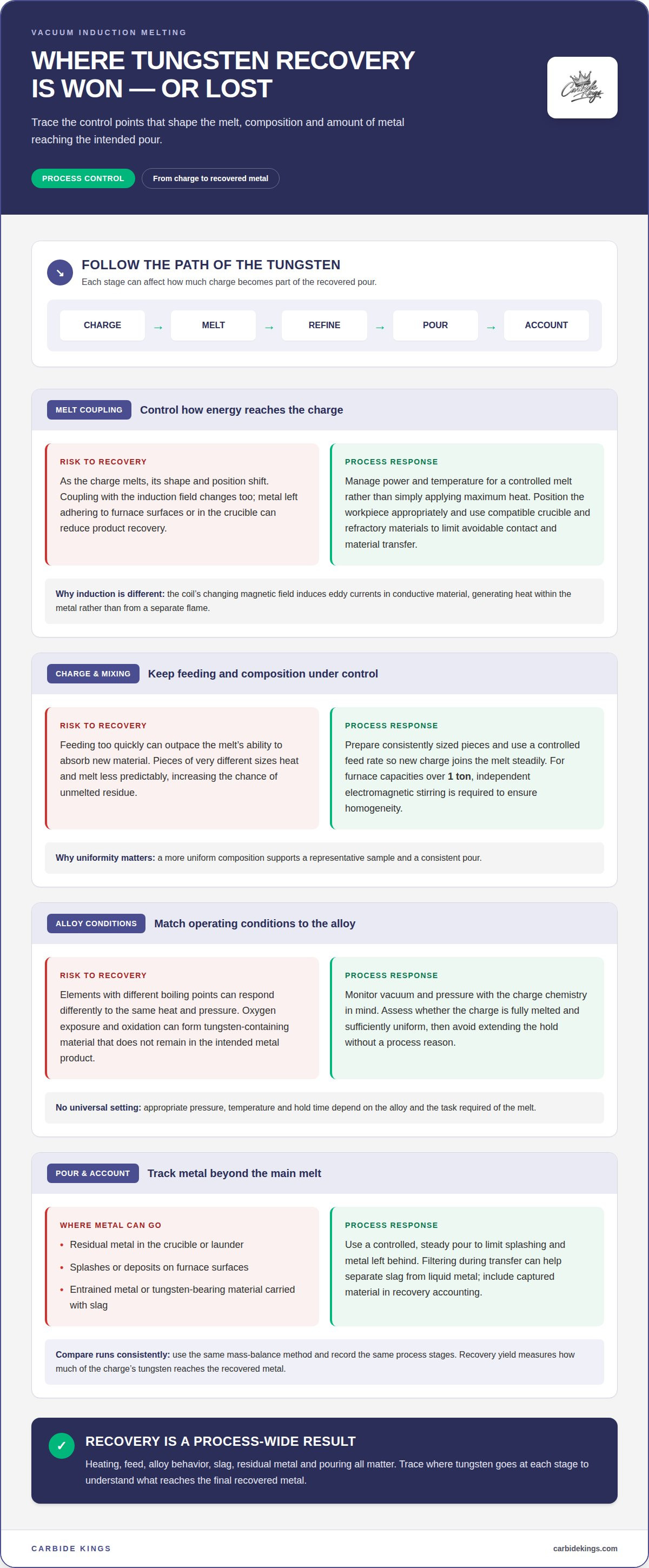
Vacuum induction melting uses electromagnetic induction to heat and melt metal in a vacuum-controlled environment. For tungsten-bearing charges, recovery depends on how heating, charge movement, and contact with furnace materials affect the melt.
An induction coil creates a changing magnetic field around the charge. The field induces electrical eddy currents in conductive material, generating heat within the metal. This heat melts the charge, while the vacuum environment supports melting and refining. Unlike direct flame heating, induction transfers energy through electromagnetic coupling between the coil and the charge.
Coupling changes as the charge melts and its shape and position shift. Furnace operators therefore manage power and temperature to support a controlled melt rather than simply applying maximum heat. For capacities over 1 ton, independent electromagnetic stirring is required to ensure homogeneity. More uniform composition helps make a representative sample and a consistent pour.
Crucible and Refractory Effects
Crucible and refractory materials contain the molten charge and form the surfaces it contacts during melting. Compatibility matters: reactions or material transfer can contaminate the melt, while metal adhering to the lining or remaining in the crucible can reduce product recovery. For tungsten, choosing compatible materials and limiting avoidable contact help protect composition and yield.
Feed Rate and Tungsten Recovery
Feed rate is the pace at which prepared charge enters the furnace, affecting how evenly new material joins the melt. Charge preparation and particle size matter too: consistently sized pieces heat and melt more predictably than a mixture of very different sizes. Feeding too quickly can outpace the melt’s ability to absorb new material, while a controlled feed supports steady melting and helps limit unmelted residue. These controls affect tungsten recovery by determining how much charge becomes part of the pour.
Electrical eddy currents induced within the workpiece heat the metal. Positioning the workpiece appropriately can help it couple with the induced currents. Unlike a separate heat source applied to the metal, induction generates energy within the workpiece through the induced currents.
Induction melting alloys with elements of diverse boiling points
Vacuum induction melting can process alloys whose elements respond differently to heat and pressure. Those differences matter because melt conditions can affect composition, tungsten losses, and final recovery.
Recovery Yields and Operating Costs
Recovery yield measures how much of the charge’s tungsten reaches the recovered metal, while operating costs reflect the resources needed to complete the melt. Neither has a single useful value across different furnace runs: charge composition, energy use, processing time, and metal retained in the furnace all influence the result.
In the United States, melting plans need to account for worker safety, emissions, and waste handling. Relevant controls depend on the furnace process, charge materials, and resulting waste streams. Comparing runs is most useful when each uses the same mass-balance method and records the same process stages.
Causes of Tungsten Losses
Tungsten is lost when metal fails to enter the recovered pour or process conditions change the charge’s composition. Residual metal, material caught in slag, and splashes or deposits on furnace surfaces can all reduce the recovered amount. These losses affect the yield calculation even when the melt appears complete.
Alloy composition also matters. Elements with different boiling points can respond differently under the same melt conditions. Oxidation can form tungsten-containing material that does not remain in the intended metal product. Charge chemistry, oxygen exposure, and slag separation therefore need to be considered together.
Vacuum Level and Melting Pressure
Vacuum level and melting pressure describe the atmosphere around the charge. They influence how volatile alloy elements behave, so pressure control can affect final composition as well as tungsten recovery. Depending on the charge chemistry, a pressure change may alter evaporation or gas removal.
The appropriate operating conditions depend on the alloy, not on a universal pressure target. If vacuum and pressure conditions encourage volatile elements to leave the melt, the remaining alloy composition can shift. Consistent monitoring helps operators relate such changes to charge composition and observed recovery.
Melting Temperature and Hold Time
Melting temperature determines whether the charge becomes a workable liquid, while hold time is how long it remains under the selected conditions. Together, they affect melting, refining, and potential losses. Excessive heat or an unnecessarily long hold can increase exposure to conditions that change alloy composition.
The right balance depends on the alloy’s melting behavior and the task required of the melt. Operators assess whether the charge is fully melted and sufficiently uniform, then avoid extending the hold without a process reason. This supports consistent recovery without assuming one temperature or duration suits every tungsten-bearing alloy.
Pouring, slag filtering, and residual metal
Pouring determines how much molten tungsten-bearing alloy reaches the intended product. A controlled, steady pour helps limit splashing and metal left behind in the crucible or launder. Furnace geometry also affects the transfer path. For example, a 500 kg-class furnace typically casts master alloy bars around 80mm in diameter rather than massive electrodes.
Slag can carry entrained metal or tungsten-bearing material away from the main melt. Filtering during transfer can help separate slag from liquid metal, but captured material still belongs in the recovery accounting. Treating it as waste without measuring its tungsten content can hide a recoverable portion of the charge.
To reduce evaporation, spatter, and residue losses, operators control melt temperature and hold time, avoid unnecessary disturbance, and pour smoothly into the intended casting setup. They also manage slag separation and account for metal remaining in the crucible, filter, or transfer path. These measures connect furnace operation to the material actually recovered.
Measure losses in slag, dust, condensate, and furnace residues through a mass balance. Weigh each collected stream, determine its tungsten concentration, and compare its tungsten mass with that in the charge and recovered product. Keeping streams separate helps identify whether slag, dust, condensate, or retained metal accounts for the difference.
Record the charge, product, and each residue stream for every melt. For example, if slag mass rises while product recovery falls, measuring its tungsten content helps distinguish entrainment from other losses. Use consistent sampling and weighing methods across runs so comparisons reflect process changes, not changes in accounting. Include filter material and furnace cleanout residues in the same record.
IoT sensors provide real-time visibility into the vacuum metallurgy process, helping operators detect and respond to deviations. That visibility complements attention to pouring, transfer, and residue accounting. Industries that use these processes include aerospace, energy, defense, powder metallurgy, medical, automotive, and nuclear.
Across these industries, process visibility complements careful weighing and sampling of the charge, product, and collected residue streams. Timely detection and consistent accounting help operators track material through melting and transfer, including what remains in slag, filters, and furnace residues.
How is tungsten recovery yield calculated in vacuum induction melting?
When optimizing tungsten recovery yield in vacuum induction melting furnaces, calculate recovery by comparing the tungsten in the recovered product with the tungsten in the furnace charge. Use the same mass basis and assay units for both sides of the calculation.
Product recovery (%) = tungsten mass in recovered product ÷ tungsten mass in charge × 100. First, multiply charge mass by its tungsten fraction. Then multiply recovered product mass by its tungsten fraction. Divide the product’s tungsten mass by the charge’s tungsten mass, then multiply by 100.
A charge containing several tungsten-bearing materials requires a weighted calculation. Find each material’s mass and tungsten fraction, calculate its tungsten contribution, then add the contributions. Don’t use an unweighted average of assay results: a small, high-grade portion shouldn’t count as much as a larger portion.
Keep product recovery distinct from the broader process balance. If slag, dust, condensate, filters, or furnace residues contain tungsten, measure and record their mass and tungsten content separately. These streams help explain the difference between input tungsten and product tungsten. Adding them to the product numerator would change the meaning of the yield, so report them separately.
Consistent weighing and sampling matter. Use representative samples for the charge and product, and apply the same assay basis across melts. Record the charge, recovered metal, and residue streams under one batch identifier. If an alloy addition changes product mass, calculate tungsten mass from the assay rather than treating total product mass as tungsten.
Consistent records support efforts to optimize tungsten recovery yield in vacuum induction melting furnaces. Compare like with like: runs with different feed composition or sampling practices may not provide meaningful yield comparisons. Track the calculation alongside process notes, including melt conditions and pouring observations, to connect recovery changes with operating differences.
Use this mass-balance method to assess tungsten-bearing feed for a VIM charge, and explore tungsten material options.
Carbide Kings
Carbide Kings supplies tungsten-bearing feedstock for VIM charges, including Tungsten Hard Scrap, Tungsten Soft Scrap, Carbide scrap, and Tungsten Alloys for industrial use. Choose categories that fit your alloy requirements and planned melt, then account for their tungsten content in your charge calculation. This connects sourcing to the same mass-balance approach used to assess recovery. For production teams reviewing feedstock options or planning future melts, Carbide Kings offers a focused source of industrial tungsten and carbide scrap. Contact Carbide Kings to discuss your material needs.
Plan the next tungsten melt
Use recovery findings to shape the next charge rather than changing several melt conditions at once. A consistent approach to optimizing tungsten recovery yield in vacuum induction melting furnaces helps your team assess how feedstock choices align with production needs. Connect material selection to your melt plan, then use the same recovery calculation to evaluate each run.
For industrial feedstock planning, Carbide Kings offers Tungsten Hard Scrap, Tungsten Soft Scrap, and Carbide scrap. These material categories can support a range of tungsten-bearing charge requirements. Consider how incoming material fits your intended alloy and process before planning a melt.
Ready to discuss feedstock for your operation? Talk with Carbide Kings about tungsten recovery. Take the next step with a clear charge plan and a focused material conversation.
Frequently Asked Questions
What is Vacuum Induction Melting?
Vacuum induction melting (VIM) melts and refines metals and alloys under controlled vacuum using electromagnetic induction. Beyond producing alloy melts, VIM can support scrap consolidation, metal powder production, and waste remediation. For tungsten-bearing materials, it provides a controlled way to process a charge, while alloy composition and melt conditions shape the result.


