
Did you know that the global tungsten market is projected to face a 17% annual supply-demand gap through 2026? With China authorizing only 15 companies for export this year, your industrial waste is now a high-stakes strategic asset. Most local scrap yards still offer opaque pricing and limited logistics support, leaving you to handle the heavy lifting for a lower return. Finding reliable hard scrap carbide buyers shouldn't feel like a gamble. It's time to stop settling for local markdowns and start treating your scrap as the valuable resource it is.
You deserve a transparent, streamlined selling process that puts market-leading payouts directly into your account. This guide shows you exactly how to identify your materials, value them correctly, and ship them safely to maximize your returns. We'll cover everything from distinguishing carbide from high-speed steel to using the U.S. Postal Service's Flat Rate boxes for cost-effective transport. Follow these steps to turn your logistical burdens into fast, verified payments via wire or check. The process is straightforward, and the results are immediate.
Key Takeaways
- Learn how to accurately identify high-value tungsten carbide using simple density and magnetism tests to ensure your materials are graded correctly.
- Discover why it's more lucrative to work with specialized hard scrap carbide buyers who bypass local yard markdowns to offer market-leading payouts.
- Master the logistics of heavy material transport with professional packaging tips that protect your shipment and minimize your freight expenses.
- Simplify your shop's operations by moving from complex inventory management to a streamlined, 24-hour verification and payment process.
- Understand how the current global tungsten supply gap transforms your industrial waste into a high-priority strategic asset for 2026.
Understanding Hard Scrap Carbide and Its Industrial Value
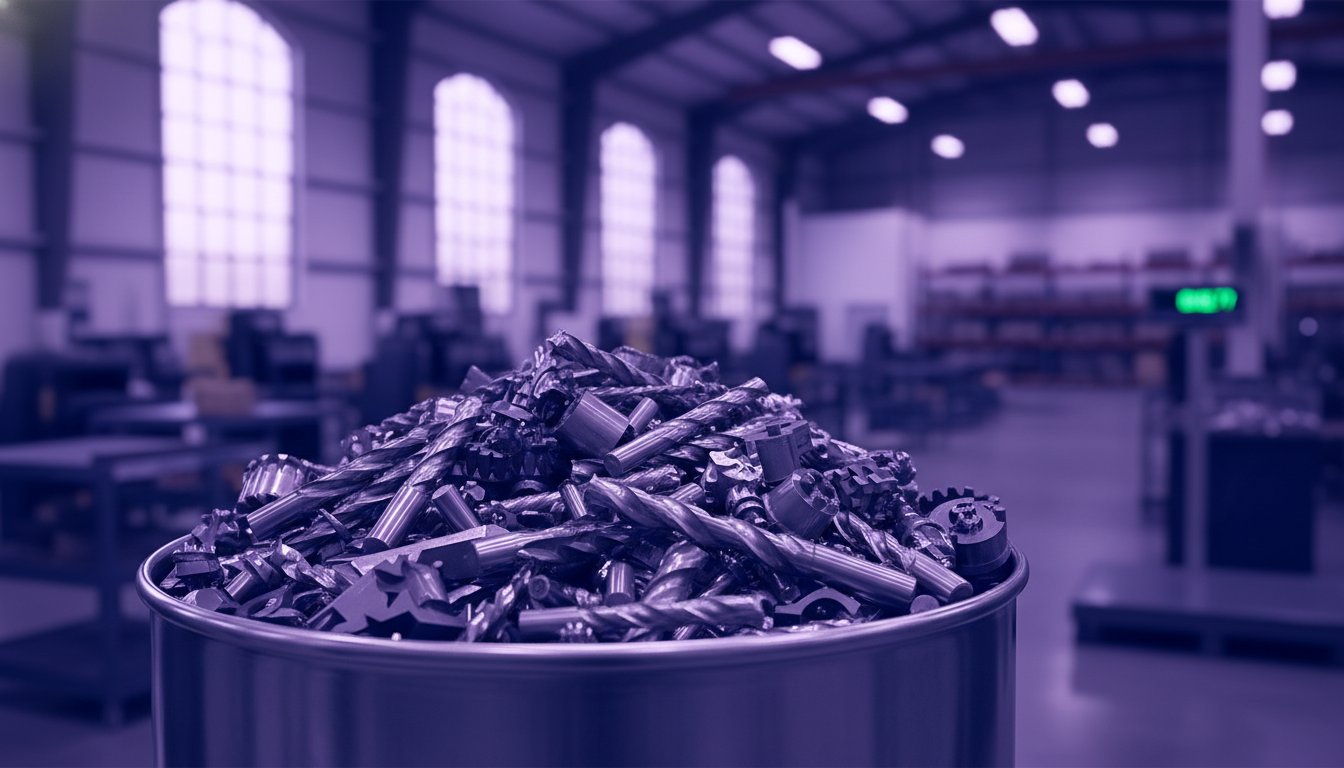
Tungsten carbide is a dense, inorganic chemical compound that defines the backbone of modern manufacturing. It combines equal parts tungsten and carbon atoms to create a material nearly as hard as diamond. In industrial settings, we use the term "hard scrap" to describe this material when it's in a solid, sintered state. This includes items like worn-out milling inserts, broken end mills, and retired drawing dies. It's a distinct category from soft scrap, such as grinding sludge or powders; it's highly sought after by professional hard scrap carbide buyers due to its high purity and ease of processing.
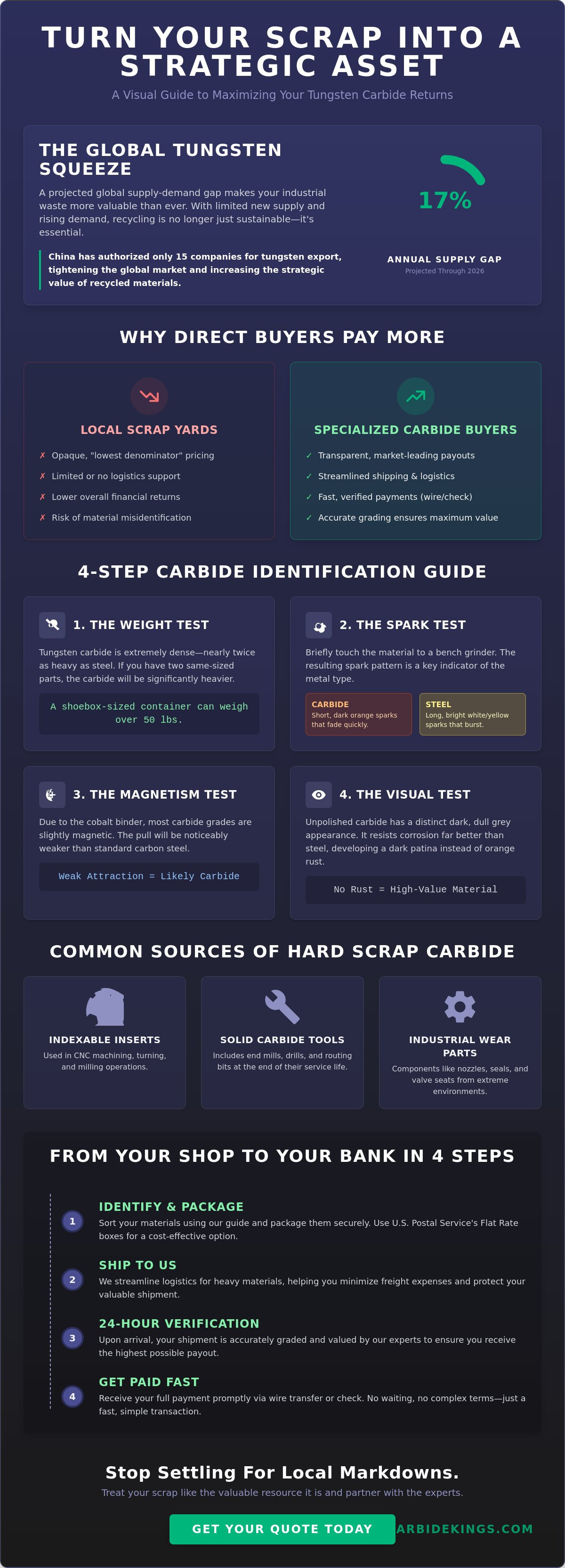
Cobalt plays a critical role here. It's the metallic binder that holds the brittle carbide particles together. Think of it as the industrial glue that provides necessary toughness. Without cobalt, your cutting tools would shatter under the first sign of pressure. In 2026, the global market has reached a turning point. With a projected 17% annual supply-demand gap, the industry can't rely solely on new mining. Initiatives like "Project Vault" in the U.S. highlight how critical these materials have become. Reclaiming tungsten from existing tools is now more efficient and reliable than extracting primary ore from volatile international markets.
Common Sources of Hard Scrap Carbide
Your shop likely generates high-value scrap every day without realizing the full extent of its worth. Identify these common items to maximize your recycling returns:
- Indexable Inserts: Used in CNC machining, turning, and milling operations.
- Solid Carbide Tools: This includes end mills, drills, and routing bits that have reached the end of their service life.
- Industrial Wear Parts: Components like nozzles, seals, and valve seats designed for extreme environments.
The Environmental Impact of Tungsten Recovery
Recycling isn't just about the payout; it's about industrial resilience. Recovering tungsten from hard scrap requires significantly less energy than traditional mining and refining processes. This creates a closed-loop system for metal procurement that reduces your company's overall industrial footprint. Many organizations now use these recycling programs to meet strict corporate sustainability and ESG goals. By selling to reputable hard scrap carbide buyers, you're directly contributing to a more stable and environmentally responsible supply chain. It's a rare scenario where the most profitable choice is also the most sustainable one. The work is clean, the process is efficient, and the environmental benefits are measurable.
How to Identify and Grade High-Value Tungsten Carbide Scrap
Identifying carbide isn't a guessing game. It's a technical process that ensures you get paid every cent you're owed. Most local yards won't tell you if your bin is mixed. They'll just pay you the lowest common denominator price. To avoid this, you need to think like professional International Tungsten Industry Association members who value material purity above all else. Accurate grading is the only way to secure the top-tier rates offered by specialized hard scrap carbide buyers.
Start with the spark test. Touch the material to a bench grinder for a split second. If you see short, dark orange sparks that don't travel far, you're likely holding tungsten carbide. Steel produces long, white or yellow sparks that burst like fireworks. Check the magnetism next. Most carbide grades use cobalt as a binder, which makes them slightly magnetic. However, the pull is much weaker than standard carbon steel. Visually, unpolished carbide is a dull, dark grey. It doesn't rust like steel; it simply develops a darker patina over time. These simple checks prevent high-value material from being tossed into the iron bin.
Density and Weight Comparison
Carbide's density is its most defining trait. It's nearly twice as heavy as standard tool steel. To put this in perspective, a small box the size of a shoebox filled with carbide can easily weigh over 50 pounds. Don't overexert yourself during the sorting process. You can use a simple digital kitchen scale for preliminary grading. If you have two tools of the same size and one feels significantly heavier, that's your carbide. Professional hard scrap carbide buyers rely on this density to verify material before the payment process even begins.
Distinguishing Carbide from High-Speed Steel (HSS)
High-Speed Steel (HSS) is the most common material mistaken for carbide. While HSS is a quality tool material, its market value is significantly lower. Mixing them ruins the value of your entire lot. Look closely at the tool shanks before tossing them into your scrap bucket. Manufacturers often laser-etch "HSS" or "Cobalt" directly onto the metal. If you see these markings, set the tool aside. Keeping your bins pure ensures you receive the highest possible rate per pound. If you're unsure about a specific batch, you can always consult with a specialist to verify your material before you pack it for shipping.
The Economics of Carbide: Why Direct Buyers Offer Better Rates
Selling your industrial scrap to a local yard is often the fastest way to lose money. Most local recyclers are generalists. They process aluminum cans and copper pipes, but they lack the specialized XRF analysis equipment needed to identify the precise cobalt-to-tungsten ratio in your tooling. Because they can't verify the material's purity on-site, they protect their margins by grading your carbide as generic "heavy melt." This classification significantly devalues your material. Specialized hard scrap carbide buyers eliminate this middleman penalty by connecting your shop directly to the refinery level.
Direct buyers understand the intrinsic value of tungsten as a strategic mineral. They don't just see a bin of old inserts; they see a critical resource required for high-tech manufacturing. By working with a specialist, you benefit from a pricing structure based on real-time market data rather than local scrap averages. Volume also plays a major role in your final payout. While we accept smaller lots, bulk shipments allow for logistical efficiencies that command premium per-pound rates. It's a simple matter of overhead. Processing one large, well-sorted pallet is more cost-effective than handling dozens of small, mixed boxes, and those savings are passed directly to you.
The Problem with Local Scrap Yards
General recyclers often lack the infrastructure to handle carbide correctly. Without advanced testing tools, they can't distinguish between high-value tungsten and lower-grade alloys. This leads to the "mixed metal" penalty, where your entire lot is priced at the value of the least expensive metal in the bin. National hard scrap carbide buyers maintain lower overhead by specializing in specific alloys, allowing them to offer higher payouts while providing a more transparent, professional experience for industrial clients.
2026 Market Trends for Tungsten and Cobalt
The global landscape for tungsten has shifted dramatically this year. For the 2026-2027 period, China has authorized only 15 companies to export tungsten, significantly tightening international supply channels. At the same time, the U.S. has launched "Project Vault," a $12 billion program designed to stockpile critical materials. These geopolitical factors, combined with a projected 17% annual global supply-demand gap through 2028, have made domestic recycling a strategic necessity. Your scrap isn't just waste; it's a vital component of supply chain resilience. As the global market reached an estimated $7.6 billion in early 2026, the value of reclaimed carbide remains high, making this an ideal time to clear out your inventory and secure a lucrative return.
Streamlining Logistics for High-Volume Carbide Shipments
Shipping heavy metal requires more than a standard cardboard box. Tungsten carbide's extreme density means a small volume carries immense weight. To ensure your shipment reaches hard scrap carbide buyers safely, you must use double-walled boxes and reinforced filament tape. Never skimp on the packaging materials. A single box failure during transit can lead to lost material and delayed payouts. Focus on structural integrity from the moment the scrap leaves your CNC machine.
Weight distribution is your primary safety concern. Keep individual boxes between 40 and 50 pounds. This is the "sweet spot" for manual handling; it protects both the shipping carrier's employees and the box itself from structural failure. If you're managing an industrial facility with thousands of pounds of scrap, transition to bulk handling. Use heavy-duty plastic buckets or steel barrels. Secure these containers to a pallet using steel strapping to prevent shifting. This professional approach allows freight carriers to move your material efficiently using standard forklifts, ensuring a smooth handoff from your dock to our facility.
Small Parcel vs. Freight Logistics
Your total weight determines your shipping strategy. For loads under 200 pounds, utilizing multiple USPS Flat Rate boxes is often the most cost-effective method. It's simple, predictable, and fast. However, once your inventory exceeds 200 pounds, LTL (Less Than Truckload) freight becomes the superior choice. This method reduces the risk of individual box loss and often lowers your total shipping cost per pound. We make this process effortless by assisting with carrier scheduling and providing pre-filled shipping labels. To get started, contact us for a freight shipping quote tailored to your specific volume.
Internal Collection Strategies for Machine Shops
Efficiency starts on the shop floor. Don't wait until you have a mountain of scrap to start sorting. Set up dedicated, color-coded carbide bins at every CNC station to capture inserts and end mills immediately. This proactive approach prevents contamination from steel, aluminum, or floor sweepings. Contamination is the fastest way to lower your payout. Label every bin clearly with "Carbide Only" and ensure your team understands the difference between carbide and HSS tools. A clean, well-organized collection system ensures that when you're ready to ship, the material is already graded and ready for rapid processing. This discipline turns your waste stream into a predictable revenue source with minimal administrative effort.
Partnering with Carbide Kings for Professional Metal Procurement
The final step in your recycling workflow should be the most rewarding. Once your material is packed and shipped, you need a partner that values speed as much as accuracy. We've eliminated the traditional administrative hurdles that slow down industrial transactions. When you choose Carbide Kings, you're working with elite hard scrap carbide buyers who prioritize your bottom line through a transparent, high-velocity process. We don't just buy your scrap; we provide a professional procurement service designed for the modern industrial sector.
Our 24-hour processing promise is the foundation of our reliability. From the moment your shipment arrives at our facility, our team begins the verification process. We move quickly from receipt to verified weight, ensuring you aren't left wondering about the status of your material. Transparency is non-negotiable. We offer multiple fast payment options to suit your accounting needs, including wire transfers, ACH payments, and overnight checks. Whether you're a single-machine shop or a multi-state manufacturing corporation, you receive the same direct, authoritative service and market-leading rates.
The Carbide Kings Advantage
Our expertise extends across the entire spectrum of tungsten recycling. We maintain deep specialization in tungsten alloys, soft scrap, and hard solids, allowing us to grade complex materials that general recyclers simply can't handle. By maintaining direct-to-refinery pipelines, we eliminate middleman fees and pass those savings directly to you. We buy from every state in the country, providing consistent pricing regardless of your location. This nationwide reach makes us the preferred hard scrap carbide buyers for companies looking to consolidate their scrap management into one reliable point of contact. We handle the heavy lifting so you can stay focused on your core operations.
Get Your Quote and Start Recycling Today
Starting the process is straightforward and requires zero guesswork. To receive a current price, contact our procurement team with a few basic details about your inventory. Have your estimated weight and material type ready. This allows us to provide a fast, accurate quote that reflects the latest 2026 market data. We've refined our "No Hassle" quote process to be as efficient as a standard retail transaction. Don't let valuable tungsten sit on your shop floor and collect dust. Turn your industrial waste into a strategic liquid asset today. Get a fast quote from Carbide Kings now and experience a more professional way to recycle.
Turn Your Industrial Waste Into Capital
The global tungsten market is shifting rapidly. Your used inserts and end mills are no longer just waste; they're high-value assets in a tightening supply chain. By moving away from local generalists and partnering with specialized hard scrap carbide buyers, you secure the transparent pricing your business deserves. You've learned how to identify your materials and streamline your shop's collection process to ensure every shipment is pure and profitable.
Carbide Kings is ready to handle the heavy lifting for you. We provide nationwide logistics support and competitive industrial-grade pricing that reflects the true value of your scrap. Our 24-hour processing ensures you receive payment quickly upon receipt via wire, ACH, or check. There's no reason to let valuable material sit idle on your shop floor when a streamlined payout is just one step away. Take control of your scrap management and boost your facility's revenue today.
Get a Fast Quote for Your Carbide Scrap
Start your next shipment now and experience the satisfaction of a fair, fast transaction with a partner you can trust.
Frequently Asked Questions
What is the current scrap price for tungsten carbide per pound?
Prices for tungsten carbide fluctuate daily based on global market demand and the specific cobalt content of your material. While benchmarks in May 2026 have shown significant volatility, the most accurate way to value your inventory is to request a real-time quote based on your material's weight and grade. Avoid relying on outdated online charts. Instead, speak directly with professional hard scrap carbide buyers to lock in a rate that reflects current refinery values.
Can I sell carbide inserts that are chipped or broken?
Yes, you can sell chipped, broken, or heavily worn carbide inserts for their full recycling value. The recovery process focuses on the chemical composition of the tungsten and cobalt rather than the physical integrity of the tool. As long as the material is genuine tungsten carbide, its condition doesn't impact its eligibility for recycling. Simply collect these fragments in your dedicated bins alongside your intact retired tools to maximize your total shipment weight.
How do I tell the difference between carbide and steel scrap?
Use the density test to quickly separate these materials in your shop. Tungsten carbide is nearly twice as heavy as standard tool steel; a small box of carbide will feel much heavier than a similar box of steel. You can also perform a spark test on a grinder. Carbide produces short, dark orange sparks, while steel creates long, bright yellow bursts. These simple physical checks ensure your high-value carbide isn't accidentally sold at lower steel prices.
Is there a minimum weight requirement for shipping carbide scrap?
We don't enforce a strict minimum weight, but shipping small amounts is only lucrative if you manage freight costs effectively. For loads under 50 pounds, the U.S. Postal Service's Flat Rate Box is the most efficient and predictable option. If you have a very small quantity, it's often better to wait until you've filled a bucket to maximize your payout relative to the shipping expense. Most industrial clients find that shipping in 50-pound increments offers the best return.
How long does it take to get paid after I ship my material?
You'll receive payment within 24 hours of our facility verifying your shipment's weight and material grade. We understand that cash flow is critical for machine shops and industrial facilities. Once the verification is complete, we issue funds immediately via your preferred method, such as wire transfer, ACH, or an overnight check. This streamlined process eliminates the long waiting periods common with traditional scrap dealers and ensures your capital is back in your hands quickly.
Do you provide shipping labels or freight support for bulk loads?
Yes, we provide comprehensive logistics support, including pre-paid labels and freight scheduling for bulk loads. For shipments exceeding 200 pounds, our team can arrange LTL (Less Than Truckload) freight to pick up directly from your dock. We handle the paperwork and carrier coordination so you can focus on your shop's operations. This proactive support removes the logistical hurdles often associated with moving heavy industrial materials across the country and ensures a professional handoff.
What forms of carbide do you buy besides hard scrap?
We buy tungsten soft scrap and tungsten alloys in addition to hard scrap solids. Soft scrap includes materials like grinding sludge, swarf, and powders generated during tool manufacturing or sharpening. We also process various tungsten-based alloys used in specialized industrial and aerospace applications. If your facility produces multiple types of tungsten waste, you can consolidate these into a single procurement process to simplify your recycling workflow and increase your total payout from a single partner.
Why shouldn’t I sell my carbide to a local scrap yard?
Local scrap yards typically lack the specialized XRF equipment needed to accurately analyze tungsten content. Because they are generalists, they often grade carbide as low-value "heavy melt" steel to protect their own margins. Selling to specialized hard scrap carbide buyers ensures you receive a price based on the actual tungsten market value. This direct-to-refinery approach bypasses middleman markdowns and provides the transparency required for professional industrial recycling and accurate corporate financial reporting.


