
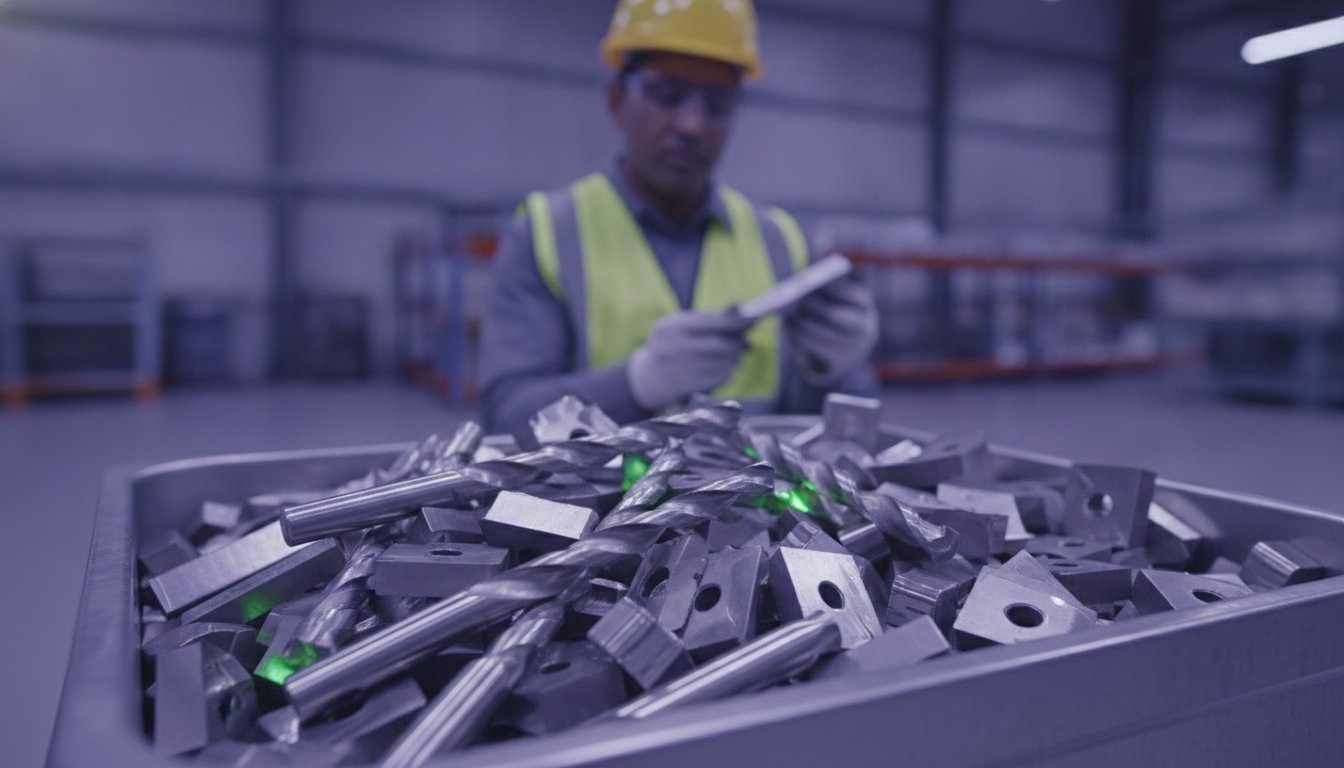
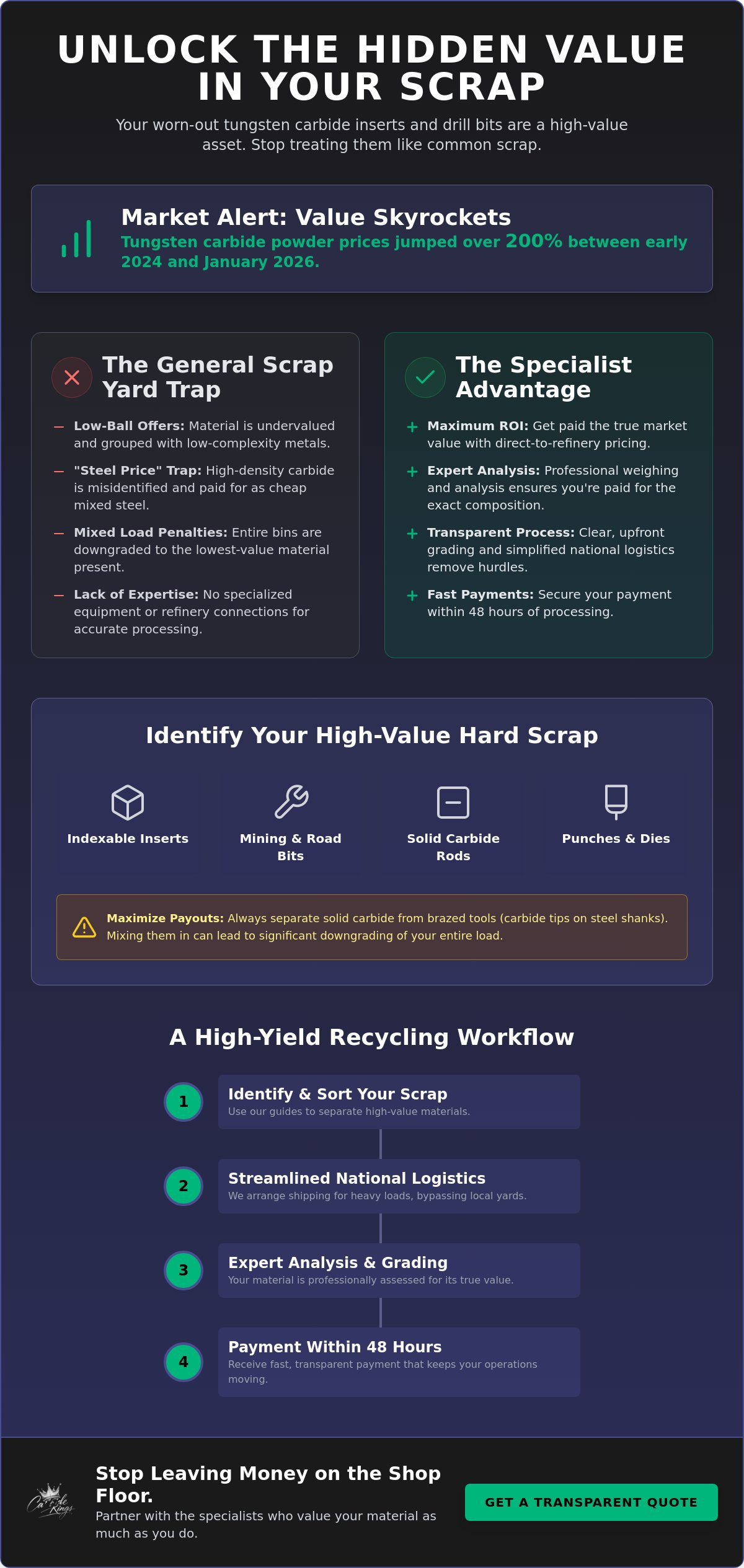
If you're treating your worn-out inserts and drill bits like standard scrap metal, you're leaving significant revenue on the table. Tungsten carbide powder prices jumped over 200 percent between early 2024 and January 2026, transforming your industrial waste into a high-value strategic asset. Finding where to recycle tungsten carbide shouldn't involve settling for generalist scrap yards that offer low-ball prices. You need a partner who understands the current market value of these specialized alloys and provides the streamlined logistics required for heavy industrial shipments.
You've likely dealt with the headache of complex shipping for heavy metals or the frustration of waiting weeks for a payment to arrive. It's a common bottleneck that drains your time and your ROI. This guide shows you how to eliminate those hurdles. Discover how to identify your most valuable scrap, simplify national logistics, and secure the fast, transparent payments that keep your operations moving forward. We'll outline a clear path to maximize your returns while removing the administrative burden of traditional recycling.
Key Takeaways
- Learn why general scrap yards often undervalue your material and why specialized refining is required for maximum returns.
- Master the identification of high-value hard scrap and soft alloys to ensure your inventory is graded with precision.
- Determine where to recycle tungsten carbide by evaluating national partners based on payment speed and transparent logistics.
- Discover professional sorting and cleaning techniques that simplify shipping while boosting your final payout per pound.
- Establish a high-yield recycling workflow that removes administrative hurdles and ensures your payments are processed within 48 hours.
Why General Scrap Yards Are the Wrong Choice for Tungsten Carbide Recycling
Most local scrap yards are designed to handle high-volume, low-complexity metals like aluminum, copper, and structural steel. They operate on thin margins and quick turnover, which works well for residential waste but fails the industrial professional. When you're searching for where to recycle tungsten carbide, a generalist yard is rarely the right answer. These facilities lack the specialized equipment and refinery connections needed to process high-value refractory metals accurately. They simply aren't equipped to give you the full market value for your specialized tooling.
Generalist buyers often lack the expertise to distinguish between different grades of industrial scrap. They see a heavy, gray metal and assume it belongs in a mixed-use bin. This lack of specialization leads to conservative offers that protect the yard's profit while sacrificing yours. A professional partner treats your scrap as a strategic commodity, not just another pile of junk. You've worked hard to optimize your shop's efficiency; don't let a local scrap dealer undo that progress with a low-ball offer.
The Specialist Advantage: Understanding Refining Value
Specialized buyers offer a significant financial advantage because they sell directly to refineries. By cutting out the local middleman, you keep more of the market value in your own pocket. These experts understand the complex metallurgy of What is Tungsten Carbide? and how different binders like cobalt or nickel impact the final price. Professional weighing and analysis ensure that you aren't just getting an estimate. You're getting paid for the exact composition of your material. It's a transparent process that rewards you for the quality of your scrap.
Avoiding the "Steel Price" Trap
Tungsten carbide possesses a density nearly double that of carbon steel, yet it's frequently misidentified and undervalued by generalist recyclers who don't know what they're looking at. This mistake is costly. The financial impact of misidentifying tungsten carbide vs steel scrap is staggering when you consider the price difference per pound. If you allow your carbide to be graded as "mixed steel," you're essentially giving away your highest-value assets for pennies on the dollar.
Mixed loads are a trap that always favors the buyer. A general recycler will look at a contaminated bin and quote the price for the lowest-value material inside. Specialized buyers provide national logistics that bypass these local market limitations. They make it easy to ship heavy loads directly to a facility that understands how to maximize your industrial ROI. Don't settle for the convenience of a local yard when a national specialist offers better transparency and significantly higher payouts. It's time to stop leaving money on the shop floor and start working with a partner who values your material as much as you do.
Identifying High-Value Materials: Hard Scrap vs. Soft Scrap
Maximizing your industrial ROI starts with accurate inventory identification. Tungsten carbide is a strategic composite material engineered for extreme durability and heat resistance. It's not a single metal but a blend of tungsten and carbon, typically held together by a metallic binder like cobalt or nickel. Because of this complexity, knowing exactly where to recycle tungsten carbide depends on the form your material takes. Most industrial waste falls into two distinct categories: hard scrap and soft scrap. Both are valuable, but they require different handling to secure the highest market payout.
Common Sources of Tungsten Hard Scrap
Hard scrap is the most common form of carbide found in machine shops and manufacturing facilities. These are solid, dense tools that have reached the end of their operational life. Identifying worn carbide end mills and drills is the first step toward recovery. Other high-value sources include:
- Indexable inserts used in turning and milling operations.
- Mining bits and road milling teeth used in heavy construction.
- Solid carbide rods and wear parts from high-friction machinery.
- Punch and die sets used in metal forming.
It's important to distinguish between solid carbide and brazed tools. Brazed tools feature a carbide tip joined to a steel shank. These require different handling because the steel must be separated during the refining process. Mixing solid carbide with brazed tools can lead to grading errors, so keep these streams separate to protect your margins.
Recovering Revenue from Tungsten Soft Scrap
Many industrial professionals overlook the significant value hidden in their secondary waste streams. What is tungsten soft scrap exactly? It is the fine particulate matter generated during the grinding, sharpening, and finishing of carbide tools. This material often takes the form of grinding sludge, swarf, or fine dust. If you're currently paying to dispose of grinding sludge as hazardous waste, you're losing money twice.
The valuation of soft scrap depends heavily on moisture content and purity. High concentrations of coolant or hydraulic oil can lower the price per pound, while clean, dry dust often commands a premium. Stop throwing away your grinding dust; instead, collect it in sealed drums to prevent environmental contamination and preserve its value. If you want to see how much your current waste stream is worth, you can request a material valuation to get a professional assessment of your inventory.
Whether you're dealing with solid inserts or barrels of grinding sludge, a specialized partner will provide the precise analysis needed for a fair transaction. Proper sorting at the source ensures that you're paid for the actual tungsten content rather than a guessed average. By treating your soft scrap with the same care as your solid tooling, you turn a disposal headache into a consistent revenue stream.
Evaluating National Carbide Buyers: A Comparison Framework
Choosing a recycling partner is a strategic business decision that directly impacts your bottom line. It's not just about finding the highest quote; it's about finding a buyer who can execute a professional transaction from start to finish. When you're evaluating where to recycle tungsten carbide, you need to look beyond the surface. A reliable partner will provide a transparent, documented carbide scrap recycling process that ensures every pound is accounted for. This level of detail protects you from the grading errors and "best guess" estimates common in the local scrap market.
National logistics support is another non-negotiable factor. While local yards often require you to handle the transport, a professional national buyer manages the heavy lifting. They should offer simplified shipping solutions for everything from small crates of inserts to massive shipments of grinding sludge and specialized alloys. Deciding where to recycle tungsten carbide effectively involves comparing these logistical capabilities against the limited reach of local dealers. This turnkey approach allows your team to stay focused on production while your scrap is converted into liquid capital.
Payment Security and Professional Terms
Industrial transactions require industrial-grade payment standards. While some small-scale buyers might offer Venmo or PayPal, these platforms aren't suitable for high-value commercial deals. They lack the security and record-keeping necessary for professional accounting. Instead, insist on wire transfers or business checks as the standard for tungsten scrap payment terms. These methods provide a clear paper trail and immediate access to funds.
Watch out for hidden fees that can erode your ROI. Some buyers quote a high initial price but then deduct "sorting fees" or "processing charges" after the material arrives. A professional partner offers flat-rate pricing based on verified market data. Speed is equally critical. You shouldn't have to wait weeks for your money. Professional buyers process shipments and issue payments within 24 to 48 hours of verification. This rapid turnaround keeps your cash flow healthy and predictable.
Scalability: From 50 lbs to 50,000 lbs
Your recycling partner should grow with your business. Whether you're a small machine shop with 50 pounds of worn end mills or a large-scale manufacturer producing 50,000 pounds of waste, the service level should remain consistent. Look for a buyer who treats every shipment with the same level of professional urgency. Scalability ensures that as your production increases, your recycling workflow remains a seamless part of your operations. A true partner acts as a long-term procurement ally, helping you turn waste management into a streamlined revenue center.
How to Maximize Your ROI: Sorting and Shipping Logistics
Preparation is the bridge between a standard scrap run and a high-yield industrial transaction. When deciding where to recycle tungsten carbide, the logistics of the move are just as important as the price per pound. Shipping heavy metals requires a specific strategy to prevent transit loss and ensure your material arrives exactly as it left your floor. By optimizing your sorting and packaging processes, you protect your inventory and reduce the likelihood of grading disputes. A little extra effort during the collection phase pays off significantly when the final check is cut.
Start by sorting your material by type. Keep solid inserts, end mills, and drills separate from grinding sludge or swarf. Mixing these streams complicates the weighing process and often leads to a lower average quote. Clean your scrap whenever possible. Removing excessive oil, coolant, or heavy debris can increase your price per pound because the refiner doesn't have to account for the weight of the contaminants. It's a simple step that ensures you're paid for metal, not moisture.
Effective Packaging for Heavy Metals
Tungsten carbide is incredibly dense. A small volume of material can easily exceed the weight limits of standard shipping containers, leading to catastrophic box failure during transit. Follow a professional How to package carbide scrap for shipping guide to avoid these risks. The "box-in-a-box" method is critical for any shipment over 40 lbs. Place your scrap in a small, sturdy box, then nest that box inside a larger one with plenty of padding to absorb impacts.
For sludge and small inserts, 5-gallon plastic buckets are the industry standard. Secure the lids with heavy-duty tape or locking rings to prevent leaks. If you're shipping multiple buckets, palletize them and use shrink wrap to keep the load stable. This professional approach signals to the buyer that you value your material, which sets a positive tone for the entire transaction.
Streamlining National Logistics
Knowing when to switch from parcel services like UPS to LTL (Less Than Truckload) freight is key to maintaining your margins. Generally, if your shipment exceeds 200 lbs, LTL freight becomes the more cost-effective choice. You can leverage your buyer's freight accounts to access discounted rates that aren't available to the general public. This is a major advantage of working with a national partner; they handle the scheduling and documentation so you don't have to.
Lock in your returns by requesting a quote online to secure current market rates before you ship. Your documentation should be clear and concise. Include a packing slip that details the weight and type of material in each container. If you're ready to clear out your inventory and maximize your returns, get a shipping quote today and let our logistics team handle the heavy lifting. We've refined the process to ensure your scrap moves quickly from your dock to our scales with zero friction.
Carbide Kings: Your National Partner for High-Yield Recycling
Stop searching for a "recycler near me" and start working with an established national leader. Carbide Kings is the premier choice for industrial professionals deciding where to recycle tungsten carbide. We've eliminated the logistical bottlenecks and pricing uncertainties that frequently plague the local scrap industry. Our model is built for speed, transparency, and maximum industrial ROI, ensuring that your waste stream becomes a predictable source of capital. By removing the traditional barriers to entry, we make it easier than ever to convert your worn tooling into liquid assets.
We provide a modern, professional approach to industrial carbide recycling. By operating as a high-volume national buyer, we bypass the local middleman markups that drain your profits. Our direct-to-refinery pricing model ensures you receive the most competitive rates available in the United States. We handle everything from hard scrap inserts to complex alloys and soft sludge, providing a single-source solution for all your tungsten waste regardless of your location. You no longer have to settle for the limited reach and low-ball offers of generalist dealers.
The 24-Hour Payment Guarantee
Speed is a core pillar of our service because we know that cash flow drives your business. As soon as your shipment arrives at our facility, it enters our streamlined check-in process. We perform an immediate weight verification and material analysis using precision equipment to ensure every ounce is accounted for. Once the material is verified, we trigger our 24-hour payment guarantee. You don't have to wait for weeks or chase down a local yard owner for a check. You choose your preferred payment method, whether it's a secure wire transfer for immediate liquidity or a traditional business check for your accounting records. We maintain an unwavering commitment to transparency by providing detailed documentation for every pound of material we weigh and sort.
Get Your Quote Today
Selling industrial waste shouldn't be a complex administrative chore. Determining where to recycle tungsten carbide effectively means finding a partner that removes friction from your workflow. Our simple online quote request tool allows you to lock in market-leading rates for all forms of tungsten carbide in minutes. Whether you have a small crate of worn drills or a massive inventory of grinding swarf, we have the capacity and the logistics network to handle it with professional efficiency. Contact Carbide Kings to turn your scrap into revenue today and experience a faster, more professional way to recycle. Your inventory is a valuable asset; it's time you started working with a partner who treats it that way.
Turn Your Industrial Waste Into Strategic Capital
Recycling tungsten carbide is no longer just about cleaning up the shop floor; it's a critical component of your facility's financial health. You've learned how to distinguish between high-value hard scrap and overlooked soft sludge, ensuring every pound of material is accounted for. By bypassing generalist scrap yards and optimizing your shipping logistics, you secure the maximum market value for your specialized alloys. Knowing where to recycle tungsten carbide with a professional partner ensures your business remains lean and profitable in a volatile market.
Carbide Kings is ready to streamline your next transaction. We provide nationwide shipping assistance and a 24-hour processing guarantee upon receipt of your material. Whether you prefer a secure wire transfer or a traditional business check, our payments are fast, transparent, and built for industrial standards. Get a Fast Quote for Your Carbide Scrap at Carbide Kings today and let us handle the heavy lifting while you focus on production. It's time to experience a more efficient, lucrative way to manage your industrial assets.
Frequently Asked Questions
How much is tungsten carbide scrap worth per pound in 2026?
The value of tungsten carbide scrap is currently undergoing a structural repricing due to global supply constraints and strict export controls activated in early 2026. While market rates fluctuate daily, prices for carbide powder and inserts jumped over 200 percent between 2024 and the start of 2026. Your final payout depends on the purity of the material, the current market demand, and whether you're selling clean solids or grinding sludge.
Where can I find a tungsten carbide recycler that buys nationwide?
You can find a nationwide partner by selecting a specialist that manages logistics and freight from any industrial hub in the country. Choosing where to recycle tungsten carbide effectively requires a buyer who handles the transport details for you, rather than a local yard that requires a drop-off. A national partner provides the scale necessary to offer direct-to-refinery pricing that local generalists simply can't match.
Can I recycle carbide tools that are still attached to steel shanks?
Yes, you can recycle carbide-tipped tools, but they're classified as "brazed" scrap and carry a different value than solid carbide. Because the steel must be separated from the carbide during the refining process, these items are graded based on the weight of the recovered tungsten. It's best to keep brazed tools separate from your solid end mills to ensure your high-purity shipments are graded with total accuracy.
Is there a minimum weight requirement for shipping carbide scrap?
Most industrial recyclers prefer shipments of at least 50 pounds to ensure the transaction is cost-effective for both parties. While there's no legal minimum, shipping smaller amounts often results in higher transit costs that can eat into your final ROI. Consolidating your worn bits and inserts into a single 5-gallon bucket is the most efficient way to prepare a shipment for national transport.
How do I know if my scrap is tungsten carbide or just heavy steel?
Tungsten carbide is nearly twice as dense as steel, so it'll feel remarkably heavy for its size when you pick it up. You can also perform a quick spark test on a grinding wheel; carbide produces short, orange sparks, while steel creates long, white, branching sparks. If you're still unsure, a specialist can use XRF analysis to confirm the exact metallurgy of your material before processing.
What happens if my carbide scrap is contaminated with other metals?
Contaminated scrap is still valuable, but it'll be graded at a lower rate to account for the additional sorting and refining required. If your bin contains a mix of high-speed steel, aluminum, or ceramic inserts, it's best to sort them out before shipping. Refineries pay the highest premiums for clean, uniform loads that don't require manual separation of non-carbide materials.
How long does it take to get paid after I ship my carbide scrap?
You can expect to receive payment within 24 to 48 hours after your shipment is received and verified at the facility. This rapid turnaround is a hallmark of professional industrial buyers who understand the importance of cash flow for your operations. Once the weight and purity are confirmed, funds are typically issued via secure wire transfer or a business check according to your preference.
Do I need to pay for shipping when recycling carbide scrap?
Most national buyers allow you to use their discounted freight accounts, which significantly reduces the cost of transporting heavy metal scrap. These shipping fees are often deducted from your final payout, so you don't have to worry about out-of-pocket expenses. Using a partner's LTL freight services is the most efficient way to move large volumes of material while protecting your margins.


