

A 50-pound box of tungsten scrap can be worth over $500, but that value disappears the moment a bottom seam fails during transit. Learning how to package carbide scrap for shipping is the only way to ensure your high-density material doesn't turn standard shipping supplies into liabilities. It's frustrating to watch your profits leak out of a ruptured box or get eaten up by inefficient freight choices. You need a shipping process that's as reliable as the material you're recycling.
We're here to help you master the industrial standards for packaging high-density tungsten scrap to ensure secure transit and a maximum payout. You deserve a workflow that prevents box breakage and deters theft while keeping your freight costs low. This guide provides the professional logistics standards required to handle your material safely. We'll walk you through the precise steps to secure your load, from double-boxing small parcels to prepping LTL freight, so you can get back to business and receive your payment faster.
Key Takeaways
- Understand why tungsten's extreme density requires reinforced packaging to prevent structural failure during transit.
- Learn how to package carbide scrap for shipping using the 500-pound threshold to choose between parcel carriers and LTL freight.
- Sort materials into hard scrap, soft scrap, and alloys to streamline the logistics process and ensure a fast, accurate payout.
- Utilize reinforced plastic pails or wooden crates for bulk loads to protect your shipment from breakage and theft.
- Master the documentation requirements, including Bills of Lading and real-time tracking, to secure your high-value industrial assets.
The Unique Challenges of Carbide Scrap Shipping Logistics
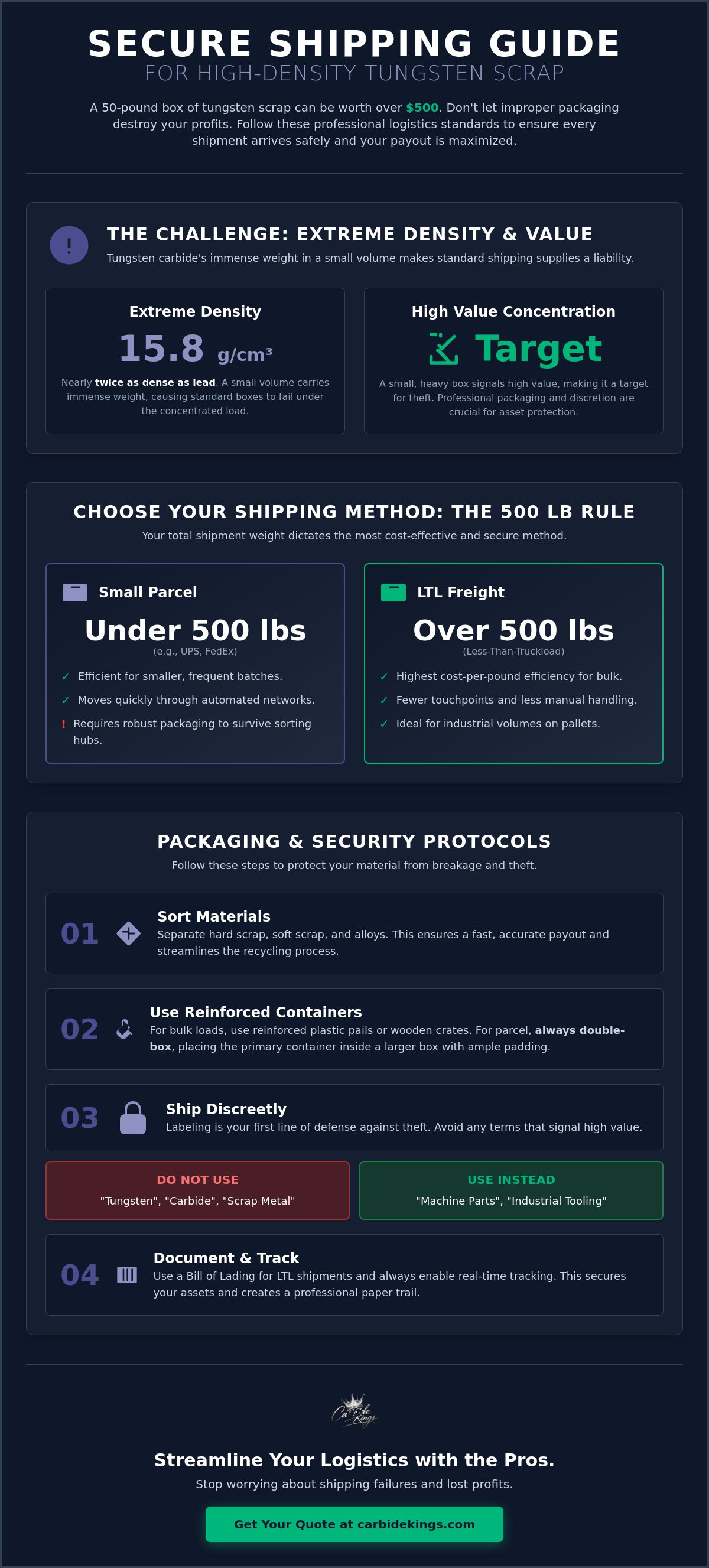
Shipping industrial scrap isn't a one size fits all process. When you're dealing with tungsten carbide, you're handling a material with a density of up to 15.8 g/cm³. To put that in perspective, it's nearly twice as dense as lead. These unique Tungsten Carbide Properties mean that a very small volume of material carries immense weight. Standard cardboard boxes, even those rated for heavy duty use, aren't designed for this kind of concentrated load. They often fail during the sorting process at national hubs because the material shifts and punches through the bottom seams. Understanding how to package carbide scrap for shipping starts with acknowledging that you're moving "heavy metal" in the most literal sense.
The concept of value density also plays a critical role in your logistics strategy. Because carbide is so heavy and valuable, a single small box can represent hundreds or even thousands of dollars in assets. This high value-to-size ratio makes shipments a target for theft and complicates insurance claims if the packaging fails. A professional logistics workflow isn't just about getting the box to its destination; it's about protecting your profit margin from the moment the material leaves your floor until the payout is in your hand.
Understanding Weight vs. Volume in Metal Transport
Logistics for tungsten scrap are counterintuitive. In most shipping scenarios, you're worried about "dim weight" or how much space your package takes up on a truck. With carbide, volume is almost irrelevant. A small five gallon bucket of carbide scrap can easily weigh as much as a large wooden crate filled with aluminum. National carriers like UPS or FedEx will bill you based on actual weight because the material is so compact. The extreme weight-to-volume ratio of tungsten carbide makes structural integrity, rather than space, the primary logistics hurdle. You must prioritize internal bracing and reinforced containers to ensure the load remains stable throughout the journey.
Security and Discretion for High-Value Alloys
Security is a major SERP gap that many shippers overlook. High-value industrial alloys are susceptible to "porch piracy" and internal theft at shipping hubs. One of the most effective ways to protect your shipment is through discreet labeling. You should never use words like "Tungsten," "Carbide," or "Scrap Metal" on the outer shipping labels. These terms signal high value to anyone handling the package. Instead, use neutral descriptions such as "Machine Parts" or "Industrial Tooling" to keep the contents anonymous.
- Neutral Packaging: Use plain, unmarked outer boxes to avoid drawing attention to the shipment.
- Tamper-Evident Seals: Apply high-strength, tamper-evident tape to all seams. This allows you to verify shipment integrity immediately upon receipt.
- Double-Boxing: Always place your primary container inside a second, larger box with ample padding to prevent the inner weight from shifting.
By following these security protocols, you significantly reduce the risk of your shipment being intercepted or tampered with. It's a simple step that ensures your hard-earned scrap reaches the recycler without incident.
Choosing Your Shipping Method: Small Parcel vs. LTL Freight
The total weight of your inventory dictates your entire logistics strategy. If you're moving less than 500 pounds of material, small parcel carriers like UPS or FedEx are usually the most efficient choice. Once your inventory crosses that 500-pound threshold, switching to Less-Than-Truckload (LTL) freight becomes the standard for professional operations. This transition point is critical because it marks where cost-per-pound efficiency shifts in favor of palletized transport. Choosing the wrong method can lead to inflated shipping costs that eat directly into your final payout.
Your choice also impacts the speed of your industrial carbide recycling workflow. Parcel shipments move quickly through automated networks, which is ideal for smaller, frequent batches. However, LTL shipments are more streamlined for large industrial volumes, as they involve fewer touchpoints and less manual handling of individual containers. If you're operating out of a facility with a loading dock, LTL is almost always the superior choice. For those without a dock, coordinating a lift-gate pickup is a simple way to maintain professional standards without specialized equipment.
Small Parcel Best Practices for Hard Scrap
When you're learning how to package carbide scrap for shipping via parcel, ergonomics and structural integrity are your primary concerns. We recommend an absolute safety limit of 50 pounds per box. While carriers allow more, heavier boxes are prone to being dropped or mishandled by parcel staff. Every shipment exceeding 20 pounds should follow the "Double Box" rule. Place your primary container inside a second, larger corrugated box with at least two inches of cushioning on all sides. Secure every seam with high-tensile reinforced tape. Standard clear packing tape often fails under the pressure of high-density tungsten scrap.
Less-Than-Truckload (LTL) for Industrial Volume
For shipments over 500 pounds, palletizing is the only way to ensure transit stability. Secure your carbide drums or crates to a sturdy pallet using steel or heavy-duty plastic strapping. It's vital to understand NMFC freight classes to avoid unexpected fees; scrap metal typically falls under Class 50, but density can change this classification. Always verify the weight accuracy on your Bill of Lading to prevent "re-class" charges from the carrier. If you don't have a forklift on-site, simply request a lift-gate service when scheduling your pickup. If you need help determining the most cost-effective route for your bulk inventory, contact our logistics experts for a tailored shipping plan.
Packaging Standards for High-Density Tungsten Scrap
Efficiency in industrial recycling begins at the packing station. To master how to package carbide scrap for shipping, you must move beyond basic retail methods and adopt industrial logistics standards. A professional workflow ensures your material arrives intact and your inventory count matches the recycler's receipt. Follow this five step process to secure your load for national transit.
First, sort your materials into three distinct categories: Tungsten Hard Scrap, Tungsten Soft Scrap, and Tungsten Alloys. Mixing these materials can complicate the assay process and delay your payment. Second, select the right container for your volume. For loads under 500 pounds, reinforced plastic pails with a minimum 90 mil wall thickness are ideal. For larger bulk shipments, use heavy duty wooden crates or steel drums. Third, eliminate "dead space" within the container. Use vibration dampening liners like heavy cardboard or crumpled industrial paper to prevent the material from shifting. Fourth, secure your lids using mechanical fasteners or steel strapping. A lid that pops open during a sudden stop can result in a total loss of material. Finally, apply redundant packing manifests. Place one copy inside the container and secure a second copy to the exterior under a clear adhesive pouch.
Securing Hard Scrap: Inserts and End Mills
Hard scrap like indexable inserts and end mills presents a unique challenge: sharp edges that can easily pierce standard poly bags. To prevent this, use heavy duty poly liners with a thickness of at least 6 mils. Double bagging is standard practice for loose inserts to ensure no material escapes if the primary bag fails. If you're unsure about how to categorize your tooling, check our guide on where to sell carbide scrap for detailed sorting tips that maximize your return. Once bagged, place the material into your reinforced pail and fill any gaps to ensure the load is immobile.
Handling Soft Scrap and Grinding Sludge
Grinding sludge and swarf require a different approach due to their moisture content and consistency. For these materials, leak proof, UN-rated drums are a non-negotiable requirement. These containers are specifically designed to withstand the pressure and weight of industrial sludge without leaking. Managing moisture is also critical. Excessive coolant or water in your sludge can lead to weight disputes and unexpected shipping surcharges. We recommend allowing sludge to settle and decanting excess liquid before sealing the drum. For a deep dive into handling these specific materials, reference our tungsten soft scrap buyers guide. Proper containment here doesn't just protect the truck; it protects your reputation as a professional industrial partner.
Documentation and Tracking for National Shipments
Secure packaging is only half the battle. To complete the process, you must master the paperwork that follows. The Bill of Lading (BOL) serves as your primary legal document during transit. Weight accuracy on this form is non-negotiable. Carriers frequently re-weigh shipments at industrial hubs, and discrepancies lead to costly "re-class" fees that diminish your bottom line. When you understand how to package carbide scrap for shipping, you also understand that the numbers on your scale must match the numbers on your manifest exactly.
Digital tracking provides the transparency you need for high-value industrial assets. We recommend using carriers that offer real-time GPS monitoring so you can track your inventory across state lines. This visibility is vital for managing your cash flow. It allows you to predict exactly when your material will reach the facility for assay. Don't overlook insurance and liability coverage. Standard carrier liability often fails to cover the full market value of tungsten. Always verify your coverage limits before the truck leaves your dock to protect against transit damage or loss. Streamlining this paperwork ensures 24-hour processing once your material is received.
Creating a Professional Packing List
A professional packing list speeds up the valuation process significantly. You should match individual container weights to a master manifest to ensure nothing goes missing during a cross-dock transfer. Itemizing your shipment by material type, such as separating indexable inserts from solid end mills, allows the receiving team to verify your inventory faster. We also suggest taking pre-shipment photos of the sealed containers on the pallet. These images serve as critical evidence if a container arrives damaged or tampered with. They provide a clear record of the material condition at the point of origin.
Compliance with National Shipping Standards
Your shipment must meet all Department of Transportation (DOT) requirements for heavy metal transport. While solid carbide tools are generally not classified as hazardous, certain types of grinding sludge or powders require specific hazardous material declarations and specialized shipping papers under federal law. Failing to disclose these can lead to federal fines and shipment rejection. Review our detailed breakdown of tungsten scrap payment terms to see how documentation accuracy impacts your final settlement. If you're ready to move your inventory with a partner that handles the logistical heavy lifting, get a shipping quote from Carbide Kings today.
Streamlining Your Logistics with Carbide Kings
Logistics shouldn't be a bottleneck for your shop. We've built our reputation on removing the administrative and physical hurdles that typically slow down industrial recycling. Our proactive approach to national logistics ensures that you spend less time worrying about freight and more time focused on production. By providing pre-paid shipping labels and coordinating professional LTL freight pickups, we eliminate the guesswork from the equation. Once you've mastered how to package carbide scrap for shipping, you've handled the most critical part of the physical labor. We take over from there to ensure the rest of the journey is seamless and secure.
Expert carrier partnerships are the backbone of our logistics support. We don't just find a truck; we find the most reliable route for your high-value assets. This reduces the risk of transit delays and ensures your material is handled by professionals who understand the nuances of industrial cargo. By leveraging our established network, we remove the friction often found in traditional scrap metal transactions. This results in a faster, more predictable cycle for your business.
Requesting Your Professional Shipping Plan
Start the process by sending us clear photos of your material. This allows our team to provide a rapid logistics quote based on volume and material type. We align our pickups with your shop’s production schedule to minimize disruption on your floor; we work around your deadlines, not the other way around. Because we maintain high-volume national carrier accounts, you benefit from lower freight rates that a single shop rarely accesses on its own. This partnership turns a complex logistics problem into a routine, profitable task. We handle the heavy lifting, the paperwork, and the carrier coordination so your team stays focused on their core operations.
From Receipt to Payment: The Final Step
Speed is our priority. Once your shipment arrives at our facility, it undergoes an immediate, transparent weighing and analysis process. We use calibrated industrial scales and precise testing to verify the material against your manifest. You'll receive an immediate notification of receipt and a final material valuation based on real-time market data. Our 24-hour promise means we aim to move from material receipt to a wire transfer in just one business day. This efficiency applies whether you're shipping Tungsten Hard Scrap, Tungsten Soft Scrap, or complex Tungsten Alloys. We've refined this workflow to ensure that industrial professionals receive their payout without unnecessary delays or administrative friction. Get your streamlined carbide scrap quote today and experience a faster, more reliable way to recycle your industrial assets.
Secure Your Profits with Professional Logistics
Mastering the logistics of high-density tungsten scrap is a critical skill for any industrial professional. You now understand the importance of reinforced packaging, the 500-pound threshold for LTL freight, and the necessity of accurate documentation. These steps protect your material from transit failure and ensure your valuation remains high. Knowing how to package carbide scrap for shipping turns a messy cleanup task into a streamlined, predictable revenue stream for your facility.
The work doesn't have to be a burden. We provide national logistics support and expert material analysis upon receipt to ensure you receive the most accurate value for your inventory. Our 24-hour payment processing means you won't be left waiting for your funds after the material arrives. It's time to clear your floor and maximize your return with a partner that handles the heavy lifting for you. We've refined our process to perfection so you can stay focused on your core operations.
Get a Professional Carbide Scrap Quote & Shipping Plan today. You've done the hard work of generating the scrap; let us handle the complexities of getting it to market safely and quickly. We're ready to help you streamline your recycling process and boost your bottom line immediately.
Common Logistics and Shipping Questions
Do I need to pay for shipping when selling my carbide scrap?
We provide pre-paid shipping labels for small parcel shipments and coordinate LTL freight for larger volumes at no upfront cost to you. This eliminates out-of-pocket expenses for our partners and streamlines the entire logistics process. By leveraging our national carrier accounts, we keep freight costs low and remove the administrative burden from your shop. Every quote we provide includes a tailored logistics plan to ensure your material moves efficiently from your floor to our facility.
What is the maximum weight I can put in a single shipping box?
You should limit each individual box to 50 pounds to ensure structural integrity and safe handling during transit. While carriers like USPS or UPS allow up to 70 pounds, the extreme density of tungsten often causes standard cardboard to fail under that much pressure. Keeping boxes at 50 pounds or less reduces the risk of breakage during automated sorting. This weight limit also protects parcel handlers from injury while moving your high-value inventory.
How do I ship carbide grinding sludge without it leaking?
Shipping grinding sludge requires a UN-rated, leak-proof steel or plastic drum to prevent environmental contamination and carrier rejection. Before sealing the container, decant as much excess coolant or water as possible to reduce weight and prevent shifting. Secure the lid with a bolt ring or heavy-duty locking mechanism to maintain a tight seal. Following these steps is a core part of learning how to package carbide scrap for shipping when dealing with soft scrap or swarf.
Can I use my own freight carrier for large industrial shipments?
You're welcome to use your own freight carrier, but most partners prefer using our established national accounts to access lower commercial rates. If you choose to manage your own transport, we require a copy of the Bill of Lading (BOL) before the shipment arrives at our dock. This ensures our receiving team is prepared for the delivery and can begin the weighing process immediately. Using our coordinated logistics usually results in a faster, more predictable payout cycle.
Is my carbide scrap shipment insured during national transit?
Most shipments carry standard carrier liability, but this often doesn't cover the full market value of high-density tungsten. We recommend verifying your internal business insurance or requesting additional coverage through the carrier for high-value loads before the truck leaves. Our logistics team can help you determine the appropriate level of protection based on the current market price of your inventory. Protecting your assets against loss or damage is a vital step in professional scrap management.
What documents must be included inside the shipping container?
You must include a detailed packing list inside the container that specifies the material types and estimated weights for each category. This should match the external manifest to provide redundancy if the outer label is damaged during transit. Including a copy of your initial quote or purchase order number helps our team identify your shipment the moment it arrives. This documentation speeds up the analysis phase and ensures your payment is processed within our 24-hour window.
How should I palletize drums for a professional freight pickup?
Center your drums on a standard sturdy pallet and secure them using at least two steel or heavy-duty plastic straps. Ensure the drums don't overhang the edges of the pallet, as this increases the risk of damage during forklift handling at freight hubs. For multiple drums, use stretch wrap in addition to strapping to keep the load unitized and stable. A professional pallet build ensures your material remains secure throughout the national freight network.
What happens if my shipment is damaged by the carrier during transit?
If a shipment arrives damaged, our receiving team documents the condition with photos and notes the damage on the delivery receipt immediately. We'll work with you to file a claim with the carrier and use your pre-shipment photos as evidence of proper initial packaging. This is why learning how to package carbide scrap for shipping with double-boxing and reinforced containers is so important. Proper preparation is your best defense against carrier negligence and lost profits.


