

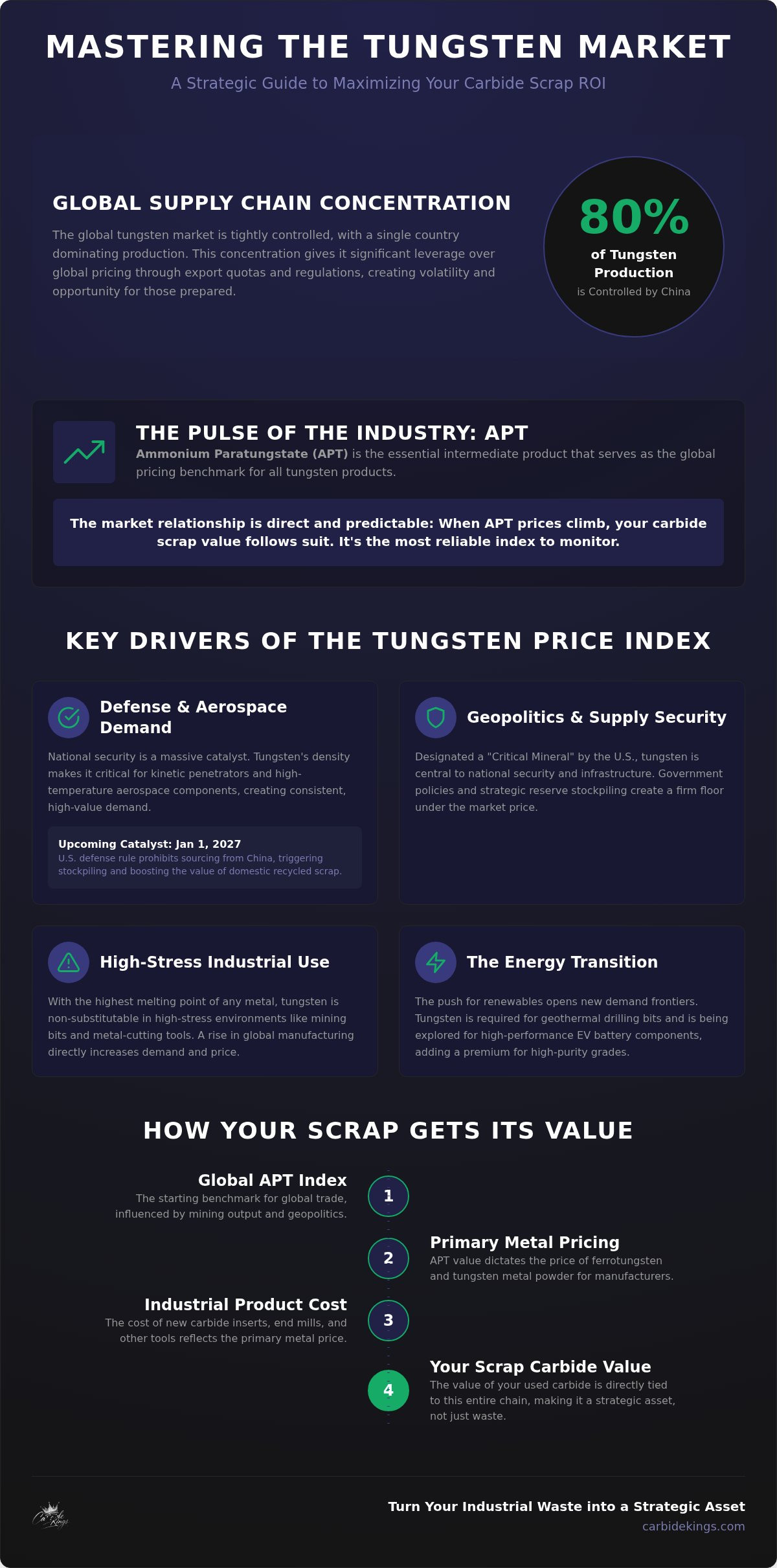
China currently controls 80% of global tungsten mine production, yet many industrial professionals still treat their scrap as an afterthought. You've likely felt the frustration of watching the tungsten price fluctuate without knowing how it impacts your bottom line. It's hard to track global metal indices when you're busy running a plant. Selling your carbide at the wrong time often means leaving significant money on the table.
We know that opaque pricing in the scrap industry is a major hurdle. This guide helps you master the complexities of the tungsten market so you can see exactly how global indices dictate the value of your industrial carbide scrap. We'll provide a clear framework for monitoring market value and share strategies to maximize your ROI on every load. From current APT price stability to the impending 2027 U.S. defense procurement shifts, you're about to gain the clarity needed to turn your industrial waste into a strategic asset.
Key Takeaways
- Understand why Ammonium Paratungstate (APT) serves as the primary global benchmark for all industrial tungsten products.
- Identify how surging demand in the defense and semiconductor sectors directly influences the current tungsten price.
- Learn the predictable relationship between primary metal indices and the market value of your carbide inserts and end mills.
- Use seasonal manufacturing trends and global export data to time your scrap sales for the highest possible returns.
- Discover a streamlined procurement process that converts bulk carbide scrap into liquid capital without administrative hurdles.
What Determines the Tungsten Price? Fundamentals of Global Value
Tungsten is a heavy hitter in the industrial world. Known as element W, it possesses the highest melting point of any metal and a density that rivals gold. These physical properties aren't just scientific curiosities; they're the foundation of its market value. You can't easily substitute tungsten in high-stress environments. Because of this, the tungsten price maintains a consistent floor driven by non-negotiable industrial demand. Understanding the Fundamentals of Tungsten helps you see why this metal is a strategic asset rather than a simple commodity.
Demand for wear-resistant materials keeps the market moving. Whether it's for mining bits, metal-cutting tools, or aerospace components, tungsten's durability makes it indispensable. When global manufacturing ramps up, the pressure on supply increases immediately. This creates a direct link between industrial output and the value of the raw material in your facility.
The Role of Ammonium Paratungstate (APT)
Ammonium Paratungstate, or APT, is the pulse of the industry. It's a white crystalline salt produced during the refining of tungsten concentrates. You won't find many manufacturers using APT directly, but it's the essential intermediate product for almost everything else. APT serves as the pricing basis for ferrotungsten, tungsten metal powder, and the carbide inserts you use every day.
The market treats APT as the industry-standard unit of measure for global trade. Most scrap buyers and primary suppliers calculate their offers based on the current APT index. If APT prices climb in the European or Chinese markets, your scrap value follows suit. It's the most reliable benchmark for anyone looking to track the tungsten price with precision.
Supply Chain Concentration and Geopolitics
Supply is tightly controlled. China currently manages over 80% of global tungsten production, which gives them significant leverage over global pricing. When the Chinese government implements export quotas or tightens environmental regulations on mines, the global supply shrinks. These policy shifts can cause sudden, sharp movements in the market that catch unprepared businesses off guard.
Geopolitical tension adds another layer of complexity. The United States has designated tungsten as a "Critical Mineral" due to its importance in national defense and energy infrastructure. This designation influences national procurement strategies and incentivizes domestic recycling. New regulations, such as the upcoming 2027 U.S. defense procurement rules, aim to reduce reliance on foreign sources. These shifts make your on-site carbide scrap more valuable to domestic buyers who need traceable, reliable material.
Key Drivers of the Tungsten Price Index in 2026
The global tungsten price in 2026 is shaped by a tug-of-war between high production costs and shifting geopolitical requirements. While midstream powder producers face pressure from lower order volumes, the upstream market remains resilient. Miners are currently reluctant to sell at lower rates, effectively keeping a firm floor under the market. This stability is further reinforced by governments implementing strategic reserve policies to secure long-term supply. Monitoring USGS Tungsten Data reveals that while production remains concentrated, the demand profiles for this critical mineral are evolving rapidly.
Defense and Aerospace Demand
National security is a massive catalyst for market movement this year. Tungsten's extreme density makes it the primary material for kinetic energy penetrators and high-temperature engine components. As of August 2026, the industry is bracing for the January 1, 2027, U.S. defense procurement regulation. This rule will prohibit defense contractors from sourcing tungsten metal powder and heavy alloys from China.
This upcoming shift has triggered a wave of stockpiling among commercial buyers who fear a localized supply crunch. Aerospace production cycles also contribute to price stability. Long-term contracts for engine parts provide a consistent demand stream that offsets temporary lulls in other sectors. When defense agencies prioritize traceable, non-Chinese material, the value of domestic recycled scrap increases significantly.
The Impact of the Energy Transition
The push for renewable energy has opened new frontiers for tungsten consumption. Geothermal drilling requires specialized bits that can withstand intense heat and abrasive rock. Similarly, the EV battery sector is exploring tungsten-based components to improve performance and longevity. These technological shifts require high-purity material, often putting a premium on the tungsten price for specific grades.
Sustainability is no longer just a buzzword; it's a procurement requirement. Manufacturers are under pressure to establish circular supply chains. This makes the decision to sell tungsten carbide wear parts back into the recycling stream a strategic business move. By recycling, you help satisfy the growing demand for domestic, sustainable raw materials while capturing the inherent value of your used tooling.
Inflationary pressures also play a role in 2026. The cost of mining equipment, electricity, and global logistics remains high. Even as China's trade structure changes with increased raw material imports from Kazakhstan, the overhead for extracting and refining ore hasn't dropped. For industrial professionals, these factors mean that the cost of primary metal will likely stay elevated. Partnering with a national buyer who understands these drivers ensures you receive a fair, transparent return on your scrap regardless of market volatility.
Comparing Primary Tungsten (APT) vs. Carbide Scrap Pricing
Your carbide scrap value isn't a random number. It's a direct reflection of the global tungsten price, specifically the Ammonium Paratungstate (APT) index. However, scrap prices don't move in lockstep with the primary market. They typically trail APT indices by a predictable margin. This lag happens because scrap must be processed back into a pure form before it can re-enter the manufacturing cycle. Understanding this relationship helps you forecast your returns based on current market trends.
The tungsten carbide scrap price is also influenced by secondary metals. Most industrial carbide contains a binder, usually cobalt or nickel. While tungsten is the primary value driver, the fluctuating cost of these binders can shift your total payout. When cobalt prices are high, your "trash" becomes even more lucrative. Clear transparency regarding these binders ensures you receive the full value of the alloy, not just the tungsten content.
The Spread: Why Scrap Costs Less Than APT
The "spread" refers to the price gap between raw APT and your scrap material. This gap exists to cover the significant energy costs required to refine scrap back into usable powder. Refining isn't just about melting; it involves chemical processes to strip away impurities and binders. Several factors dictate how wide this spread becomes for your specific lot.
- Yield: A high-quality lot of clean inserts has a higher "yield" than contaminated material. Higher yield means less waste and a tighter spread.
- Sorting: Mixing steel shanks with carbide bits is a common mistake. Sorting your hard scrap to remove steel contaminants increases your payout immediately.
Refining companies must account for these processing variables. Clean, well-sorted material reduces their overhead. When you present a clean stream of material, it allows the buyer to offer a price much closer to the primary market index.
Hard Scrap vs. Soft Scrap Valuation
Not all tungsten is created equal in the eyes of a buyer. Hard scrap consists of solid carbide tools like end mills, drill bits, and indexable inserts. These items are easy to identify, sort, and process. Because of their high tungsten content and predictable chemistry, they command a much higher percentage of the APT value. They're the gold standard for industrial recycling.
Soft scrap is a different story. This category includes grinding sludge, swarf, and fine powders generated during tool manufacturing. These materials often contain high levels of moisture, coolant, or oil, making them harder to refine. If you're managing fines and powders, refer to our tungsten soft scrap buyers guide to understand the specific logistics involved. While soft scrap requires more effort to move, it remains a valuable asset that shouldn't be overlooked in your recycling strategy.
Strategic Market Timing: When to Sell Your Tungsten Carbide
Timing your sale shouldn't feel like a gamble. Many industrial professionals wait for a price peak that never comes, only to sell in a panic when the market cools. To maximize your return, you need to look beyond the local scrapyard and focus on global indicators. The tungsten price is sensitive to macro-economic shifts. Knowing when to pull the trigger can mean the difference between a minor rebate and a significant cash injection into your operations.
Market transparency is your best tool for success. Identify seasonal manufacturing lulls, as these often lead to temporary price dips when demand for new tooling softens. Conversely, when aerospace and defense sectors ramp up production, refinery demand for feedstock typically increases. This is the ideal window to move your accumulated scrap for a premium.
Monitoring Global Indicators
Start by tracking the Metric Ton Unit (MTU) price. This is the primary indicator for bulk sales and provides a more accurate picture than per-pound retail quotes. You should also watch for supply shocks, such as sudden shifts in Chinese APT export data or releases from strategic stockpiles. These events can flood the market and drive values down overnight. Understanding the carbide scrap recycling process helps you anticipate when refineries are most aggressive in their procurement. When refineries have low inventory, they're often willing to tighten their margins to secure your material.
Optimizing Your Scrap Inventory
Holding too much inventory is a common mistake that ties up liquid capital. While it's tempting to wait for the absolute highest tungsten price, storing bulk scrap exposes you to unnecessary risk. Market volatility can wipe out the gains of a price increase faster than you can ship your load. Establishing a consistent recycling cadence is often the most profitable strategy. This approach allows you to average out market fluctuations. It ensures you aren't over-exposed during a sudden downturn while keeping your facility clear of industrial waste.
Cleanliness also dictates your timing and your final payout. A lot that is free from steel, ceramic, and general trash reduces the buyer's risk and processing time. This leads to a faster transaction and a higher price per pound. Instead of guessing the market's next move, focus on the factors you can control. Partnering with a national buyer who offers transparent pricing formulas removes the administrative hurdles from the equation. If you're ready to convert your used tooling into working capital, request a direct quote on your carbide scrap to see how current indices impact your specific inventory.
Maximizing ROI with Carbide Kings: Professional Tungsten Procurement
Carbide Kings bridges the gap between global market complexity and your facility's bottom line. We understand that tracking the tungsten price shouldn't be your full-time job. Our team acts as a proactive extension of your procurement department. We translate opaque indices into fair, transparent payouts for your industrial waste. By removing the traditional barriers found in the scrap industry, we ensure you receive the highest possible return with the least amount of effort.
Efficiency is our standard. We've refined our process to eliminate the friction that typically slows down industrial recycling. From the moment you contact us, the workflow is designed to be logical and fast. You don't have to worry about administrative hurdles or complex paperwork. We provide the clarity you need to make informed decisions about your scrap inventory in real-time.
A Streamlined Process for US Manufacturers
Contact us today to receive a professional quote based on the most accurate 2026 market data. We manage the entire lifecycle of your scrap recovery, starting with national logistics support that reaches every corner of the United States. You don't need to coordinate shipping or worry about the heavy lifting. We handle the transport and perform a precise metallurgical analysis at our facility to verify the exact composition of your lot.
Our focus on selling tungsten hard scrap is built for maximum efficiency. We know that industrial professionals value time and clarity above all else. By providing a direct, results-oriented path for your used tooling, we turn a logistical burden into a streamlined revenue stream. You stay focused on your core manufacturing operations while we handle the complexities of the metal market.
Your Partner in Industrial Metal Recovery
We position ourselves as a supportive partner rather than a distant scrap dealer. Our communication is straightforward. We value your time and prioritize reliability in every transaction. This commitment shows in our 24-hour payment terms. Once your material is verified, we move quickly to ensure the capital is back in your hands. There's no waiting for weeks to see the results of your sale.
Don't let your high-value inventory sit idle while the tungsten price shifts. Market volatility can be a risk, but our transparent evaluation process protects your interests. We encourage immediate engagement to lock in rates for carbide rods and other high-value alloys. Our process is refined, reliable, and built for the speed of modern industry. Partner with a veteran of the industrial sector who is proud to offer the most efficient recycling solution in the country.
Secure Your Competitive Edge in the 2026 Tungsten Market
Mastering the relationship between global indices and your carbide inventory is the first step toward maximizing your returns. You've seen how defense procurement shifts and energy transition needs keep the market floor resilient. By monitoring these global drivers, you can move your material when the tungsten price is most favorable for your bottom line. Success in this sector requires more than just luck; it requires a strategic partnership.
We're here to handle the heavy lifting. Our national US logistics and procurement network ensures your material moves quickly from your floor to our facility. We provide expert analysis of both tungsten hard and soft scrap to guarantee accuracy. With our direct, efficient 24-hour payment process, you'll see the results of your recycling efforts immediately. We remove the administrative hurdles so you can stay focused on your core operations.
Don't let valuable alloys sit idle in your shop. Take control of your industrial waste today. Get a Professional Quote for Your Tungsten Scrap and start a partnership that prioritizes your profitability. Your next successful transaction is just one step away.
Frequently Asked Questions
What is the current tungsten price per pound in 2026?
The tungsten price per pound in 2026 is determined by global benchmarks like the Ammonium Paratungstate (APT) index. As of August 2026, European APT prices sit between USD 2,900 and 3,275 per metric ton unit. While raw material costs fluctuate daily, the value of your scrap is a calculation of this index minus processing fees. You should check current indices regularly to understand how these global shifts impact your local scrap returns.
How does the APT price index affect my carbide scrap value?
The APT price index serves as the primary valuation floor for the entire tungsten industry. Because carbide scrap is refined back into APT or tungsten powder, buyers use this index to set their purchase rates. When global supply tightens and the APT index rises, the market value for your used inserts and end mills increases accordingly. It's the most reliable metric for predicting when your industrial scrap will command a higher payout.
Why is tungsten considered a critical mineral in the United States?
Tungsten is classified as a critical mineral because it's indispensable for national defense and high-tech manufacturing. Its extreme density and heat resistance make it vital for kinetic energy penetrators and jet engine components. Since the U.S. relies heavily on imports, specifically from China, the government prioritizes domestic recycling to ensure supply chain security. This designation influences procurement rules, such as the 2027 defense regulations that restrict sourcing from designated foreign countries.
Can I sell tungsten alloys and hard scrap together in one lot?
You can combine tungsten alloys and hard scrap in a single shipment, but keeping them sorted is often more lucrative. Different alloys have unique chemical compositions and binder metals like cobalt or nickel. When you keep your hard scrap, such as carbide drills, separate from other alloys, it simplifies the metallurgical analysis. This precision allows buyers to offer a more accurate price based on the specific tungsten content of each material type.
What is the difference between an MTU and a pound in tungsten pricing?
A Metric Ton Unit (MTU) is the standard international trading unit for tungsten, representing 10 kilograms or 22.046 pounds of tungsten trioxide. While global markets and refineries trade in MTUs, most domestic scrap transactions are calculated by the pound for simplicity. To convert an MTU price to a per-pound value, you must account for the purity of the material and the current exchange rates between global currencies and the U.S. dollar.
How often do tungsten market prices fluctuate?
Tungsten market prices fluctuate daily based on trading activity in major hubs like China and Europe. While the market can experience periods of low volatility, sudden geopolitical shifts or changes in export quotas can cause rapid price swings. In 2026, we've seen stability in August, but the upcoming 2027 U.S. defense regulations are already creating anticipatory movement. Monitoring weekly index reports is the best way to stay ahead of these constant market adjustments.
Does the price of cobalt affect the value of my tungsten carbide scrap?
The price of cobalt significantly impacts your total scrap value because it's the primary binder used in most tungsten carbide tools. While the tungsten price drives the majority of the lot's value, cobalt is a valuable secondary metal. When cobalt prices rise on the global market, the recovery value of your scrap increases. A professional buyer will account for both the tungsten and cobalt content to ensure your payout is fair.
Is it better to sell carbide scrap in bulk or smaller frequent lots?
Selling in bulk typically yields a higher return because it reduces the per-pound cost of logistics and metallurgical analysis. Large lots are more attractive to national buyers who prioritize high-volume procurement. However, if the market is volatile, establishing a consistent recycling cadence can help you average out price fluctuations. This strategy ensures you aren't sitting on too much inventory if the market takes a sudden, unexpected downward turn.


