

A bigger tungsten stockpile isn’t automatically a safer one. Securing bulk secondary tungsten inventory ahead of trade restrictions starts with understanding which rules apply to your material, transaction, and end use, then committing only to supply your production can use. Buying ahead without checking scope, timing, and material fit can create a different risk: inventory that doesn’t meet your needs.
For defense applications, a DFARS change taking effect January 1, 2027, extends country-of-origin restrictions to the mine or ore stage and includes recycled and scrap material. Other measures have different scopes and conditions, so review current official text and effective dates before changing purchase plans.
This guide explains how to verify policy exposure, compare material specifications and documentation, assess supplier continuity, and stage commitments against actual demand. It also covers how hard scrap, soft scrap, carbide scrap, and tungsten alloys can fit different sourcing requirements. Carbide Kings supplies these materials to industrial buyers, giving procurement teams a focused set of categories to consider when planning bulk purchases.
Key Takeaways
- Separate policy headlines from rules that apply to your material, transaction route, end use, and timing.
- Map demand by production line, minimum usable specification, and replenishment cycle before deciding how much inventory to pursue.
- Compare spot purchases, scheduled buying, and staged buffers against material fit, documentation, consistency, and supply continuity.
- Make securing bulk secondary tungsten inventory ahead of trade restrictions a staged process, with clear gates for policy review, supplier qualification, and purchase approval.
- Connect documented procurement needs with relevant material categories, including tungsten hard scrap, soft scrap, carbide scrap, and tungsten alloys.
What 2026 tungsten trade restrictions could mean for secondary supply
A policy headline can prompt urgent questions, but it doesn’t mean every buyer faces a shortage or a universal restriction. Secondary tungsten is recovered material, including scrap that can return to industrial use. Its sourcing requirements can differ from those for finished tungsten products. Material form, transaction, destination, and intended use can all affect which rules apply. If you’re evaluating tungsten hard scrap, soft scrap, or carbide scrap, start by identifying exactly what you’re buying and how it will be used.
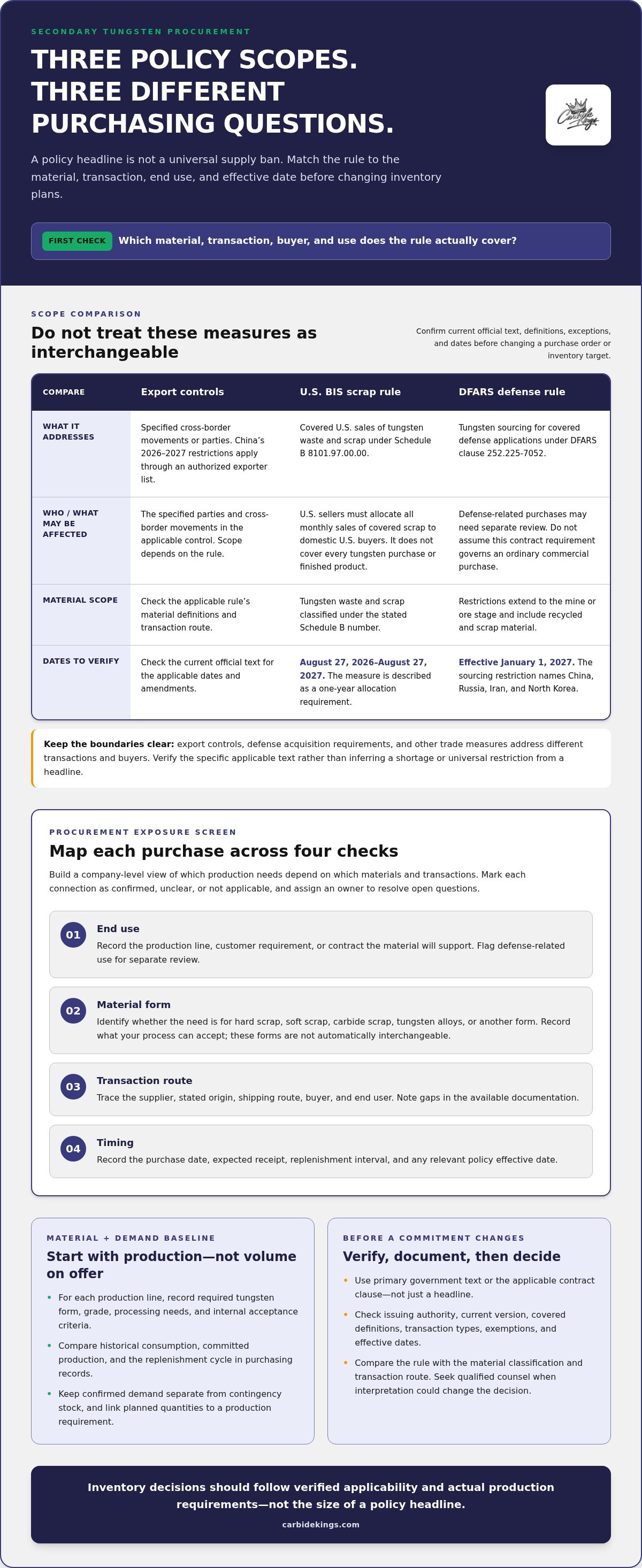
Keep three policy categories separate. Export controls govern specified cross-border movements or parties. Defense acquisition rules can restrict what qualifies for particular government-related contracts. Other trade measures may direct or condition transactions without applying to every buyer or product. A U.S. BIS rule effective August 27, 2026, through August 27, 2027, requires U.S. sellers of tungsten waste and scrap under Schedule B 8101.97.00.00 to allocate all monthly sales to domestic U.S. buyers. The measure concerns covered scrap sales, not every tungsten purchase or finished product.
Defense rules have a different scope. From January 1, 2027, DFARS clause 252.225-7052 extends restrictions on tungsten sourcing for defense applications from China, Russia, Iran, and North Korea to the mine or ore stage, including recycled and scrap material. Don’t assume a defense-specific requirement governs an ordinary commercial purchase. Check whether the purchase supports a covered defense application and how the contract applies the clause.
Which policy details should buyers verify first?
Use primary government text before changing a purchase order or inventory target. Confirm the issuing authority, publication date, current version, amendments, covered material definitions, transaction types, exemptions, and effective dates. Then compare those details with your material classification and transaction route. A one-year tungsten scrap export measure beginning August 27 has also been reported. Check the applicable BIS text for its exact scope and dates rather than relying on a summary.
- Check the official rule or contract clause, not just a headline.
- Match its definitions to the material and transaction under review.
- Record the applicable date and any relevant exception.
Why policy headlines don’t equal a universal supply ban
A measure’s stated purpose and its enforceable requirements aren’t necessarily the same as its effect on every procurement plan. China’s 2026-2027 export restrictions, for example, apply through an authorized exporter list, while the U.S. scrap rule and defense acquisition clause address different transactions and buyers. These distinctions matter when Tungsten moves through different material forms and supply chains.
Don’t infer a shortage, price change, or universal buyer exposure from a policy announcement alone. Applicability depends on the covered material, transaction, and effective date. Before securing bulk secondary tungsten inventory ahead of trade restrictions, verify those three points and make inventory decisions against actual production requirements.
Map your tungsten exposure before committing to bulk inventory
Once you’ve identified which rules may matter, translate them into a company-level picture. The aim isn’t to buy the largest possible buffer. It’s to identify which production needs depend on which materials and transactions, then focus procurement effort where exposure is real.
Use this four-step screen for each purchase or planned purchase:
- End use: Record the production line, customer requirement, or contract the material will support. Flag defense-related use for separate review.
- Material form: Identify whether the requirement calls for hard scrap, soft scrap, carbide scrap, tungsten alloys, or another form. Document what your process can accept.
- Transaction route: Trace the supplier, stated origin, shipping route, and buyer or end user. Note gaps in the available documentation.
- Timing: Record the purchase date, expected receipt, replenishment interval, and any relevant policy effective date.
A procurement exposure review matches applicable rules to the specific materials, transactions, uses, and dates in your purchasing plan. Mark each connection as confirmed, unclear, or not applicable, and assign an owner to resolve open questions. If statutory or contract interpretation could change the decision, have qualified counsel assess it. A preliminary screen isn’t legal advice.
Build a material and demand baseline
Start with production, not the volume on offer. For each line, record the required tungsten form, grade, processing needs, and internal acceptance criteria. Track hard scrap, soft scrap, carbide scrap, and alloys separately; they aren’t automatically interchangeable. The International Tungsten Industry Association offers industry context on tungsten’s production, processing, and uses, but your process requirements should determine material acceptance.
Compare three demand signals: historical consumption, committed production, and the replenishment cycle shown in your purchasing records. Keep confirmed demand separate from contingency stock. Link each planned quantity to a production requirement, a documented buffer rationale, or a review date. This helps identify orders that exceed practical use or require processing your operation can’t support.
Assess policy and sourcing exposure
Map each relevant purchase from supplier to intended use. Capture available origin and shipping details, then compare them with the specific rule or contract requirement under review. A supplier’s location alone doesn’t resolve origin questions, and a material category alone doesn’t determine applicability. Record the basis for each conclusion and flag gaps for follow-up.
Connect the review to procurement decisions. If a purchase is confirmed as exposed, document the affected production need and account for it in the next sourcing plan. If its status is unclear, don’t treat uncertainty as proof of a restriction or as a reason for an unplanned bulk order. For a focused review of potential bulk tungsten scrap sourcing, organize your material category and demand notes first. That makes the discussion more precise and keeps inventory decisions tied to actual use.
Compare secondary tungsten sourcing and inventory strategies
Choose a purchasing model that fits demand and operating flexibility. Spot buying can address a defined near-term requirement, but it may leave future replenishment uncertain. Scheduled purchases can support routine consumption when requirements and supply timing are predictable. Staged buffer inventory spreads commitments across decision points, helping buyers respond to changing demand without reacting to every policy headline with an immediate purchase.
No approach is automatically right. Compare each against the cost of holding material, storage capacity, working capital, quality-control capacity, and the consequences of a supply interruption. A production line with a stable, documented requirement may suit planned replenishment. A process still qualifying a material may call for smaller commitments until acceptance is established.
Match material form to the production requirement
Physical form and processing needs determine whether a secondary material can work in a specific process. Compare it with your internal specification and acceptance criteria, not an assumed universal grade. Record the processing required, which steps your operation can perform, and the checks needed before use. Category-specific information on tungsten hard scrap recycling can add context, but it doesn’t replace production-line qualification.
| Material category | Procurement fit to assess | Key question |
|---|---|---|
| Tungsten hard scrap | Potential fit where the process accepts the specific form after required handling or processing. | Does its condition meet internal acceptance criteria? |
| Tungsten soft scrap | Assess against the intended recovery or manufacturing process and its preparation requirements. | What processing is needed before use? |
| Carbide scrap | Consider for requirements that specifically call for the relevant carbide material category. | Does the material form match the application? |
| Tungsten alloys | Evaluate against alloy-specific needs and the product or process specification. | Are composition and application requirements aligned? |
These categories aren’t interchangeable. Verify the material description, supporting documentation, consistency between lots, and fit with the planned process. To assess supplier continuity, review whether purchasing records and material documentation support repeat orders, not just a single transaction. A clear description of your requirements makes comparisons more useful than broad supply claims.
Choose an inventory approach that limits overcommitment
Compare an immediate bulk purchase with phased replenishment or split commitments. A larger upfront order may provide a buffer, but it also ties up working capital and increases storage and quality-control demands. Phased purchases can preserve flexibility, provided you have a workable replenishment plan. Set each commitment against forecast demand and review the plan when production, material acceptance, or supply conditions change.
Market context can help explain changing interest in tungsten carbide scrap, but it shouldn’t replace your demand and sourcing records. A price guide may outline market drivers, but it doesn’t predict your purchase terms or guarantee availability. When securing bulk secondary tungsten inventory ahead of trade restrictions, prioritize documented material fit, dependable records, and a commitment schedule your operation can support.
Build a staged procurement plan before restrictions take effect
A staged plan turns policy monitoring into purchasing decisions without committing to inventory prematurely. Start with documented production demand, then set decision gates for qualifying material, authorizing a purchase, or adjusting quantities. This connects each commitment to an operational need and a verified sourcing requirement.
Use a staged inventory decision process
Set baseline demand from production forecasts and consumption records. Add a buffer only when you can explain the operational need, such as coverage for a documented replenishment interval or a specific production contingency. Use lead-time assumptions from your own purchasing history and records, not a generic estimate. Approve additional volume only when a defined trigger is met.
Build four decision gates into the process:
- Policy verification: Review current official text and record the rule, material, transaction, and effective date relevant to the purchase.
- Supplier qualification: Confirm that you can assess the material description and supporting documents against internal acceptance criteria.
- Purchase authorization: Link the requested quantity to a forecast, approved buffer, or documented contingency, then obtain the required internal approval.
- Periodic review: Assign a procurement owner and set a review cadence that fits your purchasing cycle. Reassess sooner if a rule, customer requirement, or production forecast changes.
Define quantity triggers before urgency rises. For example, a revised production forecast could justify an adjustment, while an unverified report should prompt policy review, not an automatic bulk order. Keep confirmed demand and contingency stock distinct in purchasing records so decision-makers can see what each quantity supports.
Prepare documentation and contingency procedures
Organize purchase records, material descriptions, supplier documents, and internal approvals in one traceable file or system. Include the intended use and the basis for the quantity decision. A shared record helps procurement, operations, and quality teams review a shipment or respond when requirements change.
Document alternate material forms only after engineering and quality teams approve their suitability. A different category isn’t automatically a substitute. If a shipment is delayed, a rule changes, or production demand shifts, follow a written response path: identify affected orders, assign an owner, assess approved alternatives, and record any revised purchasing decision. Route legal or contract questions for qualified review.
Keep the plan active. Set clear triggers for revising quantities, such as a changed official requirement, a customer specification update, an approved production forecast, or a shift in replenishment performance shown in your records. This makes securing bulk secondary tungsten inventory ahead of trade restrictions a controlled procurement process, not a one-time rush to stockpile.
Once your material categories and demand requirements are documented, review Carbide Kings’ bulk tungsten material options as part of your sourcing plan.
Source bulk secondary tungsten with Carbide Kings
A procurement plan works best when the material category is clear. Carbide Kings supplies industrial buyers with tungsten hard scrap, tungsten soft scrap, carbide scrap, and tungsten alloys for bulk procurement. These categories give manufacturing and metallurgical buyers a focused starting point for matching material needs with sourcing options.
Keep the categories distinct in your purchase requirements. A production process that specifies a particular form or internal acceptance criterion shouldn’t be treated as a general request for “tungsten scrap.” Describe the intended use, required material category, relevant documentation, and any processing or quality requirements your team has established. This gives procurement a more useful basis for evaluating fit than a broad request for volume alone.
Align material needs with Carbide Kings’ tungsten offerings
Use your documented requirement to identify the category to consider:
- Tungsten hard scrap: Consider this category when your requirement and process are suited to hard scrap material.
- Tungsten soft scrap: Assess it against the specific form and handling or processing needs of your operation.
- Carbide scrap: Match this category to requirements that call for carbide scrap, using your established material criteria.
- Tungsten alloys: Consider alloys where the requirement specifies an alloy category and aligns with your production needs.
Carbide Kings focuses on industrial tungsten and carbide materials for manufacturing and metallurgical buyers, with inventory for bulk procurement. Match each sourcing decision to your documented requirements, and keep supplier documentation connected to your internal acceptance criteria. This is especially important if your operation handles multiple forms or material must meet requirements for a particular production line.
Take the next step in bulk sourcing
Bring three items to the sourcing discussion: your demand baseline, the material category and requirements your operation can accept, and the results of your policy review. Include the intended use and purchasing schedule. With this information organized, your team can discuss a relevant bulk sourcing approach and distinguish contingency stock from confirmed production demand.
Resilience comes from sound decisions, not simply larger orders. Verify the rule that applies to your transaction, qualify material against your process, and stage commitments to match documented demand. This keeps securing bulk secondary tungsten inventory ahead of trade restrictions focused on usable supply and controlled procurement rather than assumptions.
To align your documented requirements with industrial tungsten material categories, discuss bulk tungsten sourcing with Carbide Kings.
Keep your tungsten sourcing plan ready to adapt
Trade policy and production needs can shift. Treat your sourcing plan as a working tool, not a one-time response to headlines. Review it when official requirements change, a customer updates specifications, or your forecast moves. This helps your team make purchasing decisions from current records rather than urgency.
For buyers securing bulk secondary tungsten inventory ahead of trade restrictions, the next step is a focused sourcing discussion grounded in material fit and documented demand. Carbide Kings supplies industrial buyers with bulk tungsten hard scrap, tungsten soft scrap, carbide scrap, and tungsten alloys.
Bring your material requirements and planned use into the conversation. Discuss your bulk tungsten sourcing needs with Carbide Kings.
Frequently Asked Questions
What U.S. trade restrictions could affect secondary tungsten inventory in 2026?
Two measures have different potential implications. A BIS rule effective August 27, 2026, through August 27, 2027, covers U.S. sellers of tungsten waste and scrap under Schedule B 8101.97.00.00, requiring all monthly sales to go to domestic U.S. buyers. Separately, a DFARS change effective January 1, 2027, affects tungsten sourcing for defense applications and includes recycled and scrap material. Check current official text to determine how either measure relates to a specific transaction.
Does a tungsten scrap export restriction apply to every buyer and material form?
No. The BIS rule addresses U.S. sellers and specified tungsten waste and scrap, not every tungsten product or purchase. Its domestic-allocation requirement shouldn’t be treated as a universal restriction on finished goods, alloys, or all buyer activity. The transaction, material classification, and parties involved matter. Compare the official rule’s definitions with your purchase documents and seek qualified legal guidance if classification or interpretation could change a decision.
How can manufacturers decide how much secondary tungsten inventory to secure?
Base the quantity on usable demand, not a headline or the volume on offer. For each production line, estimate expected consumption over the replenishment period using purchasing and production records, then subtract usable on-hand inventory and confirmed incoming orders. Consider a contingency amount only when it addresses a documented operational risk, such as a known demand swing. This measured approach supports securing bulk secondary tungsten inventory ahead of trade restrictions without confusing precautionary stock with production need.
Can tungsten hard scrap, soft scrap, carbide scrap, and alloys be used interchangeably?
No. These are distinct material categories, and suitability depends on the process and its acceptance requirements. For example, a production line specified for an alloy shouldn’t assume carbide scrap can serve as a substitute simply because both contain tungsten. Have engineering and quality teams assess the material description, processing requirements, and acceptance criteria before approving a substitute. Document approved alternatives by application so purchasing teams don’t infer interchangeability from a broad category name.
What documentation should buyers keep when sourcing bulk secondary tungsten?
Keep records that connect the purchase to its material and intended use. A practical file can include purchase orders, invoices, supplier material descriptions, available origin or shipping documentation, internal specifications, quality acceptance records, and approval history. Preserve the version of any policy or contract requirement used in the purchasing decision, along with the date it was reviewed. Organized records help teams trace a lot, explain its qualification, and reassess obligations if requirements change.
Is it safer to buy tungsten inventory early or use staged procurement?
Neither approach is automatically safer. An early bulk purchase may cover a documented operational need, but it can also leave a buyer holding material that production can’t use. Staged procurement can limit overcommitment and create review points, though it depends on a replenishment plan that fits the operation. Compare both options against forecast demand, past replenishment records, storage and quality-control capacity, and the consequences of delayed supply.
How should procurement teams respond if a trade rule changes after a purchase?
First, identify which open orders, shipments, material categories, and intended uses could be affected. Retrieve the current official text and compare its scope and effective date with the transaction record. Don’t assume a new measure applies retroactively or affects every order. Escalate material legal or contract questions to qualified counsel, then document the decision and coordinate next steps with procurement, legal, operations, and quality teams before changing the order or accepting material.


