

What if a delivery problem starts before a shipment leaves the supplier, because the lot has not been qualified against your foundry’s requirements? Tungsten hard scrap delivery contracts for continuous casting foundries work best when material fit, lot acceptance, and delivery planning are addressed together. A clear framework helps procurement teams identify gaps before they affect receiving, processing, or production schedules.
A dependable supply should not create avoidable interruptions or paperwork. A recurring arrangement is useful only when the material description and documentation meet your needs, and everyone understands how lots will be reviewed and how to handle a delivery that differs from plan. Qualification should reflect your intended use, not assumptions about process compatibility.
This guide covers a practical sequence: define material requirements, establish lot documentation and acceptance procedures, set a delivery cadence around demand, and plan for exceptions. Carbide Kings supplies tungsten hard scrap to industrial buyers, providing a direct starting point for discussing recurring supply. Use the framework to focus that discussion on your foundry’s requirements.
Key Takeaways
- Separate tungsten hard scrap from soft scrap and finished alloys before defining the material your process is intended to use.
- Use tungsten hard scrap delivery contracts for continuous casting foundries to document lot descriptions, receiving records, and a clear process for handling discrepancies.
- Choose a delivery approach that reflects consumption patterns, storage capacity, and tolerance for supply variation.
- Align procurement and operations on one material description, demand forecast, and receiving workflow before discussing recurring supply.
- Carbide Kings supplies tungsten hard scrap to industrial buyers and describes its inventory as consistent, a practical starting point for discussing ongoing requirements.
Tungsten hard scrap delivery contracts: start with foundry material fit
A recurring delivery plan cannot make unsuitable material fit a foundry process. Start by defining the intended use and the technical criteria each lot must meet. The label “continuous casting foundry” alone does not establish compatibility. Requirements depend on the foundry’s process and material needs.
Material qualification determines whether a defined scrap category meets the buyer’s technical requirements; delivery-contract negotiation sets how accepted material will be supplied. Keep those decisions distinct. First establish what your operation can accept, then build delivery terms around that material description.
What should a foundry qualify before contracting?
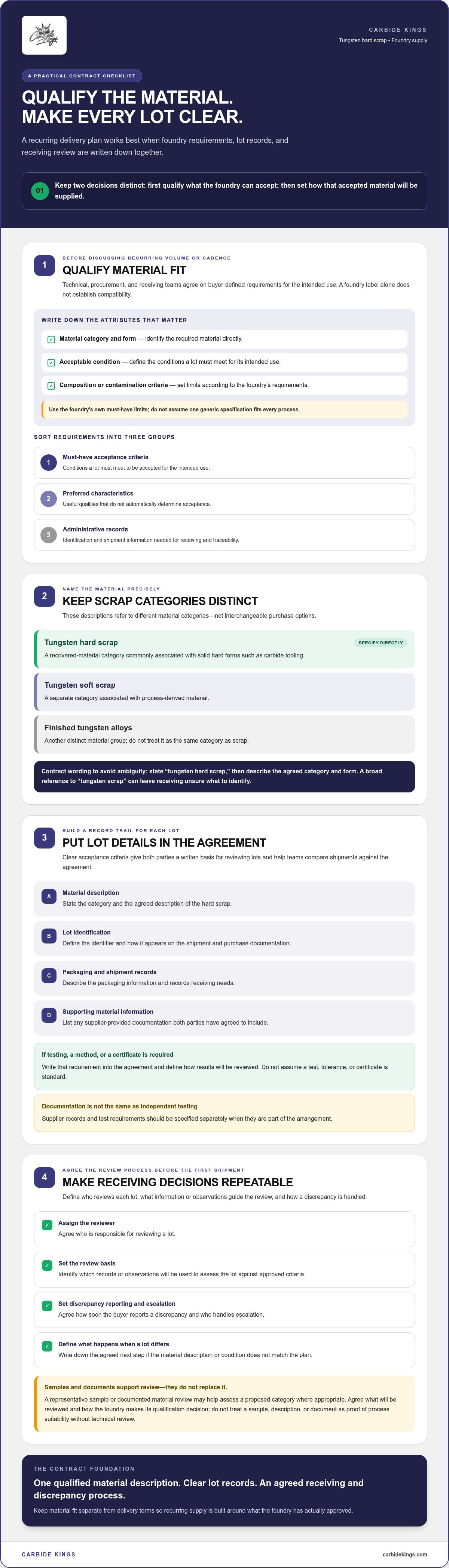
Before discussing recurring volumes or cadence, have technical, procurement, and receiving teams agree on buyer-defined attributes. Depending on the intended use, these may include material category and form, acceptable condition, and composition or contamination criteria established by the foundry. Avoid relying on generic specifications. Set your own must-have limits rather than assuming one standard applies to every process.
Separate requirements into three groups:
- Must-have acceptance criteria: Conditions a lot must meet for the intended use.
- Preferred characteristics: Qualities that are useful but do not automatically determine acceptance.
- Administrative records: Identification and shipment information needed for receiving and traceability.
A representative sample or documented material review may help the buyer assess a proposed category, where appropriate. Agree on what information will be reviewed and how the foundry will make its qualification decision. Do not treat a sample, description, or document as proof of process suitability without the foundry’s technical review.
Hard scrap, soft scrap, and alloys are not interchangeable
Tungsten hard scrap is a recovered-material category commonly associated with solid hard forms such as carbide tooling. Soft scrap is a separate category associated with process-derived material. Finished tungsten alloys are another distinct material group. These labels describe different categories, not interchangeable purchase options. For background on tungsten carbide’s material properties, see Tungsten Carbide Properties.
Name the required category directly in the purchase description. A broad reference to “tungsten scrap” can leave uncertainty about what the buyer expects and what receiving should identify. For more context on the difference between hard scrap and soft scrap, read this hard scrap and soft scrap comparison. Once the category and acceptance criteria are clear, tungsten hard scrap delivery contracts for continuous casting foundries can address recurring supply without confusing material fit with delivery terms.
Set contract specifications for tungsten hard scrap lots and acceptance
Once the foundry has defined the material category and its technical requirements, put them in the supply agreement. A general reference to “tungsten scrap” leaves room for mismatched expectations. State that the material is tungsten hard scrap, describe the agreed category and form, and record the buyer’s acceptance criteria in clear terms.
Clear acceptance criteria reduce avoidable receiving disputes by giving both parties the same written basis for reviewing each lot. For recurring supply, consistent records help procurement and receiving compare shipments against the agreement rather than rely on memory or informal descriptions.
Which lot details belong in a supply agreement?
Build a simple record trail from the purchase document to the received lot. Specify how each shipment or lot will be identified and how that identifier will appear on associated paperwork. Describe packaging in terms agreed by the parties, and list the shipment records the buyer needs for review before acceptance. Tie each requirement to the foundry’s approved criteria.
- Material description: State the category and agreed description of the hard scrap.
- Lot identification: Define the identifier used on the shipment and purchase documentation.
- Packaging and shipment records: Describe the packaging information and records needed for receiving.
- Supporting material information: Specify any supplier-provided documentation the parties have agreed to include.
Supplier documentation and independent testing are not the same. If testing, a particular method, or a certificate is part of the arrangement, put that requirement in the agreement and define how the result will be reviewed. Do not assume that a test, tolerance, or certificate is standard. The Virginia Department of Energy explains tungsten’s strategic relevance in its overview of Tungsten as a Critical Mineral, but the foundry’s own acceptance criteria should guide each purchase.
How should receiving and rejection procedures work?
Set the review process before the first shipment. Agree on who reviews a lot, which records or observations form the basis for review, how soon the buyer must report a discrepancy, and who handles escalation. Define the next step if the material’s description or condition appears inconsistent with the contract.
If the parties choose to hold disputed or potentially nonconforming material separately, document the procedure and who authorizes its release or other disposition. Clear steps prevent an unresolved lot from being confused with accepted inventory. For background on scrap handling, see the industrial carbide scrap recycling process.
This structure makes tungsten hard scrap delivery contracts for continuous casting foundries easier to administer, from shipment records through acceptance. Learn about tungsten hard scrap from Carbide Kings.
Compare delivery models, cadence, and continuity safeguards
Choose a delivery model based on how your foundry consumes material and receives shipments. A predictable operating pattern may support planned releases. Variable demand may call for more frequent forecast reviews or buyer-triggered releases. Neither approach suits every foundry. Storage limits, receiving capacity, production schedules, and the effort required to manage each shipment all affect the fit.
Which delivery model fits a foundry’s operating pattern?
Compare the trade-offs before setting a cadence. Scheduled releases create a planned flow, while buyer-triggered releases give the foundry more control over timing. Periodic spot purchases avoid committing to a recurring release pattern, but require procurement to review needs for each purchase.
| Delivery model | Planning control | Administrative effort | Exposure to schedule changes |
|---|---|---|---|
| Scheduled releases | More predictable planning for both parties | Lower routine ordering effort once releases are agreed | Changes in demand or downtime may require revisions |
| Buyer-triggered releases | Buyer controls release timing within agreed terms | Requires ongoing communication and release coordination | Timing can shift with production needs, subject to agreed arrangements |
| Periodic spot purchases | Decision made for each purchase | Repeated purchasing and planning work | Each purchase is planned separately, so future supply is not scheduled |
Use actual operating assumptions to set shipment frequency. Consider how much material the foundry can store, how often receiving can handle deliveries, and whether consumption stays steady or changes with production. Planned releases may suit stable demand; a flexible review point can help when usage varies. Revisit the model if a production shift, downtime, or storage change alters those assumptions.
What continuity terms should buyers discuss?
Continuity depends on shared planning, not an unsupported promise of uninterrupted supply. Agree on how the parties will communicate forecast changes, shipment delays, and revised requirements. Define who receives updates and how proposed changes to timing or quantities will be handled. Discuss in advance how to address a shortfall, proposed substitution, or schedule change, including which changes require buyer approval.
Commercial discussions may also be affected by market conditions. The tungsten carbide scrap price guide offers background on factors that can inform those conversations. Buyers may also review ISRI scrap specifications for industry context, while stating the parties’ agreed material description and requirements directly in their contract.
For tungsten hard scrap delivery contracts for continuous casting foundries, the practical goal is a cadence both sides can plan around and a clear process for communicating when assumptions change.
Prepare a foundry-ready tungsten hard scrap contract checklist
Turn material and delivery decisions into a shared working plan. Procurement, operations, quality, and receiving should use the same material description, expected delivery cadence, and receiving workflow. This sequence helps surface gaps before they lead to contract changes or shipment issues.
- Define the intended use. Record how the foundry plans to use the material and which internal requirements apply. Keep technical assumptions visible for review.
- Qualify the material. Have the appropriate technical and quality teams assess the defined category against those requirements. Separate acceptance criteria from preferences and administrative needs.
- Forecast demand. Assemble historical usage or a working forecast, along with known production changes. Treat projections as planning inputs, not as a supplier commitment.
- Agree the terms. Align the material description, acceptance process, delivery cadence, shipment records, and procedures for handling discrepancies or schedule changes.
- Review performance. Set a regular internal review of receiving outcomes, forecast accuracy, and recurring issues. Use what you learn to inform future planning and agreed contract updates.
What information should procurement assemble first?
Gather the intended use, internal material requirements, and receiving procedures before discussing a recurring arrangement. Bring together demand history or forecasts, inventory capacity, and known downtime or production changes. Identify who represents procurement, operations, quality, and receiving so each team can flag practical constraints early.
How can buyers review the contract before launch?
Check that the same material description appears throughout the agreement, purchase documents, and receiving instructions. Confirm that acceptance language, shipment cadence, and discrepancy procedures do not conflict. Assign clear owners for forecasts, shipment coordination, receiving review, and contract changes. Arrange appropriate technical review of material requirements and legal review of the agreement. This checklist supports preparation, but it is not legal advice.
Before launch, run a short risk review. Could a quality dispute leave a lot awaiting direction? Who communicates if demand or shipment timing changes? Does the planned cadence fit available storage and receiving capacity? Who needs to be notified, and who can approve a change? Writing down the answers gives each team a clear next step.
Use this framework to prepare for tungsten hard scrap delivery contracts for continuous casting foundries, then bring your foundry’s requirements into a focused supply discussion. Explore tungsten hard scrap supply from Carbide Kings.
Plan a tungsten hard scrap supply discussion with Carbide Kings
A focused supply conversation starts with your foundry’s requirements, not a preset delivery schedule. Carbide Kings supplies tungsten hard scrap and other tungsten materials to industrial buyers. The company describes its inventory as consistent, giving buyers a practical starting point for discussing recurring requirements without assuming specific volumes or delivery dates.
Bring the information that connects material qualification to day-to-day receiving. This helps keep procurement, operations, quality, and receiving aligned as the conversation moves toward an agreement.
What should a buyer bring to the first supply discussion?
- Intended application: Describe how the foundry plans to use the material and share the buyer-defined criteria for technical qualification.
- Planning assumptions: Bring expected lot sizes, preferred delivery cadence, demand forecasts, and known factors that could change them. Treat forecasts as planning inputs, not a supplier commitment.
- Receiving requirements: Outline the documentation your team needs, how shipments are identified, and the receiving workflow for reviewing and accepting a lot.
- Internal contacts: Identify who owns technical review, purchasing decisions, shipment coordination, and receiving questions.
Be clear about what is essential and what can remain flexible. For example, distinguish a required acceptance criterion from a preferred delivery interval. This gives both sides a useful starting point without assuming tungsten hard scrap is automatically compatible with a particular foundry process.
How does a supply conversation move toward an agreement?
First align on material scope and the foundry’s qualification approach. Then discuss recurring delivery expectations in light of demand, inventory planning, and receiving capacity. Before finalizing terms, document the agreed acceptance process, shipment coordination, communication responsibilities, and steps for handling exceptions or changing requirements.
This sequence keeps the discussion practical: define what the buyer needs, establish how lots will be reviewed, then shape delivery expectations around an informed plan. It also gives procurement and operations a shared reference as they review tungsten hard scrap delivery contracts for continuous casting foundries.
Ready to put your requirements into a focused supply conversation? Discuss your tungsten hard scrap requirements with Carbide Kings.
Build a Clear Path to Recurring Tungsten Hard Scrap Supply
Strong procurement begins with material fit. Define the foundry’s intended use and acceptance criteria first, then document how each lot will be identified, reviewed, and handled if questions arise. Set delivery cadence around actual demand, receiving capacity, and storage needs, with a clear communication plan for changes.
That sequence gives tungsten hard scrap delivery contracts for continuous casting foundries a sound foundation: qualify the material, agree on workable terms, and review how the arrangement performs over time. It also helps procurement and operations bring consistent requirements to a supply discussion.
Carbide Kings supplies tungsten hard scrap to industrial buyers and describes its inventory as consistent. The company serves customers nationally across the United States, giving foundries a direct source for discussing their requirements. Share your material needs, expected cadence, and receiving criteria to start a focused conversation.
Discuss your tungsten hard scrap requirements with Carbide Kings. A clear plan is a practical first step toward a more organized supply relationship.
Frequently Asked Questions
What is tungsten hard scrap?
Tungsten hard scrap is recovered material identified and traded in the hard-scrap category. Its form and condition can vary, so the category name alone does not establish composition or suitability for a specific use. For purchasing, describe the material clearly and define the buyer’s technical acceptance criteria. Keep it distinct from tungsten soft scrap and finished tungsten alloys in purchase documents and receiving records.
Can continuous casting foundries use tungsten hard scrap?
Whether a continuous casting foundry can use tungsten hard scrap depends on its intended application and technical requirements. The words “continuous casting” do not establish material compatibility. Before planning recurring deliveries, have the appropriate technical and quality teams define required material attributes and acceptance criteria. Treat a supplier description or general material category as a starting point for qualification, not proof that a lot is suitable for your process.
What should a tungsten hard scrap delivery contract include?
A tungsten hard scrap delivery contract should state the material category and description, buyer-approved acceptance criteria, lot identification, agreed packaging details, and required shipment records. It should also explain the receiving review, how and when to report a discrepancy, and how the parties will resolve it. For tungsten hard scrap delivery contracts for continuous casting foundries, document delivery cadence, forecast communication, and how proposed schedule changes or substitutions will be handled.
How can a foundry maintain consistent tungsten hard scrap deliveries?
Build consistency through shared planning and clear communication, not an assumed guarantee of uninterrupted supply. Provide demand forecasts, flag expected production changes, and agree how often forecasts and release plans will be reviewed. Align delivery expectations with receiving capacity and storage limits. Carbide Kings supplies tungsten hard scrap to industrial buyers and describes its inventory as consistent, a useful starting point for a focused supply discussion.
How should foundries qualify a tungsten hard scrap lot?
Start with the foundry’s intended use and buyer-defined requirements. Identify must-have acceptance criteria separately from preferred characteristics and administrative records. Then review the lot using the agreed process, which may include supplier-provided documentation or a representative sample if the parties have established that approach. Define who reviews the information and how discrepancies are handled. Do not assume a particular assay, certificate, or tolerance without agreement.
What is the difference between tungsten hard scrap and tungsten soft scrap?
Tungsten hard scrap and tungsten soft scrap are separate recovered-material categories, so buyers should not treat them as interchangeable. Hard scrap is associated with solid hard material forms, while soft scrap is generally process-derived. The category description alone does not specify a lot’s composition or condition. Name the required category in the purchase description, then set acceptance criteria around the foundry’s intended use and receiving requirements.
How do foundries choose a delivery schedule for tungsten hard scrap?
Choose a schedule based on demand patterns, production plans, storage space, and receiving capacity. Predictable consumption may support planned releases; variable usage may benefit from buyer-triggered releases or regular forecast reviews. Periodic spot purchases keep each order separate but require fresh planning each time. Compare the administrative work and flexibility of each approach, then revisit the choice when demand, downtime, or inventory needs change.


