

A dependable casting supply chain is built before scrap reaches the production line. For wear-component manufacturers, the challenge isn’t simply finding carbide. It’s determining whether each lot fits the intended production route and can be sourced consistently. That’s why industrial carbide scrap supply chains for wear component casting need clear material criteria, repeatable incoming checks, and plans that account for variation between lots.
Inconsistent material identification, condition, or documentation can complicate production planning. A dependable supply process starts by qualifying each scrap stream against the intended route, then setting practical controls for receiving and replenishment. This guide explains how to evaluate material suitability, compare scrap categories, and set up purchasing and receiving steps that support steadier production.
We’ll look at tungsten hard scrap, tungsten soft scrap, carbide scrap, and tungsten alloys, and outline how to match material categories to a casting or other production route. You’ll also find a practical framework for managing lot variation and planning replenishment. Carbide Kings supplies these industrial material inputs to buyers across the United States.
Key Takeaways
- Qualify each scrap stream against the intended manufacturing route before adding it to a wear-component production plan.
- Track material from source segregation through shipment, receipt, evaluation, and process allocation, accounting for route-specific preparation needs.
- Compare hard scrap, soft scrap, and tungsten alloys by their identification and handling needs. Don’t assume one category suits every application.
- Use a practical checklist to set material requirements, maintain lot separation, organize records, and plan deliveries.
- Build more dependable industrial carbide scrap supply chains for wear component casting by matching material categories to production and sourcing requirements.
Why Industrial Carbide Scrap Supply Matters for Wear-Component Casting
A casting plan can’t rely on a material label alone. Wear-component producers need to know what they’re sourcing, how it will be evaluated, and whether it fits the next stage of their manufacturing route. Industrial carbide scrap supply chains for wear component casting connect those decisions from identification and qualification through purchasing, receipt, and process allocation.
In brief: An industrial carbide scrap supply chain is the managed flow of identified scrap from procurement through incoming evaluation to allocation for a defined manufacturing route. It helps teams distinguish a material’s potential as a recycled input from confirmed suitability for a particular process. Scrap may contain recoverable material, but that possibility alone doesn’t establish its composition, condition, or fitness for use.
What counts as industrial carbide scrap feedstock?
Industrial carbide scrap is a material category, not a synonym for mixed-metal scrap. Cemented carbide, often called hardmetal, combines tungsten carbide with a binder metal; Cemented carbide, also known as hardmetal, is a composite material noted for its exceptional hardness and wear resistance. Mixed-metal scrap may include unrelated metals or attached components, so its label doesn’t provide the same material context.
For procurement, keep tungsten hard scrap, tungsten soft scrap, carbide scrap, and tungsten alloys distinct. These categories help organize sourcing, but they don’t certify exact composition or determine whether a lot suits casting or another production route. Treat each category as a starting point for identification and qualification, not as process approval.
Why casting applications need a qualified supply chain
Incoming material affects planning before any conversion step begins. Purchasing teams need consistent identification and records to schedule evaluation, plan procurement, and direct lots to the intended route. Clear lot separation preserves what’s known about each shipment and helps prevent an uncertain batch from being treated as interchangeable with another.
Unknown composition or mixed material can add work downstream. A lot described broadly as carbide scrap may still need evaluation against the receiving process’s requirements. Attached materials, mixed categories, or incomplete records can make it harder to determine what the lot contains and how it should be handled. Don’t assume scrap can be melted or used as received. Preparation and conversion depend on the manufacturing route.
Use a simple decision sequence for each lot:
- Identify the stated material category and available records.
- Keep distinct categories and lots separated during purchasing and receipt.
- Compare known material information with the intended route’s requirements.
- Allocate the lot only after the receiving process determines its next step.
This approach makes recycled-material potential useful without overstating technical suitability. It also gives procurement and production teams a shared basis for discussing incoming material, resolving gaps, and planning replenishment.
How Carbide Scrap Moves from Source to Casting Feedstock
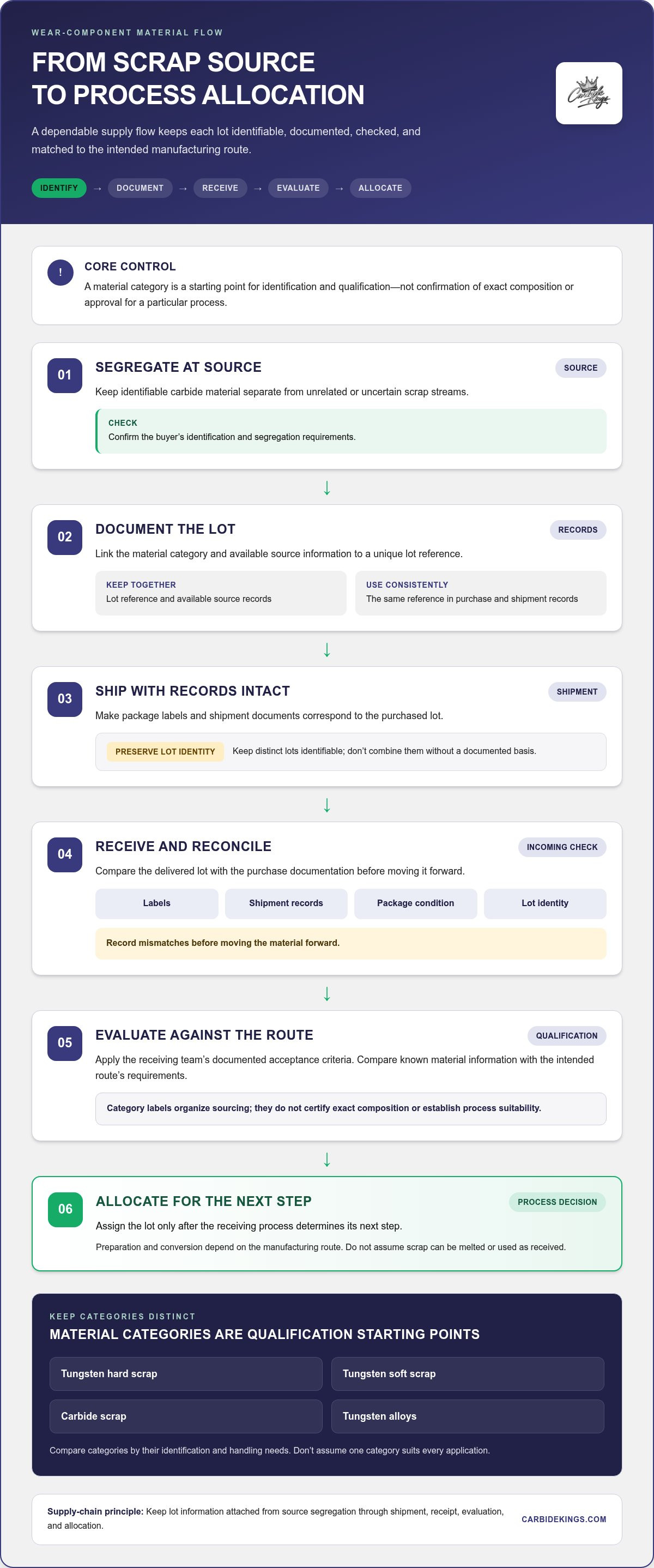
A reliable material flow keeps information attached to each lot as it changes hands. For industrial carbide scrap supply chains for wear component casting, the practical sequence is to identify and separate the material, document it, ship it, check it on receipt, evaluate it against the intended route, and allocate it for the next step. Preparation and conversion depend on the receiving process.
From source segregation to process allocation
Keep identifiable carbide material separate from mixed or uncertain scrap streams at the point of collection. Record the purchasing category, available source information, and a lot identifier. These details give procurement and receiving teams a consistent reference for comparing shipments or investigating a discrepancy.
Recycling methods vary. A historical Bureau of Mines report describes a zinc-alloying method for recovering components from cemented-carbide scrap, but that example is not a universal preparation instruction. The Bureau of Mines developed a method for recycling cemented-carbide scrap involving zinc alloying to recover costly components. Validate technical preparation or conversion steps against the requirements of the receiving manufacturing route.
- Segregate at source. Separate identifiable carbide material from unrelated or uncertain scrap. Verify: the buyer’s identification and segregation requirements.
- Document the lot. Link the material category and available source records to a unique lot reference. Use the same reference in purchase and shipment records.
- Ship with records intact. Use shipment documents and package labels that correspond to the purchased lot. Keep distinct lots identifiable rather than combining them without a documented basis.
- Receive and reconcile. Compare labels, shipment records, package condition, and lot identity with the purchase documentation. Record mismatches before moving the material forward.
- Evaluate and allocate. Apply the receiving team’s documented acceptance criteria, then assign the material to the appropriate next step. Validate: any sampling, testing, preparation, or conversion procedure for the specific process.
Protecting traceability at receipt
Receiving checks should confirm that a shipment matches its paperwork. A category label alone doesn’t prove technical suitability. Check that package labels are legible, records identify the same lot, and packaging preserves separation. Follow the buyer’s documented acceptance criteria, since no single sampling or testing protocol applies to every route.
If the material identity, package condition, or lot reference differs from the purchasing record, pause allocation. Document the discrepancy, keep the affected material separate, and follow the buyer’s established review process. This hold point helps prevent uncertain material from being treated as a confirmed process input.
Clear records also make replenishment conversations more useful. Buyers sourcing industrial tungsten and carbide scrap materials can use consistent category names and lot references to compare incoming shipments and plan procurement.
Compare Scrap Categories for Wear-Component Supply Needs
Category labels help organize procurement, but they don’t rank materials or establish that a lot suits a specific wear component. Composition, condition, records, and the receiving manufacturing route all matter. Use the comparison below to frame purchasing questions, then match the answers to documented process requirements.
| Category | Handling and identification focus | Procurement questions |
|---|---|---|
| Tungsten hard scrap | Keep it identified and separated from other scrap categories. Record the lot and its form as described by the source. | What source and category information accompanies the lot? Does its documented identity align with the buyer’s process requirements? |
| Tungsten soft scrap | Maintain a separate stream and record its physical condition. Don’t assume it can be handled or allocated like hard scrap. | How is the material identified and packaged? What records distinguish this lot from other incoming material? |
| Tungsten alloys | Manage as a distinct material stream, not as an interchangeable form of carbide scrap. | Does the material identity match the documented production specification? What information does the receiving team need for evaluation? |
Hard scrap versus soft scrap in procurement planning
Hard scrap and soft scrap are separate sourcing categories. Their labels alone don’t fully describe a lot’s composition, condition, or application fit. Physical form can also affect practical decisions. Lots that differ in size, shape, or packaging may need different segregation, storage, and shipment plans. Record those details instead of assuming every shipment in a category will arrive in the same form.
For broader material context, use this tungsten carbide reference and recycling guide. Buyers comparing the hard-scrap stream can also review the hard scrap recycling guidance for category-specific context.
When tungsten alloys need separate evaluation
Tungsten alloys need their own procurement and identification path. Don’t group them with carbide scrap simply because both are tungsten-bearing materials. Their identities may differ, and a category name doesn’t establish compatibility with a particular production route. Compare the available material information with the receiving team’s documented specifications before assigning a lot to an application.
For industrial carbide scrap supply chains for wear component casting, this comparison is a screening tool, not a substitute for process qualification. Keep category records clear, preserve lot separation, and direct questions about composition or condition through the buyer’s evaluation process. That gives production planners a sounder basis for forecasting inputs without making unsupported assumptions about performance or suitability.
Build a Practical Procurement and Incoming-Material Checklist
A dependable purchasing process starts before the order is placed. Separate the requirements that protect production from preferences that can be negotiated. This keeps material qualification clear while giving procurement room to plan shipment and receiving details. For industrial carbide scrap supply chains for wear component casting, buyer-defined process requirements should guide acceptance, not assumptions based on a category label.
Questions to resolve before placing a material order
Write down the material category, intended manufacturing route, and buyer-defined acceptance criteria. Make the specification clear to procurement, receiving, and production teams. For example, if the route requires a particular type of material documentation, state that requirement in the purchase records rather than relying on an informal understanding.
- Material identity: Specify the category being purchased and the information needed to identify it.
- Lot control: Agree on how lots will be labeled and kept distinct through shipment and receipt.
- Records: Define which shipment or source records should accompany the material and how they’ll be transferred.
- Receiving plan: Set packaging expectations, confirm receiving capacity, and assign responsibility for incoming checks.
- Disposition: Before the first shipment, document who can accept a lot, who can place it on hold, and how discrepancies are escalated.
Keep must-have process specifications separate from negotiable commercial and logistics preferences. Process specifications determine whether material can proceed through the buyer’s qualification process. Preferences may include shipment arrangements or delivery coordination, subject to agreement. Don’t let a flexible preference replace a required acceptance criterion.
How to reduce supply interruptions without overpromising
Use purchasing and receiving records to track approved categories, shipment history, and recurring discrepancies. Review them during planning to identify patterns, update forecasts, and clarify which material streams are qualified for a defined use. The guide to industrial scrap logistics planning can also inform shipment coordination.
Keep alternatives in view, but don’t treat a different category or source as an automatic substitute. Route any alternate stream through technical review and the buyer’s acceptance process before relying on it in production planning. This helps teams plan for continuity without assuming composition or process fit.
Commercial considerations belong in the plan too, but they shouldn’t blur material requirements. Procurement teams can use the guide to tungsten carbide scrap valuation factors as context when comparing sourcing options, while keeping buyer-defined technical criteria in focus.
Use these controls to prepare a clear material request for industrial tungsten and carbide scrap sourcing. A documented category, receiving plan, and escalation path give each incoming lot a defined next step.
Source Industrial Carbide Scrap with Carbide Kings
Dependable sourcing starts with a clear request. Carbide Kings supplies industrial buyers across the United States with tungsten hard scrap, tungsten soft scrap, carbide scrap, and tungsten alloys. These are distinct material categories for industrial procurement. Naming the category and intended application gives the sourcing discussion a practical starting point without treating sourcing as casting or technical process approval.
For wear-component producers, the goal is to align material purchasing with production needs. Define the material identity and documentation your process requires, then use those requirements to guide sourcing and incoming review. Technical acceptance depends on your manufacturing route and your organization’s criteria.
Match the sourcing request to the material stream
Be specific about the category. A request for tungsten hard scrap, tungsten soft scrap, carbide scrap, or tungsten alloys gives procurement a clearer basis than a broad request for “tungsten material.” Add the industrial application and any buyer-defined lot or documentation requirements. Clear information helps organize sourcing and align the material request with your receiving process.
Before making a request, bring together the details your team uses to define an acceptable input:
- Material category: Identify the stream that matches your procurement need.
- Application context: Describe the intended industrial use and production route.
- Lot requirements: Note the identification and records your receiving process relies on.
- Planning needs: Outline relevant delivery coordination and receiving considerations.
Move from evaluation to a sourcing conversation
Keep the steps simple. First, define your internal material and acceptance requirements. Next, identify the relevant category. Then discuss sourcing with those requirements in view. This sequence helps procurement teams communicate clearly while keeping technical evaluation tied to the buyer’s production process and documented criteria.
Carbide Kings supplies industrial material inputs, including tungsten hard scrap, tungsten soft scrap, carbide scrap, and tungsten alloys. These categories provide a starting point for procurement. Your team determines whether a particular lot meets its process specifications before allocating it to production.
Reliable industrial carbide scrap supply chains for wear component casting depend on clear requirements, defined material categories, and disciplined incoming review. Put your sourcing needs in order and identify the material stream before moving to the next step.
Turn Material Requirements into Your Next Sourcing Step
A dependable supply plan starts with a request your procurement and production teams can use consistently. Put the intended application, essential acceptance criteria, and lot documentation needs in one place. This gives each sourcing conversation a clear purpose and helps your team evaluate options against its own process, not assumptions about a material label.
Use that framework to strengthen industrial carbide scrap supply chains for wear component casting. Review the requirements with the people responsible for purchasing, receiving, and production, then address any gaps before the next order. Alignment upfront makes sourcing decisions easier to communicate and incoming material easier to manage.
Carbide Kings supplies industrial tungsten and carbide scrap materials to buyers across the United States, including hard scrap, soft scrap, carbide scrap, and tungsten alloys. When you’re ready to connect your requirements with a material stream, discuss your industrial carbide and tungsten scrap requirements with Carbide Kings.
Frequently Asked Questions
Can carbide scrap be used directly in wear-component casting?
Not automatically. A scrap lot needs evaluation and, where required, preparation or conversion for the receiving manufacturing route before it can serve as a production input. A category name alone doesn’t establish that a lot’s composition and condition meet a component’s requirements. Treat scrap as a potential recovered-material source, then use documented process criteria to determine its next step.
What is the difference between tungsten carbide hard scrap and soft scrap?
They are separate procurement categories, but the labels alone don’t fully describe physical form or composition. Classification practices can vary, so use the material description and available source records to understand what a shipment contains. Record whether the lot is supplied as identifiable pieces or another form rather than assuming every hard-scrap or soft-scrap shipment is identical.
How can buyers evaluate a carbide scrap lot for casting supply?
Compare the purchase description and lot records with your receiving process requirements. Note the material category, source information, package condition, and any visible difference from what was ordered. Then follow your organization’s approved evaluation procedure. If required information is missing or a shipment doesn’t match its documentation, hold the lot for review instead of assigning it to a production route by assumption.
Why does lot traceability matter in an industrial carbide supply chain?
Traceability connects a material lot to its purchase and receiving records. If a question arises later, such as a missing document or packaging discrepancy, staff can identify which shipment needs review without confusing it with other inventory. Consistent lot references also help procurement compare shipments over time and distinguish confirmed material information from assumptions or notes that apply to another batch.
Are tungsten alloys interchangeable with tungsten carbide scrap?
No. Tungsten alloys and tungsten carbide scrap are distinct procurement categories, so one shouldn’t be substituted for the other based only on their shared tungsten content. Match an alloy request to the buyer’s documented material requirements rather than treating it as a carbide-scrap order. Keep each stream separately identified and evaluate any proposed alternative against the production process before use.
How can manufacturers reduce interruptions in carbide scrap supply?
Build continuity around information your team controls. Keep current records of approved material categories, prior shipments, receipt outcomes, and open purchasing needs. If a planned stream becomes difficult to schedule, identify possible alternatives early, but don’t place unqualified material into the production plan. Have the technical team review substitutions before procurement treats them as acceptable inputs.
What information should a buyer provide when sourcing industrial carbide scrap?
Share the material category, intended industrial application, relevant production-route requirements, and the lot information your receiving team needs. Include packaging or delivery coordination details if they affect your receiving plan. Clear requests help organize industrial carbide scrap supply chains for wear component casting and reduce avoidable back-and-forth. Keep technical acceptance criteria specific to your process, and distinguish essential requirements from preferences.


