

Your local scrap yard is likely costing you thousands in lost revenue every time you drop off a load of tungsten. These generalist yards are convenient for common metals, but they rarely have the expertise or the incentive to pay true market value for high-performance industrial materials. It's frustrating to see your high-value inventory priced like basic structural steel. You know your material is worth more. This guide will show you exactly how to maximize your return when you sell carbide rods for scrap by outmaneuvering the volatile 2026 market.
The industry shifted rapidly this August with new federal regulations requiring tungsten scrap to stay within domestic borders. We'll help you understand these price drivers and why choosing a specialized national buyer is the only way to secure a professional, high-ROI transaction. You'll learn how to bypass local pricing traps, handle the logistics of heavy shipments, and determine if current trends suggest you should liquidate your stock immediately. We've refined the process so you can focus on your core operations while we handle the heavy lifting. It's time to stop settling for local rates and start capturing the full value of your industrial scrap.
Key Takeaways
- Understand the specific chemical composition of tungsten and cobalt that makes industrial rods significantly more valuable than standard steel scrap.
- Identify how 2026 global supply chain shifts and new domestic regulations are creating a unique window to maximize your scrap returns.
- Learn why specialized national buyers offer a higher ROI than local yards when you decide to sell carbide rods for scrap.
- Streamline your logistics by implementing a simple sorting and cleaning process that ensures you receive the highest possible tier of pricing.
- Accelerate your shop's cash flow by leveraging professional logistics and 24-hour payment terms designed for industrial scrap transactions.
What Are Scrap Carbide Rods and Why Are They High-Value?
Scrap carbide rods are high-density industrial solids that represent some of the most valuable material in your shop. Unlike common iron or aluminum, these rods are composed of Tungsten carbide, a compound of tungsten particles bonded together by a metallic binder, usually cobalt. This specific chemistry makes it incredibly hard and heat-resistant. It also makes it a strategic metal. Global supply chains are tightening; with China controlling over 80% of production, recycling domestic material is no longer just an environmental choice. It's a national priority.
When you prepare to sell carbide rods for scrap, you're dealing with what the industry calls "hard scrap." This category includes solid items like rods, end mills, and inserts. It's far more valuable than "soft scrap," which consists of grinding sludge or powders. Hard scrap is easier to refine. That translates directly to more money in your pocket. Because of federal regulations issued in August 2026, domestic buyers are now the primary outlet for this material. You need a partner who understands the industrial value of these solids.
Common Sources of Scrap Carbide Rods
You'll find these high-value materials in several areas of an industrial facility. Identifying them correctly ensures you don't overlook hidden revenue. Common sources include:
- Industrial drill blanks: Leftover stock or defective pieces from tool manufacturing.
- Aerospace and mining: Worn-out structural components and wear parts designed for extreme environments.
- Tool and die shops: Obsolete inventory or broken components from high-precision machining.
The Difference Between Carbide and Steel Rods
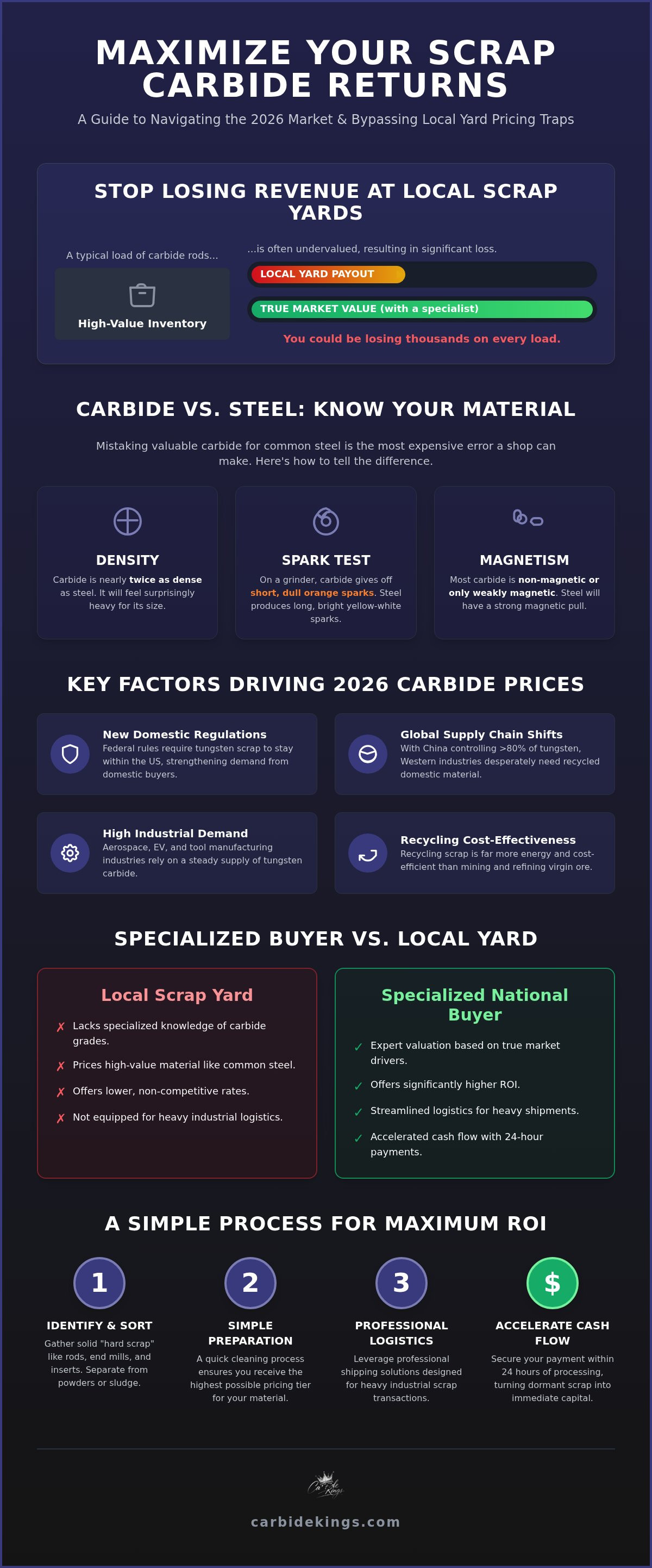
Mistaking carbide for common tool steel is a mistake that costs shops thousands of dollars. Carbide is nearly twice as dense as steel. If a rod feels surprisingly heavy for its size, it's likely carbide. You can also perform a "spark test" on a grinding wheel. Steel produces long, branching yellow sparks. Carbide produces short, dull orange sparks that stay close to the wheel. Most carbide is also non-magnetic or only weakly magnetic, whereas steel pulls a magnet strongly. If you treat these rods like steel, you're essentially throwing away the majority of their value. Identifying them correctly is the first step to a successful transaction when you sell carbide rods for scrap.
Factors Driving the Carbide Scrap Price Per Pound in 2026
Pricing for tungsten carbide doesn't happen in a vacuum. It's driven by global scarcity and intense industrial hunger. In August 2026, the market faced a significant shift. The US Bureau of Industry and Security (BIS) implemented a temporary rule requiring domestic scrap to stay within the country. This creates a unique environment for those looking to sell carbide rods for scrap. While it limits some export options, it strengthens the hand of specialized domestic buyers who need this material to fuel aerospace and EV manufacturing. These industries rely on the high-density properties of tungsten to maintain production schedules.
Don't ignore the cobalt binder when evaluating your inventory. Cobalt prices often fluctuate independently of tungsten, yet they can account for up to 15% of the rod's composition. When cobalt stays high, your scrap value follows. Additionally, the energy required to refine virgin tungsten ore is massive compared to the recycling process. High energy costs globally make your scrap more attractive to refiners than ever before. Recycling is simply more cost-effective than mining. This economic reality keeps the floor under scrap prices even when other commodities dip.
Global Market Trends Affecting Tungsten
Geopolitical tensions have tightened the grip on primary tungsten sources. China currently controls over 80% of global production and processing. Their recent export controls have forced Western industries to pivot toward domestic recycling to secure strategic metal supplies. This isn't just about environmental goals anymore; it's about national supply chain security. The current tungsten price acts as the primary benchmark for all scrap valuations, directly dictating how much a buyer can offer per pound. If you have significant inventory, you're sitting on a critical resource that industries are desperate to reclaim.
Purity and Grade: How They Affect Your Quote
Not all carbide is created equal. The specific grade of your rods matters. A higher percentage of cobalt binder can slightly shift the price per pound, as can the presence of advanced coatings. Materials like Titanium Nitride (TiN) or Titanium Aluminum Nitride (TiAlN) are common in high-performance rods. While they add performance in the shop, they require slightly more processing during recycling. Clean rods, free from steel attachments or heavy contamination, always command the highest premiums. Knowing the exact grade of your rods is essential when you prepare to sell carbide rods for scrap to ensure you aren't leaving money on the table. You can get a clear, transparent assessment of your material's value through the Carbide Kings process.
Specialized Buyers vs. Local Scrap Yards: A ROI Comparison
Choosing where to sell carbide rods for scrap is the single biggest factor in your final ROI. Most shop managers default to the nearest local scrap yard because it's five miles away. This convenience comes at a steep price. Generalist yards operate on high overhead and low specialized knowledge. They can't afford to pay you the full market value for tungsten because they don't have a direct path to industrial refiners. They act as middlemen, taking a significant cut of your profit before passing the material up the supply chain. You're essentially paying them for the privilege of taking your most valuable scrap off your hands.
Technology makes the ultimate difference in valuation. A local yard often relies on visual inspections or simple magnet tests. If they aren't 100% sure of the grade, they'll quote you a "safe" low price to protect their own margins. Specialized national buyers use portable X-Ray Fluorescence (XRF) analyzers to determine the exact chemical composition of your rods in seconds. This precision eliminates the guesswork. When a buyer knows exactly how much tungsten and cobalt is in your shipment, they can offer a price that reflects the actual metal content rather than a "best guess" estimate.
Why Local Yards Underpay for Carbide
The "mixed bin" trap is a common profit killer for industrial shops. Local yards frequently toss high-value carbide into a bin of heavy melting steel or low-grade alloys. They treat your strategic metals like common construction debris. Because they don't handle tungsten daily, they don't track the rapid fluctuations of the 2026 market. They charge a "risk premium" by underpaying you, ensuring they don't lose money if the market shifts before they can resell your material. This lack of transparency is why local transactions rarely result in a fair deal for the seller.
The National Buyer Advantage
National buyers provide a streamlined alternative that prioritizes your shop's bottom line. They possess deep expertise in selling tungsten hard scrap and maintain direct relationships with the refiners who need this material for aerospace and EV production. This skip-the-middleman approach allows for significantly higher payouts and standardized pricing models. You aren't subject to the whims of a local yard's cash flow. Instead, you get rates based on real-time global market data. Most national partners also provide comprehensive logistics support. They handle the freight and documentation, effectively erasing the distance between your shop and the best possible price. When you sell carbide rods for scrap through a specialized channel, you're choosing professional efficiency over local convenience.
How to Sell Carbide Rods: Preparation and Logistics
Maximizing your return begins long before the material leaves your shop floor. A methodical approach to preparation ensures you receive the highest tier of pricing without administrative delays. Follow these five steps to streamline your workflow when you sell carbide rods for scrap.
- Step 1: Sorting and cleaning. Remove all contaminants. Separate carbide rods from steel shanks, end mills, or inserts. Wipe off excess coolant or oil. Clean material always commands a premium.
- Step 2: Accurate weighing. Use a calibrated scale to record the weight of each lot. This documentation protects your bottom line and provides a baseline for your quote.
- Step 3: Secure packaging. Carbide is incredibly dense. Standard shipping containers often fail under the weight of industrial rods. Use reinforced materials to prevent box rupture.
- Step 4: Request a quote. Contact a specialized buyer to verify the carbide scrap recycling process. This ensures your material is valued based on real-time 2026 market data.
- Step 5: Finalize and get paid. Once the material is verified, professional buyers initiate payment immediately. At Carbide Kings, we focus on 24-hour payment terms to keep your cash flow moving.
Packaging Heavy Rods for Safe Transport
Don't risk a lost shipment by using flimsy packaging. Carbide rods are heavy and can easily punch through single-walled cardboard. Use double-walled boxes or, for larger lots, reinforced plastic buckets. It's vital to eliminate all "void space" inside the container. If rods can shift during transit, they act like a battering ram against the box walls. Use heavy-duty packing tape and clearly label the exterior with the total weight. If you're unsure about the best method for your volume, get professional logistics advice from Carbide Kings to ensure a smooth transaction.
Documenting Your Lot for Transparency
Transparency is the foundation of a high-ROI transaction. Take clear photos of your material and the scale reading before you seal the package. Create a simple manifest that lists the rod types and estimated weights. This small step speeds up the verification process significantly once the shipment reaches the refinery. It provides an immediate point of reference for the XRF analysis. When your documentation matches the buyer's findings, the payment process moves faster. You've done the hard work of identifying the material; proper documentation ensures you're rewarded for it. It's the most efficient way to sell carbide rods for scrap while maintaining a clear audit trail for your business.
Maximize Your ROI with Carbide Kings
Choosing a partner to sell carbide rods for scrap shouldn't be a gamble. You've seen how market volatility and improper sorting can drain your profits. Carbide Kings exists to solve these industrial pain points through a streamlined, national platform. We've refined our operations to remove the traditional barriers of heavy-metal logistics. When you work with us, you're choosing a partner that values your time and your material's true worth.
- Nationwide Logistics: We handle the shipping from any industrial facility in the United States.
- 24-Hour Payment: Our terms are designed to improve your shop's cash flow immediately after verification.
- XRF Transparency: We use precision analysis to ensure every quote is market-driven and accurate.
- Same-Day Response: Get the answers you need to keep your shop floor clear and your operations moving.
The Carbide Kings Process: Simple and Fast
Our workflow is designed to be as straightforward as a basic retail transaction. You don't have to worry about the complexities of global tungsten shifts or domestic export rules. We provide direct access to specialists who understand where to recycle tungsten carbide for maximum industrial value. Once you request a quote, we provide hassle-free shipping labels and can even schedule pickups for bulk lots. Our secure verification process happens in our facility, where we analyze your material and confirm weights with total transparency. It's a no-nonsense approach that ensures you get paid for every ounce of tungsten you ship.
Commercial Accounts and Bulk Solutions
High-volume manufacturing plants require more than a one-off transaction. We offer customized recycling programs tailored to the specific needs of large-scale operations. If your facility generates a consistent stream of scrap tool inventory, our dedicated support team can help you manage disposal schedules and logistics. This proactive partnership allows your team to remain focused on production while we handle the reclamation of strategic metals. It makes it easier to sell carbide rods for scrap on a recurring basis without adding to your administrative burden. We're proud of the reliability we offer to the industrial community; we're ready to prove it with your next lot.
Get Your Instant Carbide Scrap Quote from Carbide Kings
Secure Your Industrial ROI Today
Industrial scrap shouldn't be a headache or a loss leader for your facility. You've seen how specialized valuation and direct-to-refinery pipelines outperform local yards every time. Timing is critical in the 2026 market. New domestic regulations mean your inventory is a strategic asset. When you decide to sell carbide rods for scrap, you deserve a professional partner that respects your shop's efficiency and bottom line.
We've eliminated the traditional friction of metal recycling. Our team provides nationwide shipping and logistics support to get your material moving without administrative delays. Once we verify your lot, you can count on our fast 24-hour payment terms to boost your cash flow immediately. It's a transparent, market-based process designed for the modern industrial professional.
Get a Competitive Quote for Your Carbide Rods Today. Don't let valuable tungsten collect dust on your shelves. Take control of your scrap revenue and partner with a leader that delivers results. Your next high-ROI transaction is just one quote away.
Frequently Asked Questions
What is the current carbide scrap price per pound in 2026?
Market prices for tungsten carbide in August 2026 range from $6.00 to over $20.50 per pound based on material grade. High-quality solids recently peaked at $20.47 per pound on August 10. These rates are highly sensitive to the new US federal rule requiring 100% of tungsten scrap to be sold to domestic buyers. We provide real-time quotes to ensure your shop captures the highest possible value in this volatile environment.
How can I tell the difference between carbide and high-speed steel rods?
Weight is the most immediate indicator because carbide is nearly twice as dense as high-speed steel. A 6-inch carbide rod will feel significantly heavier than a steel rod of identical dimensions. You can also use a spark test. High-speed steel produces long, yellow, bushy sparks, while carbide creates short, dull orange sparks. Most carbide is also weakly magnetic or non-magnetic compared to the strong magnetic pull of common tool steel.
Is there a minimum weight requirement to sell scrap carbide rods?
We typically focus on industrial-grade volumes to ensure the shipping process is cost-effective for your shop. While we handle shipments of various sizes, larger lots often yield a significantly better return on investment due to shared logistics costs. If you are unsure if your current inventory meets the threshold to sell carbide rods for scrap, contact our team for a quick assessment. We specialize in managing bulk removals for high-volume manufacturing plants.
How do I ship heavy carbide rods without the box breaking?
Use double-walled corrugated boxes or reinforced plastic buckets to prevent high-density rods from punching through the packaging. It's critical to eliminate all void space using heavy-duty packing material or spray foam. If the rods can shift during transit, they will act like a battering ram against the container. Secure the exterior with multiple layers of reinforced packing tape and ensure the total weight is clearly labeled for the carrier's safety and compliance.
Do I need to remove coatings from the rods before selling them?
No, you don't need to remove coatings like TiN or TiAlN before shipping your material. Modern refining processes are designed to handle these thin layers without issue. While clean, uncoated rods are preferred, the presence of industrial coatings won't prevent you from receiving a competitive quote. Focus your time on removing steel shanks or heavy oil contamination instead, as these factors have a much larger impact on your final valuation.
How long does it take to get paid after I ship my carbide rods?
We prioritize speed to keep your shop's cash flow moving. Once your shipment arrives at our facility, we conduct a precision XRF analysis to verify the material grade and weight. We issue payment within 24 hours of this verification process. This streamlined timeline is a core part of our professional commitment, ensuring you aren't waiting weeks for a check like you might with traditional scrap dealers or local yards.
Can I sell broken or damaged carbide rods for the same price?
Broken or damaged rods are classified as "hard scrap" and command the same price per pound as intact tools. Refiners prioritize the chemical composition, specifically the tungsten and cobalt content, rather than the physical condition. As long as the material is solid carbide and free from steel shanks, the value remains high. This makes it easy to sell carbide rods for scrap even after they have shattered or worn out on the production line.
Why do national buyers pay more than my local scrap yard?
National buyers operate with direct-to-refinery pipelines that skip the local middleman. Most local yards don't have the technology to verify tungsten purity, so they offer lower "safe" prices to protect their own margins. We use XRF analyzers to provide transparent, market-driven quotes based on the actual metal content of your lot. Our nationwide logistics network also allows us to move large volumes efficiently, passing those overhead savings directly back to your business.


