

As of August 2026, every pound of your tungsten carbide scrap is now a matter of national security and industrial leverage. New export restrictions mean your domestic materials are more critical to the U.S. supply chain than ever before. You likely feel the weight of this responsibility, along with the literal weight of the heavy metal crates cluttering your shop floor. It's frustrating to let high-value materials sit idle because shipping is a logistical nightmare or because you're uncertain about the actual grade of your accumulated inserts and sludge.
You deserve a recovery process that's as precise as the tools you manufacture. This guide shows you exactly how to differentiate your hard solids from soft grinding scrap to maximize your valuation. We provide a clear framework for identifying scrap types and a streamlined process for national bulk procurement. Learn how to navigate the 2026 market shifts and secure competitive returns without the administrative hurdles of traditional dealers. We'll handle the logistics so you can stay focused on your core operations. The work is almost done once you know the right steps to take.
Key Takeaways
- Identify high-value carbide with precision using simple density and spark tests to distinguish it from common industrial steels.
- Maximize your recovery returns by segregating tungsten carbide scrap into distinct hard solid and soft grinding sludge categories.
- Navigate 2026 market shifts, including new export restrictions and the critical role of cobalt binders in material valuation.
- Streamline your operations by utilizing national bulk logistics that remove the complexity of shipping heavy industrial metals.
- Accelerate your cash flow with a professional procurement process that offers 24-hour payment terms following material verification.
Understanding Tungsten Carbide Scrap: Composition and Industrial Value
Industrial efficiency starts with understanding the materials on your shop floor. Tungsten carbide (WC) isn't just a metal; it's a cemented carbide compound where hard tungsten particles are "glued" together by a metallic binder, usually cobalt. This unique composition makes tungsten carbide scrap significantly more valuable than standard tool steel. While tool steel relies on iron and carbon, carbide offers superior hardness and heat resistance. Cobalt plays a dual role here. It provides the necessary toughness for industrial applications, but its market volatility directly impacts your scrap valuation. High cobalt content often increases the desirability of the material for recyclers looking to reclaim both elements.
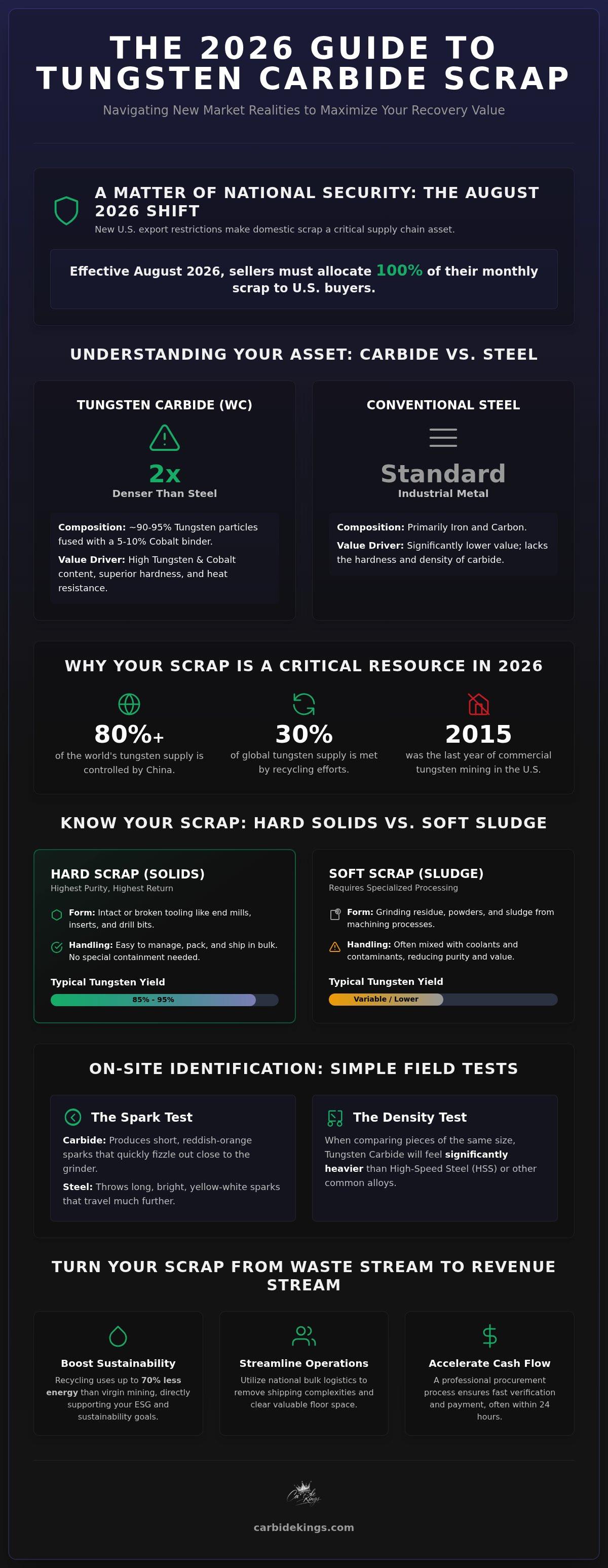
In 2026, the global supply chain has shifted the focus toward domestic recovery. China currently controls over 80% of the world's tungsten supply and has limited exports to just 15 state-approved companies. Since the United States hasn't seen commercial tungsten mining since 2015, recycling now provides approximately 30% of the global supply. Effective August 2026, new U.S. regulations require domestic sellers to allocate 100% of their monthly scrap sales to U.S. buyers. This makes your on-site inventory a critical asset for domestic manufacturing stability.
The Chemistry of Industrial Carbide
High-grade industrial tools typically maintain a precise ratio of roughly 90% to 95% tungsten to 5% to 10% carbon and binder. Understanding specific tungsten carbide properties helps you categorize material before it leaves your facility. Additives like tantalum or titanium are often introduced to enhance performance in high-heat environments. While these improve tool life, they require specialized processing during the recycling phase. Tungsten carbide is a metallic compound with twice the density of steel. This density is the primary reason it feels significantly heavier than high-speed steel (HSS) or common alloys.
Why Industrial Facilities Prioritize Carbide Recovery
The push for "closed-loop" manufacturing has reached a peak in 2026. Forward-thinking facilities don't view tungsten carbide scrap as waste; they see it as a secondary raw material. Recovering these minerals is far more efficient than virgin mining, which requires up to 70% less energy to refine ore into usable metal. By implementing a strict recovery program, your facility directly supports its sustainability audits and ESG goals. It's a straightforward way to reduce your carbon footprint while simultaneously generating immediate cash flow. Turning your used inserts and sludge into a revenue stream isn't just good for the environment; it's a smart business move that keeps your operations lean and profitable.
Tungsten Hard Scrap vs. Soft Scrap: A Side-by-Side Comparison
Differentiating between material types is the fastest way to improve your bottom line when managing tungsten carbide scrap. While both forms contain valuable elements, their physical states dictate how they are processed, valued, and transported. According to USGS tungsten market data, recycling efficiency is the primary driver of domestic supply stability in 2026. Understanding the difference between solids and powders ensures you don't leave money on the table during the recovery process.
Tungsten Hard Scrap: Tools, Inserts, and Solids
Hard scrap consists of solid, intact, or broken tooling components that have reached the end of their service life. This category includes high-value items such as end mills, wear parts, and the ability to sell carbide inserts for maximum recovery. Solids are the most straightforward materials for your shop to manage. They don't leak, they don't require special containment, and they offer the highest tungsten yield, typically between 85% and 95%. This high purity makes them a favorite for industrial manufacturers looking for quick transactions.
Industrial facilities often find that tungsten carbide drill bit recycling is the most efficient way to clear floor space while securing a high valuation. Because these items are dense and uniform, they are easy to pack in bulk crates for national shipping. This simplicity reduces your administrative burden and speeds up the verification process at the intake facility. You simply collect, weigh, and ship without worrying about complex chemical stabilization.
Tungsten Soft Scrap: Grinding Sludge and Swarf
Soft scrap is the secondary waste generated during the manufacturing or sharpening process. This includes grinding sludge, swarf, and floor sweeps. Unlike solids, soft scrap contains a mix of tungsten particles, metallic binders, and industrial coolants or oils. Specialized tungsten soft scrap buyers evaluate these materials based on their dry weight and purity rather than just total volume.
Managing sludge requires more attention to detail. It must be stored in leak-proof containers to prevent environmental contamination and logistical delays. The tungsten yield in soft scrap is generally lower than solids, often ranging from 30% to 70% depending on the moisture content. Dry swarf typically commands a higher price than wet sludge because it requires less energy to reach a refined state. If you have questions about your specific material grade, reaching out to a professional partner like Carbide Kings can clarify your recovery potential immediately.
The logistical gap between these two types is significant. While you can toss solids into a bucket, sludge requires specialized containment and moisture analysis to determine its true value. Knowing these differences helps you organize your tungsten carbide scrap for the most lucrative outcome in the 2026 market.
Identification Guide: Carbide vs. Steel and Other Industrial Metals
Accurate identification is the difference between an average payout and a top-tier recovery return. Don't rely on guesswork when sorting tungsten carbide scrap on your shop floor. The most reliable indicator is the density test. Tungsten carbide is roughly 1.5 to 2 times heavier than steel. If you hold a carbide end mill in one hand and an HSS end mill of the same size in the other, the weight difference is immediate and unmistakable. This physical property is why carbide feels "heavy" even in small quantities.
Spark testing offers another layer of verification. When held to a grinding wheel, high-carbon steel produces long, branching yellow sparks that travel far. In contrast, tungsten carbide produces very few sparks. Those that do appear are short, straight, and orange. Visual cues like coatings also provide clues. TiN coatings appear gold, while TiAlN coatings look dark violet or charcoal grey. Following guidelines for safe handling of tungsten carbide ensures your team stays protected while performing these manual checks. Always use proper ventilation and PPE when grinding or handling dust.
Magnetism is often misunderstood in the scrap world. While pure tungsten is non-magnetic, the cobalt binder used in industrial carbide makes the material weakly magnetic. It won't stick with the same force as mild steel, but a strong magnet will reveal a slight pull. If a tool is aggressively magnetic, it's likely high-carbon steel or an alloy with a much lower tungsten concentration. These simple tests allow you to verify your materials before they ever reach a scale.
Distinguishing Carbide from High-Speed Steel (HSS)
Mixing HSS into your carbide lot is a costly mistake. Most scrap yards will downgrade the entire container to the lowest-value metal present if they find significant contamination. An HSS end mill might look identical to a carbide one after years of use, but the weight will always give it away. Always segregate your HSS tooling into its own bin to preserve the purity and value of your tungsten carbide scrap.
Identifying Specialized Tungsten Alloys
Your facility might produce more than just cutting inserts. Specialized items like Mallory metal or high-density "heavy alloys" are often used for counterweights or radiation shielding. These require specific carbide wear parts recycling procedures due to their unique alloy signatures. You should also watch for brazed tools, where a carbide tip is silver-soldered to a steel shank. These must be categorized separately because the steel shank dilutes the total tungsten percentage of the piece. Proper segregation at the source ensures you receive the full value for the high-density components.
Maximizing Your 2026 Tungsten Carbide Scrap Value
Maximizing the value of your tungsten carbide scrap requires a shift from viewing it as waste to treating it as a managed asset. In the 2026 industrial market, the gap between a well-prepared lot and a disorganized one can represent thousands of dollars in lost revenue. You shouldn't leave your returns to chance. Purity is the primary driver of value. If your scrap arrives at a facility mixed with high-speed steel or common alloys, the time required for manual sorting will likely be deducted from your payout. Professional preparation ensures you keep that profit in your own pocket.
Decontamination is equally vital for industrial manufacturers. Excess coolant, oil, and floor debris add dead weight that doesn't contribute to your bottom line. Clean, dry material is verified faster and paid out at higher rates. Additionally, focus on volume. Bulk shipments dramatically improve the tungsten carbide scrap price by reducing the per-pound cost of freight and administrative processing. Consolidate your materials until you reach a significant weight threshold to maximize your logistical efficiency and overall return on investment.
Best Practices for Shop Scrap Management
Efficiency on the shop floor prevents losses before they happen. Implement a color-coded bin system to ensure every machinist knows exactly where used inserts and broken end mills belong. A simple mistake like tossing a steel shank into the carbide bin lowers the purity of the entire lot. Training your team on the economic value of these materials is a high-return investment. When staff realize that these materials represent a premium commodity, they become more diligent about segregation. Finally, keep your high-value bins in a secure, monitored area. The density of carbide makes it easy to transport and attractive for unauthorized removal.
Evaluating the 2026 Market Drivers
The 2026 market is currently shaped by a combination of limited virgin mining output and surging demand from high-tech manufacturing sectors. As aerospace and defense industries expand, the need for recycled tungsten has never been higher. This scarcity drives prices upward, but only for those who can prove the quality of their material. Generic local scrap yards often lack the specialized analysis tools to give you a fair price for carbide. They typically offer a safe, lower rate that protects their margins rather than yours.
Working with a specialized industrial buyer allows you to access direct-to-refinery pricing. This eliminates the middleman and ensures your valuation is based on current global market indices. If you want to streamline your recovery and secure the best possible returns, contact Carbide Kings to handle your industrial scrap procurement with professional precision. The process is designed to be fast, transparent, and lucrative for your facility.
Streamlining Industrial Procurement with Carbide Kings
Efficiency in the front office is just as important as efficiency on the shop floor. Dealing with traditional scrap yards often leads to slow quotes and even slower payments. Carbide Kings eliminates these bottlenecks. We focus exclusively on industrial-grade materials, providing a professional alternative to generic recyclers. Our process for managing tungsten carbide scrap is built for speed and accuracy. We understand that your time is valuable, so we've removed the traditional barriers to material recovery. You get a transparent, results-oriented partner that treats your scrap as a premium commodity.
National Logistics and Industrial Shipping
Shipping heavy metal across the country shouldn't be your problem. We handle the freight for large industrial lots across the entire U.S., removing the logistical burden from your team. You can request pre-paid shipping labels or scheduled freight pick-ups directly through our platform. Because tungsten carbide scrap is exceptionally dense, secure packaging is mandatory. We recommend using double-walled boxes or reinforced crates to prevent shifting during transit. This proactive approach ensures your material arrives safely and is ready for immediate verification. We manage the heavy lifting so your facility stays focused on its core operations.
The Fast-Track Payment Process
Cash flow is the lifeblood of your operation. Our 24-hour payment term after material verification is the benchmark for the industrial sector. The process is straightforward and methodical. First, you receive a transparent quote based on 2026 market rates. Next, you ship your material using our streamlined logistics. Once it arrives, we verify the grade and purity using specialized analysis tools. Finally, we issue payment within one business day. There's no unnecessary paperwork or administrative hurdles. We also provide detailed settlement reports for your facility’s records, making the audit trail for your ESG goals or financial accounting effortless.
Ready to clear your floor and maximize your returns? You can start the selling tungsten hard scrap process today. It’s a direct, honest conversation between industry peers that results in a fair, fast transaction. The work is as good as done once you engage with our streamlined system. Let us show you why industrial manufacturers across the country trust us with their high-value material recovery.
Securing Your Industrial Recovery Returns in 2026
You now have the strategic framework to differentiate between high-value solids and complex grinding sludge. By implementing strict shop-floor segregation and density testing, you ensure your facility never leaves money on the table. With 2026 export controls tightening the global supply, your domestic tungsten carbide scrap has become an essential industrial asset that requires professional management. It's no longer just about clearing floor space; it's about maximizing a critical financial resource that supports your bottom line.
Don't let valuable materials sit idle or settle for the safe, lower rates offered by generic local scrap yards. We provide expert valuation for both hard and soft scrap, supported by national industrial logistics that remove every shipping hurdle. You can Get a Quote for Your Industrial Carbide Scrap Today and benefit from our 24-hour payment processing once your material is verified. We're ready to handle the heavy lifting so you can stay focused on your primary production goals. Your recovery process should be as efficient as the tools you manufacture.
Frequently Asked Questions
Is tungsten carbide scrap worth more than standard steel scrap?
Yes, tungsten carbide scrap is significantly more valuable than standard steel because it contains rare elements like tungsten and cobalt. While standard steel is primarily iron, carbide is a dense, engineered compound with superior hardness. This rarity and the energy-intensive nature of virgin mining make recycled carbide a premium industrial asset. You'll consistently see higher recovery returns for carbide compared to high-speed steel or common alloys.
Can I recycle carbide grinding sludge and swarf?
You can certainly recycle grinding sludge and swarf, which are classified as soft scrap. These materials require leak-proof containment and careful moisture analysis to determine the actual tungsten yield. While processing sludge is more complex than handling solids, it remains a lucrative revenue stream for manufacturing facilities. We specialize in the chemistry of soft scrap recovery, ensuring you receive a fair market valuation for your industrial byproducts.
What is the best way to identify tungsten carbide without an XRF analyzer?
The most reliable manual methods are the density test and the spark test. Tungsten carbide is nearly twice as heavy as steel, so a simple weight comparison often reveals the material grade. Additionally, if you touch the metal to a grinding wheel, carbide produces short, orange sparks, whereas steel creates long, branching yellow sparks. These shop-floor techniques allow your team to sort materials quickly without expensive analysis equipment.
Do I need to remove the steel shanks from brazed carbide tools before selling?
You don't necessarily need to remove the steel shanks, but doing so will increase the purity and valuation of your lot. Brazed tools are considered mixed because the steel shank dilutes the overall tungsten percentage. If you sell them as-is, the price per pound will reflect the lower total density. Segregating the carbide tips or clearly labeling brazed items helps us provide a more accurate and transparent settlement for your facility.
How much tungsten carbide scrap do I need for a bulk shipment?
We recommend a minimum of 50 pounds to make the logistics of a bulk shipment cost-effective, though we handle much larger industrial loads. Consolidating your tungsten carbide scrap into significant lot sizes reduces the per-pound impact of freight and administrative costs. Our national logistics support is designed to manage heavy shipments efficiently, ensuring that the recovery process remains profitable regardless of the physical volume you've accumulated on your shop floor.
How fast does Carbide Kings issue payment for scrap lots?
We issue payment within 24 hours of material verification. Once your lot arrives at our facility, our team performs a precise analysis to confirm the grade and weight. This streamlined process eliminates the long wait times associated with traditional scrap dealers. Our goal is to provide immediate liquidity for your facility, turning your used industrial tools into capital with a fast, results-oriented transaction that respects your schedule.
What are the current 2026 market drivers for tungsten carbide prices?
The 2026 market is primarily driven by strict export controls in China and new U.S. domestic allocation requirements. Because the U.S. relies entirely on recycling for its tungsten supply, domestic scrap has become a critical strategic resource. These geopolitical shifts, combined with the 70% energy savings achieved through recycling versus mining, have created a high-demand environment. Staying informed on these trends helps you time your shipments for maximum profitability.
Does coating on carbide inserts affect the recycling value?
Coatings like Titanium Nitride (TiN) or Titanium Aluminum Nitride (TiAlN) generally don't negatively impact the recycling value. While these coatings are essential for tool performance, they represent a microscopic fraction of the tool's total mass. Recyclers prioritize the core tungsten carbide scrap composition, specifically the tungsten and cobalt content. You can include coated inserts in your bulk lots without worrying about a reduction in your final valuation or settlement.


