
Your worn-out carbide wear parts aren't just industrial waste; they're a high-yield asset currently sitting idle in your scrap bin. Most facility managers treat disposal as a necessary chore, but shifting your perspective can turn a logistical burden into a high-impact procurement strategy. Professional carbide wear parts recycling is the key to reclaiming significant value from your production cycle while keeping your facility lean and organized.
You've likely dealt with the typical industry headaches: confusing logistics for heavy shipments, uncertainty about material purity, and those agonizingly slow payment terms from traditional dealers. It's frustrating when administrative hurdles eat into the profits of your scrap. We believe the process should be as straightforward and lucrative as any other part of your business operation. You deserve a transparent system that values your time as much as your material.
This guide shows you exactly how to identify, value, and move your industrial carbide to maximize your ROI. We'll preview the steps to streamline your scrap management, from metallurgical identification to securing 24-hour payment cycles. By the end of this article, you'll have a clear, no-nonsense plan to handle your heavy scrap with professional efficiency and total transparency.
Key Takeaways
- Learn to identify high-value tungsten carbide using density and spark tests to separate premium materials from common industrial steel scrap.
- Discover how material purity and lot volume directly influence your total return on investment for carbide wear parts recycling.
- Master the logistics of bulk scrap management by using reinforced containers and national shipping support to move high-density loads efficiently.
- Increase your facility's liquid assets by taking advantage of streamlined administrative processes and 24-hour payment cycles.
- Learn the critical preparation steps, such as removing steel casings and braze material, to ensure you receive the highest possible market price.
Understanding the Industrial Value of Tungsten Carbide Wear Parts
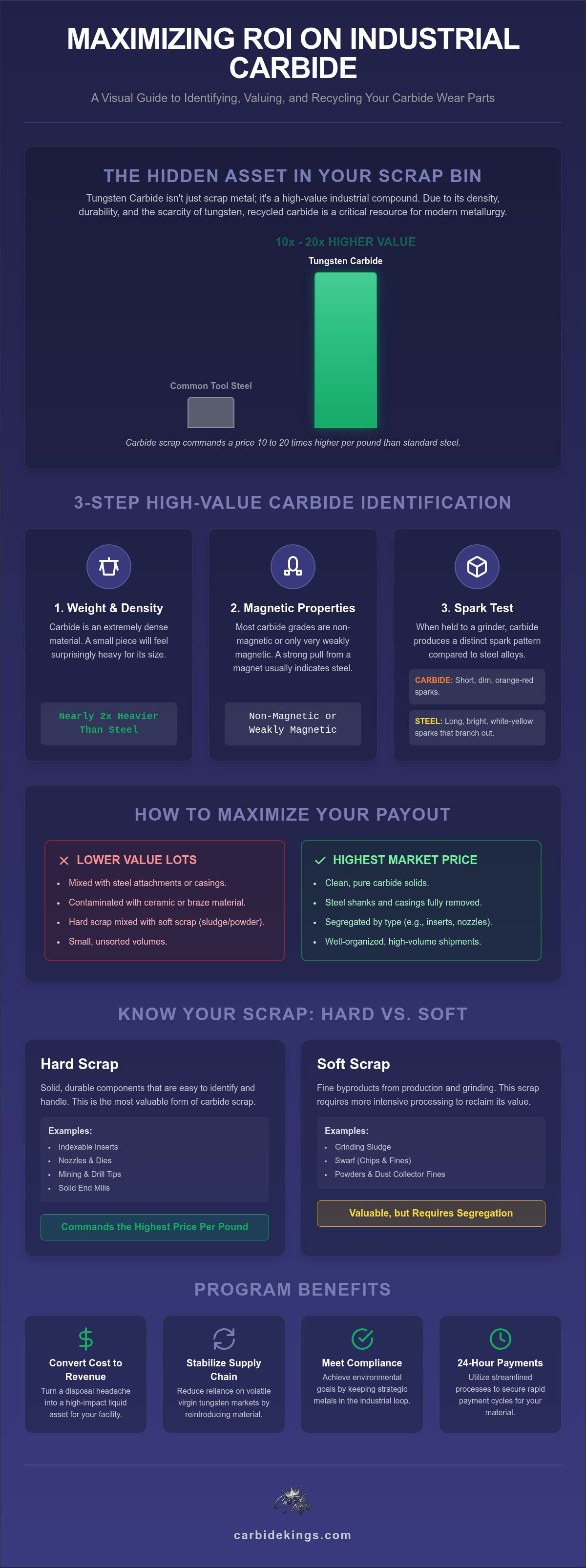
Tungsten carbide is a critical industrial compound, not just another metal in the bin. These wear parts are engineered for the most punishing environments. They survive extreme heat and abrasion that would melt or shatter standard alloys. Because of these unique Tungsten Carbide Properties, the material is incredibly dense, heavy, and valuable. Carbide scrap often commands a price 10 to 20 times higher than common tool steel. This massive value gap exists because tungsten is a scarce, finite resource. Today, recycled material serves as the primary feedstock for modern metallurgy. This makes carbide wear parts recycling a vital financial strategy for any high-output facility looking to reclaim capital.
The material structure relies on a cobalt binder to hold the carbide grains in a metallic matrix. This allows the part to resist impact while maintaining its cutting or grinding edge. Cobalt is itself a high-value strategic metal. Its presence in the alloy significantly enhances the recyclability of the part. When you recycle these components, you aren't just selling tungsten; you're selling a complex, high-value alloy package that is in constant demand by manufacturers worldwide.
Why Industrial Facilities Prioritize Carbide Recovery
Turning a disposal cost into a revenue stream is a major economic win. Most facilities view scrap as a logistical headache. We view it as a liquid asset. Relying on virgin tungsten markets is risky due to global supply fluctuations and mining output limits. By prioritizing recovery, you stabilize your internal supply chain and protect your margins. It's also a straightforward way to meet environmental compliance goals. Responsible metallurgical recovery ensures that these strategic metals remain in the industrial loop rather than being wasted in a landfill.
The Difference Between Hard Scrap and Soft Scrap
Your facility likely produces different types of waste, and knowing the difference is key to your ROI. Executing a consistent carbide wear parts recycling program for your hard scrap ensures you capture the top tier of market value. We categorize material into two primary types:
- Hard Scrap: These are solid components like nozzles, dies, mining tips, and indexable inserts. They're heavy, durable, and easy to identify.
- Soft Scrap: This category includes the fine byproducts of production like grinding sludge, swarf, and powders.
Solid wear parts command the highest market price per pound. They require less intensive processing than contaminated sludge or fine powders. Because they are nearly pure alloy, they offer the most direct path to a high-yield payout. Segregating these solids from other shop waste is the fastest way to streamline your scrap management and maximize your facility's returns.
Identifying High-Value Industrial Carbide Wear Components
Identifying your scrap correctly is the first step toward a high-yield payout. Don't let valuable material get tossed in the tool steel bin by mistake. Tungsten is officially recognized on the USGS Critical Minerals List, meaning its recovery is a strategic priority for the entire industrial sector. To separate carbide from lower-value metals, follow this simple checklist:
- Weight and Density: Carbide is nearly twice as heavy as steel. If a small part feels unexpectedly heavy in your hand, it's likely carbide.
- Non-Magnetic Properties: Most tungsten carbide is non-magnetic or only weakly magnetic. If a magnet sticks firmly, you're likely looking at steel or a heavy steel casing.
- Spark Testing: When held to a grinder, carbide produces short, orange, discrete sparks. Steel produces long, white, branching sparks that explode at the ends.
Maximizing your lot value requires minimal contamination. Clean carbide is defined as material free from excessive steel attachments or ceramic coatings. If your parts are brazed to steel shanks or encased in steel housings, take the time to separate them. Removing these attachments ensures your shipment is graded at the highest possible purity level. Specialty alloys, such as cobalt-tungsten carbide, are particularly sought after for their specific metallurgical properties. If you're unsure about your material grade, you can request a professional valuation to ensure no value is left on the table.
Common High-Value Wear Parts in Manufacturing
In high-precision environments, carbide is found in various critical components. Look for drawing dies and extrusion nozzles used in wire and cable manufacturing; these parts are often solid carbide to withstand high friction. High-pressure pump systems frequently utilize carbide bushings, bearings, and seal rings to prevent premature failure. Wood and paper processing facilities should collect industrial knives and circular saw tips. These components represent some of the most consistent streams for carbide wear parts recycling because of their high purity and predictable weights.
Mining and Construction Carbide Scrap
The mining and road construction sectors generate massive volumes of heavy-duty scrap. Tungsten carbide drill bits and road milling teeth are prime candidates for recovery. You will also find value in rock crushing jaws and heavy-duty wear plates designed for maximum impact resistance. To increase your payout, separate the used carbide bits from their steel shanks. While it takes extra effort upfront, shipping pure carbide inserts instead of mixed steel-carbide assemblies drastically improves your price per pound. This simple step transforms a low-value mixed load into a premium industrial shipment that moves through the carbide wear parts recycling process with ease.
The Economics of Carbide Recycling: ROI and Market Factors
Market dynamics for tungsten are dictated by global scarcity and high domestic demand. The United States relies heavily on imported material, which makes secondary recovery through carbide wear parts recycling a critical economic lever for local manufacturers. The 2022 Final List of Critical Minerals highlights the strategic vulnerability of tungsten supply chains. Because of this, industrial buyers pay a premium for consistent, high-purity scrap streams that reduce their reliance on volatile virgin ore prices.
Individual facility ROI depends on two primary factors: purity and lot volume. While selling mixed loads is faster, the labor cost of internal sorting often pays for itself through a significantly higher price per pound offer. For an up-to-date look at how these variables shift your bottom line, consult our tungsten carbide scrap price guide. Understanding these market drivers allows you to time your sales for maximum yield rather than just clearing floor space. It's a shift from simple waste management to active asset recovery.
Zinc Process vs. Chemical Recovery
The method used to process your scrap directly dictates the offer you receive. The Zinc Process is the preferred choice for solid, clean wear parts. It converts scrap back into usable powder without altering the chemical composition, preserving the material's integrity with lower energy costs. Chemical Recovery is a more intensive process reserved for contaminated or low-grade materials. Because chemical processing involves higher overhead and lower yields, the payout for these lots is naturally lower. Segregating your high-grade solids ensures they qualify for the more efficient zinc reclamation path, putting more money back into your budget.
Maximizing ROI on Bulk Carbide Lots
Shipping in bulk is the most effective way to protect your margins. Logistics costs for high-density materials can be prohibitive for small, frequent shipments. Consolidating your material into larger lots reduces the per-pound freight expense and simplifies your administrative workload. Transparency is vital in these transactions. We prioritize clear weight verification and documentation to ensure you're paid for every ounce of material delivered. Combining bulk logistics with our 24-hour payment terms transforms carbide wear parts recycling from a slow administrative hurdle into a reliable, fast-acting source of facility cash flow. The work is as good as done once the shipment leaves your dock.
Streamlining Industrial Scrap Logistics for National Operations
Moving thousands of pounds of dense material across the country requires more than just a truck. Most facilities struggle with the logistics of carbide wear parts recycling because they treat it like standard waste. It's not. It is a high-value industrial asset that requires specialized handling. A national buyer should do more than just quote a price. They should handle the heavy lifting of logistics coordination. We simplify this by managing the freight, providing the paperwork, and ensuring your material moves from your dock to our facility without administrative friction.
Packaging and Securing Heavy Carbide Scrap
Standard cardboard boxes are a liability when dealing with tungsten carbide. The extreme density of the material means even a small volume can easily exceed the burst strength of corrugated paper. To ensure a safe arrival, use reinforced steel drums or heavy-duty crates. Standard packaging won't hold up under the weight of solid wear parts.
- Use 5-gallon or 30-gallon steel drums for manageable bulk lots.
- Never exceed the weight rating of your pallet; standard 48x40 pallets have specific limits.
- Secure all containers with steel banding or heavy-duty stretch wrap to prevent shifting.
- Center the weight on the pallet to maintain stability during forklift maneuvers and transit.
Safety for your machine shop floor staff is the top priority. Clearly marking the weight on every container prevents over-exertion and equipment failure. Once the material is palletized, it's ready for the long haul. Preparing your shipment correctly ensures you get the full value of your lot without deductions for damaged packaging or lost material.
National Shipping and Freight Coordination
Leveraging a buyer's freight accounts is the fastest way to reduce your shipping overhead. We coordinate the carrier and provide a pre-filled Bill of Lading (BOL) to ensure accuracy. This documentation is vital for national transit. It protects you by verifying the weight and class of the material before it leaves your site. You can learn more about the step-by-step workflow in our guide to the industrial carbide scrap recycling process.
High-value industrial assets deserve professional protection. We include tracking and insurance as standard parts of our logistics support. This removes the risk of loss or damage during transit. When the process is this streamlined, your scrap management becomes a predictable, hands-off operation. The work is as good as done once the truck pulls away from your facility.
Ready to ship your bulk lot? Contact us to schedule your freight pickup today.
Partnering with Carbide Kings for High-Yield Recovery
Traditional scrap dealers often operate with outdated, manual processes that slow down your facility's cash flow. We've built Carbide Kings to be the streamlined, modern alternative. Our entire business model focuses on professional efficiency and high-yield recovery for industrial clients. By removing the administrative friction typical of the recycling industry, we let you stay focused on your core manufacturing operations. Our process is built on a foundation of speed: fast quotes, nationwide logistics support, and 24-hour payment terms. You get the relief of removing logistical burdens and the satisfaction of a fair, fast transaction every time.
The Carbide Kings Advantage: Speed and Transparency
When you contact us, you speak directly with industrial metal experts, not generic scrap yard staff. This deep metallurgical expertise is critical when selling tungsten carbide wear parts for maximum value. We understand the specific nuances of your scrap and price it according to real-time market data. We've eliminated the unnecessary paperwork and administrative barriers that usually stall these transactions. Our pricing is consistent and competitive, ensuring you receive a premium return on your high-value alloys. Transparency isn't just a buzzword for us; it's how we maintain our reputation as a trusted national partner for carbide wear parts recycling. We're proud of the reliability we offer to the industrial community.
Getting Started: Your First Bulk Evaluation
Initiating your first recovery lot is simple and direct. You don't need to navigate complex portals or wait weeks for a representative to call you back. We only need a few key details to begin the process. Our team is ready to move as quickly as you are. To get started, simply follow these steps:
- Provide an estimated weight of your current carbide scrap lot.
- Identify the primary part types, such as mining tips, drawing dies, or indexable inserts.
- Share any specific details regarding material purity or remaining steel attachments.
Once we have this information, we provide a competitive quote based on current industrial demand. If the terms meet your approval, we handle the rest of the heavy lifting. We schedule your national freight pickup with a supportive carrier that understands the requirements of heavy industrial loads. The entire workflow is designed to move your material quickly from your shop floor to our processing center. Request a bulk lot evaluation today and see how easy it is to turn your wear parts into liquid capital. We handle the logistics so you can remain focused on your own core operations. The work is as good as done.
Turn Your Industrial Scrap into Liquid Capital
Maximizing the value of your facility's waste requires a shift in perspective. By correctly identifying high-density components and preparing clean lots, you transform a disposal chore into a high-yield asset recovery program. Efficient carbide wear parts recycling is about more than just clearing floor space; it's a strategic procurement move that protects your margins against volatile virgin material markets.
We handle the heavy lifting so you can stay focused on your core production. Our specialized industrial tungsten experts provide the transparency and speed you need to keep your operations lean. With our national logistics support and industry-leading 24-hour payment terms, the entire process is as straightforward as any other business transaction. You've done the hard work of manufacturing; let us handle the final step of the material lifecycle.
Ready to see the real value of your current inventory? Get a Fast Quote for Your Carbide Wear Parts today. We are ready to streamline your scrap management and put capital back into your budget immediately.
Frequently Asked Questions
What are the most common industrial items that contain tungsten carbide?
Common industrial items include indexable cutting inserts, mining drill bits, road milling teeth, and wire drawing dies. You will also find tungsten carbide in high-pressure waterjet nozzles, pump seal rings, and specialized wood-processing knives. These components are selected for their extreme hardness and resistance to thermal shock. Identifying these parts correctly on your shop floor is the first step toward a successful asset recovery program.
How can I tell the difference between tungsten carbide and stainless steel?
Density and weight are the most reliable indicators for identification. Tungsten carbide is nearly twice as heavy as stainless steel for the same volume. A small carbide part will feel surprisingly heavy in your hand. Additionally, you can perform a spark test on a grinder. Carbide produces short, discrete orange sparks. Stainless steel produces long, branching white sparks that explode at the ends.
Is there a minimum weight requirement for recycling carbide wear parts?
We primarily focus on bulk industrial lots to ensure the best logistics efficiency for our clients. While there is no strict legal minimum, we recommend consolidating at least 50 pounds of material before scheduling a pickup. Larger lot sizes allow you to leverage our national logistics support more effectively. Shipping in bulk minimizes the per-pound freight cost and maximizes the total return on your investment.
Do I need to remove steel attachments from carbide parts before selling?
Removing steel shanks, casings, or braze material is highly recommended to maximize your payout. Clean carbide parts are graded at a higher value because they don't require the extra labor of mechanical separation. If you choose to sell mixed lots, the price is adjusted downward to reflect the weight of the lower-value steel attachments. Taking the time to separate these materials ensures you receive the top market price.
How is the price of carbide scrap determined in the US market?
The price of carbide scrap is determined by global tungsten market drivers and domestic industrial demand. Factors include mining output from major global producers and the current scarcity of critical minerals in the US supply chain. The purity of your lot and the current price of cobalt binders also impact the final offer. We track these metallurgical market shifts daily to provide the most accurate and competitive pricing possible.
What is the fastest way to get paid for a bulk lot of carbide scrap?
Choosing a specialist buyer with 24-hour payment terms is the fastest way to receive your funds. Traditional scrap dealers often lack the metallurgical expertise to value your material quickly, leading to long administrative delays. By focusing your carbide wear parts recycling efforts through a streamlined partner, you eliminate unnecessary paperwork. We verify the weight and purity immediately upon arrival to ensure your facility maintains a healthy, predictable cash flow.
Can you recycle carbide grinding sludge along with solid wear parts?
Grinding sludge and solid wear parts can both be recycled, but they must be kept in separate containers. Sludge is categorized as soft scrap and undergoes a chemical recovery process. Solid components like nozzles and dies are hard scrap and usually processed via the more efficient Zinc Process. Mixing these materials complicates the recovery and will significantly lower the price per pound offered for your solid carbide parts.
What shipping methods are recommended for heavy tungsten scrap?
We recommend using reinforced steel drums or heavy-duty crates secured to a standard pallet with steel banding. Because tungsten carbide is exceptionally dense, standard cardboard or plastic containers often fail under the weight during national transit. Our team provides comprehensive freight coordination to assist with these heavy loads. Using the correct carbide wear parts recycling logistics prevents material loss and ensures your high-value industrial assets arrive safely at our facility.


