
If you're currently tossing your worn-out drill bits into the heavy melt steel bin, you're likely throwing away 90% of their actual value. It's a common mistake in busy shops, but it's one that drains your bottom line every single month. Mastering tungsten carbide drill bit recycling isn't just about being environmentally conscious; it's about capturing the high-value returns your operations deserve.
You've probably felt the frustration of trying to distinguish between low-grade alloys and high-purity carbide while parts pile up on the floor. It's easy to let logistics get in the way of profit when shipping heavy industrial scrap feels like a second job. We're here to change that. This checklist provides a clear, professional framework to identify, sort, and prepare your materials for maximum return. You'll learn how to handle the August 2026 export regulations and find a reliable national partner to handle the heavy lifting. Let's turn your scrap pile into a streamlined revenue stream.
Key Takeaways
- Learn the visual and magnetic tests used to distinguish high-value carbide inserts from standard steel bodies.
- Discover how basic cleaning and manual separation of inserts can significantly increase your payout per pound.
- Understand how market drivers like the London Metal Exchange and cobalt binder percentages dictate the final value of your scrap.
- Stay compliant with the 2026 domestic sales mandate while optimizing your tungsten carbide drill bit recycling program for maximum efficiency.
- Partner with a national direct buyer to eliminate administrative hurdles and handle all logistical heavy lifting for your bulk scrap.
Why Tungsten Carbide Drill Bit Recycling is an Industrial Priority
Tungsten carbide is a dense, exceptionally hard compound formed by the precise combination of tungsten and carbon atoms. In the industrial sector, it's the gold standard for durability. This material is the lifeblood of the mining, oil and gas, and heavy construction industries. These sectors rely on carbide for its ability to withstand extreme heat and abrasive environments that would shatter standard steel. However, the value of these tools doesn't vanish once the cutting edge is gone. High-volume tungsten carbide drill bit recycling is now a core requirement for any operation looking to maintain a lean, profitable bottom line.
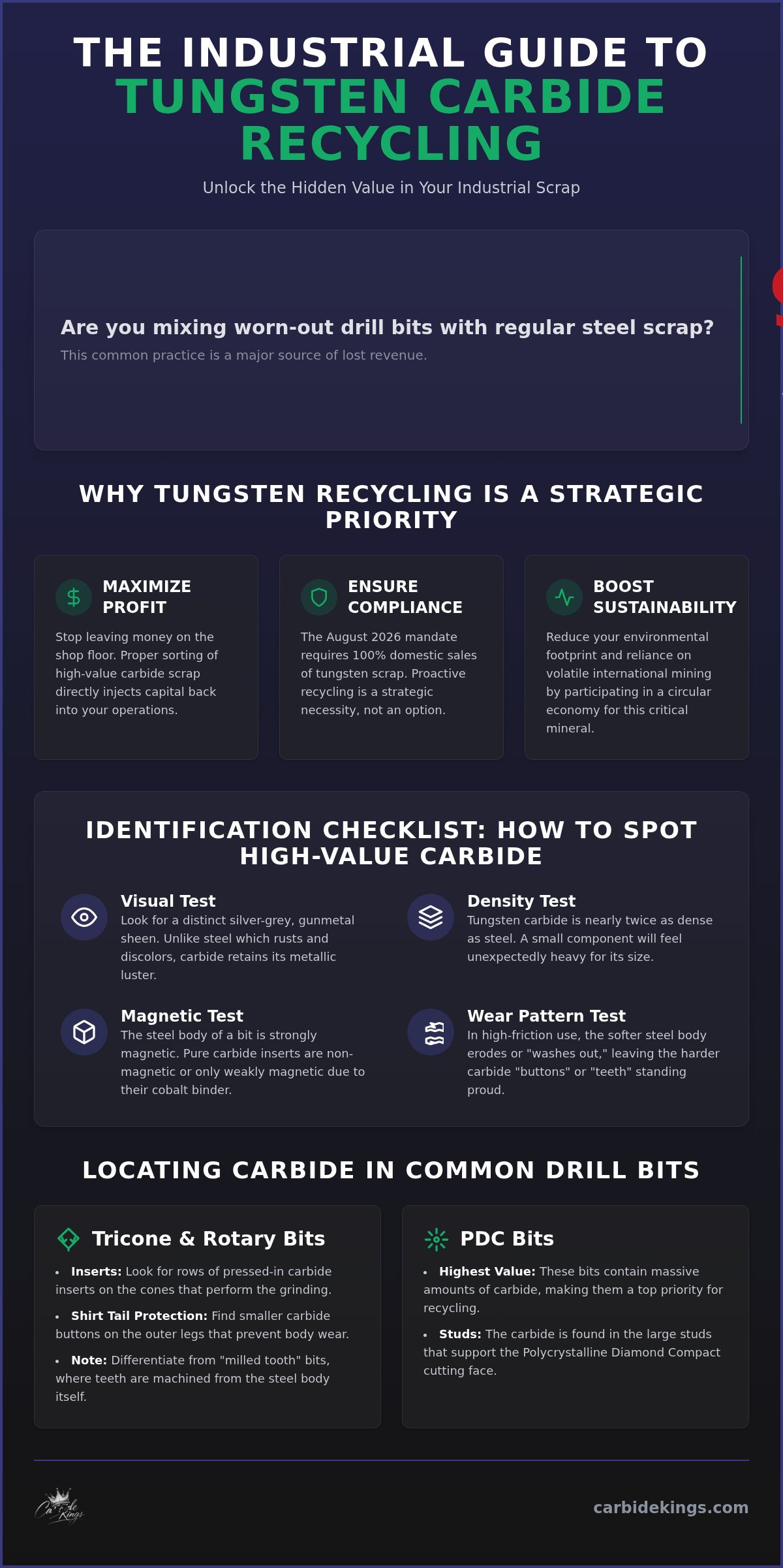
The global landscape for this material changed significantly in August 2026. With the U.S. Department of Commerce's Bureau of Industry and Security implementing a 100% domestic sales requirement for tungsten scrap, domestic recovery is no longer optional; it's a strategic necessity. This rule covers everything from tungsten waste to battery black mass. Industrial professionals must now look inward to secure their supply chains and maximize the value of their existing assets.
The Economic Impact of Proper Sorting
Many facilities fall into the "Heavy Melt" trap. This happens when a shop throws worn-out bits into a general steel scrap bin. Most general scrap dealers aren't equipped to value carbide correctly. They'll pay you for the weight of heavy melt steel, which is a fraction of what carbide solids are actually worth. The price delta between mixed scrap and pure tungsten hard scrap can be staggering. By implementing a dedicated process for recycling tungsten carbide tools, you stop leaving money on the shop floor. It's a direct injection of capital back into your operations simply by changing how you sort your waste.
Sustainability and Supply Chain Security
Raw tungsten ore is a finite and increasingly rare resource. Mining it is energy-intensive and carries a heavy environmental footprint. Recycling provides a "circular economy" solution that fits perfectly within modern industrial ESG goals. It's a straightforward way to reduce your company's reliance on volatile international markets. By recovering tungsten from used drill bits, you help stabilize the domestic supply of a critical mineral used in defense and aerospace. This proactive approach turns a logistical burden into a documented environmental win for your facility.
Identification Checklist: Locating Carbide in Industrial Bits
Accurate identification is the first step toward a higher payout. Most industrial drill bits are hybrid tools, meaning they combine a heavy steel body with high-value carbide cutting elements. To maximize your return on tungsten carbide drill bit recycling, you must know exactly where the carbide ends and the steel begins. Look for the distinct silver-grey color of the inserts. Unlike the surrounding steel, which often rusts or discolors after use, tungsten carbide retains its metallic, gunmetal sheen. This color contrast is your primary visual indicator.
Density is another dead giveaway. Tungsten carbide is nearly twice as heavy as steel. If a small component feels unexpectedly heavy for its size, it's likely carbide. You should also use a magnet as a diagnostic tool. While the bit body will pull strongly, tungsten carbide is typically non-magnetic or only weakly magnetic due to its cobalt binder. Finally, examine the wear patterns. In high-friction environments, the steel body often erodes or "washes out," leaving the carbide "buttons" or "teeth" standing proud. If the part hasn't worn down despite heavy use, you've found the carbide.
Tricone and Rotary Bit Components
In tricone and rotary bits, the carbide is concentrated in the cones. Look for the rows of pressed-in inserts that do the actual grinding. These are often referred to as TCI (Tungsten Carbide Insert) bits. Differentiate these from "milled tooth" bits, where the teeth are simply machined out of the steel body. You'll also find "shirt tail" protection on the outer legs of the bit. These are smaller carbide buttons designed to prevent the bit body from wearing against the borehole wall. Identifying these secondary sources of material is essential for modern Tungsten recycling processes that prioritize full material recovery.
PDC (Polycrystalline Diamond Compact) Bits
PDC bits represent some of the highest value in tungsten hard scrap recycling due to their massive carbide content. These bits use large carbide "studs" to support the diamond cutting face. You'll encounter two main types: matrix body and steel body. Matrix body bits are made from a tungsten carbide powder composite, making the entire head valuable scrap. Steel body PDC bits have carbide cutters pressed into a traditional steel frame. If you're unsure which type you have, get a professional evaluation to ensure you aren't leaving money on the table. Distinguishing between these constructions ensures you get paid for the actual carbide weight rather than a lower-value steel average.
Preparation Checklist: Maximizing Scrap Value Before Sale
Preparation is the stage where you turn raw waste into premium inventory. If you ship dirty, mixed lots, you're forcing the buyer to do the labor you skipped. They'll adjust your payout accordingly. To get the best results from tungsten carbide drill bit recycling, you must present a lot that is clean, categorized, and accurately documented. This isn't just about aesthetics. It's about refinery yield and operational transparency.
Start with a thorough cleaning. Bits coming off a rig are often coated in heavy grease, drilling mud, and environmental debris. This material adds deceptive weight that doesn't contain any tungsten. Use a high-pressure wash or an industrial degreaser to strip these contaminants. Once cleaned, you can accurately assess the weight of the actual metal. Follow this with a rigorous sorting process. Keep your PDC cutters, hammer bit buttons, and tricone inserts in separate, labeled containers. Different applications use different carbide grades, and mixing them can dilute the value of your highest-quality material.
Debrazing and Mechanical Removal
Separating the carbide from the steel substrate is the most effective way to spike your return. For brazed inserts, use a targeted heat source to melt the binder material. This process, known as debrazing, allows the carbide buttons to drop free from the steel body. For larger mining bits where buttons are press-fitted, you may need mechanical pressing or controlled crushing techniques. Always prioritize safety during this phase. Use appropriate PPE and ventilation when applying heat to industrial alloys. Removing the steel yourself ensures you're paid for 100% carbide weight, not a diluted "mixed" rate.
Contamination Control
Steel is the primary contaminant in carbide recycling. Even a small percentage of steel fasteners, bearings, or rubber seals can lower the purity grade of your lot. Refineries look for "clean" solids to streamline their processing. Don't mix your "soft scrap," such as grinding sludge or turnings, with your "hard scrap" solids. These materials require different processing paths and should never be combined. Finally, document every lot. Track the origin, bit type, and dry weight before shipping. This level of detail protects your interests and helps you identify which of your operations generate the most valuable scrap.
Evaluating Your Scrap: Market Factors and Valuation
Market volatility is a constant reality in 2026. The London Metal Exchange (LME) serves as the primary benchmark for raw material pricing, but it isn't the only factor that dictates your return. For tungsten carbide drill bit recycling, the percentage of cobalt binder plays a critical role. Cobalt is a strategic mineral with its own supply chain pressures. High-quality industrial drill bits typically contain between 6% and 15% cobalt. Professional buyers use X-ray fluorescence (XRF) technology to provide an instant, non-destructive analysis of your lot's chemistry. This ensures you get paid for the actual tungsten and cobalt content rather than a guessed average.
Volume is your greatest leverage. Industrial procurement thrives on scale. Lots exceeding 500 lbs often command more favorable logistics terms because they justify the administrative and transport overhead. Smaller, mixed lots require more intensive handling and provide lower margins for the buyer. If you want to maximize your return, consolidate your scrap until you hit these higher weight tiers. This methodical approach turns a series of small, expensive shipments into a single, high-value transaction.
Hard Scrap vs. Soft Scrap Valuation
Drill bits fall into the "hard scrap" category. This is the most desirable form of tungsten carbide because it requires less intensive processing than "soft scrap" like grinding sludge, swarf, or powders. Solid carbide bits offer a higher yield during the recycling process, which translates to a better bottom line for your facility. Matrix body PDC bits are particularly valuable because the entire head is a tungsten composite. To understand how these specific material grades interact with current market drivers, consult the tungsten carbide scrap price guide for deeper market analysis.
The Logistics of Industrial Scrap
Shipping high-density tungsten requires a methodical approach. These materials are exceptionally heavy but occupy very little space, which can lead to dangerous shifting during transport if not secured. Use steel drums or reinforced wooden crates to package your bits. For national transport, Less Than Truckload (LTL) is the standard for mid-sized industrial lots, while full truckloads are reserved for massive site cleanouts. Calculating shipping costs accurately is vital to protecting your profit margin. If you're ready to move your inventory, request a bulk logistics quote today to see how we handle the heavy lifting for you.
The Carbide Kings Streamlined Recycling Process
We've removed the traditional barriers that make industrial recycling a headache for busy operations. Our system is built for professional efficiency and total transparency. You don't have time to chase down missing paperwork or haggle over weight discrepancies with local scrap yards. We handle the administrative hurdles and logistical planning so you can stay focused on your primary operations. As a direct buyer of tungsten hard scrap and alloys, we eliminate the middleman. This ensures a direct, honest transaction based on real-time 2026 market data and precise material analysis.
Our national reach means we serve industrial clients across the entire United States. Whether you're clearing out a remote mining site or a central oilfield tool room, we have the infrastructure to manage the move. We use expert valuation techniques, including XRF analysis, to verify every lot we receive. This isn't a guessing game. It's a professional procurement process designed specifically for high-volume industrial partners who value their time as much as their material's worth. With the August 2026 domestic sales mandate now in effect, having a reliable US-based partner is a strategic necessity for your supply chain security.
How to Get Started with Your First Lot
We've condensed our onboarding into three logical steps to ensure your first transaction is as smooth as your tenth. Our goal is to move your material from the shop floor to our processing facility with zero friction.
- Step 1: Request Your Quote. Contact us with the details of your bulk drill bit scrap. We'll provide a transparent quote based on current market drivers and your estimated volume.
- Step 2: Coordinate Logistics. Receive full shipping and logistics support regardless of your national location. We handle the heavy lifting of transport coordination for high-density materials.
- Step 3: Verification and Payment. Once your lot is verified through our expert testing process, we move directly to payment. We prioritize fast processing to keep your cash flow moving.
Why Industrial Professionals Choose Carbide Kings
We understand the unique demands of mining and oilfield operations. Our process is built for speed and reliability, not just "scrap dealing." We don't just buy your waste; we act as a proactive partner in your facility's material management. Industrial professionals choose us because we offer a no-nonsense alternative to the administrative mess of traditional recycling. You can learn where to recycle tungsten carbide strategically to turn a standard waste stream into a long-term profit center. By choosing a partner that focuses exclusively on industrial-grade materials like carbide solids and alloys, you ensure your scrap is valued by experts who know its true worth.
Secure Your Industrial Scrap Revenue Stream
Transforming your shop's waste into a predictable revenue stream requires a methodical approach. You now have the professional framework to identify high-value carbide inserts and the preparation steps needed to secure the highest market return. By separating your materials and maintaining clean lots, you ensure that your facility captures every dollar of value from its worn-out tooling. Don't leave your profit to chance by selling to general scrap dealers who don't understand the 2026 market drivers.
Mastering tungsten carbide drill bit recycling is a strategic win for your bottom line and your sustainability goals. It's time to stop the heavy melt trap and start working with a partner that handles the heavy lifting. We are a direct industrial tungsten buyer with national US logistics support and a streamlined 24-hour payment process to keep your cash flow moving. Our goal is to make your transition from scrap to success as fast as possible.
Get a Quote for Your Industrial Carbide Scrap Today and let us turn your metal into momentum.
Frequently Asked Questions
Is it worth recycling drill bits if they are still attached to the steel body?
Yes, though the price will be adjusted for the steel weight. High-volume tungsten carbide drill bit recycling often involves lots where the carbide is still embedded in the steel substrate. We can process these mixed bits, but you'll maximize your return by separating the carbide yourself. If the labor cost of separation exceeds the price delta, shipping them intact is a viable industrial solution. This allows you to clear space quickly while capturing material value.
What is the difference between PDC bits and standard carbide bits in terms of value?
PDC bits generally command a higher value because they contain massive carbide studs and often a matrix body composed of tungsten composite. Standard tricone or hammer bits use smaller carbide inserts pressed into a steel frame. While both are lucrative, the weight-to-volume ratio of PDC material is superior. This makes PDC bits a top priority for facilities looking to maximize their scrap returns quickly and efficiently without excessive manual sorting labor on the shop floor.
How do I know if my drill bit inserts are actually tungsten carbide?
Use the color and magnet test. Tungsten carbide has a distinct silver-grey, gunmetal sheen that doesn't rust like steel. It is also significantly denser and heavier than standard alloys. Most importantly, carbide is non-magnetic or only weakly magnetic. If your magnet pulls strongly on the insert, it's likely a high-speed steel or a different alloy rather than true tungsten carbide. This simple check prevents you from mixing low-value steel into your high-purity carbide lots.
Can I recycle broken or shattered carbide drill bits?
Yes, broken and shattered carbide pieces retain their full metallurgical value. We accept carbide in any physical condition, provided it is free from excessive steel contamination or environmental debris. Shattered bits are processed as hard scrap solids just like intact inserts. Ensure these smaller fragments are secured in reinforced containers or steel drums to prevent loss during national transport. We value the material's weight and chemistry, not its physical shape or structural integrity.
Do you provide shipping containers for bulk industrial scrap?
We provide full logistical support for our industrial partners across the United States. While we don't always provide the initial bins, we coordinate the pickup of your steel drums or reinforced crates. Our team handles the heavy lifting of transport scheduling and carrier communication. This streamlined approach ensures your high-volume scrap moves from your facility to our intake center with minimal administrative friction. We make the shipping process as simple as a basic retail transaction.
How long does the payment process take once you receive the scrap?
Our payment process is designed for speed and reliability. Once your lot arrives at our facility, we perform an expert valuation using XRF technology to verify the tungsten content. We typically finalize the transaction and issue payment within 24 hours of verification. This fast processing time helps our industrial clients maintain consistent cash flow without the long wait times associated with traditional dealers. We prioritize transparency and speed to ensure you are satisfied with every single transaction.
What is the minimum weight required for a national scrap pickup?
We focus on high-volume industrial procurement to ensure the logistics remain cost-effective for both parties. While we evaluate lots on a case-by-case basis, we generally look for a minimum of 500 lbs for national pickup. Smaller volumes can be shipped, but bulk lots command better logistics terms. Consolidating your tungsten carbide drill bit recycling into larger shipments is the most efficient way to protect your profit margins and simplify your facility's ongoing scrap management.
Does the presence of cobalt in the carbide affect the recycling price?
Yes, the cobalt binder percentage is a key factor in determining the final valuation. Cobalt is a critical mineral with its own market value and supply chain complexities. Most industrial-grade carbide drill bits contain between 6% and 15% cobalt. During our XRF analysis, we verify the exact chemical composition of your lot. This ensures you get paid fairly for both the tungsten and the cobalt binder. We use current market data to provide an accurate, professional quote.


