

Your machine shop floor is likely covered in high-value assets disguised as scrap metal. With the U.S. Department of Commerce's August 2026 export ban on tungsten scrap now in effect, the domestic landscape for industrial recycling has changed overnight. It's no longer enough to just drop off a bucket at the local yard; you need a strategy to sell carbide inserts that maximizes your return in a restricted market.
You probably feel the frustration of opaque pricing and the logistical burden of moving heavy, high-density materials. Most shop managers know their used inserts are valuable, yet they let them collect dust because the shipping costs and grading confusion make liquidation feel like a chore. We understand that your time is better spent on production than haggling over scrap. You deserve a transparent process that respects your schedule and your bottom line.
This guide provides the exact steps to audit, sort, and sell your machine shop's used carbide to secure the highest industrial market rates. You'll learn how to distinguish high-value tungsten from low-value steel and implement a streamlined, weight-based liquidation process. We are covering everything from current market trends to fast payment terms so you can turn your waste into a predictable profit center.
Key Takeaways
- Identify the specific metallurgical properties of tungsten carbide that drive its high industrial value.
- Use the magnet test to separate high-speed steel contaminants so you can sell carbide inserts at the highest possible grade.
- Shift your strategy from local scrap yards to industrial specialists to access transparent, market-based pricing.
- Secure your bulk shipments with reinforced packaging techniques designed specifically for high-density tungsten alloys.
- Establish a fast, repeatable workflow for periodic scrap liquidation that turns floor waste into immediate cash flow.
Understanding the Industrial Value of Scrap Carbide Inserts
Machine shops often treat spent indexable inserts as a secondary concern. In reality, these small components represent a high-density industrial "hard scrap" that holds significant market value. When you decide to sell carbide inserts, you are dealing with a material that is far more valuable than standard scrap. Unlike general tool steel, which is primarily iron-based, carbide inserts are built from a sophisticated alloy designed to withstand extreme thermal and mechanical stress.
The core of this value lies in the metallurgy. Tungsten carbide is a sintered metal composite used for high-heat machining applications. It combines tungsten particles with a cobalt binder to create a material nearly as hard as diamond. In 2026, the industrial demand for these elements has reached a critical point. S&P Global reports that global tungsten demand is projected to reach 180,000 metric tons by 2030, yet mine output continues to lag. This makes your used inserts a vital link in the domestic supply chain.
Why Tungsten Hard Scrap is a Strategic Asset
Tungsten is officially classified as a critical raw material due to its scarcity and the dominance of overseas production. Recycling used carbide is significantly more cost-effective than mining and refining virgin ore. When you choose to sell carbide inserts, you aren't just cleaning your shop; you're feeding high-quality material back into the manufacturing of new precision tools. This circular economy keeps domestic production lines moving. With the 2026 U.S. export restrictions on tungsten scrap, domestic buyers are more motivated than ever to secure high-purity hard scrap from local machine shops.
Hard Scrap vs. Soft Scrap: Where Inserts Fit
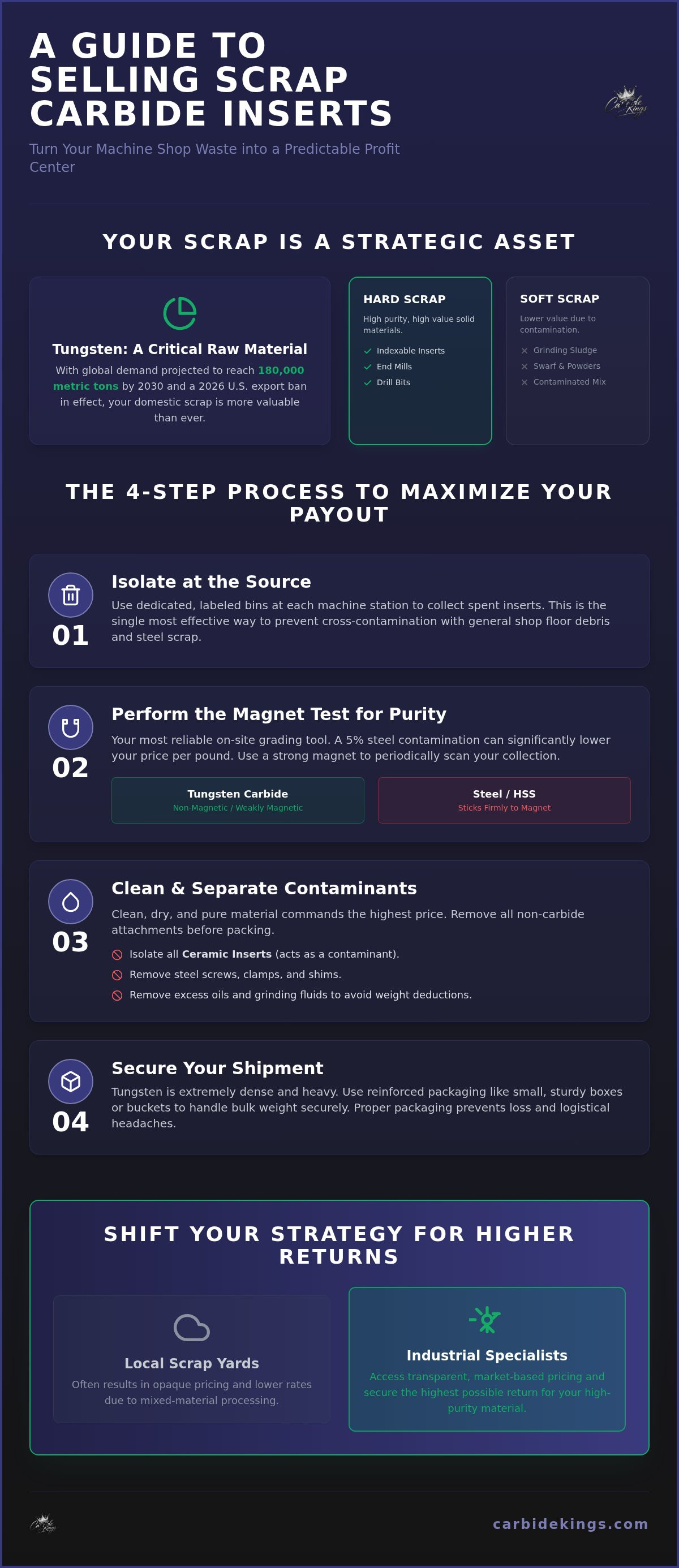
Understanding the difference between scrap categories is essential for maximizing your return. "Hard scrap" refers to solid, consolidated materials like indexable inserts, end mills, and drill bits. These are prized for their high purity and ease of processing.
In contrast, "soft scrap" includes grinding sludge, swarf, and powders. While still valuable, soft scrap often contains higher levels of contamination from coolants and other metals, requiring more intensive refining. Focusing on your solid inserts ensures you get the highest possible price per pound. For more details on the refining side, you can explore the industrial value of scrap carbide end mills.
Step-by-Step: Preparing Your Carbide Inserts for Sale
Maximizing your return starts at the spindle, not the shipping dock. If you wait until you have a 55-gallon drum to begin sorting, you've already lost money. Effective preparation requires a proactive collection system at every machine station. Use dedicated, labeled bins to catch spent inserts before they mix with general shop floor debris. This prevents cross-contamination and ensures that when you are ready to sell carbide inserts, the material is already organized for a high-value quote.
Purity is the most significant factor in your final payout. You must separate your inventory by material type. While coated and uncoated tungsten carbide can typically be processed together, ceramic inserts must be strictly isolated. Ceramic contains no tungsten value and acts as a contaminant in the recycling stream. Additionally, take a moment to remove excessive oils or grinding fluids. While some residue is expected, saturated loads can lead to weight deductions during the final assay. Clean, dry material represents the professional standard that industrial buyers expect.
The Magnet Test and Material Purity
The magnet test is your most reliable tool for on-site grading. Pure tungsten carbide is only weakly magnetic or entirely non-magnetic. If a part sticks firmly to your magnet, it is likely high-speed steel (HSS) or a common tool steel alloy. Even a 5% steel contamination rate can significantly lower your price per pound because it complicates the chemical recovery process. Use a strong neodymium magnet to scan your collection bins periodically. Remove steel shims, tool holders, and broken drills immediately to maintain the integrity of your hard scrap. Reviewing Tungsten market data confirms that global demand for high-purity scrap remains high, making your sorting efforts well worth the time.
Removing Attachments and Braze Material
Clean indexable inserts are the gold standard of industrial recycling. Before packing your shipment, ensure all steel screws, clamps, and shims are removed. These attachments add "dead weight" that lacks any tungsten value and can skew your pricing expectations. There is also a major difference between clean inserts and brazed saw tips. Brazed materials contain silver solder and steel backing, which requires a specialized refining path. Keep these categories separate to ensure you receive the correct market rate for each. If you're managing a high-volume facility and want to simplify this process, you can partner with Carbide Kings for a streamlined industrial liquidation. Store your final sorted material in heavy-duty, leak-proof containers to avoid structural failure during transport.
Evaluating Your Inventory: Market Pricing and Grading
Global market indices dictate the daily value of your scrap, moving in sync with the supply and demand for raw tungsten and cobalt. When you prepare to sell carbide inserts, you're participating in a high-stakes industrial commodity market. In 2026, the strategic importance of tungsten recycling has never been more apparent, as domestic supply gaps drive buyers to seek high-purity hard scrap. Your payout isn't a random number; it's a reflection of current Ammonium Paratungstate (APT) pricing and the specific chemistry of your lot.
Volume significantly impacts your final return. While small batches are accepted, bulk industrial lots exceeding 50 pounds often command premium rates. This is because larger volumes reduce the relative cost of logistics and assaying for the buyer. Additionally, the cobalt content in your inserts plays a critical role. Cobalt acts as the binder in the sintering process, and its own market volatility can either bolster or soften the total valuation of your material. Industrial specialists look for these specific markers to provide a quote that reflects the true metallurgical value of your inventory.
Scrap Yard vs. Industrial Carbide Buyer
The biggest mistake a machine shop can make is treating carbide like common steel. Local scrap yards often lack the specialized equipment to verify alloy purity. They might categorize your inserts as "heavy melt" or low-grade scrap, offering a flat-fee price that ignores the actual tungsten concentration. This lack of transparency costs you money.
Specialized buyers like Carbide Kings operate differently. We understand the specific chemistry of tungsten alloys and use weight-based quotes that align with industrial market trends. You get a clear, transparent transaction based on the actual density and purity of your material. It's the difference between getting a "guess" from a generalist and a professional valuation from an industrial partner.
Grading Your Carbide: Solids vs. Mixed Lots
A "clean" lot of uniform inserts is the most profitable way to sell carbide inserts. When your material is already sorted by type, it skips several steps in the refining process. Uniform lots of indexable inserts are easier to batch and process, which allows the buyer to pass those savings back to you in the form of higher rates.
Mixed lots, while still valuable, require more labor-intensive sorting and chemical analysis. Keeping your specialty alloys, particularly cobalt-rich grades, in separate containers ensures you don't lose their individual value in a generic "mixed" bucket. For a deeper look at what is driving these numbers today, consult our Tungsten Carbide Scrap Price Guide to understand the current 2026 market drivers.
Logistics and Shipping: Handling Bulk Carbide Securely
Shipping tungsten carbide is a unique logistical challenge. Most shop managers treat it like steel, but that's a mistake that leads to damaged goods and lost revenue. Tungsten carbide is roughly 2.5 times denser than standard steel. A container that looks half-empty can easily exceed 70 pounds. When you decide to sell carbide inserts, you must plan for this extreme density. Standard shipping supplies aren't built for these concentrated, heavy loads.
Cardboard boxes often fail during transit because the inserts shift and punch through the corners. This isn't just a nuisance; it's a liability. Lost material means a lower payout and potential insurance disputes. You need a secure, industrial-grade solution to move your hard scrap from the shop floor to the refinery without incident. Proper containment ensures your weight verification matches the buyer's assay.
Packaging Standards for Heavy Metals
Smaller shipments require extreme reinforcement. We recommend using double-walled corrugated boxes or reinforced plastic pails. Line the bottom with plywood or heavy-duty plastic to distribute the weight. Use cross-woven filament tape on every seam to prevent the box from bursting under pressure. Any box over 50 lbs must be clearly marked and reinforced to prevent transit ruptures. Internal padding is equally important. Fill every void with dense foam or crumpled heavy-duty paper to stop the inserts from acting like a wrecking ball inside the package.
Freight and LTL Logistics for Large Lots
The most efficient way to sell carbide inserts in bulk is through palletized LTL freight. For lots exceeding 500 pounds, individual boxes are no longer safe or efficient. Place your reinforced pails on a sturdy, four-way entry pallet. Use high-gauge shrink wrap to secure the load, ensuring the wrap grips the pallet base itself. Secure the pails with steel or heavy-duty plastic strapping for added stability during transit.
Less Than Truckload (LTL) freight is the industrial standard for these high-value shipments. You'll need a Bill of Lading (BOL) to track the metal and provide proof of weight for your records. This documentation is your primary defense in case of a weight discrepancy or transit loss. Carbide Kings simplifies national logistics for manufacturing partners by handling the heavy lifting of freight coordination. If you're ready to clear out your inventory, schedule your bulk carbide pickup today. We manage the paperwork and the carriers so you can stay focused on your production schedule. High-value scrap shouldn't be a logistical headache.
Maximizing ROI with Carbide Kings
Choosing to sell carbide inserts shouldn't feel like a secondary shop task. It's a strategic move for your facility's liquidity and operational efficiency. Carbide Kings provides a national infrastructure designed specifically for the high-volume manufacturing sector. We aren't generalists who dabble in common metals; we are industrial specialists who understand the precise value of your high-grade tungsten alloys. Our process removes the traditional barriers of scrap liquidation, replacing them with a streamlined, professional experience.
Start your journey toward higher returns with a comprehensive "Scrap Audit." Walk through your tool crib and identify obsolete inserts, forgotten bulk lots, or mixed bins that have been collecting dust. These hidden assets represent frozen capital that can be thawed with a single transaction. Beyond the immediate financial gain, selling to a specialist supports the global circular economy. By recycling your spent inserts, you're reducing the industrial reliance on aggressive mining and helping stabilize the domestic supply chain during a period of significant market volatility.
Streamlined 24-Hour Payment Terms
Cash flow is the lifeblood of any machine shop. We've refined our verification process to ensure that once your shipment arrives at our facility, the turnaround is immediate. Our team performs a rapid assay to confirm metallurgical purity and verifies the weight against your documentation. This speed allows us to offer 24-hour payment terms in the 2026 market, helping you reduce inventory overhead and reinvest in your core operations without delay. For a complete step-by-step walkthrough of how we handle your material from arrival to final settlement, see The Carbide Kings Process.
A Partner for Industrial Manufacturing
We position our service as a recurring logistics solution rather than a one-time transaction. When you sell carbide inserts to a partner that understands the nuances of tungsten alloys, you eliminate the risk of the "flat-fee" lowballing common at local yards. We treat your scrap with the same professional respect you give your finished precision parts. Our national reach ensures that whether you're managing a single shop or a multi-state manufacturing enterprise, the experience remains consistent, transparent, and lucrative. Contact Carbide Kings today to liquidate your current insert inventory and turn your floor waste into a predictable profit center. Our team is ready to handle the heavy lifting so you can stay focused on production.
Turn Your Machine Shop Waste into Industrial Capital
Your shop floor is a source of untapped revenue. By implementing a strict sorting system and understanding the metallurgical value of your scrap, you transform a disposal problem into a predictable profit center. Success in the 2026 market depends on purity and professional logistics. When you sell carbide inserts through a specialized partner, you bypass the guesswork of local yards and tap into current industrial rates.
Carbide Kings is your specialized industrial tungsten buyer. We handle the heavy lifting with national shipping and logistics support, ensuring your high-density materials move safely and efficiently. You receive transparent, weight-based pricing that reflects the true value of your tungsten and cobalt alloys. Don't let your spent inserts sit in a bucket when they could be improving your cash flow today.
Get a Professional Quote for Your Carbide Inserts and see how simple industrial liquidation can be. We are ready to help you clear out your inventory and secure the market rates your business deserves. Your next shipment is as good as done.
Frequently Asked Questions
What is the current scrap price for carbide inserts in 2026?
Market rates for those looking to sell carbide inserts fluctuate daily based on global commodity indices and the recent 2026 U.S. export restrictions. While specific values change, high-purity inserts consistently command the highest industrial rates compared to mixed scrap or sludge. You'll get the best return by requesting a real-time quote. This captures the most accurate valuation based on current Ammonium Paratungstate (APT) prices and your specific lot density.
How can I tell if my inserts are carbide or high-speed steel?
Use the magnet test to distinguish between these materials quickly. Tungsten carbide is either non-magnetic or only very weakly magnetic; high-speed steel (HSS) will stick firmly to a strong magnet. Additionally, carbide is significantly heavier because it's roughly 2.5 times denser than steel. If a small tool feels surprisingly heavy for its size and ignores a magnet, it is likely high-value carbide that belongs in your scrap bin.
Do you buy coated carbide inserts or just uncoated ones?
We buy both coated and uncoated carbide inserts. Modern PVD and CVD coatings, such as Titanium Nitride (TiN) or Alumina, don't negatively impact the scrap value for industrial recycling. The primary value remains in the underlying tungsten carbide substrate. You don't need to separate inserts by coating type, but ensure they're free from ceramic inserts or steel shims which do affect the purity of your hard scrap lot.
Is there a minimum weight requirement to sell carbide inserts?
There's no strict minimum weight to sell carbide inserts, but shipping efficiency is key to maximizing your profit. Small batches under 10 pounds are often offset by high shipping costs. Most professionals accumulate at least 50 pounds to qualify for more competitive industrial rates. Bulk lots over 500 pounds are handled via palletized LTL freight to ensure the best possible return on your industrial scrap inventory.
How should I package my carbide scrap for safe shipping?
Secure your inserts in reinforced, double-walled corrugated boxes or heavy-duty plastic pails. Because carbide is extremely dense, standard packaging often fails during transit. Use cross-woven filament tape to seal all seams and fill any internal voids with dense padding to prevent the material from shifting. If a box exceeds 50 pounds, clearly mark it as heavy and reinforce the bottom to prevent transit ruptures or loss.
What is the difference between resale value and scrap value for inserts?
Resale value applies to new or lightly used inserts that can be returned to service, while scrap value is based solely on the metallurgical weight of the tungsten and cobalt. Most machine shops find that selling for scrap is more efficient for high-volume liquidation. It eliminates the need to catalog individual part numbers or brands. Scrap pricing provides a transparent, weight-based payout for your entire used inventory.
How long does it take to receive payment after shipping my carbide?
Payment is typically issued within 24 hours of the material being verified at our facility. Once your shipment arrives, our team performs a rapid assay to confirm the weight and purity of the tungsten alloys. This streamlined process ensures you receive your funds quickly, helping you maintain healthy shop cash flow. We prioritize fast electronic payments to minimize the time between your initial shipping and final settlement.
Can I sell carbide inserts that are still in the tool holders?
You should remove all inserts from their steel tool holders before shipping. We focus on purchasing high-purity tungsten hard scrap; steel tool holders are considered a contaminant that reduces the overall value of your lot. Taking the time to strip screws, clamps, and shims ensures you're paid for the actual weight of the carbide rather than low-value steel attachments. This preparation directly impacts your final industrial payout.


