

A sound receiving process starts before a drum is moved or opened. Standard operating procedures for receiving bulk drums of tungsten hard scrap should set out how staff inspect incoming drums of broken tungsten cutting tools, prepare empty drums, choose handling equipment, and secure barrels with strapping.
That sequence organizes receiving work and gives staff clear steps from arrival through storage or shipment. It also helps them identify issues, such as damaged containers or unclear material labels, before drums move further through the facility.
This guide outlines each step: reviewing an arriving shipment, preparing empty drums, choosing handling equipment, training staff, and securing barrels with straps. Use it to build a practical workflow suited to your facility and the materials you handle.
Key Takeaways
- Set a consistent receiving check for drum condition, labels, and the broken cutting tools inside.
- Prepare empty drums for reuse or handling by building inspection and cleaning steps into the workflow.
- Match handling equipment to the drums and train staff to follow the same process from arrival onward.
- Use strong strapping to help keep barrels secure during shipment and reduce the risk of spills.
Broken cutting tools imported in drums
Use standard operating procedures for receiving bulk drums of tungsten hard scrap to set a consistent route from arrival through acceptance. Match each drum to its shipment paperwork and identify the material as broken cutting tools. Imported pieces from Japan were certified as containing 73-89% tungsten and 6-21% cobalt by weight. Those ranges describe documented material, not every drum. HTSUS Section XV, Note 6(a), includes metal goods definitely unusable because of breakage, cutting-up, wear, or other reasons. A U.S. Customs ruling classified particular imported carbide cutting-tool pieces as cermet waste and scrap under HTSUS heading 8113.00.00.
Effective standard operating procedures for receiving bulk drums of tungsten hard scrap also explain how to store and segregate accepted material. Keep drums upright, closed, and labeled with the material description and shipment identifier. Separate tungsten hard scrap from other grades and unidentified material.
OSHA and EPA requirements depend on the activity, material condition, and waste determination. Follow applicable workplace safety rules and your facility’s waste-handling procedures for receiving and storage.
Retain delivery records, supplier descriptions, drum identifiers, inspection notes, weights, and any sampling or assay results. Link every record to its shipment for traceability.
Scrap value varies with grade, tungsten content, contamination, and market conditions. Suppliers should provide material descriptions, drum counts, declared weights, and available composition or assay information.
At receiving, record each drum’s identifier and weight according to the facility’s documented weighing process. If sampling is needed, identify the sample and link its assay result to the relevant drum or lot. Representative sampling supports a meaningful assessment of tungsten content and value.
Broken carbide can have sharp edges, and handling may generate dust. Follow facility protective procedures, limit dust-generating steps, and use the controlled cleanup process for spills instead of sweeping material into general waste.
Empty drum preparation and inspection
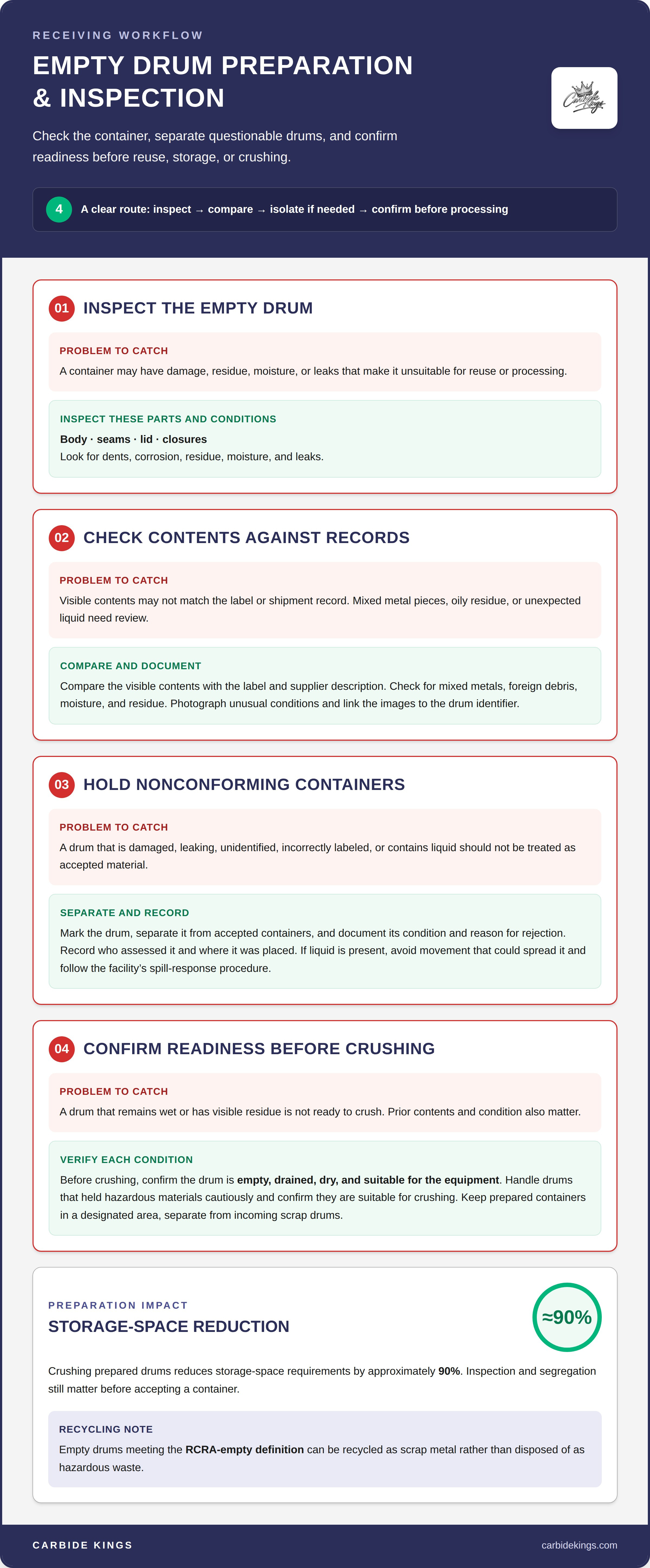
Inspect each empty drum before reuse, storage, or crushing. Check the body, seams, lid, and closures for dents, corrosion, residue, moisture, and leaks. Compare visible contents with the label and shipment record. Mixed metal pieces, oily residue, or unexpected liquid are reasons to isolate the drum and record the discrepancy rather than treat it as clean tungsten carbide scrap.
Separate drums by prior contents and condition. Handle drums that held hazardous materials cautiously and confirm they are suitable for crushing before processing. Do not crush a drum that remains wet or has visible residue. Empty drums meeting the RCRA-empty definition can be recycled as scrap metal rather than disposed of as hazardous waste. Crushing prepared drums reduces storage-space requirements by approximately 90%.
Use a clear hold process for nonconforming containers. Mark damaged, leaking, unidentified, or incorrectly labeled drums; separate them from accepted containers and document the condition and reason for rejection. If liquid is present, avoid movement that could spread it and follow the facility’s spill-response procedure. Record who assessed the drum and where it was placed.
To identify a possible grade mismatch, compare the label and supplier description with the visible material. Check for mixed metals, foreign debris, moisture, and residue that could affect sorting or recycling. Photograph unusual conditions and link the images to the drum identifier. This record helps resolve discrepancies without mixing questionable material into an accepted lot.
Before crushing, confirm the drum is empty, drained, dry, and suitable for the equipment. Keep prepared containers in a designated area so they remain separate from incoming scrap drums. For material classification, use the tungsten carbide scrap category when it accurately describes the contents.
These figures can help compare preparation and recycling with disposal. Inspection and segregation still matter before accepting a container.
Reviewing that scenario alongside the container’s condition and prior contents can support consistent decisions about which drums are suitable for processing and which require disposal.
Equipment selection and personnel training
Choose equipment based on the drum’s actual weight, dimensions, and handling route. A forklift can move palletized drums when the load is stable and within the equipment’s rated capacity. A drum handler can help control individual containers during lifting or positioning. Use a suitable scale to record receiving weights, and link each reading to the drum identifier.
Plan the route before lifting. Confirm the path is clear, the drum is closed, and the receiving area can accommodate the load. For example, move a secured drum to a designated inspection zone before staging it with other carbide scrap. Keep loose tungsten carbide inserts and broken cutting tools in suitable containers rather than carrying them by hand across the receiving area.
- Forklift: Move stable, appropriately secured loads along the planned route.
- Drum handler: Position individual drums with controlled lifting and placement.
- Scale: Record weights against the correct shipment and drum identifiers.
- Inspection tools: Use a flashlight and camera to document visible container damage.
- Handling aids: Use suitable tools to transfer loose pieces without hand-sorting sharp edges.
Train each receiving employee to follow the written sequence: review shipment details, inspect the container, record its identifier and weight, then move it to the assigned area. Demonstrate the steps with a sample drum of tungsten carbide scrap. Show staff how to stop work and notify a supervisor if a container shifts, leaks, or differs from its paperwork.
Use a practical sign-off process. Ask each trainee to demonstrate equipment checks, load positioning, communication with nearby staff, and completion of receiving records. Repeat instruction when the handling route, equipment, or material type changes. Explain the distinction between intact cutting-tool inserts and mixed loose pieces, since it affects sorting and storage. Keep the procedure accessible at the receiving station so staff can follow the same steps across shifts.
Securing barrels with strong strapping
Secure strapping helps keep barrels of tungsten sludge contained and prevent spills during shipment. After closing each barrel, use the facility’s approved method and inspect the closure and restraint before moving it. Treat strapping as a final containment check, not a substitute for a sound drum or properly closed lid.
Build a repeatable sequence into the shipping procedure:
- Check the barrel body, lid, and closure for damage or residue.
- Confirm the contents and shipment label match the receiving record.
- Close the barrel using its intended closure before applying straps.
- Fit strong strapping securely, following the equipment maker’s instructions.
- Inspect the finished restraint and document the barrel’s shipping condition.
Keep straps clear of the lid closure and label. This keeps the identification readable and makes movement or damage easier to spot during later inspections. For example, a barrel labeled as tungsten sludge should remain identifiable after strapping, rather than being grouped with drums of solid carbide scrap or loose drill bits.
Train staff to stop and correct visible problems before dispatch. A loose strap, damaged barrel, wet surface, or leaking closure calls for a hold and inspection under facility procedures. Record the barrel identifier, observed condition, corrective action, and release decision. This creates a clear handoff between receiving, storage, and shipping teams.
Consistent restraint and documentation help protect material as it moves through the supply chain. Keep the same identification linked to the shipment record, especially when a lot contains tungsten carbide and cobalt cutting tools. Clear records help prevent a secured barrel from becoming unidentified further along the route.
For help sourcing tungsten scrap for your operation, explore tungsten scrap supply.
Tungsten sludge is commonly transported and shipped in secure plastic barrels and drums. These are the container forms commonly used to transport and ship this material. For an average shipment of tungsten sludge, one or two barrels typically suffice.
The typical amount for an average shipment is one or two barrels. Tungsten sludge is commonly transported and shipped in secure plastic barrels and drums, with one or two barrels typically sufficient for an average shipment.
Carbide Kings: Tungsten Hard Scrap
Carbide Kings supplies tungsten hard scrap for industrial manufacturing and metallurgical processes. Once your receiving procedure is in place, clearly identifying the scrap category can help organize purchasing and material handling. Carbide Kings also supplies tungsten soft scrap, carbide scrap, and tungsten alloys for operations that use these materials.
Choose Carbide Kings when your operation needs tungsten hard scrap as an industrial material. Share the material category and intended use to focus the discussion on the type of scrap that fits your requirements. Contact Carbide Kings to discuss tungsten hard scrap for your operation.
Put a dependable receiving process into practice
Consistent standard operating procedures for receiving bulk drums of tungsten hard scrap give each incoming lot a clear path to its next use. Make the procedure part of routine operations and update it when handling needs or material streams change. Clear records and assigned responsibilities help teams keep decisions traceable as material moves through the facility.
For operations sourcing tungsten materials, Carbide Kings offers Tungsten Hard Scrap, Tungsten Soft Scrap, and Carbide scrap. Choose the material category that fits your production needs, then take the next step toward a suitable supply relationship. Contact Carbide Kings to discuss your tungsten scrap needs. A well-managed receiving process can support confident material decisions from the start.
Frequently Asked Questions
What qualifies as tungsten hard scrap, and what grades or forms are commonly received?
Tungsten hard scrap includes unusable tungsten carbide material, such as worn or broken cutting-tool pieces. Common forms include inserts, rods, endmills, drills, reamers, dies, and rings. Keep sorting practical by recording each item’s form and condition separately, such as distinguishing broken inserts from mixed shapes. Evaluate grade and composition using material records or an assay, not appearance alone.
What PPE and handling equipment are needed to unload and inspect heavy tungsten scrap drums?
The facility’s task-specific hazard assessment should define PPE for each unloading and inspection step. It may specify safety footwear, gloves, and eye protection according to the work and material condition. Choose handling equipment suited to the drum’s dimensions, load, and route, and allow only trained staff to operate it. Keep the inspection area clear so workers can communicate and document issues without handling the load unnecessarily.


