

Your scrap bin isn't just a collection of industrial waste; it's a fluctuating financial asset that most local yards fail to value correctly. If you've ever felt the frustration of opaque pricing or struggled to distinguish high-value carbide inserts from low-grade tool steel, you're not alone. Determining the true tungsten carbide scrap value in 2026 requires more than a quick glance at a generic price sheet. It's about understanding the specific chemistry, form factors, and global market demands that drive industrial recovery today.
We're here to strip away the complexity and put the control back in your hands. You'll learn exactly how cobalt binder percentages and material purity dictate your final returns. This guide breaks down the critical 2026 market drivers and provides a repeatable, step-by-step sorting strategy to maximize your ROI. We'll also show you how to bypass logistical hurdles by partnering with a national recovery expert that manages the heavy lifting for you. It's time to stop guessing and start treating your hard and soft scrap like the valuable commodity it is. This process is straightforward, lucrative, and designed to keep your focus on production.
Key Takeaways
- Understand how global market demand and the cost-effectiveness of recycling over mining influence the current tungsten carbide scrap value for industrial operations.
- Distinguish between Tungsten Hard Scrap and Tungsten Soft Scrap to ensure every pound of material is graded and valued accurately.
- Master simple density and magnetic tests to quickly separate high-value carbide from low-value steel contaminants.
- Identify how cobalt binder percentages and material purity levels directly impact the complexity of the recovery process and your final ROI.
- Streamline your disposal logistics by partnering with a national recovery expert that handles the administrative and transport burdens for you.
What Determines Tungsten Carbide Scrap Value in 2026?
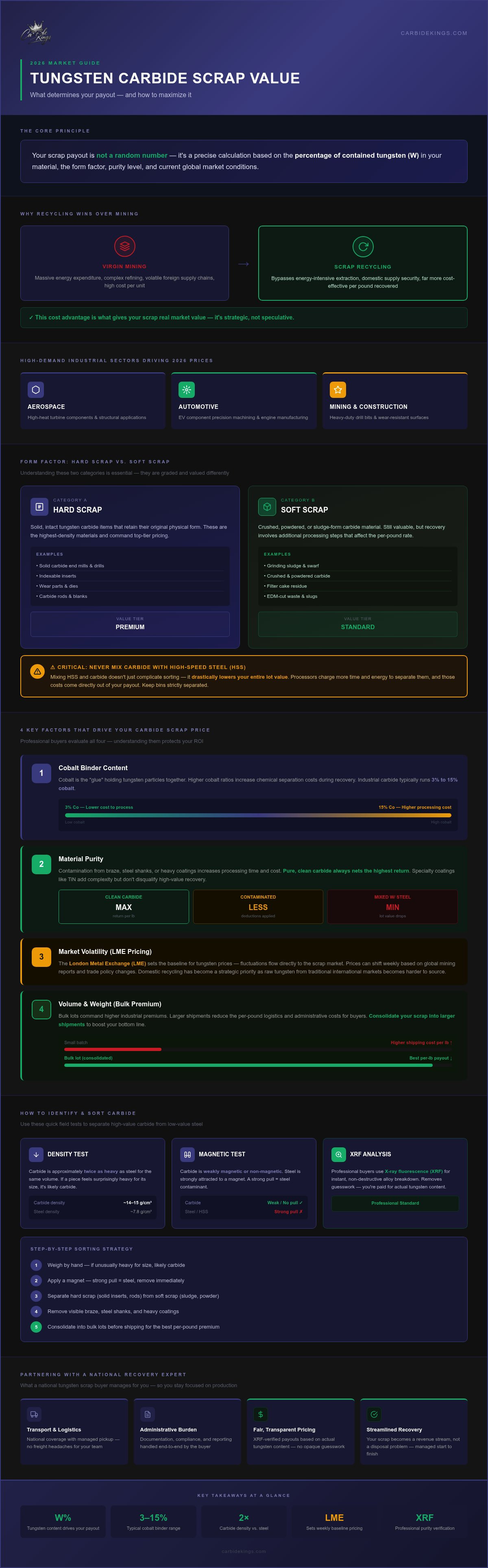
Tungsten carbide isn't just another metal in your shop; it's a high-density alloy of tungsten and carbon that commands premium rates. In 2026, the logic for recovery is simple: recycling is far more cost-effective than mining virgin ore. Extracting tungsten from the earth involves massive energy expenditure and complex refining. By contrast, recovering it from existing scrap bypasses these hurdles. This efficiency directly impacts the tungsten carbide scrap value you receive. Your payout isn't a random number; it's a calculation based on the specific percentage of contained tungsten (W) within your material.
Key industrial sectors are currently pushing demand to new heights. You'll see this most clearly in:
- Aerospace: High-heat applications and turbine components.
- Automotive: Precision machining for EV components and traditional engines.
- Mining and Construction: Heavy-duty drill bits and wear-resistant surfaces.
The Role of Global Supply Chains in 2026
Trade policies have shifted significantly, making raw tungsten harder to source from traditional international markets. This has turned domestic recycling into a strategic industrial priority for manufacturers who want to secure their supply chains. Tungsten carbide scrap is a secondary raw material for metallurgical processes. By keeping these materials within the country, we reduce reliance on volatile foreign exports. This shift ensures that your shop's waste remains a valuable commodity rather than a logistical burden.
Tungsten vs. Steel: The Price Disparity
One of the biggest mistakes we see is the mixing of high-speed steel (HSS) and carbide. There's a massive value gap between these two materials. While steel is common and relatively cheap, carbide is rare and dense. Mixing them doesn't just make sorting harder; it drastically lowers your overall lot value because processors must spend more time and energy on separation. To get a better handle on these differences, check out our tungsten price guide 2026 for a deeper market analysis. Keep your bins strictly separated to protect your ROI. This simple habit turns a messy disposal problem into a streamlined revenue stream for your facility.
Key Factors That Drive the Price of Carbide Scrap
Determining the tungsten carbide scrap value isn't a matter of guessing. It's a technical evaluation of several key variables that dictate how much a refiner can recover from your material. Cobalt binder content is one of the most significant drivers. Cobalt acts as the "glue" holding the tungsten particles together; however, higher cobalt ratios can actually increase recovery costs during the chemical separation process. Material purity also plays a massive role. If your carbide is contaminated with braze, steel shanks, or heavy coatings, the processing time increases. Pure, clean carbide always nets the highest return for your shop.
Market volatility is another factor you can't ignore. The London Metal Exchange (LME) sets the baseline for tungsten prices, and those fluctuations flow directly down to the scrap market. Prices can shift weekly based on global mining reports and trade policies. Finally, volume and weight matter. Bulk lots command higher industrial premiums because they reduce the per-pound logistics and administrative costs for the buyer. Smaller batches often incur higher shipping fees relative to their value, which can eat into your total profits. Consolidating your scrap into larger shipments is a simple way to boost your bottom line.
Chemical Composition and Alloy Grades
Industrial carbide typically contains cobalt percentages ranging from 3% to 15%. While essential for tool performance, this chemistry affects the valuation. Specialty coatings like Titanium Nitride (TiN) add a layer of complexity to the recycling process, though they don't necessarily disqualify the material from high-value recovery. To ensure you get a fair deal, professional buyers use X-ray fluorescence (XRF) analysis. This technology provides an instant, non-destructive breakdown of the alloy's purity. It removes the guesswork and ensures you're paid for the actual tungsten content, not a rough estimate. This level of transparency is what separates professional recovery partners from general scrap yards.
Industrial Demand and Manufacturing Cycles
The 2026 manufacturing output in the United States is a primary driver for scrap buy-back programs. When domestic production is high, the demand for recycled tungsten spikes to support new tool fabrication. We see this clearly in the oil and gas sector. Increased drilling activity leads to a higher consumption of carbide bits, which in turn tightens the scrap supply and pushes values upward. To capitalize on these cycles, it's essential to focus on selling tungsten hard scrap to buyers who understand these industrial nuances. If you're looking for a streamlined way to offload your inventory, Carbide Kings provides the logistics and expertise to handle bulk recovery with zero friction.
Hard Scrap vs. Soft Scrap: How Form Factor Impacts Your Payout
The physical form of your material is just as critical as its chemistry. When evaluating tungsten carbide scrap value, we categorize everything into two primary groups: hard scrap and soft scrap. Hard scrap consists of solid, recognizable pieces like indexable inserts, end mills, and drill bits. These are the simplest to process because they require minimal cleaning before they enter the recycling stream. Because the recovery process is direct, these solids typically carry a higher payout per pound.
Soft scrap is a different animal. This category includes grinding sludge, swarf, powder, and fines. While the tungsten content inside these materials is still valuable, the form factor presents significant recovery challenges. Sludge is often "wet," contaminated with coolants, oils, and moisture. These additives increase the weight of the shipment without adding any metallurgical value. Buyers must adjust their pricing to account for the energy-intensive drying and filtration steps required to extract the usable tungsten. If you want to protect your tungsten carbide scrap value, keeping your soft scrap as clean and dry as possible is the first step.
Valuing Solids: Inserts, End Mills, and Rods
Clean, solid carbide remains the gold standard for industrial recovery. Because these pieces are high-purity and easy to verify, they consistently command the highest market premiums. Many manufacturers find significant returns by selling carbide rods for scrap, as these uniform solids are ideal for direct chemical processing. Identification is straightforward. Solid carbide is noticeably heavier than steel. If you're looking at a tool with a steel shank and a brazed tip, remember to separate the carbide portion. Mixing steel shanks with solid carbide lowers the purity of the entire lot and complicates the transaction.
The Economics of Grinding Sludge and Swarf
Soft scrap pricing is heavily influenced by moisture and oil content. If your swarf is dripping with coolant, you're paying to ship liquid that has zero industrial value. To maximize your ROI, try to centrifuge or drain your sludge before packing it for transport. Safety is also a factor. Fine powders and wet swarf can be messy or reactive, requiring specific logistical handling and leak-proof containers. Working with specialized tungsten soft scrap buyers ensures you have the right guidance to move these materials safely. We manage these logistical hurdles for you, turning your grinding waste into a predictable revenue stream without the typical administrative headaches.
How to Identify and Sort Carbide to Maximize Value
High-volume machine shops often leave money on the table because they treat all grey metal the same. Maximizing your tungsten carbide scrap value starts at the machine, not at the scrap yard. You need a reliable, fast method to distinguish carbide from tool steel or high-speed steel (HSS). The Weight Test is your most accurate field tool. Tungsten carbide has an extreme density of 15.6 g/cm³, making it nearly twice as heavy as steel. If a small insert feels unexpectedly heavy for its size, it's likely carbide.
The Magnet Test offers another layer of verification. Unlike pure steel, which has a strong magnetic snap, carbide typically exhibits a weak magnetic pull. This happens because of the cobalt binders used in the manufacturing process. If your material barely sticks to a magnet, you've found the high-value alloy. For a final check, use the Spark Test. Touch the material to a grinder. Carbide produces short, dull orange-red sparks that don't travel far. Steel, by contrast, throws long, bright white or yellow sparks with branching explosions.
Removing Contaminants and Attachments
Purity is the primary driver of profit. Mixing materials is a costly mistake. Removing steel shanks, plastic cases, or ceramic attachments might seem tedious, but the labor pays for itself in higher recovery rates. Braze material also complicates chemical recycling, so clean joints are always preferred. Keep in mind that 100 pounds of clean carbide is worth significantly more than 120 pounds of contaminated material. Refiners discount heavily for dirty lots because of the extra processing required to reach the tungsten core.
Storage and Logistics for Industrial Scraps
Your internal workflow should mirror a professional recovery operation. Use heavy-duty, reinforced containers to prevent bin failure. Carbide is incredibly dense; a standard plastic bin will crack under the weight of a full load during transport. Label every bin clearly to avoid cross-contamination. This simple step ensures your high-purity inserts don't end up mixed with low-value swarf. For a deeper look at how these materials move through the facility, review our guide on the carbide scrap recycling process.
Implementing these sorting best practices turns a chaotic disposal problem into a streamlined revenue stream. Once your materials are sorted and ready for pick-up, contact a partner that understands the industrial scale of your operation. Request a quote from Carbide Kings to see how our national logistics network can simplify your recovery process and maximize your returns.
Partnering with National Tungsten Scrap Buyers for Industrial Recovery
Local scrap yards often operate as generalists. They handle everything from aluminum cans to copper pipe, which means they rarely have the specialized equipment or market connections to offer the true tungsten carbide scrap value for industrial alloys. When you bring carbide to a local yard, you risk receiving a mixed metal rate that ignores the high tungsten concentration of your inserts and end mills. Partnering with a direct industrial supplier like Carbide Kings removes this uncertainty. We specialize exclusively in high-grade tungsten and carbide, allowing us to provide pricing that reflects real-time global demand.
Working with a national partner streamlines your entire recovery operation. Large plants don't have the time to haggle with local dealers or manage complex disposal paperwork. We handle the heavy lifting by providing national logistics support. Whether you have 500 pounds or 50,000 pounds, we coordinate the pickup and transport. This ensures your scrap moves from your floor to our facility without disrupting your core production. It's a professional, efficient solution for a high-stakes industrial need.
Transparency and Professional Integrity
Fair payouts rely on two factors: accurate weight and precise material analysis. We use calibrated industrial scales and advanced XRF technology to verify every shipment. This no-nonsense approach appeals to busy professionals who value clarity over complex contracts. We position scrap recovery as a lucrative revenue stream rather than a waste management chore. By treating your scrap like a managed asset, you improve your facility's bottom line while maintaining high environmental standards. Our process is designed to be fast, transparent, and results-oriented.
Getting Started with Your Carbide Recovery Program
Initiating a recovery program is a straightforward process. You don't need to struggle with administrative hurdles or wait weeks for a response. Follow these simple steps to clear your floor:
- Request a quote: Provide a brief overview of your current inventory and material type.
- Review your offer: We provide a direct, market-based valuation for your specific lot.
- Schedule pickup: We arrange for national industrial pickup at a time that works for your schedule.
- Receive payment: Benefit from fast payment terms once the material is verified at our facility.
Don't let valuable materials sit idle in your warehouse. You can sell tungsten carbide wear parts and other industrial scraps to maximize your facility's ROI immediately. Every pound of material you recover is a pound of capital returned to your operations. We're here to serve as your supportive partner, handling the logistics so you can stay focused on manufacturing excellence. The work is as good as done once you make the call.
Secure Your Industrial Revenue Stream for 2026
Turning your shop floor waste into a predictable revenue stream requires a proactive approach to sorting and market awareness. By mastering the density and magnetic tests discussed, you ensure that every pound of high-purity material is graded correctly. This attention to detail, combined with an understanding of current cobalt and tungsten supply shifts, directly protects your tungsten carbide scrap value. You don't have to manage these complexities alone or settle for the opaque pricing of local generalist yards.
Carbide Kings provides the specialized support your facility needs to streamline the recovery process. We handle the heavy lifting with National Industrial Logistics and provide Expert Material Analysis to guarantee transparency. Once your material is verified, you benefit from our Fast 24-Hour Payment Terms, keeping your capital moving as quickly as your production line. It's time to stop letting valuable alloys sit idle in your warehouse.
Get a Streamlined Quote for Your Tungsten Carbide Scrap today and experience a faster, more lucrative way to manage your industrial waste. We're ready to help you optimize your returns and keep your facility running at peak efficiency.
Frequently Asked Questions
How much is tungsten carbide scrap worth per pound in 2026?
Pricing depends on current London Metal Exchange (LME) rates and the specific purity of your material. Because tungsten is a globally traded commodity, the price shifts daily based on mining output and industrial demand. To get the most accurate tungsten carbide scrap value for your specific inventory, you should request a direct quote from an industrial buyer. This ensures you receive a rate based on real-time market conditions rather than outdated estimates.
Is tungsten carbide magnetic?
Pure tungsten isn't magnetic, but industrial tungsten carbide often exhibits a weak magnetic pull. This attraction comes from the cobalt or nickel binders used to hold the alloy together during the manufacturing process. While tool steel has a very strong magnetic snap, carbide's pull is noticeably fainter. Using a magnet is a reliable field test for sorting, but keep in mind that the strength of the pull varies with the binder percentage.
What is the difference between carbide hard scrap and soft scrap?
The primary difference lies in the material's physical form and the complexity of the recovery process. Hard scrap consists of solid items like indexable inserts, end mills, and drill bits. Soft scrap refers to the byproduct of grinding or machining, such as sludge, swarf, and fine powders. Solids are easier to process and typically command higher returns, while soft scrap often contains oils or coolants that require additional filtration and drying before refining.
Can I sell used carbide drill bits and end mills for scrap?
Yes, used and broken carbide tooling is highly valuable for industrial recovery. Even if a drill bit is chipped or an end mill is worn beyond sharpening, the metallurgical content remains unchanged. These solid pieces are classified as Tungsten Hard Scrap and are preferred by recyclers because they're easy to analyze and refine. Collecting these items in dedicated bins is a simple way to recover capital from your annual tooling spend without extra administrative work.
Why do scrap prices for carbide fluctuate so much?
Fluctuations occur because tungsten is a critical mineral influenced by global trade policies and supply chain stability. Changes in mining production or shifts in demand from sectors like aerospace and automotive can cause prices to move rapidly. Additionally, the tungsten carbide scrap value is tied to the price of virgin ore. When the cost of mining increases, the demand for recycled secondary raw materials spikes, leading to more competitive scrap rates for manufacturers.
How do I tell the difference between tungsten carbide and high-speed steel?
Density and spark testing are the most effective identification methods for machine shops. Carbide is significantly heavier than high-speed steel (HSS), with a density of 15.6 g/cm³ compared to steel's 8.0 g/cm³. If you touch the material to a grinding wheel, carbide produces short, dull orange sparks. High-speed steel throws long, bright white or yellow sparks with many branches. Separating these materials is essential for maintaining the purity and value of your scrap lot.
What is the minimum amount of carbide scrap I can sell to an industrial buyer?
Minimum quantities vary by buyer, but industrial recovery programs typically focus on bulk lots to offset logistics costs. While some local yards accept small quantities, national buyers often look for shipments starting at 50 to 100 pounds. Consolidating your scrap until you reach these thresholds ensures that shipping and administrative fees don't consume your profits. Large-scale manufacturers often schedule recurring pickups for hundreds or thousands of pounds to maximize their total facility ROI.
Does the cobalt content in my carbide tools affect the scrap price?
Yes, the ratio of cobalt to tungsten directly impacts the chemical recovery process. While cobalt is a valuable metal on its own, higher percentages can increase the complexity of separating the tungsten during recycling. Most industrial carbide contains between 3% and 15% cobalt. Buyers use XRF analysis to determine the exact chemical makeup of your lot. This ensures you're paid fairly based on the actual metallic content rather than a generic or estimated alloy grade.


