

A clean assay doesn’t guarantee a dependable tungsten scrap supplier. Material can meet a target on paper and still create problems if lots vary, records are incomplete, or shipments don’t fit your operation. A multi metric qualification process for secondary tungsten scrap suppliers looks beyond one test result to assess whether a source is ready for routine purchasing.
That broader view matters when you’re assessing different forms of tungsten scrap and need confidence in both the material and the supply relationship. This practical checklist helps you build a repeatable scorecard, set measurable criteria, and define acceptance and escalation rules before approving a supplier.
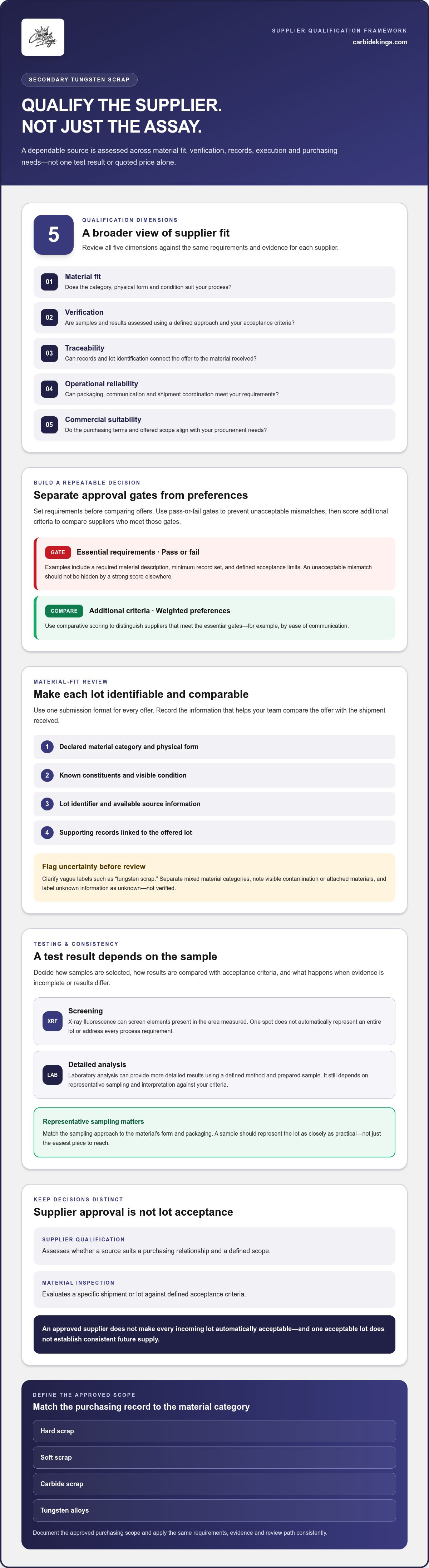
Work through five dimensions: material fit, verification, traceability, operational reliability, and commercial suitability. Together, they give your team a consistent way to review lot quality, documentation, shipment coordination, and purchasing terms. The result is a more informed qualification decision and a source aligned with your process and procurement needs.
Key Takeaways
- Set material requirements and acceptance limits before comparing offers, so each supplier is assessed against the same criteria.
- Use the multi metric qualification process for secondary tungsten scrap suppliers to look beyond assay and price when assessing supplier fit.
- Compare lot descriptions, verification records, traceability, communication, packaging, and shipment coordination using consistent evidence.
- Separate mandatory approval gates from weighted criteria to make decisions clear, repeatable, and easier to review.
- Document the approved purchasing scope and match it to the required material category: hard scrap, soft scrap, carbide scrap, or alloys.
Why Qualify Secondary Tungsten Scrap Suppliers Across More Than Price and Assay?
Secondary tungsten scrap is recovered tungsten-bearing material intended for further industrial use. It can enter procurement in different forms, from hard scrap and soft scrap to carbide scrap and tungsten alloys. Because tungsten is used across industrial applications, buyers need to define how a material’s form and characteristics fit their own process rather than rely on a broad material label alone.
A single assay answers a limited question about the sample tested. It doesn’t establish that future lots will match, that material descriptions are complete, or that records and shipments will be handled consistently. A supplier quote has a similar limit: it captures commercial terms, but cannot show by itself whether the offered material fits the process or whether execution will meet purchasing needs.
Multi-metric qualification is a procurement method for checking whether a supplier meets essential material and operating requirements, then scoring additional criteria to compare supplier fit. In a multi metric qualification process for secondary tungsten scrap suppliers, pass-or-fail gates protect the purchase from unacceptable mismatches. Weighted preferences help distinguish between suppliers who meet those gates. For example, a required material description or minimum record set could be a gate, while ease of communication could be scored comparatively.
What makes supplier qualification different from a material inspection?
A material inspection evaluates a specific shipment or lot against defined acceptance criteria. Supplier qualification assesses whether a source is suitable for a purchasing relationship and a defined scope. Keep the decisions separate: an approved supplier doesn’t make every incoming lot automatically acceptable, and one acceptable lot doesn’t establish consistent future supply.
Document the same criteria for each supplier and apply them consistently. Evaluate material suitability against your process requirements, then assess supplier execution through records, traceability, packaging, and shipment coordination. This gives purchasing and receiving teams a shared basis for decisions, exceptions, and follow-up.
Which risks should the qualification checklist reduce?
Turn each risk into a control your team can verify. For uncertain descriptions, require a clear material description before purchase. For possible mixed grades, define acceptable lot composition and handling expectations. For record gaps, identify required documents and retain them with the purchasing record. For traceability, record how lots are identified from offer through receipt.
Define packaging and shipment expectations before routine orders, too. Specify what information should accompany a shipment, how packaging should protect and identify the material, and who coordinates dispatch and receiving details. These controls won’t prevent every issue, but they make requirements visible, create a consistent review path, and help buyers flag exceptions before they become routine purchasing problems.
How to Verify Secondary Tungsten Scrap Composition, Form, and Lot Consistency
Start with your own process requirements, not the supplier’s available description. Define the material category you can use, the physical form your operation can handle, and the acceptance limits that determine whether a lot is suitable. A requirement for solid pieces, for example, won’t be met by a shipment dominated by fine material, even if both descriptions mention tungsten.
Keep the material review tied to its intended use. The U.S. Geological Survey Tungsten Information provides background on tungsten and its supply, demand, and recycling. For purchasing, your own process requirements should determine what information and evidence you need for each offered lot.
What material information belongs in a supplier submission?
Use one submission format for every offer. Record the declared material category, physical form, known constituents, visible condition, lot identifier, and available source information. Request supporting records that identify the material clearly and connect them to the lot being offered. The goal isn’t paperwork for its own sake. It’s a usable record your team can compare with the shipment received.
Flag vague descriptions such as “tungsten scrap” for clarification before review. Separate mixed material categories rather than treating them as one uniform lot. Note visible contamination, attached materials, or other conditions that could affect handling or processing. If information is unknown, label it as unknown rather than treating an assumption as verified fact.
How should procurement assess tests and lot consistency?
Decide in advance how samples will be selected, how results will be compared with your acceptance criteria, and what happens when evidence is incomplete or results differ. Make the sampling approach appropriate to the material’s form and packaging. A sample should represent the lot as closely as practical, not just the easiest piece to reach.
X-ray fluorescence (XRF) screening and laboratory analysis answer different questions. XRF can screen the elements present in the area measured, but a reading from one spot doesn’t automatically represent an entire lot or address every process requirement. Laboratory analysis can provide more detailed results using a defined method and prepared sample. Neither removes the need to choose a representative sample and interpret results against your own acceptance limits.
Use a simple review record for each lot:
- Description: Does the declared form and category match the order?
- Condition: Are visible condition and potential mixing risks recorded?
- Evidence: Are test results and supporting records linked to the lot?
- Decision: Does the evidence meet the buyer’s stated acceptance criteria?
Compare evidence across repeated lots before concluding that a supplier delivers consistent material. One sample or shipment is a starting point, not proof of ongoing consistency. This material review is one working part of a multi metric qualification process for secondary tungsten scrap suppliers. For buyers sourcing industrial tungsten scrap materials, clear category descriptions and lot-level records help keep procurement requirements aligned with the material received.
How to Compare Supplier Traceability, Documentation, and Operational Reliability
Material fit is only part of the decision. A supplier also needs to make each transaction understandable and manageable, from the records tied to a lot to shipment coordination. Compare what you can observe and document, not broad assurances such as “reliable service” or “complete traceability.” Those claims are difficult to score consistently without specific evidence.
Traceable lot records make procurement accountable by connecting the material received to the documents, decisions, and transactions that authorized its purchase. Use the same review points for each supplier, then record evidence and gaps in a comparison table like this:
| Dimension | Evidence to review | Procurement control |
|---|---|---|
| Traceability | Lot identifiers and source information across available records | Check that identifiers correspond across the offer, transaction documents, and shipment paperwork. |
| Records | Material descriptions, transaction documents, and supporting material records | Set a required record list and retention period to match your internal process. |
| Communication | Responses to routine questions and specification or paperwork discrepancies | Record whether answers are clear, relevant, and followed through to resolution. |
| Packaging | Shipment details compared with your stated handling and identification requirements | Document requirements before purchase and note any observed mismatch. |
| Shipment coordination | Updates and information needed to plan receipt | Assess whether coordination follows the agreed process and gives your receiving team the details it needs. |
Which supplier records help establish traceability?
Review available lot descriptions, transaction documents, and material records together. Check whether a lot identifier appears consistently wherever the material is described or transferred. If one record uses a different identifier, have the discrepancy explained and recorded before treating the file as complete. Define internally which records purchasing must retain, where they belong, and how long they should remain accessible.
How can buyers compare execution without unsupported promises?
Score actual evidence. During qualification, note whether the supplier follows agreed communication steps, identifies the specific issue when a discrepancy arises, and provides the information needed to resolve it. Judge packaging and shipment coordination against your written requirements, not a general claim that shipments are handled carefully.
Separate an observed strength from an unverified promise. For example, a documented response to a paperwork mismatch is evidence of issue handling; a statement that problems are always resolved quickly is not a measurable record. Use a simple rating scale with a short evidence note for each score. If evidence is missing, record the gap and decide whether it blocks approval or lowers a preference score.
This makes the multi metric qualification process for secondary tungsten scrap suppliers repeatable across procurement reviews. Keep the comparison with supplier records, revisit it when procedures or performance change, and use the same criteria for future purchasing decisions.
A Practical Checklist for Scoring and Approving Tungsten Scrap Suppliers
Turn supplier review into a repeatable decision, not a series of one-off judgments. In a multi metric qualification process for secondary tungsten scrap suppliers, mandatory gates determine whether a supplier can be approved at all. Weighted criteria then help compare suppliers who pass. Keep the scorecard focused on five areas: material fit, verification, traceability, execution, and commercial alignment.
Use a consistent evidence status for each criterion: documented for information supported by records, observed for something seen during review or a trial, unresolved for an open question, and not applicable when the criterion doesn’t fit the purchasing scope. Don’t award points for an unresolved mandatory gate.
- Define requirements. Record the intended material category, process needs, acceptance limits, documentation, packaging, and shipment requirements.
- Set approval gates. Identify requirements that must be met, such as an acceptable material description or required lot records. State what evidence satisfies each gate.
- Choose weighted criteria. Assign weights to the five scorecard areas based on your operation’s priorities. Record the rationale so future reviews use the same logic.
- Collect and rate evidence. Apply the status scale consistently. Add a brief evidence note, score, and explanation for every criterion.
- Resolve gaps and decide. Record exceptions, corrective actions, approval owner, purchasing scope, and the reason for the decision.
- Review performance. Revisit the approval when material scope, requirements, or observed supplier performance changes. Keep the record current.
How should procurement build a useful supplier scorecard?
Keep each criterion specific enough to assess. “Good documentation” is vague; “lot identifier appears consistently on the material record and transaction documents” is verifiable. Set internal weights according to process risks rather than copying a generic formula. Preserve the evidence, score, decision rationale, approved scope, exceptions, and approval owner together so another reviewer can understand how the supplier was qualified.
When should buyers use samples, trial lots, or corrective actions?
Use a sample or trial lot when documentation alone can’t show whether material fits the intended process. Define the trial scope, inspection approach, and acceptance criteria before reviewing results. For hard scrap or soft scrap, make the trial criteria reflect the form and handling needs relevant to your operation. Record any nonconformity, agree on corrective steps, and keep approval conditional until required actions are resolved.
For downstream context, the industrial carbide scrap recycling process guide outlines how material can move into further processing. Match qualification criteria to the material and your intended use. Explore industrial tungsten and carbide scrap materials as you define your purchasing scope.
Match a Qualified Supplier to Your Tungsten Scrap Requirements
Qualification is useful only when it leads to a clear purchasing decision. Convert the scorecard into a written supplier-fit record: state which material category is approved, what evidence supports the decision, any limitations, and which requirements still need monitoring. Approval should apply to a defined purchasing scope, not automatically extend to every material or lot a supplier may offer.
Keep the material categories distinct. Hard scrap, soft scrap, carbide scrap, and tungsten alloys can differ in physical form and description, so the evidence relevant to one category shouldn’t be assumed to fit another. Match the records and acceptance criteria to the material your process needs.
How do qualification criteria change by material category?
Use category-specific review questions. For hard scrap, focus on a clear description of the solid material and any known variation within the lot. The tungsten hard scrap buying guide offers additional sourcing context. For soft scrap such as fines or machining residues, capture the material form and description carefully; the tungsten soft scrap buyers guide covers sludge and swarf context. Evaluate carbide scrap and tungsten alloys as separate categories, with documentation and acceptance criteria suited to their intended use. Don’t transfer an approval from one category to another without reviewing its fit.
What belongs in the ongoing supplier review?
Keep the approved scope visible to everyone involved in purchasing, receiving, and production. Record the material categories covered, applicable acceptance criteria, restrictions, unresolved items, and who owns the approval. This prevents a past decision from being read as blanket approval for a different form or use.
Revisit the supplier record when requirements, processes, or sourcing scope change. Also review recurring lot outcomes, records, communication, and corrective actions. Look for patterns, not isolated impressions: repeated documentation gaps or recurring deviations may call for a revised purchasing control, a narrower scope, or a new qualification review. Note the review date and decision so the next buyer can follow the reasoning.
A practical closeout checklist includes:
- Fit: The approved category and intended use are explicit.
- Evidence: Supporting records and lot outcomes are attached or referenced.
- Limits: Exceptions and restrictions are easy to find.
- Ownership: The decision owner and review triggers are recorded.
That documentation turns a completed scorecard into a controlled purchasing scope and makes the multi metric qualification process for secondary tungsten scrap suppliers useful beyond initial approval. Review Carbide Kings’ industrial tungsten and carbide scrap categories to align your sourcing needs with the materials you buy.
Put Your Supplier Decision Into Practice
A supplier approval is most useful when it gives your team a clear next step. Turn your qualification outcome into a purchasing scope, share it with the people who order and receive material, and revisit it when process needs or sourcing priorities change. That keeps approval connected to operating requirements instead of letting it become a one-time checkbox.
A multi metric qualification process for secondary tungsten scrap suppliers also helps procurement choose a source with the right material categories and practical fit. Carbide Kings supplies industrial tungsten and carbide scrap, including hard scrap, soft scrap, and tungsten alloys, for industrial use. Compare the material categories with your documented requirements before placing an order.
View tungsten hard scrap, soft scrap, carbide scrap, and alloy offerings from Carbide Kings.
Frequently Asked Questions
What does secondary tungsten scrap mean?
Secondary tungsten scrap means recovered tungsten-bearing material intended for further industrial use, not a defined grade or promise of composition. The label alone doesn’t show whether material suits a specific refining, melting, or manufacturing route. Translate your process need into a clear material description and form, then compare the available supporting information with your acceptance criteria. Treat any missing detail as unknown, not as an assumed match.
Can XRF alone qualify a secondary tungsten scrap supplier?
No. X-ray fluorescence (XRF) can contribute to an initial screen, but a reading alone doesn’t establish that material meets every requirement or that the tested point represents the shipment. A multi metric qualification process for secondary tungsten scrap suppliers defines what a test result must demonstrate, how the sample is selected, and what other records or analysis the specification calls for. Escalate unclear or borderline results through your established review path.
How often should a buyer requalify a tungsten scrap supplier?
There’s no universal requalification interval. Set one in procurement policy based on material risk and the potential effect of a change on production. Reopen the review sooner if the source, material description, handling approach, or your process requirements change. A pattern of mismatches, missing records, or repeated corrective actions can also prompt reassessment. Record the trigger and resulting approval scope to give the next review a clear starting point.
What should procurement do when a delivered lot differs from its documentation?
Control the discrepancy through your established receiving process before the lot enters routine use. Record the delivery identifier, the document in question, the observed difference, and any inspection results. Compare those details with the purchase requirements and agreed acceptance criteria, then escalate to the designated quality and procurement owners. Document the disposition and any corrective action. Don’t quietly amend the material description or acceptance record to make the discrepancy disappear.
Is a supplier certificate enough to approve tungsten scrap?
No. Treat a certificate as one piece of evidence, not a complete approval decision. Check what material and lot it covers, whether its identifiers match the transaction and delivery records, and whether its declared information addresses your requirements. For example, a document that identifies a broad material category may not answer a process-specific question. Follow your organization’s quality and procurement procedures to decide what evidence is sufficient for the intended purchasing scope.
Can one supplier qualification checklist cover hard scrap and soft scrap?
Yes, a shared checklist can cover general controls such as communication, record handling, and issue escalation. Adapt the material-specific fields for each category, because form can affect which descriptions, handling details, sampling approaches, and acceptance criteria are relevant. Keep separate category records or clearly distinct sections in the same scorecard. That way, a supplier’s approval for one material type doesn’t automatically imply approval for another.
What is the difference between supplier approval and lot acceptance?
Supplier approval evaluates whether a source is suitable for ongoing purchases within a defined scope. Lot acceptance determines whether one specific delivery meets the criteria agreed for that order. For instance, an approved supplier may still deliver a lot with an identifier mismatch that requires review. Keep both controls active: supplier approval supports sourcing decisions, while lot acceptance addresses the evidence and condition of each delivery.


