

Your local scrap yard is likely the least profitable destination for your tungsten carbide. Most general recyclers lack the specialized equipment to assay exotic alloys; they hedge their bets by offering you bottom-dollar rates. It's a common frustration for industrial professionals who know their material is worth far more than standard tool steel. You've likely felt the sting of a quote that didn't reflect the true market value of your inserts or end mills.
Securing the highest price for carbide scrap in 2026 requires a shift in strategy. You don't have to settle for opaque pricing or time-consuming negotiations with local buyers who don't understand your inventory. This article provides a professional roadmap to maximize your returns through better material segregation and direct refinery partnerships. We'll examine the technical differences between hard and soft scrap, provide a repeatable sorting workflow, and explain how to build a transparent relationship with a national refiner. By the end, you'll have a streamlined system that turns your scrap pile into a consistent, high-value revenue stream.
Key Takeaways
- Learn how to bypass local scrap yards to secure the highest price for carbide scrap by leveraging direct-to-refinery market trends.
- Implement a professional "Three-Bin System" on your manufacturing floor to prevent material contamination and protect the purity of your high-value solids.
- Distinguish between hard scrap and soft scrap to ensure each material stream is priced accurately based on its specific tungsten concentration.
- Understand why industrial specialists provide better transparency and faster logistics than generalist metal recyclers.
- Streamline your disposal workflow using a simple photo-and-weight verification process for rapid, professional quotes.
Understanding the 2026 Carbide Scrap Market Dynamics
Tungsten carbide isn't a standard metal. It's a high-density refractory material. This classification puts it in a completely different category than common ferrous metals like steel or iron. Because of its extreme hardness and heat resistance, processing it requires specialized industrial facilities. In 2026, the market for this material has become increasingly sophisticated. To secure the highest price for carbide scrap, you must understand that your material's value is tied to global availability and industrial demand rather than local scrap trends.
The global tungsten price serves as the primary benchmark for all buy-back rates. These rates fluctuate daily based on the London Metal Exchange (LME) and specialized tungsten indices. In the current 2026 industrial climate, the United States is shifting heavily toward domestic recycling loops. This means high-purity scrap is no longer just waste; it's a critical domestic resource. The "highest price" you see today is a moving target influenced by these international benchmarks and local industrial needs.
Why Carbide Is Valued Differently Than Standard Steel
Carbide possesses a density nearly double that of steel. It also has one of the highest melting points of any element. These physical properties make recovery a specialized task. Standard scrap yards often lack the sophisticated equipment needed to assay these alloys accurately. As a result, they frequently underbid. They treat high-value carbide like low-grade tool steel because they don't have the downstream channels to process it correctly.
Tungsten is a critical mineral. It's essential for defense and aerospace manufacturing. Because of this strategic importance, the demand for recycled carbide remains robust. If you want the highest price for carbide scrap, you need a partner who recognizes the material's specific chemical value rather than its weight as generic metal. Specialized refiners look for the tungsten concentration, which is why your scrap is worth a premium compared to common shop floor waste.
The Impact of Global Supply on 2026 Scrap Rates
Mining output in major tungsten-producing nations directly dictates the availability of virgin material. When mining costs rise or supply chains tighten, the value of scrap increases. In 2026, many US manufacturers are adhering to circular economy requirements. These mandates prioritize the reuse of existing materials over new extraction to reduce environmental impact and secure supply chains.
This shift has created a premium for clean, well-sorted scrap lots. "In 2026, recycled tungsten carbide accounts for a significant percentage of new tool production, making high-purity scrap more valuable than ever." By positioning your business within this domestic supply chain, you move from being a seller of waste to a supplier of critical raw materials. This distinction is what ultimately drives your bottom-line returns and ensures you aren't leaving money on the table.
Key Factors That Determine Your Carbide Scrap Value
Not all carbide is created equal. Your return depends on the specific chemical makeup of your material. The tungsten carbide scrap value is primarily driven by the ratio of tungsten carbide (WC) to its cobalt (Co) binder. High-purity solids command the top rates because they require less energy to re-process into new industrial tools.
You also need to distinguish between hard and soft scrap. Hard scrap includes solid items like end mills, drill bits, and indexable inserts. Soft scrap refers to grinding sludge or swarf. Because soft scrap contains moisture and grinding fluids, it requires a more intensive refining process. This technical gap creates a price difference between the two streams. Refineries process these separately; mixing them will almost always result in a lower blended rate that hurts your bottom line.
Weight and volume also play a significant role in your final quote. Large, bulk lots reduce the per-pound logistics cost. This allows refiners to pass those savings back to you. However, the presence of attachments like steel shanks or heavy braze material will quickly erode your profit. These non-carbide elements are essentially dead weight. If you want the highest price for carbide scrap, removing these attachments before shipping is a professional best practice.
The Cobalt Factor: Binders and Purity
Most industrial carbide tools contain between 6% and 15% cobalt. While tungsten is the main driver, high cobalt prices can occasionally provide an additional boost to your scrap value. It's helpful to identify if your shop uses high-cobalt grades or micrograin carbide. These specialized alloys often require more precise assaying to ensure you receive a fair market rate based on the total metal content.
Contamination and Its Cost to Your ROI
Contamination is the fastest way to lose money on a shipment. Common offenders include ceramic inserts, steel mounting bolts, and plastic packaging. Industrial buyers use a deduction system to account for this non-carbide weight. To secure the highest price for carbide scrap, aim for clean scrap. We define clean scrap as material with less than 1% non-carbide attachment by weight. Keeping your bins pure ensures a fast transaction and a higher payout. If you're unsure about your material's purity, partnering with Carbide Kings can help you establish a more efficient recovery process.
Strategic Sorting: How to Categorize for Maximum Profit
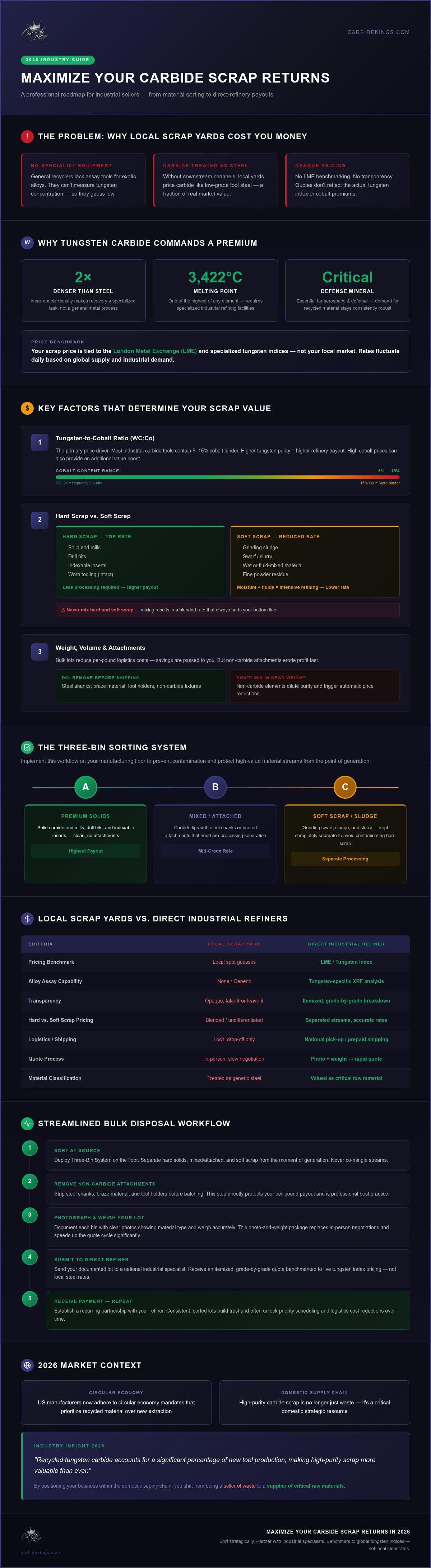
Sorting isn't just about shop floor organization; it's a financial strategy. If you toss everything into a single bucket, you're essentially asking for the lowest common denominator price. To secure the highest price for carbide scrap, you need a disciplined "Three-Bin System" on your manufacturing floor. This prevents high-purity solids from being downgraded by contact with steel shanks or contaminated sludge. By maintaining clear boundaries between material types, you protect the purity of your most valuable assets.
- Bin 1: Clean Solids. This includes items like indexable inserts, end mills, and drill bits.
- Bin 2: Brazed Tools. These are tools with steel shanks or copper braze that require extra processing to separate the carbide.
- Bin 3: Soft Scrap. This is reserved exclusively for your grinding sludge and swarf.
Separating these streams ensures your "Clean Solids" receive the absolute top-tier rate without being averaged down by lower-grade materials. Always document your weights before you request a quote. Having precise figures creates a transparent transaction and shows the buyer you understand the exact value of your inventory. This documentation acts as your baseline for comparing offers and ensures you aren't surprised by weight discrepancies during the final assay.
Segregating Hard Scrap Solids
Your clean solids are your most valuable material stream. Focus on collecting end mills, indexable inserts, and carbide rods in their own dedicated, heavy-duty containers. If labor costs allow, remove steel shanks from carbide-tipped tools before they hit the bin. A pure carbide rod is worth significantly more than one still attached to a steel housing. If your volume is high enough, consider separating different alloy types, such as C-grade inserts from specialty aerospace grades. This level of detail makes it easier for industrial refiners to provide a premium quote without building in a "risk margin" for unknown contaminants.
Managing Soft Scrap and Grinding Sludge
Grinding sludge, or swarf, is frequently overlooked by shop managers. It shouldn't be. While it looks like mud, it often contains a high concentration of tungsten. The primary challenge here is weight. Sludge is often saturated with grinding fluids, which increases shipping costs without adding any actual value to the metal. To get the highest price for carbide scrap in this category, dry your sludge as much as possible before packing it for shipment. Use specialized industrial liners in your drums to prevent the loss of "fines" or small particles during transport. This ensures the metal content remains high and the shipping bill remains manageable.
Choosing the Right Buyer: Local Yards vs. Direct Industrial Refiners
Your choice of buyer determines whether you receive a professional valuation or a generic scrap rate. Local scrap yards are generalists. They handle everything from aluminum cans to old copper pipes. Because they aren't specialists, they often treat tungsten carbide as a low-priority material. To secure the highest price for carbide scrap, you need to work with a direct industrial refiner. These specialists understand the specific chemistry of your material and have the infrastructure to pay for its true value. You shift from being a retail customer at a yard to an industrial partner in a global supply chain.
The "Middle-Man" Tax at Local Scrap Yards
Most local yards don't actually process tungsten. They act as aggregators. They buy your material at a discount and then sell it to the same national refiners you could have contacted yourself. This "middle-man tax" can cost you a significant portion of your potential ROI. Local yards also hedge against market volatility by offering lower-than-market floor prices. Since they lack specialized testing equipment, they often assume the lowest possible purity to protect their own margins. You end up paying for their lack of expertise through reduced payouts.
Benefits of National Direct-Buying Programs
Professional industrial buyers use XRF (X-ray fluorescence) analyzers to provide precise alloy identification. This technology ensures you're paid for the exact tungsten and cobalt content in your shipment. When you sell tungsten hard scrap through a national program, the logistics are often handled or subsidized by the buyer. This removes the burden of arranging heavy freight or navigating complex shipping regulations. It makes the entire process feel like a standard business transaction rather than a trip to the dump.
While a local yard might offer cash on the spot, the payout is almost always lower. Professional procurement programs offer payment terms within 24 to 48 hours of material verification. This short delay is a small price to pay for a significantly higher return on investment. You get the security of a transparent, documented transaction and the financial benefit of direct-to-refinery pricing. If you're ready to maximize your shop's returns, partner with Carbide Kings for a professional assessment of your industrial scrap lot.
Streamlining Your Bulk Carbide Disposal with Carbide Kings
Busy manufacturing managers don't have time to haggle with local yards or navigate complex recycling regulations. You need a system that works as efficiently as your production line. We've built our direct-buy process to remove the friction of traditional scrap selling. You get a direct-to-refinery partner that handles the logistical heavy lifting. This allows you to stay focused on your core operations while we handle the reclamation of your tungsten alloys. Our goal is to turn your scrap management into a hands-off revenue stream.
The 3-Step Quote and Pickup Process
Our workflow is designed for speed and clarity. It moves your inventory from a shop floor bin to a verified payment in three distinct stages. This methodical approach ensures nothing is lost in transit and every pound is accounted for.
- Step 1: Digital Assessment. Submit your inventory details online, including clear photos and estimated weights. We use this data to provide an immediate, market-linked quote. This ensures you're positioned to receive the highest price for carbide scrap based on real-time industrial benchmarks.
- Step 2: Logistics Support. Once you approve the quote, we coordinate the transit. For smaller industrial lots, we provide shipping labels. For heavy bulk shipments, we manage the freight coordination. We'll provide specific instructions on how to palletize or box your material safely to ensure it arrives at our facility securely.
- Step 3: Verification and Payment. Your material is assayed at our central facility using precise XRF technology. This confirms the exact tungsten and cobalt concentration. Once verification is complete, we initiate a rapid payment cycle to ensure maximum liquidity for your business.
Why Industrial Professionals Choose Carbide Kings
Reliability is the foundation of industrial procurement. We offer a no-nonsense approach that eliminates administrative hurdles and unnecessary paperwork. You aren't dealing with a local middle-man who takes a cut of your profit; you're working with a national partner committed to transparency. This consistency makes ongoing scrap management predictable and highly profitable. It's about building a relationship with a buyer who understands the technical value of your materials.
We understand that your time is valuable. Our process is built to be repeatable and efficient. By choosing a specialist, you ensure that every pound of your inventory is valued at its true industrial worth. Don't let your high-value materials sit in a corner collecting dust or lose value at a generalist yard. Get a quote for your carbide scrap today and experience a more professional, lucrative way to recycle.
Take Control of Your Industrial Scrap Revenue Today
You've seen how professional sorting and direct-to-refinery partnerships change the financial landscape of your shop floor. Moving away from generalist scrap yards is the first step toward securing the highest price for carbide scrap. By implementing a strict segregation process for your hard and soft materials, you ensure that every pound of tungsten is accurately valued based on its true chemical makeup.
Working with a specialized industrial partner removes the logistical friction that often stalls disposal efforts. Carbide Kings operates as a direct buyer, which means you bypass middle-man fees and benefit from national shipping support. We prioritize transparency and speed; our rapid payment terms for bulk lots ensure your business stays liquid. It's time to stop treating your carbide like common steel and start valuing it as the critical resource it is.
Maximize your ROI and get a direct quote for your carbide scrap from Carbide Kings. Your inventory is ready to work for you. We're here to make the transition fast, professional, and profitable.
Frequently Asked Questions
What is the highest price for carbide scrap currently available?
The highest price for carbide scrap is a moving target that tracks the London Metal Exchange (LME) and specialized tungsten indices. You'll find the best rates for clean, segregated solids like indexable inserts and end mills. Because market volatility is a constant factor in 2026, the top rate is only available through direct industrial buyers who assay material precisely. Avoid local yards that offer flat, low rates to protect their own profit margins.
How can I distinguish tungsten carbide from high-speed steel (HSS)?
Density is the most immediate way to tell the difference. Tungsten carbide is nearly twice as heavy as high-speed steel. If you have a bench grinder, perform a spark test. Carbide produces very short, orange-red sparks that barely leave the wheel. In contrast, HSS creates long, bright yellow sparks that fan out. This simple physical check prevents you from accidentally mixing lower-value steel into your high-value carbide bins.
Does the cobalt content in my carbide inserts change the scrap price?
Yes, the cobalt binder concentration directly impacts the final valuation of your material. Most industrial carbide contains between 6% and 15% cobalt. While tungsten remains the primary value driver, cobalt is also a high-value metal. When cobalt market prices rise, your high-cobalt inserts can see a price bump. Professional refiners use XRF analyzers to determine the exact percentage of both metals to ensure you receive a fair, market-linked quote.
Is there a minimum weight requirement to sell carbide scrap directly to a refiner?
Most direct-to-refinery programs require a minimum shipment weight, usually starting at 50 pounds. Shipping smaller amounts is rarely cost-effective because the freight costs eat into your profit. If you have a smaller shop, it's better to accumulate material in a secure bin until you reach a bulk threshold. This strategy allows you to leverage industrial shipping rates and secure the premium pricing reserved for high-volume transactions.
Why do local scrap yards pay less for carbide than industrial buyers?
Local yards operate as middle-men who eventually sell their inventory to the same national refiners you can contact directly. They lack the specialized equipment needed to identify complex tungsten alloys accurately. To account for this uncertainty, they offer a conservative floor price. By cutting out the generalist yard, you eliminate their markup and logistical fees. This direct relationship is the only way to ensure you aren't leaving money on the table.
How should I package grinding sludge for the best recycling value?
Soft scrap must be handled with care to preserve its metal concentration. Use leak-proof industrial drums with heavy-duty liners to prevent the loss of fine particles during transit. You should also dry the sludge as much as possible before sealing the container. Removing excess moisture reduces the total shipping weight without lowering the tungsten content. This simple step increases your price-per-pound and improves the overall efficiency of the refining process.
Can I sell carbide end mills with steel shanks still attached?
You can sell them, but they are categorized as brazed or attached scrap rather than clean solids. The steel shank is a contaminant that must be removed before the tungsten can be recycled. This extra labor and the lower purity of the lot will reduce your payout. If your volume is high enough, we recommend cutting off the steel shanks. This small investment in labor significantly increases the purity and value of your shipment.
How often do carbide scrap prices change in the 2026 market?
Market rates for tungsten change daily based on global mining output and industrial demand. In the 2026 landscape, supply chain shifts and domestic recycling mandates have increased price frequency. We track these movements in real-time to provide quotes that reflect the current market reality. To get the highest price for carbide scrap, you should request a quote when you're ready to ship rather than relying on outdated price lists from previous months.


