

What if a supply agreement made carbide scrap easier to plan around without locking you into terms that no longer fit production? Establishing long term supply agreements for industrial carbide scrap starts with clear, shared expectations. Unpredictable availability, vague material specifications, and changing market conditions can disrupt procurement and inventory planning.
A dependable agreement needs more than a price per shipment. It should define the material, set a workable supply rhythm, and explain how pricing, shipping, inspection, and exceptions will be handled. The goal is a clear process that accounts for changing production and market needs.
This guide covers the practical decisions involved: what to document in scrap specifications, how to plan volumes and order schedules, which pricing approaches to compare, and how to manage shipment reviews and issues. Carbide Kings supplies carbide scrap, tungsten hard scrap, tungsten soft scrap, and tungsten alloys to industrial buyers. Use the steps below to turn recurring material needs into a clearer, more manageable supply arrangement.
Key Takeaways
- Start with the operating goal: dependable feedstock, simpler procurement, budget planning, or fewer sourcing disruptions.
- When establishing long term supply agreements for industrial carbide scrap, define material categories and document relevant form, condition, packaging, and known material details.
- Compare fixed, periodically reviewed, and market-referenced pricing structures, then align volume expectations with forecasts and order flexibility.
- Map each shipment from forecast and order release through receiving, reconciliation, and communication about exceptions.
- Schedule reviews to keep specifications, supply expectations, commercial terms, and logistics aligned as manufacturing needs change.
Why Long-Term Industrial Carbide Scrap Agreements Need Clear Operating Goals
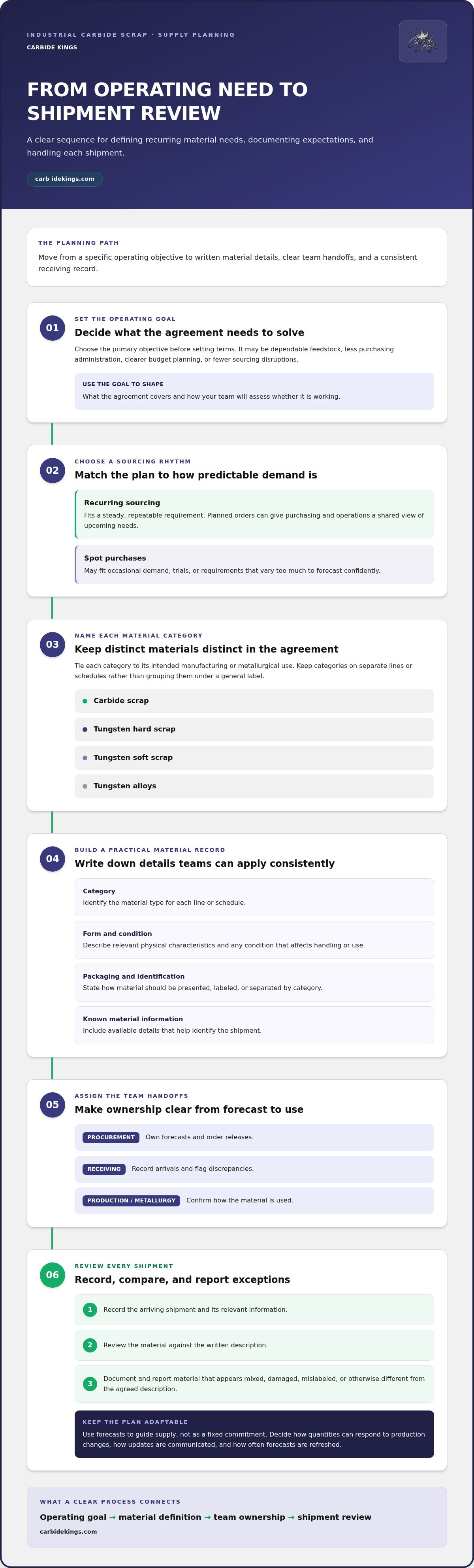
A recurring supply arrangement should solve a specific operating problem, not simply put repeat orders on a calendar. Is your priority dependable feedstock for production, less administrative work for purchasing, clearer budget planning, or fewer sourcing disruptions? Identify the main objective first. It will shape what the agreement covers and how your team measures whether it is working.
A long-term supply agreement in industrial scrap procurement is a shared plan for recurring material needs, with clear expectations for ordering, supply, and review. Unlike a one-time purchase, it connects future orders to manufacturing demand and purchasing workflows. It can support planning, but it should not be treated as a promise of unlimited availability. Set expectations that both sides can manage.
What should a carbide scrap supply agreement accomplish?
Start with the material’s intended use. Carbide scrap, tungsten hard scrap, tungsten soft scrap, and tungsten alloys are distinct categories, and the buyer’s requirements depend on the material and the process it will support. For background on carbide composition and industrial applications, review What is Carbide?. Then define the category and relevant material details in terms your purchasing and production teams can apply.
Translate the operating goal into an internal workflow. Procurement can own forecasts and order releases; receiving can record arrivals and flag discrepancies; production or the metallurgical team can confirm how the material is used. Assigning an owner to each step reduces gaps between expected demand, placed orders, and material on hand. The agreement should make those handoffs easier, not create a separate process that teams struggle to follow.
When does recurring sourcing make more sense than spot purchases?
Recurring sourcing suits a steady, repeatable requirement. If a manufacturing process regularly consumes a defined category of carbide scrap, planned orders can give purchasing and operations a shared view of upcoming needs. A spot purchase may suit occasional demand, trials, or requirements that vary too much to forecast confidently. Choose an approach based on actual usage, not a preference for longer paperwork.
Forecast visibility helps teams prepare for expected consumption, coordinate purchasing, and spot changes in demand. It does not remove uncertainty. Build flexibility into the plan so a forecast guides supply without being mistaken for a fixed commitment. Decide how order quantities can respond to production changes, how updates are communicated, and how often forecasts are refreshed.
As you begin establishing long term supply agreements for industrial carbide scrap, treat continuity and flexibility as complementary goals. Define the recurring need the plan will support, which teams will manage it, and how expectations can be reviewed when manufacturing demand changes. That gives the rest of the agreement a clear operating purpose.
Specify Carbide Scrap Material Before Agreeing to Recurring Supply
Clear material definitions turn a broad purchasing request into a shared reference for ordering and receiving. For buyers establishing long term supply agreements for industrial carbide scrap, the agreement should distinguish carbide scrap from tungsten hard scrap, tungsten soft scrap, and tungsten alloys. Avoid grouping different categories under a general label when their intended uses or acceptance requirements differ.
Precise material definitions give both parties the same written basis for ordering, receiving, and reviewing each shipment. Tie each category to its manufacturing or metallurgical application, then record the details relevant to that use. Aim for practical clarity rather than adding grade requirements or specifications that do not fit the material or application.
How should buyers describe the material they need?
Describe the material in terms your purchasing, receiving, and production teams can apply consistently. Record its category, relevant physical form, known condition, packaging expectations, and available information that helps identify it. Keep categories on separate lines or schedules so a request for carbide scrap does not silently include alloys or other tungsten scrap. A comparison titled “Hard Scrap vs. Soft Scrap: Industrial Grade Differences” can help teams keep those labels distinct.
What belongs in an acceptance and inspection process?
Set a repeatable receiving sequence. Identify who records the shipment, what information they capture, and who reviews the material against the written description. If a shipment appears mixed, damaged, mislabeled, or otherwise different from the agreed description, document the discrepancy and report it through the designated channel. Consistent records give both sides the same facts to review.
Build a compact material record for each category. It can include:
- Category: carbide scrap, tungsten hard scrap, tungsten soft scrap, or tungsten alloys.
- Form and condition: describe relevant physical characteristics and any condition that affects handling or use.
- Packaging and identification: state how the material should be presented and how categories are labeled or separated.
- Known material information: include available details that help identify the shipment, without assuming every load has identical composition or form.
Align the acceptance process with your receiving capabilities. For example, a receiving team might log shipment details, note visible differences from the description, and route questions to the person responsible for evaluating material suitability. Record what was expected, what arrived, and how the discrepancy was resolved. This makes exceptions visible without turning every delivery into an improvised review.
Keep the description usable. Avoid vague terms such as “standard carbide” unless the agreement defines what that means for the buyer’s purpose. At the same time, do not add technical thresholds, measurement methods, or inspection tools that teams do not use or cannot apply consistently. Document the information you have and make any limits clear.
For recurring requirements, consistent category descriptions make orders easier to compare and receiving records more useful over time. Carbide Kings supplies carbide scrap and other tungsten material categories to industrial buyers. Explore carbide scrap supply as you define the material needs for your operation.
Compare Pricing, Volume, and Flexibility Terms Before Committing
Pricing and volume terms determine how a recurring supply plan responds to changing purchasing needs and market conditions. Before establishing long term supply agreements for industrial carbide scrap, compare the trade-offs between price predictability, room to adjust, and the effort required to administer each order. The right structure should be clear enough to support budgeting and practical enough to follow.
Which pricing approach fits a recurring scrap requirement?
A fixed price can make budgeting and purchase approvals more straightforward during the period it applies. The trade-off is that it may not reflect later market changes. A periodically reviewed price lets the parties revisit terms on a defined schedule, while a market-referenced structure ties adjustments to an agreed source or method. Each approach balances predictability and responsiveness differently.
Make the pricing mechanics explicit. State when a review occurs, what information informs it, how changes are calculated, and when revised terms take effect. If you use a benchmark, identify it precisely and explain how it applies. A reference such as Tungsten Carbide Scrap Price Guide: Market Drivers and Valuation in 2026 can help frame market questions, but the agreement itself should define its pricing method.
| Structure | Predictability | Adaptability | Administrative effort |
|---|---|---|---|
| Fixed pricing | Higher during the stated period | Lower until terms are revisited | Generally simpler between reviews |
| Periodic review | Clear between scheduled reviews | Changes at planned checkpoints | Requires scheduled review and documentation |
| Market-referenced pricing | Depends on the defined reference and timing | Can respond to changes through the agreed method | Requires consistent tracking and calculation |
How can volume commitments leave room for operational change?
Separate firm orders from forecasts. A firm quantity tells both sides what a specific release requires; a forecast signals expected demand and supports planning without automatically becoming a purchase commitment. Set an adjustment window so production changes can be communicated before an order is released. This distinction keeps planning useful without overstating certainty.
Volume bands, minimums, maximums, or tolerance ranges can make expectations easier to manage if the agreement defines how each works. For example, a buyer might set a planned range for recurring orders, then agree how changes within or beyond that range will be handled. Avoid vague language such as “as needed” if it leaves purchasing teams unsure what they can request.
Plan regular reviews of demand assumptions. If production requirements shift, assess forecasts, order flexibility, and pricing terms together. Reviewing them as a set helps prevent one change from creating confusion across the arrangement. Carbide Kings supplies carbide scrap and other tungsten material categories for industrial buyers. Explore industrial carbide scrap supply as you shape terms around your purchasing needs.
Plan Shipping, Receiving, and Issue Resolution for Every Shipment
A recurring agreement works best when every delivery follows a clear path from forecast to reconciliation. Define who releases the order, who prepares the shipment, what information accompanies it, and who records receipt. This turns shipment coordination into a repeatable workflow instead of a series of last-minute decisions.
What should the recurring shipment workflow include?
Set a practical cadence for forecasts, order confirmation, dispatch updates, and receiving. The schedule should fit the buyer’s purchasing process and give the teams involved enough notice to prepare. Assign responsibility for packaging and shipment documentation, then specify which records procurement and receiving will use to match each delivery to its order.
For reconciliation, make sure order and receiving records share useful identifiers, such as the order reference, material category, shipment date, and recorded quantity. The parties can also define how packaging condition and shipment notes are captured. Address logistics and shipping handoffs alongside the material requirements so the process is clear from order release through receipt.
Keep the sequence simple:
- Share or update the forecast, then release an order through the agreed process.
- Confirm the order details and coordinate dispatch, packaging, and accompanying documentation.
- Record receipt, compare the shipment with the order, and note any exceptions.
- Reconcile the delivery record and communicate unresolved questions to the assigned contacts.
Clear shipment records make recurring procurement smoother by giving both parties a shared account of what was ordered, sent, received, and resolved.
How should changes and discrepancies be handled?
Define a notification path before an exception occurs. Identify who receives the first notice, what details it should include, and who evaluates the issue. If a delivery appears short, contains a mismatched category, or raises a quality concern, record the order reference, observed discrepancy, and relevant receiving notes. Keep the report factual and send it promptly to the designated contacts.
Use the same discipline for changes. Record revised forecasts and order adjustments in a shared system or documented communication channel so procurement, shipping, and receiving teams can identify the latest version. Distinguish an updated forecast from a confirmed order. That distinction prevents planning information from being mistaken for an approved shipment request.
Agree in advance how the parties will review an exception and determine next steps. Any remedies or adjustments should follow the terms both sides have documented, not assumptions made at the receiving dock. A consistent process also helps teams identify recurring issues and improve the workflow without reopening every part of the agreement.
As you establish shipment procedures, use Industrial Metal Scrap Logistics and Shipping Support as a reference point for the logistics questions your plan should address. For industrial carbide scrap supply, discuss your recurring supply needs with Carbide Kings.
Build a Carbide Scrap Supply Partnership Around Review and Reliable Sourcing
A durable supply partnership brings the agreement’s moving parts together in one operating plan: the material specification, forecast, commercial terms, order process, shipment records, and exception path. Each part should support the same goal: matching industrial material supply with real procurement and production needs. Establishing long term supply agreements for industrial carbide scrap is not a one-time paperwork exercise. It is a framework that should remain useful as those needs evolve.
What should buyers review with a supply partner over time?
Schedule reviews to see how the arrangement performs in practice. Examine shipment consistency, fit with documented material requirements, communication between assigned teams, and how closely forecasts reflect actual demand. Bring specific records, such as order changes, receiving notes, and recurring discrepancies. This makes the discussion concrete and helps distinguish a one-off exception from a pattern that needs attention.
Production changes can affect which material categories are needed and how they are used. Revisit specifications and forecasts when applications or purchasing requirements shift, then record agreed updates so procurement, receiving, and production teams work from the same version. For additional background on tungsten hard scrap, buyers can consult The Complete Guide to Tungsten Hard Scrap Recycling in 2026.
How can Carbide Kings support industrial material sourcing?
Carbide Kings supplies industrial buyers with tungsten hard scrap, tungsten soft scrap, carbide scrap, and tungsten alloys. These categories support manufacturing and metallurgical procurement needs, including bulk material requirements. A clear agreement framework connects the relevant material category to its intended use, expected demand, commercial approach, and shipment workflow.
Keep reviews practical. A focused agenda can help both teams decide what needs attention without reopening settled terms unnecessarily:
- Material fit: Are the category descriptions still aligned with the buyer’s application and receiving expectations?
- Supply planning: Do forecasts and order patterns reflect current production requirements?
- Commercial terms: Are the pricing and volume arrangements still understandable and workable for both sides?
- Execution: Are shipment records, communication, and exception handling supporting smooth reconciliation?
Document decisions, assign owners, and set the next review point through the parties’ agreed process. This creates a useful feedback loop: operational experience informs updates, while written terms keep changes clear. A supply relationship becomes more dependable when expectations are visible and reviewed rather than left to memory.
For buyers establishing long-term industrial sourcing, Carbide Kings offers multiple tungsten and carbide scrap categories for bulk supply. Explore Carbide Kings’ industrial material supply and take the next step toward aligning recurring material needs with a practical supply plan.
Turn Your Supply Plan Into a Stronger Next Step
Give the agreement a clear starting point: choose the recurring material requirement that matters most to production and make it a priority for procurement and operations. Then build a plan your teams can use, track, and refine as demand shifts. This keeps establishing long term supply agreements for industrial carbide scrap connected to day-to-day manufacturing instead of leaving the agreement untouched after signing.
A well-designed supply relationship should make planning easier and expectations clearer. Start by aligning your internal teams on the need, then identify a sourcing plan that supports your industrial operation.
Explore industrial tungsten and carbide scrap supply from Carbide Kings and take a practical step toward a more coordinated material plan.
Frequently Asked Questions
Can a long-term carbide scrap agreement guarantee uninterrupted supply?
No agreement should be treated as a guarantee of uninterrupted supply. It can clarify expected volumes, ordering procedures, communication responsibilities, and how supply constraints are handled, but actual availability can change. Buyers can reduce exposure by comparing planned deliveries with production needs, maintaining an appropriate inventory buffer, and documenting an escalation process for delays or short shipments. Set expectations that both parties can realistically manage.
How much carbide scrap inventory should a manufacturer plan to keep?
There is no single inventory quantity that fits every manufacturer. Estimate usage over the time it typically takes your operation to replenish material, then account for changes in consumption and the impact of a delayed delivery. Review actual usage against that estimate regularly. A process with steady demand may need a different buffer from one with uneven production, limited storage, or material used only for specific jobs.
What happens if a shipment contains a different carbide scrap category than expected?
Keep the unexpected material separate from accepted inventory while the discrepancy is reviewed. Record the order reference, the expected category, what arrived, and any visible identifying details. Notify the designated contacts through the agreement’s exception process. Do not blend or use the material before its status is resolved. The parties can then determine the next step under their documented terms and update records to show the outcome.
Can one supply agreement cover both tungsten hard scrap and soft scrap?
Yes. One agreement can cover both categories if it distinguishes them clearly. Use separate schedules or order lines to record the material description, intended use, quantity expectations, and applicable commercial terms for each. Keep shipment labels and receiving records equally distinct. This structure can simplify administration while reducing the risk that a forecast or delivery for tungsten hard scrap is mistaken for a requirement for tungsten soft scrap.
How often should buyers review a long-term scrap supply agreement?
Choose a review cadence that fits your purchasing cycle, then revisit the plan sooner if production requirements or supply performance change. For example, a change in the manufacturing schedule may make an existing forecast less useful before the next planned review. When establishing long term supply agreements for industrial carbide scrap, set clear review triggers as well as recurring check-ins, and document approved updates.
Should a carbide scrap agreement use fixed or market-referenced pricing?
Choose based on the balance your organization needs between budget predictability and responsiveness to changing market conditions. Fixed pricing can simplify planning for a defined period, while a market-referenced approach can adjust according to an agreed method. Before adopting a reference, specify its source, timing, calculation, and how changes take effect. A periodic review may also suit buyers who want scheduled opportunities to revisit commercial terms.
What shipment records should a buyer keep for recurring carbide scrap deliveries?
Keep records that let your team trace each delivery from order to receipt. Useful items include the purchase order, order confirmation, shipment documentation, material category, recorded quantity, receipt date, and receiving notes. If a shipment has a discrepancy, attach the related communication and document how it was resolved. Consistent records help procurement compare deliveries, answer internal questions, and identify recurring issues without relying on memory.


