

Treating secondary tungsten as mere scrap is the fastest way to leave money on the table in today's high-stakes metallurgical market. You're likely already dealing with extreme primary market price volatility and the constant threat of supply chain disruptions for critical minerals. These logistical burdens make it difficult to maintain a predictable bottom line while hitting your production targets. That's why secondary tungsten raw materials procurement for specialty steel foundries has shifted from a backup plan to a primary strategic advantage for modern industrial operations.
We agree that your foundry needs more than just a vendor; you need a proactive partner that understands the nuances of melt chemistry and consistent purity levels. This guide will show you how to master the strategic procurement of high-purity secondary tungsten scrap to optimize your feedstocks. You'll learn how to secure a reliable domestic supply chain and meet specific metallurgical standards without the traditional administrative headaches. We'll explore the direct-to-foundry model for tungsten hard scrap, soft scrap, and alloys, giving you the tools to lower your cost per pound of contained tungsten and keep your production lines moving with confidence.
Key Takeaways
- Transitioning from primary alloys to high-purity secondary tungsten helps mitigate market volatility while securing a reliable domestic supply chain.
- A structured approach to secondary tungsten raw materials procurement for specialty steel foundries ensures that your melt chemistry remains consistent and your cost per pound decreases.
- Understanding the metallurgical differences between tungsten hard scrap and soft scrap allows for more precise feedstock optimization in complex steel production.
- Sourcing bulk carbide scrap and tungsten alloys directly from a national supplier eliminates traditional administrative hurdles and logistical delays.
- Implementing a rigorous supplier qualification process ensures that your secondary raw materials meet strict purity standards for high-performance specialty steels.
The Strategic Importance of Secondary Tungsten in Specialty Steel Production
Secondary tungsten isn't just a recycled substitute; it's a high-performance feedstock. In the metallurgical sector, we define secondary tungsten as recovered carbide inserts, tooling, and alloys processed for direct re-entry into the furnace. Specialty steel foundries are increasingly moving away from primary Ammonium Paratungstate (APT) and Ferrotungsten. The reason is simple. The metallurgical properties of tungsten remain intact through the recycling process, but the procurement logistics are vastly superior. You get the same performance with less friction.
Mastering secondary tungsten raw materials procurement for specialty steel foundries allows operators to bypass the heavy premiums associated with virgin ore. You'll see an immediate reduction in the cost per pound of contained tungsten. This isn't just about saving pennies; it's about reclaiming control over your melt chemistry. By using high-purity recycled materials, you eliminate the baggage of international shipping delays and the unpredictability of primary mining outputs. It's a faster, more direct route to high-grade production.
Market Volatility and Primary Supply Constraints
Geopolitical shifts often trigger sudden shortages in primary tungsten availability. As we look toward 2026, market trends suggest that supply chain resilience will be the top priority for industrial leaders. Primary market price spikes are expected to become more frequent as global demand for high-strength alloys increases. Secondary procurement acts as a critical buffer against these fluctuations. When you shift to domestic sourcing, you remove the risks inherent in transcontinental logistics. It's a reliable way to keep your inventory stable and your costs predictable.
Sustainability and the Circular Economy in Metallurgy
Reducing the carbon footprint of your steel production is no longer just a "green" initiative; it's a business necessity. Modern industrial manufacturing must meet strict ESG requirements to qualify for major government contracts and large-scale infrastructure projects. Secondary tungsten raw materials are high-purity recycled feedstocks that bypass traditional mining energy costs. Using these materials helps you hit sustainability targets while maintaining the high-grade output your clients expect. Effective secondary tungsten raw materials procurement for specialty steel foundries ensures that your operation remains competitive in a market that values both efficiency and environmental responsibility. It's a clean, efficient loop that rewards your bottom line.
Metallurgical Classification: Hard vs. Soft Tungsten Scrap as Foundry Feedstock
Precision metallurgy requires a deep understanding of your feedstock. You shouldn't treat secondary materials as a monolith. Successful secondary tungsten raw materials procurement for specialty steel foundries depends on your ability to distinguish between hard and soft scrap varieties. Each has a specific impact on your melt chemistry and final product quality. While both categories provide essential tungsten units, their physical forms and chemical compositions dictate how they should be handled during the melt.
Tungsten Hard Scrap: Solids and Tooling
Hard scrap consists of solid pieces like carbide end mills, drills, and indexable inserts. These materials are high-density feedstocks that offer exceptionally predictable recovery rates in the furnace. Most industrial carbide inserts contain high percentages of tungsten carbide bonded with cobalt, typically ranging from 6% to 15%. This cobalt content is vital for foundries to track, as it directly influences the final properties of the specialty steel. According to USGS tungsten statistics and recycling reports, these solids represent a reliable stream for the steel industry. For a deeper look at processing these materials, consult our Tungsten Hard Scrap Recycling Guide. Solids are generally the preferred choice for high-speed steels where carbon control is tightest.
Tungsten Soft Scrap and Grinding Sludge
Soft scrap includes materials like grinding sludge, swarf, and powders. When you evaluate tungsten soft scrap buyers, you must account for the logistical complexities of these materials. Sludge often contains high levels of moisture and residual grinding oils. These contaminants must be removed or accounted for before the material is introduced to the melt to prevent porosity or carbon spikes. While soft scrap can be more labor-intensive to process, it provides a cost-effective way to hit tungsten targets in less sensitive steel grades. Nickel is also frequently present as a binder in certain soft scrap streams; this can be beneficial if your alloy specification requires it. If you need a consistent inventory of secondary tungsten that meets your specific metallurgical requirements, working with a specialist is the most efficient path forward. This targeted approach to secondary tungsten raw materials procurement for specialty steel foundries ensures that your output remains consistent load after load.
Secondary Raw Materials vs. Primary Alloys: A Cost-Benefit Analysis
Deciding between primary Ferrotungsten and secondary feedstocks is a pivot point for your foundry's profitability. Primary alloys are often subject to global price indices and import duties that can shift overnight. In contrast, secondary tungsten raw materials procurement for specialty steel foundries offers a more stable cost structure. You're paying for the contained tungsten units without the massive overhead of international mining and refining premiums. This direct approach typically results in a lower cost per pound of contained tungsten, providing an immediate boost to your margins.
Recovery rates and yield loss are equally critical. High-purity secondary solids provide recovery rates that rival primary alloys, often exceeding 95% in controlled melts. Beyond the material cost, you must consider the impact on your infrastructure. Secondary materials generally require less energy to reach liquidus temperatures compared to raw ores or dense ferroalloys. This lower thermal demand extends the life of your furnace linings and reduces your overall energy consumption per heat. According to U.S. Geological Survey tungsten mineral data, the reliance on secondary sources is growing precisely because of these operational efficiencies.
Contaminant Management and Purity Standards
Managing the "Cobalt factor" is the primary challenge when shifting to secondary materials. Most carbide scrap contains cobalt as a binder, which you must account for in your final alloy specification. We recommend rigorous testing protocols for every bulk lot to verify purity before it hits the furnace. When you balance your melt chemistry with 100% secondary feedstocks, you gain the ability to fine-tune your additions. This precision allows you to hit tight metallurgical standards while keeping your raw material costs at a minimum. It's about mastery over the chemistry, not just the cost.
Logistical Efficiency and Inventory Management
Domestic sourcing eliminates the administrative nightmare of international mineral trading. When you work with established tungsten scrap buyers usa, you benefit from just-in-time delivery schedules that primary importers can't match. This responsiveness reduces your need for massive on-site safety stocks, freeing up capital and warehouse space. The paperwork is simpler, the lead times are shorter, and the supply chain is transparent. Choosing domestic secondary tungsten raw materials procurement for specialty steel foundries turns your supply chain from a liability into a competitive advantage. You get the material you need exactly when you need it.
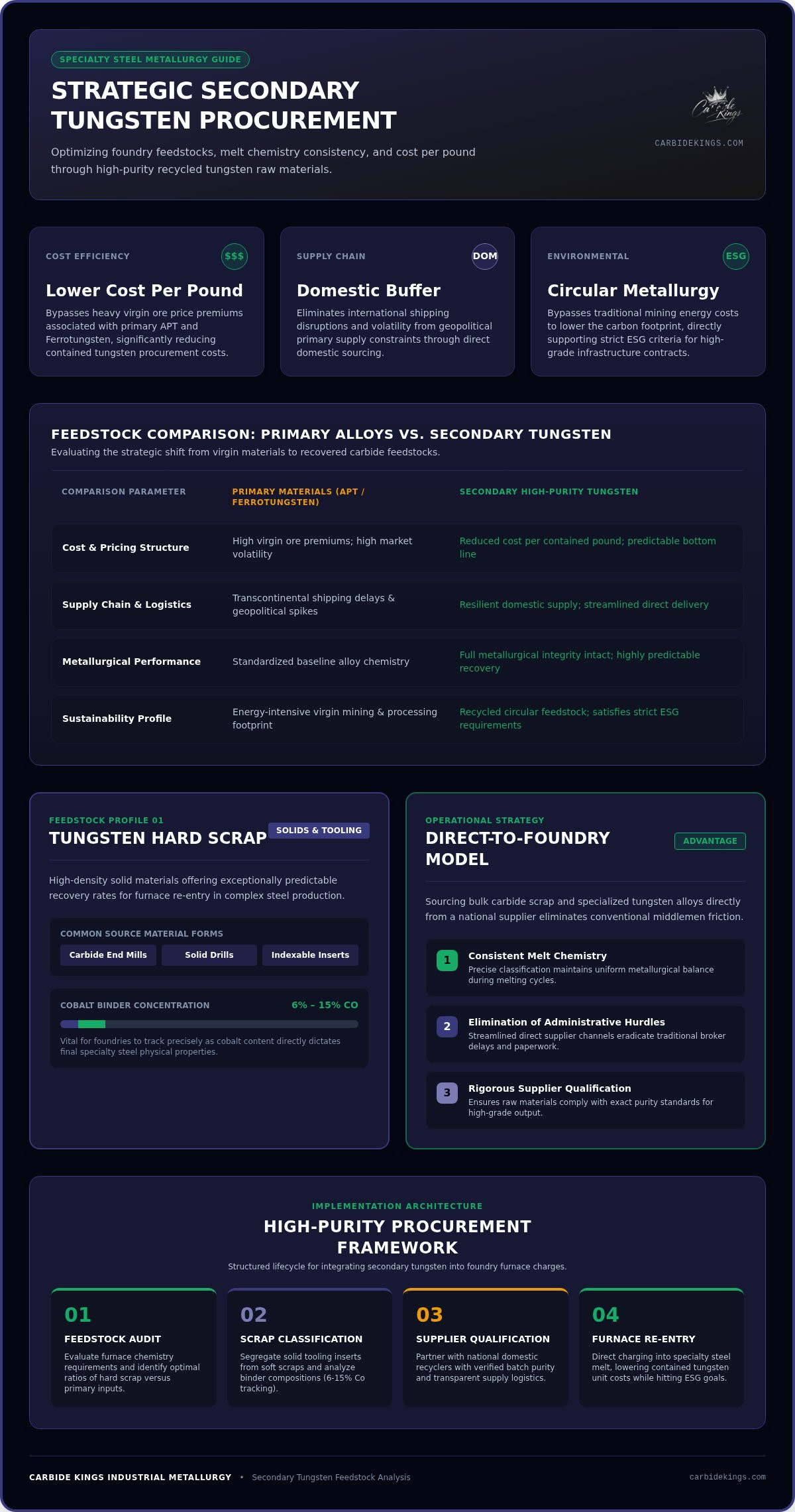
Establishing a Reliable Procurement Framework for High-Purity Tungsten
Building a procurement system is about more than just finding the lowest price. It's about creating a repeatable, high-integrity process that protects your furnace and your bottom line. Established industry leaders like Bowmanville Foundry, who have specialized in high-quality iron castings for over a century, recognize that consistent feedstock is the foundation of any successful metallurgical operation. To master secondary tungsten raw materials procurement for specialty steel foundries, you must move beyond the transactional mindset of traditional scrap buying. You need a framework that prioritizes chemical precision and logistical reliability. This starts with a clear understanding of your internal metallurgical constraints and ends with a supply chain that responds to your production schedule in real time.
Success in this area follows a logical, four-step sequence. First, define your metallurgical requirements with absolute clarity. You must establish strict tolerances for trace elements like cobalt, nickel, and carbon to ensure melt consistency. Second, qualify your suppliers based on their inventory consistency and sorting capabilities. A partner who can provide uniform bulk lots is far more valuable than a broker offering one-off deals. Third, establish lot-by-lot testing and verification procedures. Trust your supplier, but verify every shipment with XRF analysis or independent assays. Finally, optimize your logistics for bulk material handling. Domestic sourcing simplifies this by allowing for predictable shipping windows and reduced safety stock requirements.
Don't settle for traditional scrap metal brokers who lack technical expertise. When you're looking for a national carbide recycling company, prioritize those with established industrial footprints. Professional suppliers offer transparent lot evaluations and detailed assaying reports. This "direct from the source" model removes the administrative friction and hidden markups common in the brokerage market. You want a partner who understands the difference between a high-speed steel additive and a low-grade sludge. This level of technical alignment ensures that your secondary tungsten raw materials procurement for specialty steel foundries remains a strategic asset rather than a quality control risk.
Contracting and Supply Continuity
Supply continuity is the backbone of any foundry operation. You should structure long-term supply agreements that provide stability while allowing for market-based pricing adjustments. Diversifying your scrap sourcing across multiple domestic streams helps you hedge against localized shortages. To better understand the market drivers that influence your costs, consult our Tungsten Carbide Price Guide. By combining long-term contracts with a deep understanding of market valuation, you create a procurement shield that protects your operation from global mineral volatility. If you're ready to secure a stable supply of high-purity materials, partner with Carbide Kings to streamline your industrial procurement today. We handle the heavy lifting of sourcing and quality control so you can focus on your melt.
Carbide Kings: Streamlining Procurement for National Steel Foundries
General metal dealers often lack the technical precision required for high-performance metallurgy. You can't afford to guess about the purity of your feedstock when managing secondary tungsten raw materials procurement for specialty steel foundries. Carbide Kings operates as a specialized industrial partner. We provide the consistent inventory of tungsten alloys and scrap that modern foundries demand. We remove the traditional administrative hurdles that slow down your supply chain. Our national US coverage ensures that high-volume operations receive reliable deliveries without the logistical friction of local scrap yards or international importers.
Bulk Inventory and Quality Control
Our expertise lies in the rigorous sorting and grading of tungsten hard scrap. We understand that a minor variance in cobalt or nickel binders can compromise an entire melt. That's why we maintain strict quality control protocols to ensure metallurgical consistency across every bulk lot. We provide the technical data you need to balance your furnace additions with confidence. The Carbide Kings inventory serves as a reliable, direct-to-foundry solution for secondary tungsten procurement. By focusing exclusively on tungsten and carbide materials, we offer a level of purity verification that generalist dealers simply cannot match.
Direct National Procurement Solutions
We've refined the industrial procurement process to mirror a straightforward business transaction. There's no need to navigate complex brokerage networks or wait on overseas shipping containers. We handle the heavy lifting of logistics, moving bulk material across the country with professional efficiency. Our no-nonsense approach prioritizes transaction speed and reliability, ensuring your production schedule stays on track. We eliminate the unnecessary paperwork and administrative layers that often plague secondary tungsten raw materials procurement for specialty steel foundries. It's a modernized, streamlined alternative designed for the speed and transparency of 2026 manufacturing.
If your operation requires high-purity feedstocks to mitigate primary market volatility, it's time to work with a partner that understands your technical needs. We provide the transparency and consistency you need to optimize your production costs and maintain supply continuity. Contact Carbide Kings for current bulk inventory and procurement rates and experience a more efficient way to secure your metallurgical future.
Securing a Competitive Edge in Specialty Steel
Mastering the shift toward recycled feedstocks is no longer optional for foundries that value long-term stability. You've seen how high-purity solids and processed soft scrap can replace expensive primary alloys without sacrificing melt quality. By prioritizing chemical precision and domestic sourcing, you effectively insulate your operation from the volatility of global mineral markets. A structured approach to secondary tungsten raw materials procurement for specialty steel foundries ensures that your production costs remain predictable and your margins stay protected load after load.
The path to a more efficient melt chemistry starts with a partner who understands your technical constraints. We handle the heavy lifting of sourcing and quality control so you can keep your focus on the furnace floor. With our specialized industrial tungsten inventory and national US logistics support, we provide the transparency you need to scale your operations with confidence. You deserve direct procurement without middlemen, hidden markups, or unnecessary administrative hurdles. It's a faster, cleaner way to manage your inventory.
Secure Your Tungsten Supply Chain with Carbide Kings today. It's time to streamline your logistics and take control of your metallurgical future with a partner you can trust.
Frequently Asked Questions
What is the typical purity of secondary tungsten raw materials for foundries?
High-grade secondary tungsten, specifically carbide scrap, typically contains 80% to 95% tungsten carbide. The remaining percentage usually consists of metallic binders like cobalt or nickel. Foundries must account for these binders when calculating their final melt chemistry. Because these materials are recycled from precision tooling, the purity levels remain consistently high compared to raw ores. This makes them an ideal primary feedstock for specialty steel production without the need for additional refining.
How do binders like cobalt affect the steel alloying process?
Cobalt acts as a metallic binder in most tungsten carbide materials and will integrate directly into your steel alloy during the melt. It enhances high-temperature strength and magnetic properties, which is often desirable in specific tool steels. However, you must carefully monitor cobalt percentages to ensure they don't exceed your alloy's maximum tolerance. Precise secondary tungsten raw materials procurement for specialty steel foundries involves selecting scrap lots with binder profiles that complement your specific metallurgical goals.
Can secondary tungsten scrap completely replace Ferrotungsten in a melt?
Yes, secondary tungsten scrap can completely replace Ferrotungsten in many melts, provided the foundry accounts for binder elements like cobalt. High-purity solids offer similar recovery rates, often exceeding 95% in controlled environments. Many operators prefer scrap because it bypasses the high premiums and import duties associated with refined ferroalloys. Shifting to 100% secondary feedstocks allows you to reduce production costs while maintaining the same high-performance standards in your final specialty steel product.
What are the testing requirements for bulk tungsten scrap lots?
Every bulk lot of secondary tungsten should undergo X-ray fluorescence (XRF) analysis to verify chemical composition before it enters the furnace. This testing identifies the exact percentages of tungsten, cobalt, nickel, and any trace contaminants. Foundries should also perform moisture and oil content checks on soft scrap varieties like grinding sludge. Establishing these rigorous verification protocols ensures that secondary tungsten raw materials procurement for specialty steel foundries remains a predictable, high-yield process for your production team.
How does the price of secondary tungsten compare to primary APT in 2026?
Secondary tungsten typically trades at a discount to primary Ammonium Paratungstate (APT) and Ferrotungsten. While we don't provide specific pricing, industry trends show that recycled materials offer a lower cost per pound of contained tungsten. This price gap allows foundries to improve their margins significantly. By sourcing recycled feedstocks, you avoid the extreme price volatility and logistical surcharges that frequently plague the primary critical minerals market.
What are the logistical benefits of sourcing tungsten scrap domestically in the USA?
Sourcing domestically eliminates the long lead times and administrative hurdles of international mineral trading. You can implement just-in-time inventory management, which reduces the need for massive on-site safety stocks. National suppliers provide reliable delivery across the entire United States, ensuring your production lines never stall due to overseas shipping delays. This domestic loop creates a transparent, resilient supply chain that's much easier to manage than traditional import models for critical minerals.
How can foundries ensure a consistent supply of secondary tungsten?
Foundries can ensure consistency by partnering with specialized national suppliers rather than general scrap brokers. It's best to establish long-term supply agreements that guarantee priority access to high-grade inventory. You should also diversify your procurement by utilizing both hard and soft scrap streams. Working with a dedicated expert that maintains a large, consistent bulk inventory allows you to bypass the "feast or famine" cycle often found in local markets.
Is soft scrap or hard scrap better for high-speed steel production?
Hard scrap is generally better for high-speed steel production because it offers more predictable recovery rates and tighter carbon control. Solid carbide inserts and tooling have a known density that makes them easier to charge into the melt. Soft scrap, while cost-effective, often contains residual oils and moisture that require extra processing to avoid porosity issues. For precision high-speed steel grades, the high purity and reliability of tungsten hard scrap make it the superior feedstock choice.


