

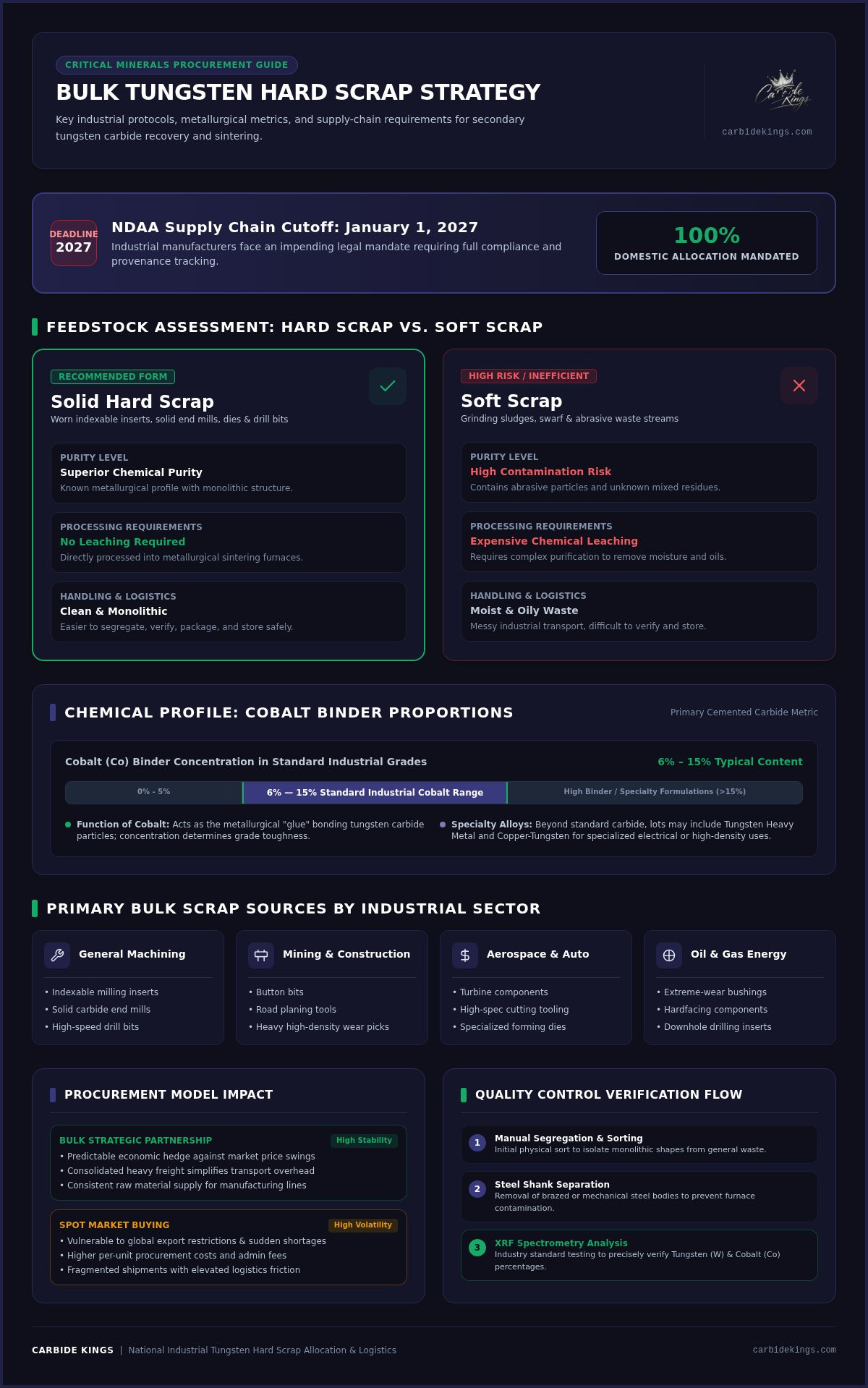
With the January 1, 2027, NDAA supply chain cutoff quickly approaching, industrial manufacturers are facing a marketplace where 100% domestic allocation is no longer a suggestion; it's a legal mandate. It's no longer enough to simply find a vendor when you need to buy tungsten hard scrap bulk. You need a partner who understands forensic provenance requirements and the critical need for chemical integrity in every lot. You've likely dealt with the frustration of inconsistent material quality from standard dealers or the logistical nightmare of transporting high-density metals that crush standard shipping containers.
We understand that volatile pricing and administrative hurdles make long-term budgeting feel like a moving target. This guide simplifies the process. You'll learn how to establish a reliable supply chain for carbide scrap while reducing raw material costs through strategic bulk acquisition. We'll break down the latest regulatory shifts and logistical best practices, giving you the tools to secure high-quality tungsten solids without the typical friction of industrial procurement. By the end of this article, you'll have a clear roadmap to navigate the 2026 landscape with confidence and efficiency.
Key Takeaways
- Understand why high-density solid carbide is essential for modern metallurgical sintering and alloy production.
- Learn how to buy tungsten hard scrap bulk by identifying high-value sources like indexable inserts and solid end mills.
- Shift from risky spot-market buying to stable industrial partnerships that protect your manufacturing lines from supply shocks.
- Simplify the logistical burden of heavy-metal transport with proven packaging and freight strategies designed for high-density scrap.
- Establish a reliable national supply chain that eliminates administrative hurdles and ensures the chemical integrity of your raw materials.
Understanding the Industrial Value of Tungsten Hard Scrap in Bulk
Tungsten hard scrap consists of high-density solid carbide waste, primarily worn indexable inserts, end mills, and specialized dies. Unlike general scrap metal, these materials are essential feedstocks for metallurgical sintering and the production of high-performance alloys. Modern manufacturing relies on cemented carbide grades and wear parts to maintain production stability. Because tungsten is classified as a critical mineral, securing a domestic supply of these solids is a matter of national manufacturing resilience.
Industrial procurement differs significantly from consumer-level recycling. While a local yard might handle mixed metals, industrial-grade lots require strict segregation and known metallurgical profiles. Large-scale manufacturing plants need consistent chemical integrity to ensure that the recycled content doesn't introduce impurities into the furnace. This focus on purity is why industrial professionals prioritize high-grade solids over mixed waste streams.
Why Industry Prefers Hard Scrap Over Soft Scrap
Hard scrap offers superior chemical purity compared to soft scrap like grinding sludges or swarf. Sludges often contain moisture, coolant oils, and abrasive contaminants that require expensive chemical leaching to remove. Solid carbide shapes are monolithic and clean; they're far easier to handle, store, and process in metallurgical furnaces. This reduces the risk of contamination and simplifies the recycling workflow, making solids the preferred choice for secondary tungsten recovery.
The Economic Impact of Bulk Procurement
When you decide to buy tungsten hard scrap bulk, you're doing more than just stocking inventory. You're creating an economic hedge against the extreme price volatility that defines the global tungsten market. Scaling your volume reduces the per-unit procurement cost and lowers the administrative overhead associated with managing dozens of smaller shipments. It's a strategic move that turns a waste stream into a predictable asset for your facility.
Bulk acquisition also streamlines logistics. Instead of managing fragmented arrivals, you can coordinate consolidated freight shipments that maximize shipping efficiency. This proactive approach ensures your manufacturing lines have a consistent supply of raw material, protecting your operations from sudden market shortages or export restrictions that often disrupt smaller, spot-market buyers.
Identifying High-Grade Carbide: Solids, Inserts, and Wear Parts
Success in procurement starts with precise identification. When you buy tungsten hard scrap bulk, you're looking for monolithic solids that offer high density and consistent chemistry. The most common sources include indexable milling inserts, solid end mills, and drill bits. These parts are typically made from tungsten carbide particles cemented with a metal binder, usually cobalt. Identifying these shapes is the first step in building a high-value inventory for industrial use.
Cobalt binders are the glue. Industrial grades typically contain between 6% and 15% cobalt, which determines the material's toughness. Beyond standard carbide, you should also look for specialty alloys like tungsten heavy metal and copper-tungsten. These alloys serve high-density or electrical applications and often command different market values. Understanding these variations is critical for accurate lot valuation. According to USGS tungsten statistics and supply chain data, secondary recovery from these high-grade sources is a vital component of the domestic supply chain.
Common Industrial Sources for Bulk Hard Scrap
Different industries produce specific types of wear parts. In mining and construction, look for button bits and road planing tools. These are heavy, dense, and highly valuable. The aerospace and automotive sectors generate high-performance cutting tools and turbine components. Finally, the oil and gas industry produces specialized wear parts and hardfacing materials designed for extreme environments. Identifying these industry-specific sources helps you predict the grade and consistency of the bulk lots you acquire.
Verification and Quality Control in Bulk Lots
Maintaining quality in bulk shipments requires rigorous verification. Hand-sorting is a useful starting point, but XRF analysis is the industry standard for verifying actual tungsten and cobalt percentages. You must also manage contamination by separating steel shanks from carbide tips. Mixing steel with carbide dilutes the value and complicates the recovery process. Understanding the carbide scrap recycling process ensures your lots meet the strict requirements of metallurgical furnaces.
If you're looking to streamline your procurement, you can partner with a national supplier to ensure every lot is verified for purity and weight. This proactive approach eliminates guesswork and guarantees the integrity of your raw materials. It's the most efficient way to maintain a steady flow of high-grade carbide for your manufacturing operations.
Evaluating ROI: Bulk Procurement vs. Spot Market Buying
Relying on the spot market for critical raw materials is a high-stakes gamble. For industrial manufacturers, the decision to buy tungsten hard scrap bulk isn't just about the price per pound; it's about securing the future of your production line. Spot-market availability fluctuates wildly based on international trade policies and mining output. When you buy in bulk through a structured agreement, you eliminate the downtime caused by sudden supply shortages. It's a strategic move that prioritizes operational continuity over short-term savings.
Calculating the Total Cost of Ownership (TCO) requires looking beyond the initial invoice. You've got to account for freight logistics, assay fees, and the impact of material purity on your manufacturing yields. Consistent chemistry is the backbone of efficient sintering. If a lot contains unexpected contaminants, your furnace settings won't be optimized. This leads to higher reject rates and wasted energy. High-quality bulk lots ensure that your processes remain predictable and profitable, which is the true measure of ROI.
Spot Market Volatility in Tungsten Procurement
Global mining trends directly influence the availability of recycled tungsten. Since China currently controls roughly 80% to 85% of global mined tungsten production, any shift in their export quotas creates immediate ripples in the secondary market. The hidden costs of "cheap" scrap from unverified sources often include high contamination levels. These impurities lower your yields and can damage expensive metallurgical equipment. Industrial buyers prioritize reliability because a consistent supply chain is more valuable than a one-time low bid.
Building a Sustainable Supply Chain
Integrating bulk scrap into your operations supports a circular economy and reduces your facility's carbon footprint. Utilizing recycled material requires significantly less energy than refining primary ore. This shift aligns with federal priorities, as seen in the critical materials classification and supply risk assessments provided by the Department of Energy. It's an efficient way to meet corporate sustainability goals without sacrificing performance.
Working with specialized tungsten scrap buyers usa helps stabilize your domestic supply. These partnerships remove the administrative hurdles of tracking material provenance and ensure compliance with the August 2026 BIS domestic allocation mandate. By securing a long-term supply of verified hard scrap, you protect your operations from geopolitical volatility while hitting your production targets. It's a straightforward process that replaces uncertainty with a reliable, streamlined workflow.
Streamlining Industrial Logistics for Bulk Tungsten Shipments
Transporting high-density heavy metals requires more than standard shipping protocols. When you decide to buy tungsten hard scrap bulk, you're dealing with material that is nearly double the density of tool steel. This physical property dictates every aspect of the transport process, from the choice of containers to the selection of freight carriers. A standard 5-gallon steel pail filled with carbide inserts can weigh between 150 and 200 lbs, which easily exceeds the limits of standard cardboard packaging or residential courier services. Efficient logistics mean planning for weight rather than volume.
Freight logistics for industrial scrap typically fall into Less Than Truckload (LTL) or Full Truckload (FTL) categories. For lots ranging from 500 to 5,000 lbs, LTL is the most cost-effective solution, provided the carrier is equipped with liftgate services. National shipping standards for industrial scrap require accurate weighing and detailed documentation to ensure compliance with domestic transport regulations. Every bulk transfer must be accompanied by a precise manifest that matches the physical weight of the load to prevent delays during transit or at the receiving facility.
Packaging Standards for Heavy Metal Solids
Security starts with the container. Industrial professionals use UN-rated steel drums or reinforced crates to secure tungsten solids. Because of the extreme density, weight distribution is critical to prevent pallet failure. You should never stack heavy-density scrap high on a single pallet. Instead, spread the weight across multiple reinforced pallets to ensure they can be safely handled by forklifts and pallet jacks. Every drum must be clearly labeled with the material type and weight to streamline the receiving process and maintain an accurate paperwork trail.
Mitigating Shipping Risks and Administrative Hurdles
High-value metal lots require specialized insurance coverage to protect your investment during transit. Relying on standard carrier liability is often insufficient for the market value of tungsten carbide. Streamlining the administrative side of procurement means having all corporate compliance documents ready before the truck arrives. This includes forensic provenance tracking and weight certifications that meet the latest federal standards for critical minerals. Managing these details upfront prevents the logistical bottlenecks that often plague industrial supply chains.
We specialize in handling the logistical heavy lifting so you can stay focused on your core manufacturing operations. Our team manages the freight coordination, insurance, and documentation required for seamless national transport. You can simplify your entire procurement process by coordinating your next shipment through our national industrial freight network. This proactive approach ensures your materials arrive on time, in full, and ready for immediate processing.
Partnering with Carbide Kings for Consistent Industrial Supply
Carbide Kings operates as a specialized national supplier dedicated to the industrial manufacturing sector. We recognize that procurement isn't just about finding a vendor; it's about building a reliable pipeline of high-purity materials. Our focus remains exclusively on industrial tungsten hard scrap and specialty alloys. This specialization ensures that when you buy tungsten hard scrap bulk from us, you're getting material that meets the rigorous standards of modern metallurgical processes. We prioritize reliability and chemical integrity in every lot we deliver. It's a straightforward process that supports your bottom line.
Tailored Solutions for Metallurgical Consumers
We provide custom lot sizing and maintain a consistent inventory to align with your facility's production cycles. Our expertise in selling tungsten carbide wear parts for industrial use means we understand the technical nuances of the materials we supply. You'll work directly with procurement experts who can answer your questions about chemistry and provenance. This direct line of communication ensures your raw material requirements are met without the delays common in general scrap markets. We focus on providing the specific grades you need for sintering and alloy production, ensuring your manufacturing lines never stop.
The Carbide Kings Advantage: Efficiency and Clarity
Our procurement process is designed to remove the traditional barriers that complicate industrial metal acquisition. We've eliminated unnecessary paperwork and administrative hurdles to keep your workflow moving. We handle the logistical heavy lifting, providing national shipping support and professional documentation for every transfer. This commitment to transparency ensures that your corporate compliance and forensic tracking needs are satisfied from the start. We act as a proactive partner, handling the complex details so your team can focus on manufacturing excellence. Our no-nonsense approach means you get fast turnaround times and clear communication at every step.
Secure your supply chain—Contact Carbide Kings for bulk procurement today. We're ready to serve as your proactive partner in securing high-quality tungsten raw materials for your long-term manufacturing goals. We take pride in being a reliable veteran of the industrial sector that simplifies complex logistics into a streamlined, professional transaction.
Secure Your Industrial Future with Strategic Procurement
Success in the 2026 tungsten market requires more than just reacting to price changes. It's about building a resilient, domestic supply chain that can withstand regulatory shifts and global volatility. You've learned that prioritizing high-purity solids preserves your manufacturing yields. You also know that professional logistics are the only way to safely move high-density carbide lots without administrative delays. When you're ready to buy tungsten hard scrap bulk, focus on partners who understand the technical and legal requirements of your industry.
We're here to handle the heavy lifting so you can stay focused on your core operations. Our specialized industrial grade inventory and national logistics coverage ensure your facility stays operational. We've refined our streamlined corporate procurement process to eliminate the friction typical of traditional scrap dealers. Don't leave your raw material supply to chance. Contact Carbide Kings for Bulk Tungsten Procurement today. Let's build a reliable partnership that keeps your manufacturing lines moving with confidence.
Frequently Asked Questions
What qualifies as tungsten hard scrap for bulk procurement?
Tungsten hard scrap consists of solid, monolithic carbide materials such as indexable inserts, end mills, reamers, and specialized industrial wear dies. These items are distinct from soft scrap because they are solid shapes with high density and consistent chemical composition. When you buy tungsten hard scrap bulk, these solids should be free from attachments like steel shanks or brazing material. This ensures the chemical integrity required for high-volume metallurgical sintering and alloy manufacturing processes.
How is the purity of bulk tungsten carbide scrap verified?
We verify the purity of every bulk lot through rigorous metallurgical assessment. While we don't offer on-site analysis services as a standalone product, our internal procurement process utilizes X-ray fluorescence (XRF) technology to confirm the exact percentages of tungsten and cobalt binders. This verification ensures that the material meets the strict chemical specifications required for your manufacturing needs. You receive a consistent product that integrates seamlessly into your existing production furnace cycles without risk of contamination.
What are the typical minimum order quantities for bulk carbide scrap?
Typical industrial lots begin at 500 pounds to qualify for specialized freight and volume pricing. We focus on serving the manufacturing and industrial sectors that require large-scale, consistent raw material supplies. Smaller quantities are often handled through spot-market channels, but bulk procurement is designed for facilities that need a reliable, high-volume inventory of carbide scrap to maintain their long-term production schedules and metallurgical stability. This ensures your facility remains focused on core manufacturing goals.
How does buying recycled tungsten compare to buying virgin tungsten powder?
Buying recycled tungsten hard scrap offers a significant reduction in energy consumption compared to refining virgin tungsten powder from primary ore. Recycled solids provide the same high-density properties and chemical integrity as virgin materials but with a smaller environmental footprint. This approach supports circular economy goals and helps manufacturers mitigate the supply chain risks associated with international mining quotas. It's an efficient way to secure high-quality raw materials while maintaining strict performance standards in your alloys.
What logistical support is available for shipping 5,000+ lbs of scrap?
We provide comprehensive national logistics support for high-volume shipments exceeding 5,000 pounds. Our team coordinates specialized Less-Than-Truckload (LTL) or Full Truckload (FTL) freight services equipped with the necessary equipment to handle high-density heavy metals. We manage the freight manifests and shipping documentation to ensure a smooth transit process. By handling the logistical heavy lifting, we eliminate the administrative hurdles that often complicate the movement of large-scale industrial scrap lots across the country.
Can Carbide Kings provide specific tungsten alloys in bulk?
Yes, we maintain a consistent inventory of various tungsten alloys tailored for industrial applications. Our offerings include tungsten heavy metal and copper-tungsten alloys used in radiation shielding, aerospace components, and electrical contacts. We specialize in sourcing and supplying these materials in bulk to ensure your facility has the specific metallurgical grades required for your production. Every alloy lot is verified for chemical consistency to ensure it meets your internal manufacturing specifications and quality standards.
What are the payment terms for industrial bulk scrap contracts?
Our payment and settlement process is designed for professional efficiency and transparency. We prioritize fast turnaround times once the material has been verified for weight and chemical integrity. For long-term industrial supply partnerships, we offer structured settlement terms that align with your facility's accounting requirements. This no-nonsense approach removes unnecessary administrative barriers, allowing you to focus on your core operations while we handle the financial details of the transaction with professional integrity.
How does the current market price of tungsten affect bulk procurement rates?
Bulk procurement rates are directly influenced by global benchmark indices, such as the Ammonium Paratungstate (APT) market price. When you buy tungsten hard scrap bulk, it typically provides a strategic hedge against the volatility of the spot market. Securing a consistent supply of recycled carbide scrap allows your facility to stabilize raw material costs even when global mining output fluctuates. This proactive strategy ensures your manufacturing budget remains predictable throughout the entire fiscal year.


