

Did you know that extracting enough tungsten for just one kilogram of finished carbide requires mining and processing roughly 15 metric tons of raw ore? Most industrial professionals see their scrap bins as a logistical burden, yet efficient carbide tooling recycling can turn that waste into a primary revenue driver. It's frustrating to watch potential profits disappear because high-value inserts are mixed with low-value steel or lost in heavy, unorganized piles. You're likely tired of the confusion and the logistical hurdles that make selling scrap feel like more work than it's worth.
This 2026 guide changes that narrative. With new U.S. Department of Commerce export restrictions and domestic sourcing mandates now in effect, your scrap has never been more valuable to the American supply chain. We'll show you how to transform this waste into a high-yield revenue stream through efficient recovery and sorting. You'll gain a clear understanding of material value, learn to navigate the latest regulatory shifts, and discover a streamlined collection process that eliminates traditional barriers. We're moving past the era of slow scrap dealers and into a faster, more lucrative way to handle your industrial waste.
Key Takeaways
- Understand why tungsten is a critical mineral and how current market drivers turn your scrap bin into a strategic asset.
- Learn how to launch an efficient carbide tooling recycling program by establishing centralized collection points and training staff on material identification.
- Discover the specific sorting and cleaning techniques required to maximize the purity and value of your tungsten hard scrap.
- Identify the massive value gap between tungsten carbide and common scrap metals to ensure you aren't leaving money on the shop floor.
- Master the criteria for selecting a national recovery partner that offers streamlined logistics and professional transparency.
Understanding the Fundamentals of Carbide Tooling Recycling
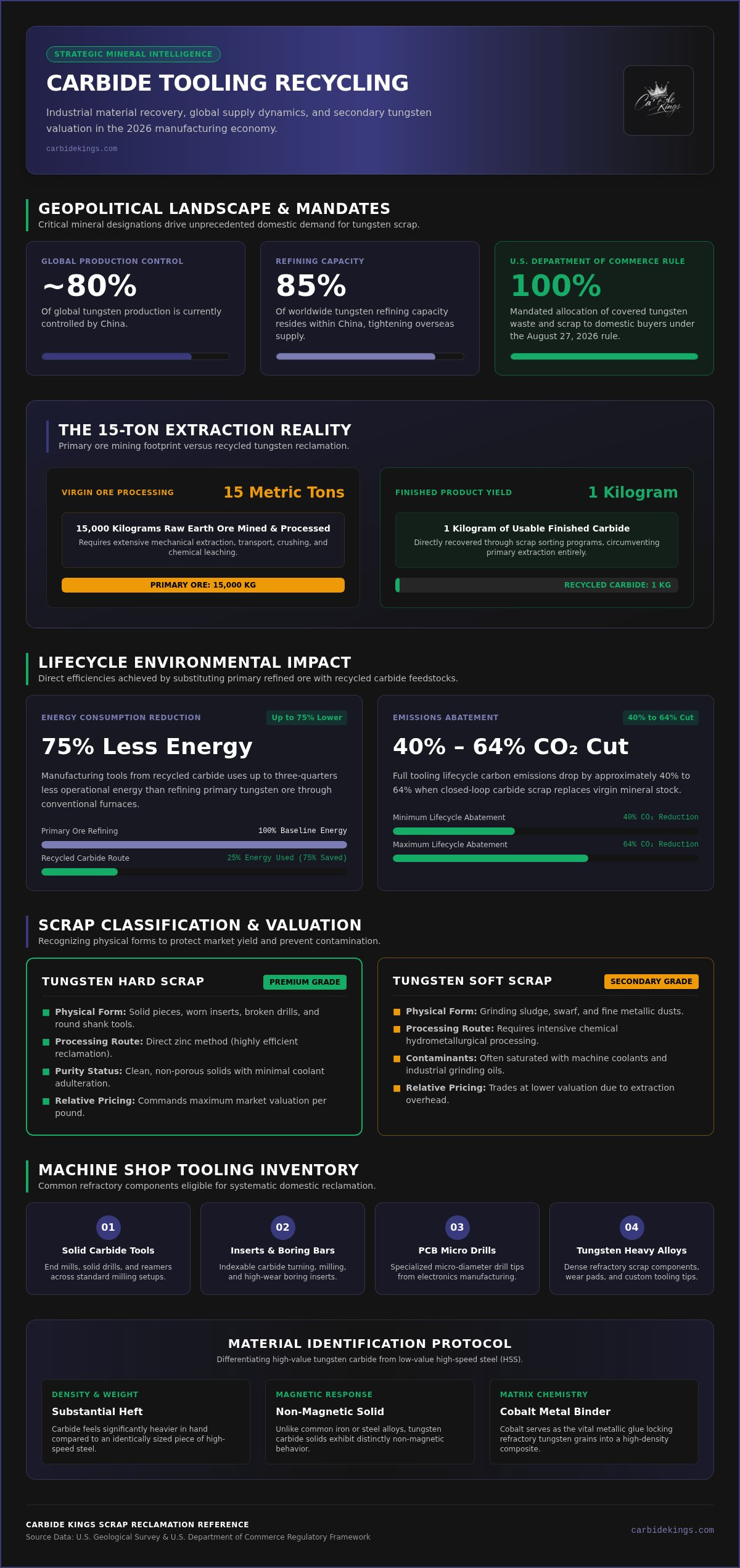
Carbide tooling recycling is the systematic recovery of tungsten carbide from spent industrial tools. It's more than just a waste management task; it's a strategic procurement move. Tungsten is officially designated as a strategic critical mineral due to its extreme density and high melting point. Because China currently controls approximately 80% of global tungsten production and 85% of refining capacity, domestic scrap has become a vital asset for U.S. manufacturers. Your shop floor is likely sitting on a hidden revenue stream of refractory metals that are essential for national defense and high-precision CNC manufacturing.
What Qualifies as Recyclable Carbide?
Identifying high-value material is the first step toward a profitable program. You need to differentiate between common tool steels and tungsten carbide. While steel is ubiquitous, carbide is a dense composite of tungsten and a cobalt binder. Most modern machine shops generate scrap from the following sources:
- Solid carbide end mills and drills
- Indexable inserts and boring bars
- PCB drills and specialized cutting tips
- Tungsten alloys and hard scrap components
Understanding the tungsten carbide material properties helps your team distinguish these heavy, non-magnetic solids from lower-value high-speed steel (HSS). Cobalt acts as the metallic "glue" in these tools. Its recovery is just as critical as the tungsten itself, especially as global prices for binder metals fluctuate. If a tool feels significantly heavier than a steel equivalent of the same size, it's likely a candidate for your recovery bin.
Why Manufacturers Are Prioritizing Recovery in 2026
The industrial landscape shifted significantly on August 27, 2026. The U.S. Department of Commerce issued a temporary final rule mandating that 100% of covered tungsten waste and scrap be allocated to domestic buyers. This isn't just about compliance; it's about securing a stable supply chain. Supply chain volatility and restrictive export whitelists from international suppliers have made carbide tooling recycling an essential business practice for 2026 and beyond.
Beyond logistics, there's a powerful environmental case. Manufacturing tools from recycled carbide consumes up to 75% less energy than refining primary ore. It also reduces carbon emissions by roughly 40% to 64% across the tooling lifecycle. By implementing a dedicated program, you aren't just clearing floor space. You're participating in a circular economy that offsets the massive environmental cost of mining 15 metric tons of raw ore for every kilogram of finished metal. This shift supports corporate ESG goals while providing a direct boost to your bottom-line revenue.
The Industrial Value of Tungsten Carbide Scrap
The industrial value of carbide tooling recycling is rooted in scarcity and high performance. Unlike common iron or aluminum, which are abundant and trade at low commodity prices, tungsten is a strategic asset. Recent USGS tungsten statistics and recycling data emphasize the critical role of secondary scrap in sustaining domestic manufacturing. While standard metals might yield cents per pound, solid tungsten carbide commands a significant premium. This price floor is reinforced by the August 2026 U.S. export restrictions, which have kept high-quality feedstock within the domestic market to support national defense and aerospace production.
Hard Scrap vs. Soft Scrap: Knowing the Difference
Understanding the physical form of your waste is vital for accurate valuation. Tungsten hard scrap refers to solid components like broken drill bits, worn inserts, and round shank tools. These items are the gold standard of recycling because they can often be processed using the direct zinc method, which is highly efficient. In contrast, soft scrap consists of grinding sludge, swarf, and metallic fines. Because soft scrap often contains coolants or grinding oils, it requires more intensive hydrometallurgical processing. Consequently, soft scrap usually trades at a lower rate compared to solids. Proper segregation of these materials on your shop floor prevents high-value solids from being devalued by contaminated sludge.
Common High-Value Tooling Examples
Machine shops often overlook the value of specialized components. While solid carbide end mills are obvious winners, several other items are consistent revenue sources:
- Indexable inserts and boring bars
- Solid carbide reamers and drill bits
- Tungsten saw tips and masonry bits
- Specialty wear parts and tungsten alloys
The purity of these items influences your final payout. Tools that are free from steel shanks or brazing materials always secure the best rates. Volume also plays a massive role in your bottom line. Large-scale operations that consolidate their scrap can negotiate more competitive industrial rates than those selling small, mixed batches. If you're looking to streamline your process, a partnership for professional carbide recovery can help you identify these high-value streams and ensure you receive fair market value for every pound you collect.
The Lifecycle of Recycled Carbide: From Shop to Refinery
The journey from a worn-out end mill to a fresh, high-performance tool is a methodical cycle. It starts at your CNC machine. Once a tool reaches its end-of-life, it shouldn't just be tossed aside. Efficient carbide tooling recycling relies on a clean, controlled flow from the shop floor to the refinery. National buyers act as the essential bridge in this process. They handle the heavy lifting of logistics and procurement, ensuring your scrap reaches specialized facilities capable of extracting pure tungsten. According to the U.S. Geological Survey tungsten commodity data, the reliance on these secondary streams is growing as primary ore becomes harder to secure domestically.
Sorting and Preparation for Maximum ROI
Your ROI starts with segregation. Never mix carbide with steel or high-speed steel (HSS). Even a small amount of iron contamination can drop your payout by 40% or more. Identifying tungsten carbide is straightforward. It's nearly twice as heavy as steel. If a tool feels surprisingly dense for its size, it belongs in the carbide bin. Follow these steps to prepare your material:
- Remove all plastic packaging and protective tubes from used inserts.
- Separate solid carbide tools from those with steel shanks or brazed heads.
- Minimize the presence of heavy oils or coolants in your collection bins.
- Use a handheld XRF analyzer if you need to verify complex alloys.
Clean, sorted material moves through the system faster and commands the highest industrial rates. By maintaining a disciplined collection routine, your shop becomes a critical link in a high-efficiency supply chain.
The Refinement and Sintering Process
Refineries use two primary methods to reclaim material. The Direct Zinc Process is the most efficient. By immersing clean carbide in molten zinc, refiners can delaminate the cobalt binder without changing the original grain size. This mechanical method uses 70% to 75% less energy than mining primary ore. For contaminated or brazed tools, chemical leaching is used to create pure synthetic Ammonium Paratungstate (APT).
Once extracted, the reclaimed tungsten powder is re-sintered. It's combined with a fresh binder and pressed into new shapes. The result is a tool that performs identically to one made from virgin ore. This circular model isn't just theory. It's a proven industrial workflow that offsets the need to process 15 metric tons of raw ore for every kilogram of metal produced. Your participation ensures these materials stay in the domestic loop, supporting both your bottom line and national supply security.
How to Implement an Efficient Tooling Recycling Program
Successful carbide tooling recycling isn't an accident. It's the result of a deliberate shop-floor strategy that treats scrap as a product rather than waste. You need to establish a centralized collection point to prevent valuable inserts from ending up in the general trash. Train your operators to distinguish between carbide and high-speed steel (HSS) immediately. A quick weight check is usually enough; carbide's density is unmistakable. Use dedicated, clearly labeled containers for each material grade to prevent cross-contamination. This simple organizational step protects your payout and ensures your material is refinery-ready.
Setting Up Your Collection Infrastructure
Pick containers that can handle the weight. Tungsten is heavy, so small, reinforced plastic bins or steel buckets work best. Safety is paramount. Ensure your team uses cut-resistant gloves when handling broken end mills or jagged inserts. Integrate these bins into your existing 5S or Lean workflows. When a tool is pulled from a spindle, it should go straight into the recovery bin. Regular audits of your waste stream will help you refine your industrial carbide scrap disposal strategy, ensuring no high-value alloys are slipping through the cracks.
Maximizing Recovery from Used Tools
Efficiency pays. Use a structured approach for selling used carbide tools to ensure you're getting maximum value from every batch. Don't overlook smaller components. Consistently selling tungsten saw tips can add a steady stream of secondary revenue to your milling or woodworking operations. Track your monthly recycling metrics. Documenting the weight recovered and the revenue generated proves the program's ROI to management. Schedule regular pickups with a national partner to keep your floor clear and your cash flow moving. It's about maintaining momentum and turning a logistical burden into a streamlined financial win.
Ready to transform your shop's scrap into a strategic revenue stream? Request a bulk carbide pickup quote from our team today.
Selecting a National Partner for Bulk Carbide Recovery
Choosing a partner for carbide tooling recycling shouldn't feel like a gamble. You need a specialist who understands the specific nuances of refractory metals. Most local scrap yards aren't equipped for this. They lack the specialized analysis tools required to distinguish between various tungsten alloys, which often leads to lower offers for your high-value material. A national partner brings a level of professional efficiency that a general recycler simply can't match. They handle the logistical heavy lifting, allowing you to stay focused on your core manufacturing operations while your scrap bin generates consistent revenue.
What to Look for in a Carbide Scrap Buyer
Transparency is the most important factor when evaluating a buyer. You're moving dense, high-value materials, so you need a partner who provides clear communication and straightforward transaction processes. Look for a buyer with verified expertise in industrial-grade materials. They should offer more than just a pickup service; they should provide comprehensive logistics support for bulk lots. A professional partner will simplify the process by handling the following:
- Accurate material analysis to ensure you're paid for the correct grade.
- Streamlined shipping arrangements that accommodate heavy tungsten solids.
- Fast payment cycles that keep your shop's cash flow moving.
- Direct communication that eliminates unnecessary paperwork or administrative hurdles.
Speed of payment and transparency in grading are non-negotiable. If a buyer can't explain their valuation process or struggles with the logistics of heavy metal transport, they aren't the right fit for a high-volume industrial environment.
The Advantage of a Direct Industrial Supplier
Working with a dedicated tungsten partner like Carbide Kings offers a distinct advantage over traditional scrap dealers. As a national US-based supplier and buyer, we focus specifically on tungsten hard scrap, soft scrap, and alloys. We aren't generalists. We're seasoned veterans of the industrial sector who have refined the procurement process to perfection. This specialization means we understand the market drivers discussed earlier in this guide, from supply chain volatility to domestic sourcing mandates.
Finalizing a deal should be the easiest part of your week. When you move beyond local yards to a specialized partner, you can expect a no-nonsense quote and a fast resolution. There's a sense of relief that comes with removing logistical burdens and knowing you're receiving a fair, market-reflective price. By aligning with a partner who prioritizes high-quality material procurement and competitive industrial pricing, you turn your recycling program into a reliable, long-term strategic asset. The work is as good as done when you have the right guide handling the details.
Strategic Recovery for a Competitive Edge
Industrial manufacturing in 2026 demands a shift from passive waste management to proactive material recovery. You've seen how tungsten scarcity and domestic mandates have turned your scrap bin into a high-yield asset. By segregating your materials and implementing a lean collection workflow, you protect your bottom line while supporting a resilient, circular supply chain. It's about recognizing that every worn insert and broken end mill represents a significant financial opportunity.
Effective carbide tooling recycling doesn't have to be a logistical burden. When you partner with specialists who understand the complexities of tungsten alloys, the process becomes as simple as any other professional transaction. We handle the heavy lifting, from national logistics support to precise material analysis. It's time to stop leaving money on the shop floor and start capitalizing on the true value of your refractory metals. Get a direct quote for your industrial carbide scrap from Carbide Kings today. Experience a streamlined industrial procurement process backed by specialized expertise. Your facility's efficiency is our priority, and we're ready to help you turn your industrial waste into a reliable revenue stream.
Frequently Asked Questions
What is the difference between carbide and high-speed steel (HSS) for recycling?
Density and composition are the primary factors. Carbide is a dense composite of tungsten and a cobalt binder, while HSS is a tool steel containing molybdenum or tungsten in much lower concentrations. For recycling purposes, carbide is significantly more valuable. You can identify the difference easily; carbide is nearly twice as heavy as steel. Mixing these materials in the same bin devalues your carbide tooling recycling efforts, so always keep them segregated.
Can I recycle carbide tools that are broken or chipped?
Yes, the physical condition of the tool doesn't change its metallurgical value. Refineries break down scrap into powders or use chemical leaching to recover the raw tungsten, so broken bits, fractured end mills, and chipped inserts are all prime candidates for recovery. Whether a tool is slightly worn or shattered into several pieces, the tungsten and cobalt content remains intact. Don't throw away damaged tools; they're just as lucrative as intact ones.
Does the coating on my carbide inserts affect their recycling value?
Standard industrial coatings like Titanium Nitride (TiN) or Titanium Aluminum Nitride (TiAlN) generally don't impact the value of your scrap. These layers are microscopic and are easily removed during the mechanical or chemical refinement phases. Refiners focus on the high-purity tungsten carbide substrate underneath. Unless you're using highly specialized or thick ceramic coatings, you can expect the same industrial rates for your coated inserts as you would for uncoated tools.
How much carbide scrap do I need to collect before it is worth selling?
While you can recycle smaller amounts, consolidating your scrap into bulk lots of 50 pounds or more usually yields the best ROI. Shipping heavy metals is expensive, and larger volumes help offset these logistical costs. National buyers prioritize bulk procurement because it streamlines the industrial workflow. If your shop generates a consistent volume, waiting to ship a full container ensures your carbide tooling recycling program stays as profitable and efficient as possible.
What is the best way to store carbide scrap in a machine shop?
The most effective method is using reinforced, clearly labeled steel buckets or heavy-duty plastic bins. Place these containers at the point of generation near your CNC machines to integrate disposal into your daily workflow. It's critical to keep your carbide dry and free from general shop trash or floor sweepings. If you produce both solids and grinding sludge, use separate bins for each to prevent contamination and ensure you receive the highest material purity rating.
Do I need to remove the steel shanks from my carbide tools before recycling?
It's highly recommended to remove steel shanks or brazed components before shipping. Tools with steel attachments are often devalued because they require extra mechanical shearing or thermal de-brazing at the refinery. By providing clean, solid carbide, you eliminate these additional processing steps for the buyer. This transparency leads to a faster transaction and a higher return on your scrap. It's a simple organizational step that directly increases your shop's bottom-line revenue.
Can grinding sludge and swarf be recycled along with solid carbide?
You can recycle both, but you must keep them in separate containers. Grinding sludge and swarf are classified as "soft scrap" and require different processing than "hard scrap" solids. Sludge often contains coolants and oils that must be removed through hydrometallurgical refinement. Mixing soft scrap with solid tools forces the refiner to use more intensive processing for the entire batch, which can significantly lower the overall price you receive for your material.
How do I know if I am getting a fair price for my carbide scrap?
Transparency and specialized expertise are the keys to a fair transaction. A reputable partner will offer a clear explanation of their grading process and provide quotes that reflect current domestic supply trends for tungsten alloys. Avoid general scrap yards that don't specialize in refractory metals. A fair buyer handles the logistical heavy lifting and uses professional analysis to ensure you're paid accurately for the specific grade and purity of your industrial carbide scrap.


