

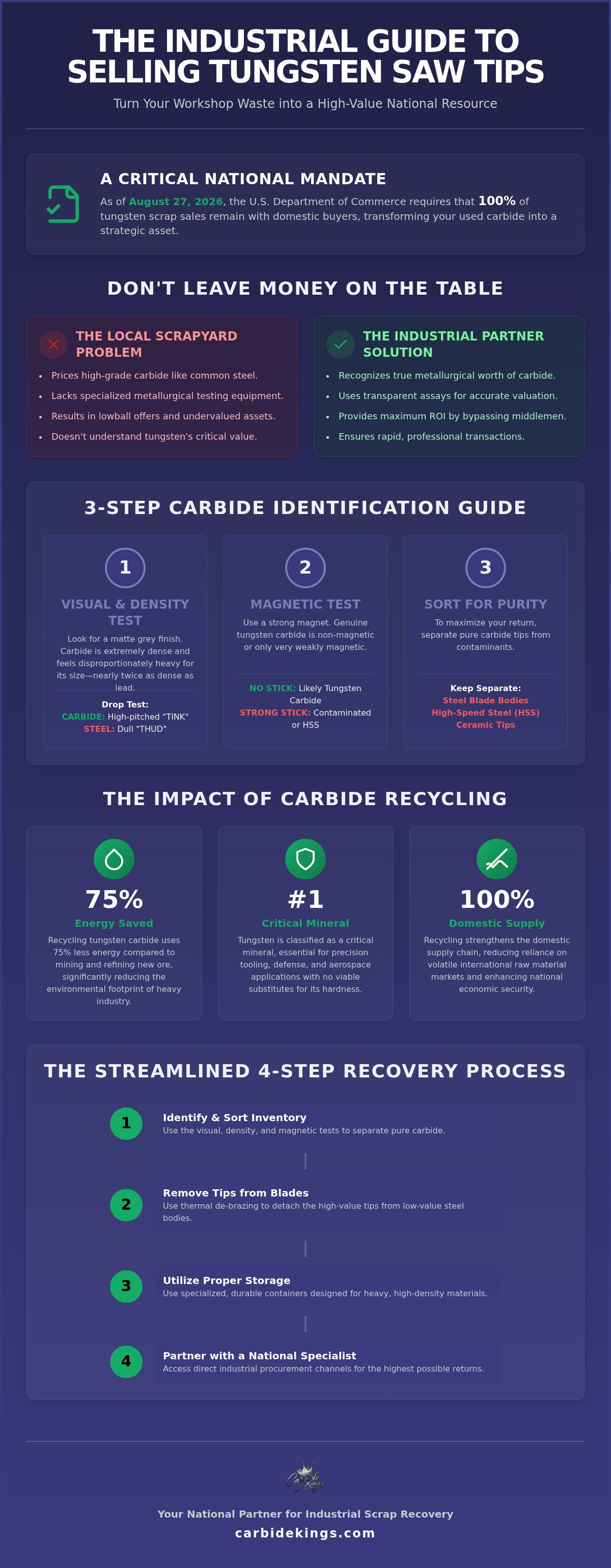
As of August 27, 2026, the U.S. Department of Commerce requires that 100% of tungsten scrap sales remain with domestic buyers. This mandate has transformed your used carbide into a critical national resource. You've probably looked at bins of dull, chipped tips and wondered if they're worth the effort to ship. Most local scrap yards don't understand the specific metallurgical value of carbide, often pricing it alongside common steel. It's a common frustration to deal with the weight and logistical hurdles of these small items only to feel lowballed at the scale.
This industrial guide ensures you never leave money on the table when you decide to sell tungsten saw tips. We'll show you how to identify high-grade carbide, sort your materials for maximum profit, and navigate the new domestic shipping requirements with ease. You'll learn a streamlined process to turn your workshop waste into a consistent revenue stream. We're moving past the guesswork and providing a clear, professional path to maximize your scrap ROI through a reliable industrial partnership.
Key Takeaways
- Learn the visual and magnetic tests required to distinguish high-density tungsten carbide from common steel contamination.
- Understand the critical tungsten-cobalt ratio that drives metallurgical value and how to maximize your return by sorting inventory correctly.
- Discover the most efficient way to sell tungsten saw tips by bypassing local middlemen and accessing direct industrial procurement channels.
- Streamline your shop's scrap management with specialized storage and weight-handling techniques designed for heavy, high-density carbide components.
- Gain a competitive edge by aligning with a national partner that offers transparent assays and rapid transaction speeds for industrial-scale recovery.
Understanding the Value of Tungsten Carbide Saw Tips
Tungsten saw tips are the specialized, high-hardness cutting edges brazed onto circular or band saw blades. They are engineered to withstand extreme heat and abrasive forces that would destroy standard steel. Because they contain significant concentrations of tungsten and cobalt, they are among the most valuable forms of hard scrap in the industrial sector. When you decide to sell tungsten saw tips, you're dealing with a material that is far more sophisticated than standard iron or copper. Understanding Tungsten Carbide is essential because its chemical stability and density make it a cornerstone of modern metallurgy.
Most general scrap yards aren't equipped to handle these components correctly. They often lack the specialized testing equipment required to verify exact alloy content. This leads to a lowest common denominator pricing model where your high-value carbide is treated like low-grade steel. We specialize in these materials because we understand their metallurgical worth. We focus on the precision of the assay, ensuring that the high density of these tips is reflected in the final transaction value.
Wood-Cutting vs. Metal-Cutting Tips
Wood-cutting tips are designed for impact resistance. They typically use a higher percentage of cobalt as a binder to prevent chipping when hitting knots or dense grain. Metal-cutting tips are often even harder and may feature specialized coatings like TiN (Titanium Nitride) or TiAlN to handle the friction of shearing through steel. These variations matter during the recycling process. Grade purity directly impacts the final assay. Clean, sorted tips command the best returns because they require less energy to reintegrate into the manufacturing supply chain.
The Role of Tungsten in Modern Manufacturing
Tungsten is currently classified as a critical mineral. Global demand is high because there is no viable substitute for its hardness in precision tooling and defense applications. By choosing to sell tungsten saw tips, you support a circular economy that reduces the reliance on primary mining. Recovered carbide is essential for producing new end mills, drill bits, and aerospace components. Every pound of recycled material strengthens domestic supply chain stability. This process offers several key industrial benefits:
- It reduces dependence on volatile international raw material markets.
- It minimizes the environmental footprint of heavy industry by lowering energy consumption during production.
- It provides immediate liquidity for tool shops and manufacturers through efficient scrap management.
Recycling these tips saves approximately 75% of the energy compared to mining and refining raw ore. It also prevents heavy metals from entering landfills. When industrial professionals choose a dedicated procurement partner, they ensure their scrap is processed according to strict standards. This transparency is vital for modern manufacturing operations that value both profit and responsibility.
Identifying and Sorting Your Tungsten Saw Tip Inventory
Identifying genuine carbide is your first step toward a successful transaction. Look for a matte grey finish and a weight that feels disproportionate to the small size. While steel is light and shiny, tungsten carbide is nearly twice as dense as lead. You can verify this density with a simple drop test. If you drop a carbide tip on a hard surface, it produces a high-pitched "tink" rather than the duller thud of steel. This acoustic difference is a quick way to verify material in the field before you decide to sell tungsten saw tips. According to the U.S. Geological Survey Mineral Commodity Summary, tungsten remains a high-demand critical resource, making your precision in sorting highly profitable.
A high-quality magnet is a basic but essential tool for your inventory. If the tip sticks aggressively to the magnet, it likely contains too much iron or is actually high-speed steel (HSS). HSS lacks the density and heat resistance of carbide, making it far less valuable. Ceramic tips, often used in specialized metal-cutting, are non-magnetic and very light. Keep these separate to avoid contaminating your high-value tungsten lot. Proper separation ensures that your final assay is accurate and your payment is processed without delays.
Removing Tips from the Blade
Don't sell your tips while they're still attached to the steel blade body. Steel bodies are worth very little, but carbide tips are high-value assets. Thermal de-brazing is the industry standard for removal. This process involves heating the brazing joint until the tip drops off freely. It's much cleaner than mechanical shearing, which often leaves steel fragments attached to the carbide. Always wear eye protection and heat-resistant gloves during this process. Carbide is brittle and can shatter under pressure, posing a safety risk. Vacuum-sealed containers or heavy-duty plastic buckets are the best options for storage once the tips are removed.
Grading and Purity Standards
Purity is the primary driver of scrap value. Clean, de-brazed tips command the highest market rates because they don't require additional chemical processing to remove silver or copper brazing alloys. If you have other worn equipment in your shop, you can sell used carbide tools alongside your saw tips to increase your total lot weight. Combining materials like end mills, drill bits, or indexable inserts with your saw tips creates a more attractive package for industrial buyers. This consolidated approach reduces your shipping overhead and maximizes the return on every pound of material you recover. When you sell tungsten saw tips as part of a clean, high-volume lot, you secure the best possible industrial pricing.
Market Drivers and Material Composition of Carbide Tips
The value of your scrap isn't determined by weight alone. It's driven by the specific chemistry of the material. Most saw tips are a composite of tungsten carbide and a cobalt binder. When you decide to sell tungsten saw tips, the ratio of these elements dictates the final assay results. Woodworking tips often contain 8% to 12% cobalt to prevent shattering during high-impact cuts. In contrast, metal-cutting tips prioritize hardness over toughness, typically featuring a lower cobalt content of around 6%. Since cobalt prices are highly volatile, these percentages directly influence the market value of your scrap lot.
Global trends also play a significant role in domestic procurement. As of August 27, 2026, new U.S. regulations require that 100% of tungsten scrap sales go to domestic buyers. This shift has tightened the internal market, making local recycling partnerships more valuable than ever. China still controls over 80% of global tungsten production, so recovering these materials is essential for U.S. manufacturing stability. High-performance tips may also include specialty alloys like Tantalum or Niobium. These elements increase heat resistance for high-speed machining. While they are present in small amounts, they contribute to the overall metallurgical profile industrial buyers look for.
Lot size is another critical factor in the pricing framework. Because carbide is extremely dense, shipping small quantities is rarely cost-effective. We focus on high-volume procurement because larger lots allow for a more streamlined logistics framework. A 100-pound lot is significantly more valuable per pound than a 10-pound bucket due to the fixed costs of assaying and transport. Efficiency is key to maximizing your return.
Cobalt as a Value Multiplier
Cobalt acts as the "glue" for tungsten particles. Its price fluctuations can swing the value of a scrap lot quickly. Woodworking operations typically accumulate higher-cobalt scrap, which can be a distinct advantage in certain market conditions. We use advanced metallurgical assays, such as X-Ray Fluorescence (XRF) technology, to determine the exact chemical makeup of your material. This ensures you get paid for the specific alloys in your bin, not just a generic estimate. The process is transparent and results-oriented.
Coated vs. Uncoated Carbide
Many modern saw tips feature Titanium Nitride (TiN) or Titanium Aluminum Nitride (TiAlN) coatings. These gold or purple layers are only a few microns thick. For bulk industrial buyers, these coatings don't require removal. They are processed during the smelting phase without degrading the quality of the recovered tungsten. You'll often see these categorized by 'C' grade classifications. C1 through C4 grades are standard for woodworking, while C5 through C8 are reserved for heavy-duty metal removal. Keeping these grades sorted can simplify the assay process and speed up your payment.
Efficient Scrap Management: Storage and Logistics for Small Components
Managing small components requires a methodical approach. Tungsten carbide is nearly twice as dense as lead. This means a standard five-gallon bucket can quickly exceed 100 pounds. Using large 55-gallon drums for saw tips is a common mistake. These drums become impossible to move without heavy machinery and often fail under the weight during transit. Stick to smaller, reinforced plastic containers to maintain safety and organization in your shop. For builders and renovators looking to optimize their workspace with custom cabinetry, learn more about CutByBEES provides high-quality flat pack solutions. When you are ready to sell tungsten saw tips, your internal organization determines your speed to payment.
Labeling is equally critical. Don't mix de-brazed tips with general steel scrap or even other carbide grades if you can avoid it. Keeping your saw tips distinct allows for a faster assay and a more accurate offer. Clear documentation of the lot weight and source helps prevent administrative hurdles later in the procurement process. We value transparency; keeping your bins clean and labeled ensures that the transaction remains straightforward and lucrative for your operation.
Establish a repeatable system to maximize your scrap ROI. This workflow minimizes loss and prepares your material for national transit without the usual logistical headaches. Follow these steps to prepare your inventory:
- Designate: Use a secure, non-porous container specifically for de-brazed carbide tips.
- Verify: Perform a basic magnetic check to ensure no steel blade fragments are mixed into the lot.
- Accumulate: Gather a minimum weight of 50+ lbs to optimize your shipping costs and lot value.
- Seal: Use heavy-duty reinforced tape on all container lids to handle the extreme density of the tungsten.
- Finalize: Contact a professional buyer for a quote and specific shipping instructions.
National Shipping Logistics
Shipping heavy, low-volume carbide lots doesn't have to be complicated. Many industrial professionals utilize flat-rate shipping options to keep costs predictable. Because the value of carbide is high, freight insurance is a standard requirement for national transit. This protects your asset from the moment it leaves your dock until it reaches the refinery. Working with an experienced procurement partner simplifies this entire stage. We handle the heavy lifting of logistics paperwork so you can stay focused on your core manufacturing operations. If you have a significant lot ready, Carbide Kings provides the streamlined support needed to move your material quickly and securely. Our process is designed to remove traditional barriers, making industrial recycling as simple as any other business transaction.
Partnering with Carbide Kings for National Scrap Procurement
Industrial professionals don't have time for the slow, opaque processes of local scrap yards. When you decide to sell tungsten saw tips, you need a partner that understands the specific metallurgical value of your inventory. We provide direct industrial access, allowing you to bypass local middlemen who often lack the equipment to assay carbide accurately. This direct-to-refinery approach ensures you receive pricing based on the actual tungsten and cobalt content of your lot, not a conservative estimate. By working with a specialized buyer, you eliminate the risk of being lowballed by generalists who don't recognize the difference between steel and high-density carbide.
Our national reach covers the entire United States. Whether you're a small tool shop or a large-scale manufacturing plant, our service remains consistent and reliable. We don't just buy saw tips; our comprehensive procurement includes grinding sludge, carbide inserts, and various tungsten alloys. This versatility allows you to consolidate your shop's scrap management under one professional partner. Instead of managing multiple vendors for different metal types, you can rely on a single industrial guide for all your carbide recovery needs. This consolidation saves time and reduces the complexity of your internal logistics and environmental reporting.
The Carbide Kings Advantage
We built our process on a no-nonsense foundation. We know that administrative burdens can stall industrial workflows. Our expertise in identifying high-value tungsten hard scrap means we can provide quick, transparent evaluations that reflect current market drivers. By simplifying the logistical chain, we remove the friction typically associated with shipping heavy, dense materials. You get the relief of a cleared shop floor and the satisfaction of a fast, fair transaction. We pride ourselves on being a proactive partner that handles the heavy lifting so you can stay focused on your core operations.
How to Start Your First Shipment
The transition from scrap inventory to liquid capital is methodical and fast. We've refined our workflow to minimize paperwork and maximize speed. Follow these steps to initiate your first procurement:
- Request a Quote: Provide your material type and an estimated weight to receive a preliminary valuation.
- Receive Documentation: We provide the necessary shipping paperwork and help you schedule a pickup that fits your shop's schedule.
- Verification: Once your material arrives at our facility, it undergoes a professional assay to confirm purity and alloy content.
- Rapid Payment: We finalize the transaction quickly, ensuring you receive your funds without the traditional wait times associated with scrap dealers.
Ready to move your inventory? Contact Carbide Kings today to see how we streamline the process when you are ready to sell tungsten saw tips. Our team is ready to provide the professional support needed to turn your used carbide into a consistent revenue stream.
Maximize Your Industrial Scrap ROI Today
Industrial recycling is no longer a logistical headache when you follow a methodical approach. By identifying high-density carbide and implementing a centralized collection workflow, you ensure every chipped tip contributes to your bottom line. Proper sorting and de-brazing remove the traditional barriers that lead to undervalued scrap. You've seen how domestic regulations have increased the importance of keeping these critical minerals within the U.S. supply chain, making your inventory more valuable than ever.
Stop letting high-value assets sit in the corner of your facility. When you're ready to sell tungsten saw tips, you deserve a partner that offers specialized expertise and streamlined logistics. We are national industrial procurement experts with a dedicated focus on tungsten and carbide recovery. Our process is designed for speed, featuring 24-hour payment processing once your lot is verified. It's time to clear your floor and capitalize on your metallurgical assets with total transparency.
Get a Direct Quote for Your Tungsten Saw Tips
Take the first step toward a more efficient and lucrative workshop today. We handle the heavy lifting so you can stay focused on your core operations.
Frequently Asked Questions
Can I sell saw tips that are still attached to the steel blade?
You should remove the tips from the blade body before shipping. While we buy the carbide, the steel blade itself has minimal scrap value and adds significant weight to your shipment, which increases your shipping costs. Most industrial professionals use thermal de-brazing to separate the two. Selling clean, separated tips ensures you get the highest possible return on your metallurgical assets without paying for the transport of low-value steel.
What is the minimum weight required to sell tungsten saw tips?
We typically recommend a minimum weight of 50 pounds to optimize your shipping return on investment. Because tungsten carbide is extremely dense, reaching this weight happens quickly even with small components like saw tips. Smaller lots are accepted, but the fixed costs of logistics and assaying can eat into your total profit. Accumulating a larger bin before you decide to sell tungsten saw tips ensures that the transaction remains highly lucrative for your shop.
How do I know if my saw tips are actually tungsten carbide?
You can identify tungsten carbide by its extreme density and characteristic matte grey finish. It's nearly twice as heavy as lead and much harder than standard steel. A simple magnetic test is also effective; carbide is only weakly magnetic due to its cobalt binder, whereas steel will stick aggressively to a magnet. If the tip feels light or produces a dull thud when dropped, it's likely high-speed steel or a ceramic composite rather than carbide.
Do you buy saw tips with coatings like TiN or TiAlN?
Yes, we buy saw tips regardless of their surface coatings. Popular industrial coatings like Titanium Nitride (TiN) or Titanium Aluminum Nitride (TiAlN) are only a few microns thick and don't interfere with the metallurgical recycling process. These materials are processed during smelting without any loss in the quality of the recovered tungsten. You don't need to strip or clean these coatings before shipping your material to our facility for procurement.
How should I package saw tips for national shipping?
Package your material in small, reinforced plastic buckets or heavy-duty cardboard boxes. Because carbide is so dense, a large container can easily become too heavy for safe handling or break through the bottom during transit. Use reinforced tape to seal all lids and seams securely. It's best to double-box high-weight shipments and include a packing slip inside the container to ensure your lot is identified immediately upon arrival at our warehouse.
What is the difference between hard scrap and soft scrap in saw tip recycling?
Hard scrap refers to solid carbide components like de-brazed saw tips, end mills, and drill bits. Soft scrap refers to the byproduct of the manufacturing process, such as grinding sludge, powders, or dust. Both are valuable, but they require different processing methods at the refinery. When you sell tungsten saw tips, you're dealing with hard scrap, which typically commands a higher price per pound because it requires less initial processing than contaminated sludge.
How long does it take to receive payment after shipping my carbide?
We are committed to a rapid transaction cycle. Once your shipment arrives at our facility, our team performs a professional assay to verify the material's purity and alloy content. After this verification is complete, we typically initiate payment within 24 hours. This streamlined process ensures that your shop maintains consistent liquidity and doesn't have to wait weeks for a check, which is a common complaint with traditional, slow-moving scrap metal dealers.
Do you provide containers for long-term scrap collection?
We provide comprehensive logistical support for high-volume industrial partners. While most shops use their own reinforced buckets for internal collection, we can help you establish a streamlined workflow for consistent procurement. If you're generating a large volume of carbide scrap, contact us to discuss the best storage and collection strategies for your specific operation. Our goal is to remove the administrative and logistical burdens so you can focus on your core manufacturing tasks.


