

That bucket of dull inserts in your tool crib isn't just shop waste; it's a dormant bank account waiting for a withdrawal. Most machine shop managers let high-value scrap collect dust because they're tired of guessing market rates or hauling heavy bins to local yards that don't understand industrial alloys. You've likely felt the frustration of sorting through piles, unsure if you're holding premium carbide or worthless steel. It's a logistical headache that takes you away from your real work on the shop floor.
We're here to change that. This professional guide and our 2026 Machine Shop Audit Template show you exactly how to sell used carbide tools with total confidence. You'll learn to identify high-value tungsten scrap and navigate the latest 2026 domestic allocation rules without the typical administrative burden. We'll walk you through the precise steps to identify your materials, maximize your return under current U.S. regulations, and ship your scrap with zero friction. It's time to stop treating your carbide like trash and start treating it like the asset it is.
Key Takeaways
- Understand the 2026 industrial recycling hierarchy and why tungsten carbide is a critical asset for modern manufacturing.
- Learn how to properly categorize scrap by tool type and remove steel shanks to ensure you receive the highest possible valuation.
- Identify the market factors, including cobalt content and global ore availability, that determine current scrap carbide prices.
- Use our step-by-step audit template to implement a professional three-bin sorting system and sell used carbide tools more efficiently.
- Discover how to streamline your facility's disposal process using nationwide logistics that handle the heavy lifting for you.
Understanding the Industrial Value of Used Carbide Tooling
In the industrial recycling hierarchy, your worn-out inserts and end mills occupy a top-tier position. They aren't just generic scrap metal. They are Tungsten Hard Scrap. For any machine shop manager, understanding this classification is the first step to effectively sell used carbide tools. While standard steel is abundant, tungsten is a critical mineral with a high barrier to entry and a volatile global supply chain. It's an asset that requires a professional approach to recovery.
By 2026, the landscape of domestic manufacturing has shifted significantly. With the U.S. Bureau of Industry and Security (BIS) implementing a temporary rule in August 2026 that requires 100% of tungsten waste sales to be allocated to domestic buyers, your scrap has never been more vital. Because the U.S. hasn't commercially mined tungsten since 2015, recycling serves as the sole domestic source for this material. This regulatory environment makes your tool crib a primary resource for essential raw materials needed for national production.
Why Manufacturers Buy Back Carbide Scrap
Refiners and manufacturers are eager to reclaim Tungsten carbide because it's a high-purity resource that streamlines production. Extracting tungsten from recycled scrap requires up to 75% less energy than refining it from raw ore. This efficiency isn't just about environmental responsibility; it's about speed and cost-effectiveness in the metallurgical process. High-purity hard scrap allows manufacturers to maintain tight tolerances and material integrity in new tool production without the logistical delays of overseas mining operations. When you prepare to sell used carbide tools, remember that this purity is the primary driver of your return.
Carbide vs. Steel: The Profit Gap
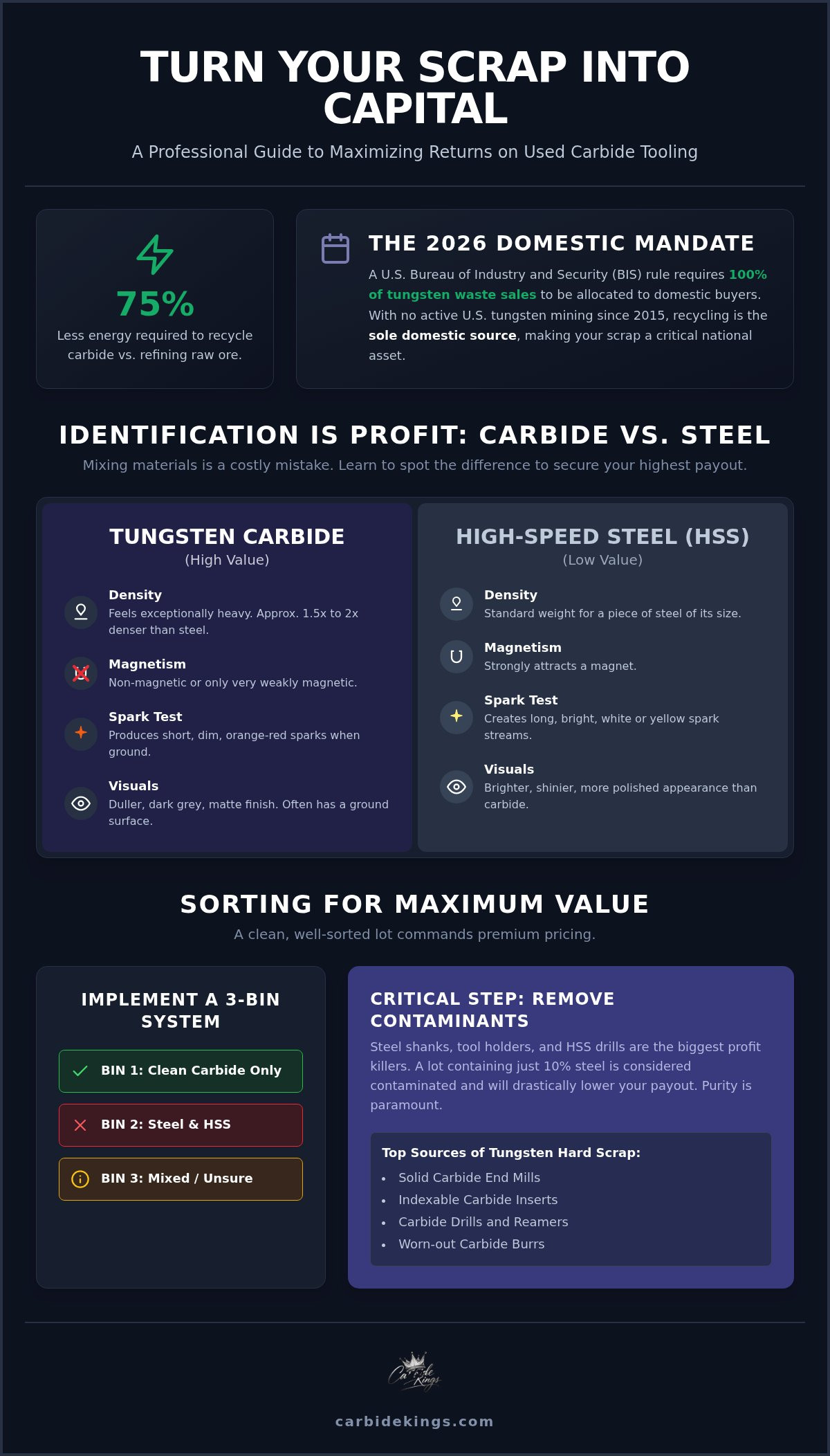
Distinguishing between High-Speed Steel (HSS) and carbide is the difference between a minor rebate and a significant revenue stream. Carbide is nearly twice as dense as steel. A simple weight test usually reveals the truth: if a tool feels unexpectedly heavy for its size, it's likely carbide. Additionally, carbide is generally non-magnetic or only weakly magnetic, whereas most HSS tools will strongly attract a magnet.
- Density: Carbide tools weigh roughly 1.5 to 2 times more than steel counterparts of the same volume.
- Spark Test: Carbide produces short, orange sparks, while steel creates long, white or yellow streams.
- Visuals: Look for the duller, grey finish of carbide versus the brighter, polished look of HSS tools.
Mixing these materials is a costly mistake. If you include steel shanks or HSS drills in your carbide lot, you dilute the purity and lower your total payout. For a deeper look at maximizing your return through proper separation, see our Industrial Carbide Scrap Disposal: The 2026 Manufacturer's Guide. Implementing a strict separation protocol ensures you capture the full value of your high-grade alloys.
Ultimately, treating your used tooling as a source of capital recovery transforms your shop's efficiency. Every pound of carbide you reclaim is money that stays in your tool budget. It's a direct, no-nonsense way to improve your shop's bottom line while supporting a domestic supply chain that currently depends on recycling to survive.
Identifying and Sorting High-Value Carbide Scrap
Sorting is the engine of your capital recovery. If you want to sell used carbide tools for the highest possible return, you must treat your scrap like inventory, not garbage. Mixed bins are the enemy of profit. Refineries pay premiums for clean lots because it reduces their processing time. Every minute they spend separating steel from carbide is a minute deducted from your payout. Professional sorting ensures that your materials move through the valuation process with zero friction.
Common Sources of Tungsten Hard Scrap
Solid carbide end mills represent the gold standard of hard scrap. They are typically high-purity and easy to identify by their weight and finish. Indexable carbide inserts follow closely; they are small but pack a significant punch in terms of cobalt-tungsten density. However, many of these tools come attached to steel shanks or holders. You must remove these steel components before shipping. A lot containing 10% steel by weight isn't a carbide lot; it's a contaminated lot. According to U.S. Geological Survey data on tungsten, this material is classified as a critical mineral. This classification means its purity is scrutinized at every stage of the supply chain, and clean sorting protects that value.
Managing Soft Scrap and Grinding Waste
Not all value comes in solid form. Tungsten Soft Scrap, which includes grinding sludge and swarf, is a significant revenue stream for high-volume shops. This material is the byproduct of tool sharpening and manufacturing. It's often damp with coolant and has a mud-like consistency. You must keep this separate from your hard scrap. Contaminating a bin of solid end mills with sludge makes the entire shipment difficult to handle and grade. Use sealed, leak-proof containers for soft scrap to prevent environmental issues and maintain material integrity. For a detailed breakdown of how these different forms are graded, reference The Complete Guide to Tungsten Hard Scrap Recycling in 2026.
Specialty carbide items also hold significant value but are frequently overlooked. Carbide-tipped saw tips, wear parts, and mining buttons are all eligible for recovery. These items often have unique geometries, but their metallurgical composition remains the priority. When you organize your collection points, create a dedicated space for these outliers. If you aren't sure if a specific wear part qualifies, you can consult with a procurement expert to verify its material grade before you ship.
Organizing your shop into these distinct categories ensures that when you decide to sell used carbide tools, the process is fast and the transaction is transparent. Clean, sorted scrap moves through the system quickly. It allows for immediate weighing and faster payment, keeping your focus on production rather than administrative hurdles.
Market Factors: What Determines Your Scrap Carbide Price?
The value of your scrap isn't a static number. It's a reflection of global supply chains and metallurgical chemistry. When you prepare to sell used carbide tools, you're participating in a high-stakes commodities market. In 2026, several specific factors are driving the rates you see on your quote. Understanding these variables allows you to move from reactive selling to strategic asset management.
Global tungsten ore availability is the primary driver. Since the U.S. hasn't commercially mined tungsten since 2015, domestic recycling is the backbone of the industry. The August 2026 Bureau of Industry and Security (BIS) rule, which mandates 100% domestic allocation of tungsten scrap, has created a unique environment. While international prices in Japan and the UK saw a softening in early September 2026, the demand for domestic scrap remains aggressive to fuel U.S. manufacturing. This domestic priority keeps the value of your local inventory high.
Cobalt content also plays a critical role. Most industrial carbide contains between 3% and 15% cobalt as a binder. Higher cobalt grades often command different rates because cobalt itself is a high-value critical mineral. However, the 'lot size' is often the biggest lever you can pull. Bulk shipments reduce the per-pound cost of logistics and processing. These efficiencies allow buyers to pass more value back to you, making it more profitable to ship larger, consolidated lots rather than small, frequent batches.
The Role of Tungsten Purity in Valuation
Refineries test for tungsten concentration (WT%) using advanced analysis tools. Contaminants are the biggest threat to your final payout. If your inserts still have steel screws or if your saw tips are covered in heavy silver solder and brazing, your purity percentage drops. 'Clean' scrap requires less refining and always commands a premium. Removing these attachments before you ship is the fastest way to increase your ROI. Purity isn't just a quality metric; it's a direct multiplier of your profit.
Timing Your Sale for Maximum ROI
Market timing requires a steady hand and a focus on long-term trends. Minor dips in the market shouldn't trigger a panic sell. Instead, monitor industrial metal indices to understand the broader trajectory of tungsten alloys. For a deep dive into how these variables interact with current market data, check our Tungsten Carbide Scrap Price Guide: Market Drivers and Valuation in 2026. Staying informed ensures you liquidate your assets at the peak of their value cycle.
The Step-by-Step Carbide Recycling Sustainability Audit Template
Efficiency on the shop floor shouldn't stop at production. To sell used carbide tools profitably, you need a repeatable system that removes guesswork. This audit template provides a structured workflow to transform your tool crib into a consistent revenue stream. By treating your scrap with the same rigor as your finished parts, you eliminate the logistical friction that typically stalls recycling efforts.
Step 1: Inventory Assessment. Walk your facility and locate every point where tools are retired. This includes CNC stations, tool sharpening areas, and the central crib. Step 2: Sorting Protocol. Move beyond the single scrap bucket and implement a dedicated three-bin system. Step 3: Weight Verification. Establish a baseline for your monthly recovery. Knowing your average output helps you spot internal leakage or inefficiencies. Step 4: Logistics Planning. Determine a removal frequency that prevents bins from overflowing and disrupting floor space. Step 5: Partner Selection. Vet national buyers who offer transparent pricing and streamlined shipping logistics.
Implementing the Three-Bin Sorting System
Organization is the key to purity. A clear three-bin system ensures that every operator knows exactly where their waste belongs. This prevents the costly contamination discussed in previous sections.
- Bin A: Solid Tungsten Hard Scrap. Reserved for indexable inserts and solid carbide end mills. This is your highest-value category.
- Bin B: Tungsten Soft Scrap. Dedicated to grinding swarf, sludge, and fines. Keep these containers sealed to prevent leaks.
- Bin C: Mixed Steel Scrap. For tool holders, shanks, and HSS drills. Keeping these out of Bin A protects your lot value.
Tracking Your Capital Recovery
Visibility creates accountability. Create a simple spreadsheet to track your scrap revenue against your total tool spend. This data allows you to calculate the true lifecycle cost of your tooling. Assign a Scrap Champion on the shop floor to oversee these bins and ensure compliance with your sorting rules. This individual becomes your point of contact for the entire recovery process.
To optimize your freight costs, set trigger weights for your shipments. Instead of shipping small amounts, wait until your bins reach a specific weight threshold that triggers a pickup. This approach maximizes your per-pound return by reducing shipping overhead. When your shop is ready to move material, request a national procurement quote to finalize your recovery. This structured approach ensures that you sell used carbide tools with maximum efficiency and minimal administrative burden.
Streamline Your Scrap Disposal with Carbide Kings
Managing industrial waste shouldn't feel like a second job. When you decide to sell used carbide tools, you need a partner that respects your time and your bottom line. We provide a direct, no-nonsense procurement process designed specifically for high-volume manufacturing environments. Our system bypasses the traditional administrative hurdles and complex paperwork that often make scrap disposal a burden for shop managers. We focus on speed, transparency, and reliability so you can stay focused on your core operations, such as sourcing high-precision components from Ridiculous Machine Tools to maintain your production standards.
Our reach is national. We serve manufacturers across the United States without the limitations of local scrap yards that may not understand the intricacies of tungsten alloys. Whether your facility is a small precision shop or a massive aerospace plant, our logistical network ensures your material moves quickly from your floor to our facility. We base our transactions on real-time market data, ensuring you receive a fair payout that reflects the current 2026 domestic demand for critical minerals.
Shipping several hundred pounds of dense metal scrap is a significant logistical challenge. We act as a supportive partner by handling the heavy lifting for you. For large manufacturing plants, we assist with bulk scrap logistics to ensure the removal process is as smooth as your production line. You don't have to worry about finding the right freight carriers or navigating complex shipping regulations; we've refined this process to perfection.
Once your material arrives, our weighing and verification process is completely transparent. We use precision industrial scales to verify your lot weights and provide a clear breakdown of your shipment. There are no hidden fees or administrative deductions. You receive a fast, honest valuation based on the exact weight and grade of the carbide you provide. This clarity builds the trust necessary for a long-term recovery partnership.
Get a Competitive Quote Today
Working with a specialized tungsten expert ensures you aren't leaving money on the table. General scrap dealers often lack the metallurgical knowledge to distinguish between different grades of carbide scrap, which can lead to lower payouts for you. We specialize exclusively in industrial tungsten and carbide alloys. This focus allows us to offer more competitive rates and faster processing times than generalists.
Initiating your first shipment is straightforward. Simply contact our procurement team with a brief description of your current inventory. We'll guide you through the initial steps and help you organize your first pickup. It's time to stop letting valuable assets clutter your facility and start seeing a real return on your tooling investment. Ready to sell? Contact Carbide Kings for a bulk scrap quote and experience the most efficient recovery process in the industry.
Maximize Your Shop's Recovery Value Today
Transforming your scrap management from a chore into a revenue stream starts with a simple, structured system. By identifying high-purity tungsten hard scrap and implementing a three-bin sorting protocol, you ensure your facility captures every dollar of potential capital recovery. The 2026 market demand for domestic critical minerals makes this the ideal time to refine your internal processes and remove the friction from your disposal workflow.
When you are ready to sell used carbide tools, you need a partner that handles the heavy lifting. We provide a specialized focus on tungsten alloys and national US-wide logistics support to streamline your shipments. Our direct industrial procurement model eliminates middleman fees; this ensures you receive the full value of your material based on real-time market data.
Take the first step toward a more sustainable and profitable tool crib today. Request an Industrial Carbide Scrap Quote from Carbide Kings and let us turn your shop waste into a transparent, high-speed transaction. Your bottom line deserves the boost.
Frequently Asked Questions
Where is the best place to sell used carbide tools in 2026?
The best place to sell used carbide tools in 2026 is a specialized national industrial partner that understands the latest U.S. export regulations. Following the August 2026 Bureau of Industry and Security (BIS) rule, domestic buyers are now prioritized for 100% of tungsten scrap sales. A national buyer like Carbide Kings offers the logistical support and transparent pricing required for manufacturing sectors. They handle bulk procurement with a focus on speed and reliability.
How much is carbide scrap worth per pound currently?
Current carbide scrap value is determined by global tungsten ore availability and domestic demand. While market indices fluctuate, the 2026 domestic allocation rules have kept demand aggressive for high-purity material. Factors such as cobalt content and the size of your lot also play a role in the final quote. Working with a specialized buyer ensures your payout reflects real-time industrial market data rather than generic local scrap rates.
Do I need to clean my used carbide tools before selling them?
You don't need to perform a deep chemical cleaning, but you must remove all non-carbide attachments to maximize your return. This includes steel shanks, holders, and heavy brazing or solder. Refineries test for tungsten concentration (WT%), and contaminants significantly lower your lot's purity percentage. Sorting your material into clean categories before you ship ensures a faster verification process and a more lucrative, transparent final transaction.
What is the difference between carbide hard scrap and soft scrap?
Carbide hard scrap consists of solid items like indexable inserts and end mills, while soft scrap refers to grinding sludge, swarf, and fines. It's critical to keep these materials in separate containers. Hard scrap is the primary source of recycled tungsten, but soft scrap remains valuable if it's uncontaminated by other metals. Most industrial professionals use a dedicated bin system to prevent mixing, which simplifies the logistical burden during pickup.
Can I sell used carbide tools that are broken or chipped?
Yes, you can sell used carbide tools regardless of their physical condition. Broken, chipped, or completely worn-out tools hold the same metallurgical value as whole ones because the recycling process focuses on reclaiming the raw tungsten and cobalt. Whether you have shattered end mills or dull inserts, the material remains a critical mineral asset. Our procurement process is designed to value the weight and purity of the alloy itself.
How do I ship heavy carbide scrap safely and affordably?
Shipping heavy scrap requires reinforced packaging such as heavy-duty buckets or palletized crates to prevent damage during transit. To keep costs low, many shops set trigger weights to consolidate shipments into larger batches. A national partner handles the logistical heavy lifting by coordinating freight and providing the necessary documentation. This approach removes the administrative burden from your shop floor and ensures your material moves safely across the country.
How do I tell the difference between carbide and high-speed steel?
Density is the most reliable indicator; carbide is roughly twice as heavy as high-speed steel (HSS) for the same volume. You can also use a magnet, as HSS is strongly magnetic while carbide is usually non-magnetic or only weakly attracted. If you perform a spark test, carbide produces short, orange sparks, whereas steel creates long, yellow streams. These simple shop-floor tests help you avoid contaminating high-value lots with lower-grade steel.
Why shouldn't I sell my carbide to a local residential scrap yard?
Local residential yards typically lack the specialized equipment needed to accurately grade tungsten alloys. They often classify carbide as low-grade steel or mixed heavy scrap, which results in a significantly lower payout for your shop. Specialized industrial buyers focus exclusively on critical minerals and understand the 2026 market drivers. By skipping the middleman and selling to a dedicated tungsten partner, you ensure a fair, transparent transaction based on industrial-grade valuation.


