

Did you know that as of August 27, 2026, new federal regulations require 100% of your tungsten waste to stay within U.S. borders? This sudden shift in industrial carbide scrap disposal means the way you handled your machine shop waste last year won't cut it today. You're likely dealing with the stress of rising shipping costs and the uncertainty of how to value your grinding sludge. It's a logistical burden that eats into your margins and distracts your team from their core operations.
We agree that your scrap should be a source of revenue, not a source of frustration. This guide will teach you how to transform your machine shop waste into a high-yield revenue stream using a systematic approach to disposal. We'll walk you through a streamlined workflow that maximizes your ROI while explaining how a reliable national partner can manage the heavy lifting of logistics. By the end of this article, you'll have a clear, chronological path to turning your scrap bins into a predictable profit center.
Key Takeaways
- Learn how to distinguish between high-value tungsten solids and soft grinding sludge to capture every dollar of potential revenue.
- Understand the 2026 regulatory shifts that make domestic industrial carbide scrap disposal a critical priority for your machine shop.
- Discover the "hidden costs" of improper sorting and how simple cleaning steps prevent value loss from contamination fees.
- Follow a step-by-step workflow to optimize shipping logistics and ensure your scrap materials are ready for high-yield processing.
- Explore how partnering with a national specialist simplifies complex logistics and provides fast, transparent payment terms.
What is Industrial Carbide Scrap Disposal?
Think of industrial carbide scrap disposal as a strategic recovery process rather than a cleaning task. It's the systematic collection, categorization, and sale of tungsten-based waste materials generated in a manufacturing environment. Industrial carbide scrap is any tungsten-cobalt waste generated during machining. While your shop likely handles high volumes of steel and aluminum, treating carbide as general ferrous scrap is a costly mistake. Tungsten carbide possesses a unique chemical composition and density that traditional recyclers aren't equipped to process or value correctly. By separating these materials, you turn an overhead cost into a primary revenue asset.
The financial impact of a disciplined disposal program is immediate. Tooling procurement costs are a major line item for any machine shop. Effective disposal allows you to recover a significant portion of that investment. Instead of letting high-value inserts and end mills sit in a bucket, you can reintegrate their value into your operational budget. This isn't just about waste management; it's about optimizing your entire supply chain. Every pound of carbide you recover directly offsets the cost of the next tool you buy.
Why Specialized Disposal Matters for Manufacturers
Tungsten is a critical raw material with a limited global supply. Every ounce of scrap your shop generates represents a vital resource for the domestic manufacturing base. Relying on a general recycler often leads to value loss because they lack the specific testing equipment to verify alloy purity. While a full-service provider like OC Recycling is an excellent resource for managing standard industrial scrap and common metals, especially for facilities in Southern California, specialized buyers are required for tungsten to accurately assess the difference between hard scrap and soft grinding fines. This expertise ensures you receive a fair price for every pound. Beyond the financial return, improper disposal of grinding sludge can lead to environmental hazards. These fines are often considered hazardous waste due to their chemical binders. A specialist handles the heavy lifting of compliance, protecting your shop from potential fines and environmental liability.
The regulatory environment for industrial metals shifted significantly on August 27, 2026. New U.S. federal mandates now require domestic manufacturers to prioritize local buyers for tungsten-based materials. This rule aims to secure the national supply chain for critical minerals. Consequently, your documentation and chain of custody have never been more important. You need clear records showing that your waste is being handled by a compliant, domestic partner. Our process for carbide tooling recycling ensures that every transaction meets these new standards. Using a specialized buyer provides the transparency required to navigate these national environmental and trade regulations without the administrative headache. We make compliance as simple as a standard business transaction.
Categorizing Your Carbide Waste: Hard vs. Soft Scrap
Effective industrial carbide scrap disposal requires precise categorization. You can't simply dump everything into one bin and expect a high-yield return. Sorting your materials at the source prevents cross-contamination and ensures you get paid for the actual weight of the tungsten you've recovered. Generally, your shop generates two types of waste: hard scrap and soft scrap. Hard scrap includes solid materials like broken end mills, drills, and indexable inserts. These are easy to identify and handle. Soft scrap consists of grinding sludge, swarf, and powder residues produced during tool sharpening or manufacturing. Professional tungsten soft scrap buyers evaluate these materials based on their moisture levels and total metal content. If your sludge is too wet or mixed with too much oil, its market value drops.
Identifying high-grade carbide versus coated steel is a critical skill for your floor team. Carbide is significantly denser than steel; it feels nearly twice as heavy for the same volume. While coatings can make steel look like carbide, a simple weight test or a spark test usually clears up any confusion. Carbide produces short, reddish-orange sparks, while steel throws long, yellow streamers. Following OSHA regulations for waste disposal ensures that your sorting area remains safe and organized for your workers while you maximize your scrap's value.
Common Sources of Hard Carbide Scrap
Hard scrap is the most common form of tungsten waste in most machine shops. You'll find it primarily in indexable inserts and saw tips used for heavy milling operations. Solid carbide rods and broken drill bits are also high-value items that should be kept separate from other metals. Don't overlook wear parts from mining, construction, or oil-field equipment. These rugged components often contain large amounts of tungsten carbide that can be recycled. If you're unsure about a specific component, get a fast quote from Carbide Kings to determine its current market value.
Managing Soft Scrap: Sludge, Swarf, and Fines
Soft scrap is often neglected, but its potential for ROI is massive. The value of tungsten carbide grinding sludge in high-precision manufacturing is often overlooked because it looks like worthless mud. To maintain its value, you must store sludge properly to prevent oxidation. Keep it in sealed, moisture-proof containers. If oxygen reacts with the tungsten fines, it creates oxides that are harder to process, which reduces your payout. Additionally, ensure your filtration systems are capturing powder and fines effectively. These micro-particles add up quickly in high-volume environments. When you manage your soft scrap with the same discipline as your solids, you unlock a secondary revenue stream that most of your competitors are throwing away.
The ROI of Machine Shop Metal Recycling Systems
Managing your machine shop waste is a financial discipline. When you implement a formal system for industrial carbide scrap disposal, you're directly protecting your profit margins. Effective carbide tooling recycling transforms an expense into a capital asset. Most manufacturers don't realize that poor sorting is a hidden tax on their operations. If a lot is contaminated with steel or high-speed steel (HSS), the buyer must spend more on processing. This results in lower payouts or even contamination fees for you. By treating your scrap as a commodity, you eliminate these avoidable losses.
Think of your scrap as a "closed-loop" procurement tool. The revenue generated from scrap sales should fund your next batch of high-performance inserts. To calculate your potential ROI, multiply your average monthly tooling consumption by your recovery rate. An academic review of recycling methods shows that shops with high recovery rates significantly lower their total cost of ownership for cutting tools. By treating your waste as currency, you create a self-sustaining cycle that reduces your reliance on external capital for tool replacement. It's a straightforward way to boost your bottom line without increasing your production overhead.
Eliminating Cross-Contamination
Mixing steel with carbide is the fastest way to devalue your lot. Even a small percentage of HSS can cause a lot to be downgraded because the chemistries are incompatible during the smelting process. You must set up dedicated, clearly labeled collection bins at every CNC station. Don't rely on a central bin at the back of the shop. If it's not convenient, operators will default to the nearest trash can. Train your staff to recognize the visual differences immediately. Carbide is significantly heavier and typically has a distinct gray hue compared to the brighter finish of steel or cobalt-coated alloys. Manufacturers that specialize in high-precision components, such as Fong’s Engineering & Manufacturing Private Limited, understand that material integrity and waste management are crucial for efficiency in medical device development.
Tracking and Auditing Your Scrap Output
Data is your best defense against waste. Implement a simple log to track the weight of your tungsten hard scrap every time a bin is emptied. This prevents internal shrinkage and ensures that every pound of material is accounted for before it leaves your facility. Conduct periodic audits to compare your scrap volume against your production output. If your production is up but your scrap weight is flat, you have an efficiency gap. This methodical approach to industrial carbide scrap disposal ensures that no value slips through the cracks of your shop floor operations.
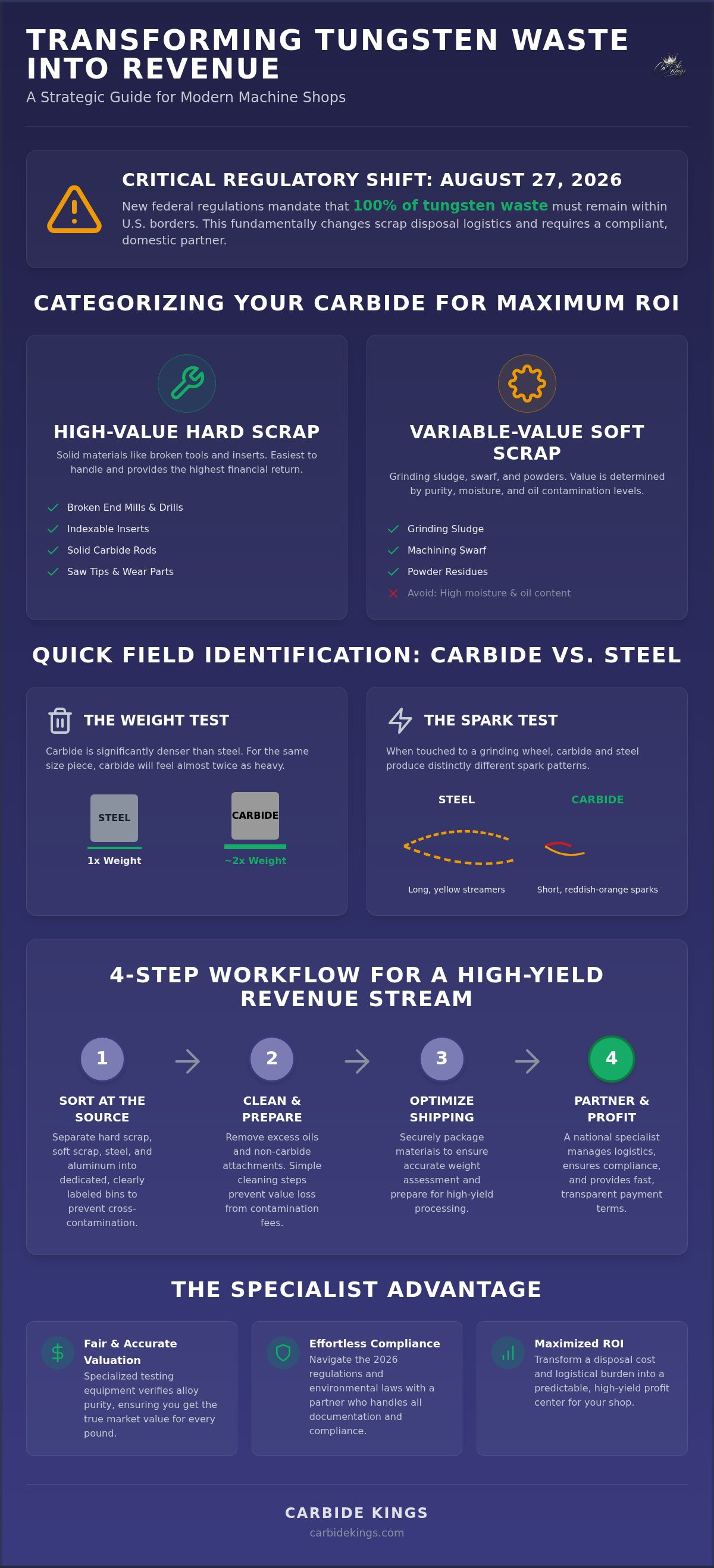
How to Dispose of Industrial Carbide: A Step-by-Step Workflow
Streamlining your industrial carbide scrap disposal is a five-step process designed for maximum speed and payout. You don't want to waste time on small, frequent shipments that eat your profits in freight costs. Instead, follow this methodical sequence to ensure your machine shop waste is handled with professional precision. It's about moving material from your floor to our facility with zero friction.
First, accumulate a significant lot size. Aim for at least 50 lbs before arranging a pickup. This volume optimizes shipping rates and makes the transaction more lucrative for your business. Second, clean and sort your materials. Remove excess coolant and separate your hard solids from soft grinding sludge. Third, package your materials for the long haul. Heavy-duty containers are mandatory to prevent transit damage. Fourth, request a quote from an expert buyer like Carbide Kings. Finally, finalize the logistics. Once the material is verified at our facility, you'll receive payment under clear, transparent terms. Request a quote from Carbide Kings today to see how simple this process can be.
Packaging for National Logistics
Don't risk your shipment with flimsy containers. Carbide is incredibly dense; a standard cardboard box will fail under the weight of solid end mills or inserts. Use reinforced 5-gallon pails for most shipments. If you're disposing of grinding sludge, ensure the lids are equipped with gaskets and are hammered shut to prevent leaks during transit. For bulk shipments of solid carbide wear parts, use heavy-duty wooden crates. Label each container clearly with the material type and weight. This preparation ensures your shipment arrives intact and is processed quickly without delays caused by spilled or mixed materials.
Evaluating National Carbide Buyers
Local scrap yards often lack the specialized equipment to assay tungsten accurately. They'll likely give you a "mixed metal" price that's far below the actual value of your carbide. In contrast, professional tungsten scrap buyers in the USA use advanced testing to provide precise valuations. You should look for a partner that offers transparent weighing processes and fast payment terms. National buyers have the logistics infrastructure to handle the heavy lifting of transport from any facility in the country. This specialization translates to higher ROI and a more reliable disposal workflow for your machine shop operations.
Partnering with Carbide Kings for Professional Disposal
Stop treating your scrap like a logistical burden. Industrial carbide scrap disposal is a revenue-generating operation that requires a specialized partner to maximize returns. Carbide Kings offers a streamlined alternative to the slow, bureaucratic process of traditional scrap yards. We provide fast quotes, clear terms, and a national reach that simplifies your entire disposal workflow. Whether you're dealing with solid end mills or complex grinding waste, we have the expertise to value your material accurately. Our goal is to remove every barrier between your waste bin and your bank account. We act as a friendly, efficient guide through the complexities of industrial recycling.
Transparency is the foundation of our business model. We don't hide behind complex fee structures or delayed timelines. Once your material is verified at our facility, we commit to 24-hour payment terms. This speed ensures your cash flow remains fluid, allowing you to reinvest in your shop immediately. We take pride in being a proactive partner that handles the heavy lifting so you don't have to. Our process is refined to perfection, ensuring that every transaction is as simple as a basic retail exchange. You focus on the floor; we handle the material recovery.
Our National Logistics Network
We service manufacturers across the entire United States with a focus on professional efficiency. Our national logistics network is designed to assist you with every aspect of freight and shipping. We understand the industrial workflow. Your team has more important tasks than managing carrier schedules or navigating complex transport regulations. We streamline the paperwork and provide clear, imperative instructions for bulk transport. This level of support gets your shop back to core operations faster while ensuring your scrap is in transit to a high-yield destination. We remove the traditional hurdles of administrative paperwork, leaving you with a clean shop and a fair payout.
Direct Access to Industrial Procurement
We aren't just middle-men in the recycling chain. Carbide Kings buys directly for industrial use, which allows us to offer top-market rates for your tungsten scrap. We value long-term partnerships over one-off transactions. By establishing a consistent scrap management plan, you ensure a predictable revenue stream for your facility. We've refined our process to ensure that your materials are processed and valued with absolute integrity. It's a no-nonsense approach that appeals to professionals who value time and clarity. Contact Carbide Kings today for a fast quote on your industrial scrap.
Maximize Your Shop's Recovery Potential
Maximize your shop's bottom line by treating waste as a primary asset. You've learned how to distinguish between high-value solids and complex grinding sludge to ensure you capture every dollar of potential revenue. By following a methodical workflow and maintaining strict sorting standards, you turn a logistical burden into a predictable profit center. Effective industrial carbide scrap disposal isn't just about cleaning the floor; it's a strategic procurement tool for the modern manufacturer.
We handle the heavy lifting so you can stay focused on your core operations. Our team provides comprehensive national logistics support and specializes in both hard and soft tungsten scrap. We're committed to transparency and speed, offering fast 24-hour payment terms once your material is verified. Don't let your valuable materials sit in a bin when they could be funding your next tooling purchase. It's time to streamline your process and get the return your facility deserves.
Get an Instant Quote for Your Industrial Carbide Scrap
Your shop is now equipped with the framework to dominate your scrap management. Start today and see the immediate impact on your margins.
Frequently Asked Questions
What is the difference between hard and soft carbide scrap for disposal?
Hard scrap consists of solid pieces like end mills, inserts, and drill bits. Soft scrap refers to powders, swarf, and grinding sludge produced during manufacturing or sharpening. While solids are easy to handle, soft scrap requires moisture-controlled storage to maintain its high tungsten value. Both categories are essential components of a comprehensive industrial carbide scrap disposal program that maximizes your shop's total recovery potential.
How much carbide scrap do I need to accumulate before selling?
You should aim to accumulate at least 50 lbs of material before arranging for disposal. This volume ensures that shipping costs don't consume your profit margins. While smaller amounts are technically recyclable, bulk shipments offer the best return on investment for your machine shop. Consolidating your waste into larger lots makes the logistics process more efficient for both you and your national buying partner.
Can I dispose of grinding sludge with my regular industrial waste?
You cannot dispose of grinding sludge with general industrial waste because it often contains heavy metals and chemical binders that require specialized handling. Improper disposal can lead to environmental violations and significant fines. Instead, treat this material as a high-value byproduct. Storing it in sealed containers allows you to sell it to specialized buyers who can recover the tungsten content safely and profitably.
How do I know if my tools are tungsten carbide or high-speed steel?
Use a weight or spark test to distinguish between tungsten carbide and high-speed steel. Carbide is nearly twice as heavy as steel for the same volume and feels much denser in your hand. During a spark test, carbide produces short, dull orange sparks, whereas HSS creates long, bright yellow streamers. Accurate identification prevents lot contamination and ensures you receive the full market value for your scrap materials.
Why shouldn't I sell my carbide to a local general scrap yard?
Local scrap yards rarely have the specialized equipment needed to assay the specific tungsten content of your materials. They often provide a flat "mixed metal" rate that is significantly lower than what a specialist buyer can offer. By working with a national expert, you gain access to transparent valuation processes and higher payouts based on the actual metallurgical chemistry of your hard and soft scrap.
What are the common contaminants that lower carbide scrap value?
Common contaminants that lower the value of your scrap include steel shanks, high-speed steel tools, ceramic inserts, and excessive moisture in grinding sludge. Even a small percentage of non-carbide material can lead to contamination fees or lot downgrades during the smelting process. Keeping your collection bins strictly segregated at the source is the most effective way to protect the purity and revenue potential of your industrial carbide scrap disposal lot.
How long does the payment process take for bulk carbide disposal?
Our payment process is designed for speed and reliability. Once your material is received and verified at our facility, we commit to 24-hour payment terms. This rapid turnaround ensures your cash flow remains steady and allows you to reinvest your scrap revenue into new tooling immediately. We eliminate the long wait times and administrative hurdles typically associated with traditional industrial metal recycling.
Is there a specific way I must package carbide for national shipping?
Package your carbide scrap in heavy-duty 5-gallon pails or reinforced wooden crates for national shipping. Because tungsten is extremely dense, standard cardboard boxes will likely fail during transit. For grinding sludge, ensure lids are sealed with gaskets to prevent leaks. Clear labeling and secure pallets are also necessary to meet national freight standards and ensure your materials arrive safely for weighing and valuation.


