

If you're still treating your worn carbide inserts like standard steel scrap, you're handing your profit margins directly to the local yard. You know that tungsten is a critical industrial asset, yet finding a buyer who actually distinguishes between hard scrap and soft sludge is often a logistical nightmare. It's frustrating to watch heavy shipping costs and delayed payments eat into what should be a straightforward recovery of capital. This guide shows you exactly where to sell carbide scrap to secure national industrial rates and bypass the low-ball offers common at regional facilities.
We'll help you identify high-value alloys and navigate the strict 2026 domestic export regulations that have fundamentally reshaped the market. You'll discover how to partner with a specialized buyer who offers transparent grading and fast payment within 24 to 48 hours. From optimizing LTL freight for heavy loads to understanding current market shifts, this is your roadmap to turning industrial waste into a high-performance revenue stream. We've refined the process to remove the administrative hurdles, ensuring your shop stays focused on production while we handle the heavy lifting of scrap recovery.
Key Takeaways
- Learn why general scrap yards often undervalue tungsten alloys and how specialized buyers use XRF technology to provide more accurate, higher margins.
- Identify the critical differences between high-density hard scrap and soft scrap, like grinding sludge, to ensure your materials are graded correctly for maximum return.
- Discover exactly where to sell carbide scrap by evaluating national buyers on their payment velocity and commitment to transparent, market-indexed pricing.
- Streamline the logistics of moving heavy industrial metals with professional containment and weight verification strategies that protect your profit during transit.
- Establish a reliable national partnership that eliminates administrative hurdles and ensures you receive fast payment within 24 to 48 hours for bulk inventory.
Why Specialized Carbide Buyers Outperform Local Scrap Yards
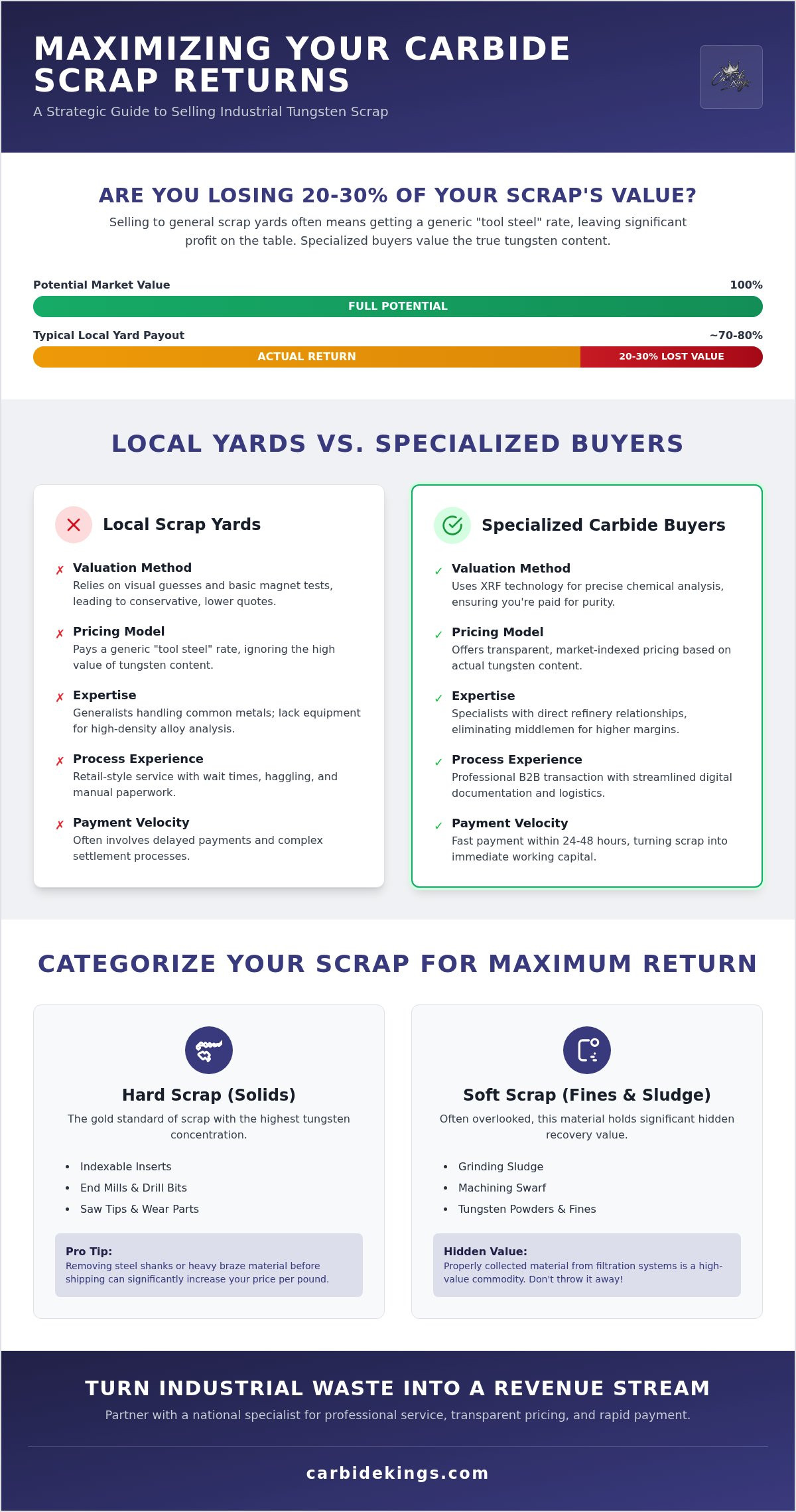
Local scrap yards operate on volume across a wide range of common metals like aluminum and copper. They rarely have the technical expertise or the equipment to value high-density alloys correctly. When you are deciding where to sell carbide scrap, the choice between a local generalist and a national specialist determines whether you get paid for the actual tungsten content or just a generic "tool steel" rate. Specialized buyers offer a specialist premium because they understand the intrinsic value of Tungsten carbide and maintain direct relationships with industrial refineries. This eliminates the middleman, allowing for higher margins on bulk lots that local yards simply cannot match.
Many machine shops choose local convenience, but this often results in losing 20% to 30% of the material's true market value. Industrial buyers leverage their scale to absorb logistics costs while still outperforming local quotes. It is a strategic shift from treating scrap as waste to managing it as a high-value industrial asset.
The Technology Gap in Metal Analysis
General scrap yards often rely on visual identification or basic magnet tests. This creates a significant problem for sellers because different carbide grades contain varying amounts of cobalt and other binders that drastically affect value. Specialized buyers use XRF (X-ray fluorescence) technology and spectrographic analysis to verify the exact chemical composition of your scrap. Visual guesses lead to conservative, lower quotes to protect the yard's bottom line. Professional analysis ensures you get paid for the specific purity of your alloy. If your material is high-grade, a specialist's report proves it, whereas a local yard might bucket it with lower-value mixed solids.
Industrial vs. Retail Scrap Experience
Selling to a national partner is a business-to-business transaction, not a retail errand. You don't have to wait in a retail line behind trucks full of residential waste. The process is designed for manufacturing plants that need to move volume quickly and efficiently. When you research where to sell carbide scrap, look for partners who offer professional procurement instead of retail-style haggling. Specialized buyers provide:
- Streamlined digital documentation that reduces administrative paperwork.
- Recurring recovery programs that automate your scrap management for consistent cash flow.
- Fast weight verification and transparent grading reports.
Establishing a recurring program turns your waste into a predictable revenue stream. You get a professional partner who handles the heavy lifting, allowing your team to stay focused on core production. The result is a faster, more lucrative transaction that respects your time and your inventory's value.
Categorizing Your Inventory: Hard Scrap vs. Soft Scrap
Properly sorting your inventory is the first step in maximizing your return. Many shops make the mistake of tossing everything into a single bin, which complicates the assay process and often results in a lower average payout. According to U.S. Geological Survey data, tungsten is a critical mineral with a finite supply, making even your machining waste a high-value commodity. Knowing where to sell carbide scrap is only half the battle; knowing how to present it ensures you capture every dollar of that value.
Maximizing Returns on Hard Carbide Solids
Hard scrap is the high-density tungsten carbide solids used in precision machining. This category includes common shop floor items like indexable inserts, end mills, drill bits, and saw tips. These tools are considered the gold standard of scrap because of their high tungsten concentration. To get the best rate, keep these solids separate from other metals. Removing steel shanks or heavy braze material before shipping can often increase your price per pound. It reduces the amount of non-carbide weight the buyer has to process, leading to a cleaner assay and a more accurate quote.
Recovering Value from Grinding Sludge and Fines
Don't overlook the material gathered in your filtration systems. There is significant hidden value in tungsten powder recycling and soft scrap recovery. This category includes grinding sludge, swarf, and fines. While it often looks like worthless mud, it contains high-grade tungsten that refineries can process back into raw material. Professional tungsten soft scrap buyers evaluate this material based on dry weight and metal content. You should dry your sludge as much as possible and use leak-proof containment for shipment. Turning this machine shop waste into a secondary revenue stream is a hallmark of an efficient operation.
Identifying high-value cobalt tungsten scrap can lead to premium returns, as cobalt prices often fluctuate independently of tungsten. If you mix these high-value alloys with lower-grade materials, the buyer must base their quote on the lowest common denominator in the lot. Keep your categories distinct to ensure a transparent and lucrative transaction. If you're unsure about your inventory's grade, you can consult with a professional buyer to confirm your scrap's worth before shipping. This simple step in organization is the fastest way to increase your total lot value when deciding where to sell carbide scrap for the best possible margin.
Evaluating National Carbide Buyers: A Comparison Framework
Choosing the right partner is about more than just the highest quote on paper. When you evaluate where to sell carbide scrap, you must look at the buyer's infrastructure and financial reliability. A professional buyer provides a clear tungsten carbide scrap price based on recognized market indices. This transparency protects you from arbitrary price drops during the shipping process. Unlike manufacturer buy-back programs that often limit you to tool credits, a national specialist provides cash liquidity. This allows you to reinvest in your operations immediately rather than being tied to a specific vendor's catalog.
Material range is another critical factor for efficiency. A truly specialized buyer isn't limited to just common inserts or drill bits. They should have the technical expertise for selling tungsten alloys and other specialty metals in the same shipment. Consolidation simplifies your logistics. It ensures you aren't managing multiple vendors for a single shop's waste stream. You want a partner who handles the full spectrum of your carbide inventory with a single point of contact.
Financial Stability and Payment Terms
Fast liquidity is the lifeblood of machine shop cash flow. Waiting for a 30 day corporate payment cycle is a significant burden on your bottom line. Compare this to 24 or 48 hour payment terms, which reflect a buyer's financial strength and commitment to your partnership. Watch for red flags like vague payment schedules or hidden processing fees that appear only after you've shipped the material. A reliable partner provides transparent weight certificates and detailed assay reports. These documents are your proof of value. They ensure the final payout matches the initial material verification exactly.
Assessing Industrial Procurement Expertise
Does the buyer understand the complexities of industrial tungsten procurement? This expertise is what allows a buyer to handle bulk lots exceeding 1,000 lbs with the same precision as a smaller shipment. It also ensures they are compliant with the latest environmental and regulatory standards. In 2026, regulatory oversight on critical minerals is stricter than ever. Partnering with a compliant buyer protects your business from the legal risks associated with improper metal handling or export violations. Look for direct access to procurement experts rather than being forced through an automated corporate portal. Real-time communication with a specialist ensures that any logistical hurdles are cleared before they impact your payment velocity. This professional approach is what separates a strategic industrial partner from a simple scrap collector.
Logistics and Shipping: How to Move Bulk Carbide Nationally
Moving bulk industrial metal across the country is a routine logistical process. Many machine shops hesitate to look beyond their local area because they fear the complexity of long-distance freight. When you understand where to sell carbide scrap on a national level, you realize that the logistics are often handled for you. A professional buyer streamlines the movement of heavy materials. They turn a potential headache into a simple dock-to-dock transaction that captures higher market values than local yards can offer.
Step 1: Secure containment. Use heavy-duty buckets or reinforced crates. Carbide is incredibly dense; a single five-gallon bucket of inserts can weigh over 100 pounds. Standard containers will not suffice.
Step 2: Weight verification. Document your pre-shipment weights accurately. This protects your bottom line and provides a clear baseline for the buyer's final assay report.
Step 3: Palletizing. Place your containers on a sturdy, undamaged pallet. Use high-quality shrink-wrap to secure the load for LTL (Less Than Truckload) transit, ensuring nothing shifts during the journey.
Step 4: Arranging pickup. National buyers typically provide the Bill of Lading (BOL). You simply schedule the dock time and load the truck. The process is designed to be as fast as a standard supply delivery.
Packaging Best Practices for Heavy Metal
Cardboard boxes are designed for retail goods, not high-density industrial alloys. They will fail under the weight of carbide inserts, leading to lost material and insurance claims. Use heavy-duty plastic buckets for solids or steel drums for grinding sludge and swarf. Each container must be clearly labeled with the material type and your company information. This ensures accuracy during the intake process and prevents your high-value tungsten from being mixed with lower-grade materials. If you're moving large volumes, request a logistics consultation to ensure your packaging meets national freight standards.
Understanding Freight and Logistics Support
National buyers leverage LTL carriers to move material efficiently across the United States. If you are shipping qualifying volumes, specialized buyers often provide pre-paid shipping labels and handle the administrative work for the Bill of Lading. This removes the burden from your shipping department. Always verify that your shipment is insured for its full tungsten value during transit. This protects your investment from the moment the pallet leaves your facility until it reaches the refinery. Professional logistics support is a key indicator of a reliable industrial partner.
Secure Your Best Rate with Carbide Kings
Finding the right destination for your material shouldn't be a secondary task for your facility manager. When you determine where to sell carbide scrap, you're choosing a partner that directly impacts your shop's liquidity and efficiency. Carbide Kings offers direct access to industrial experts who specialize in accurate material valuation. We don't guess based on visual inspections at a retail counter. Instead, we use professional analysis to ensure your tungsten hard scrap and soft scrap are priced according to their true metallurgical value. Our process is designed to remove the administrative hurdles that typically slow down industrial transactions.
We provide competitive pricing on the full spectrum of tungsten-based materials. Whether you're moving high-density end mills or complex grinding sludge, our team understands the chemistry and market drivers involved. We've refined our logistics network to handle the heavy lifting, allowing you to stay focused on your core manufacturing operations. The Carbide Kings promise is simple: reliable logistics, transparent grading, and fast, professional payment that respects your time.
The Carbide Kings Onboarding Process
We've streamlined the intake process to be as fast as a standard retail transaction. To start, simply request a quote by providing basic photos and estimated weights of your material. This allows our procurement team to give you an initial valuation without unnecessary delays. Once the material arrives at our facility, we maintain a 24-hour evaluation and payment commitment. You won't be left wondering about the status of your shipment or your funds. We prioritize building long-term recycling partnerships, helping your facility establish a consistent, recurring revenue stream from your machining waste.
Commitment to Industrial Excellence
Our business is built on a singular focus. We don't handle residential aluminum or copper because we believe specialization is the only way to provide maximum value to industrial clients. By focusing exclusively on tungsten and carbide recovery, we've become a vital link in the national industrial supply chain. We help return critical raw materials to production, supporting domestic manufacturing while ensuring your shop gets the best possible return on its inventory.
Don't settle for the "mixed steel" rates offered by generalists when you're deciding where to sell carbide scrap; work with a dedicated industrial leader. Contact Carbide Kings today to monetize your carbide scrap inventory and experience a faster, more transparent recovery process.
Maximize Your Industrial Recovery Value
Capturing the full market value of your tungsten assets requires a shift from local convenience to professional industrial procurement. You've learned how specialized analysis technology and accurate material categorization protect your margins from being diluted by generalist scrap yards. By choosing a partner with national reach, you eliminate the logistical friction that often keeps machine shops from optimizing their recovery programs. It's no longer just a question of where to sell carbide scrap; it's about establishing a strategic partnership that values your inventory as a critical resource.
Carbide Kings provides the specialized tungsten analysis technology and national LTL logistics support needed to move bulk material efficiently. We prioritize your cash flow with 24-hour payment terms and a transparent grading process that removes the guesswork from your recovery. Stop letting high-value alloys sit in your warehouse or settle for "mixed steel" rates. Get a Professional Quote for Your Carbide Scrap Now and turn your machining waste into a high-performance revenue stream. We're ready to handle the heavy lifting so you can stay focused on production.
Frequently Asked Questions
Where is the best place to sell carbide scrap for the highest price?
Specialized industrial buyers who focus exclusively on tungsten and carbide are the best option for maximizing your returns. Unlike local scrap yards that categorize everything as mixed steel, national partners use advanced spectrographic analysis to verify alloy purity. This ensures you receive a quote reflecting the actual tungsten content. By eliminating middlemen and shipping directly to a specialized facility, you capture higher margins and benefit from a more transparent, professional procurement process.
How much is tungsten carbide scrap worth per pound in 2026?
The value of tungsten carbide scrap in 2026 is determined by current market indices and the specific grade of your material. Prices fluctuate based on global supply constraints and the recent U.S. export regulations that prioritize domestic processing. High-density solids like indexable inserts typically command the highest rates. Because market conditions change frequently, it's best to request a quote based on your current inventory volume and material purity to ensure an accurate valuation.
Do you buy carbide grinding sludge and swarf?
Yes, we provide comprehensive recovery for tungsten soft scrap, including grinding sludge, swarf, and fines. While many local yards refuse these materials due to their moisture content and processing complexity, we have the infrastructure to assay and refine them. This turns what is usually a disposal cost for machine shops into a secondary revenue stream. We recommend drying the material and using leak-proof containment to ensure safe and efficient national transport.
Is there a minimum weight requirement for national carbide shipping?
We focus on industrial-grade volumes to ensure that the logistics of where to sell carbide scrap remain profitable for your business. While we evaluate each lot individually, shipments of 50 pounds or more typically offer the best balance between freight costs and return value. For larger bulk lots exceeding 1,000 pounds, we provide enhanced logistics support and LTL freight coordination to move your material quickly across the United States without administrative delays.
How do I ship heavy carbide inserts without high freight costs?
You can minimize shipping expenses by using LTL (Less Than Truckload) freight and palletizing your materials. Specialized buyers often provide pre-paid shipping for qualifying industrial volumes, which removes the financial burden from your facility. By consolidating your scrap into heavy-duty, reinforced containers and securing them to a single pallet, you reduce the per-pound cost of transit. This professional logistics approach allows you to access national rates that far exceed what is available locally.
What is the difference between hard scrap and soft scrap in pricing?
Hard scrap consists of solids like end mills and inserts, which generally command a higher price because they have a higher concentration of tungsten and require less processing. Soft scrap, such as grinding sludge or powder, contains binders and moisture that must be accounted for during the assay. While solids are the gold standard, soft scrap still holds significant value. The pricing difference reflects the additional refining steps needed to return soft scrap to a usable industrial grade.
How quickly will I receive payment after my carbide scrap is received?
We prioritize payment velocity to support your machine shop's cash flow. Once your material is received and verified at our facility, we typically issue payment within 24 to 48 hours. This is significantly faster than the 30 day corporate cycles common with larger manufacturers or general scrap dealers. Our streamlined process includes transparent weight verification and a final assay report, ensuring that you receive your funds quickly and with full visibility into the transaction details.
Can I sell tungsten alloys and cobalt-bearing carbide together?
You can include tungsten alloys and cobalt-bearing carbide in the same shipment, but it's best to keep them in separate containers. When you are determining where to sell carbide scrap, look for a buyer who can grade different alloys individually within one lot. Mixing these materials can lead to an assay based on the lowest-value alloy present. Proper sorting ensures you get paid for the specific cobalt or tungsten concentration of each material type in your inventory.


