

Did you know that tungsten prices surged by 622% between early 2025 and 2026, yet many industrial operations still leave thousands of dollars sitting in scrap bins? To sell cobalt tungsten scrap for its true value, you need to move beyond the opaque pricing and slow cycles of traditional local yards. You've likely experienced the logistical headaches of shipping heavy metal lots and the administrative friction that keeps your capital tied up for weeks. It's a frustrating bottleneck that stalls your cash flow and wastes your team's time.
This guide provides a clear, professional roadmap to identify and value your materials while maximizing industrial returns. We'll show you how to navigate the new U.S. export restrictions and leverage a streamlined national process that handles the heavy lifting for you. Expect a transparent valuation, hands-off shipping logistics, and a payment cycle that settles in under 24 hours. Stop letting administrative hurdles dictate your profit margins and start using a recycling partner that values efficiency as much as you do.
Key Takeaways
- Learn to distinguish between high-value cobalt tungsten solids and low-grade alloys using a professional identification checklist.
- Understand why cobalt’s role as a critical mineral significantly increases the valuation of your carbide scrap in the current market.
- Discover how to properly sort and bulk-ship your materials to sell cobalt tungsten scrap for the highest possible industrial return.
- Identify the differences between hard and soft scrap categories to ensure every pound of your lot is accurately appraised.
- Streamline your recycling workflow by adopting a national procurement model that eliminates paperwork and guarantees fast, reliable payment.
What is Cobalt Tungsten Scrap and Why is it Significant?
Cobalt tungsten scrap is a sintered composite material where cobalt serves as the metallic binder for hard tungsten particles. This combination creates Tungsten carbide, a substance capable of withstanding extreme heat and pressure. While tungsten provides the hardness, cobalt adds the essential toughness and impact resistance required for high-stress industrial work. Without the cobalt binder, the material would be too brittle for heavy duty machining or mining applications.
The 2026 market prioritizes cobalt recovery due to significant global supply chain shifts. With over 74% of cobalt produced in the DRC and new export quotas causing supply tightness, domestic scrap has become a vital resource. When you choose to sell cobalt tungsten scrap, you're tapping into a high-demand stream that includes worn-out end mills, dull drill bits, and spent mining inserts. These materials are no longer just waste; they're critical assets in a strained global market.
The Metallurgical Bond: Tungsten vs. Cobalt
Manufacturers use a liquid phase sintering process to create these high-performance hard metals. During this process, cobalt melts and flows around the solid tungsten grains, creating a dense, non-porous structure. This bond allows the tool to maintain a sharp edge while absorbing the shocks of industrial vibration.
The cobalt binder is the glue that holds tungsten grains together.
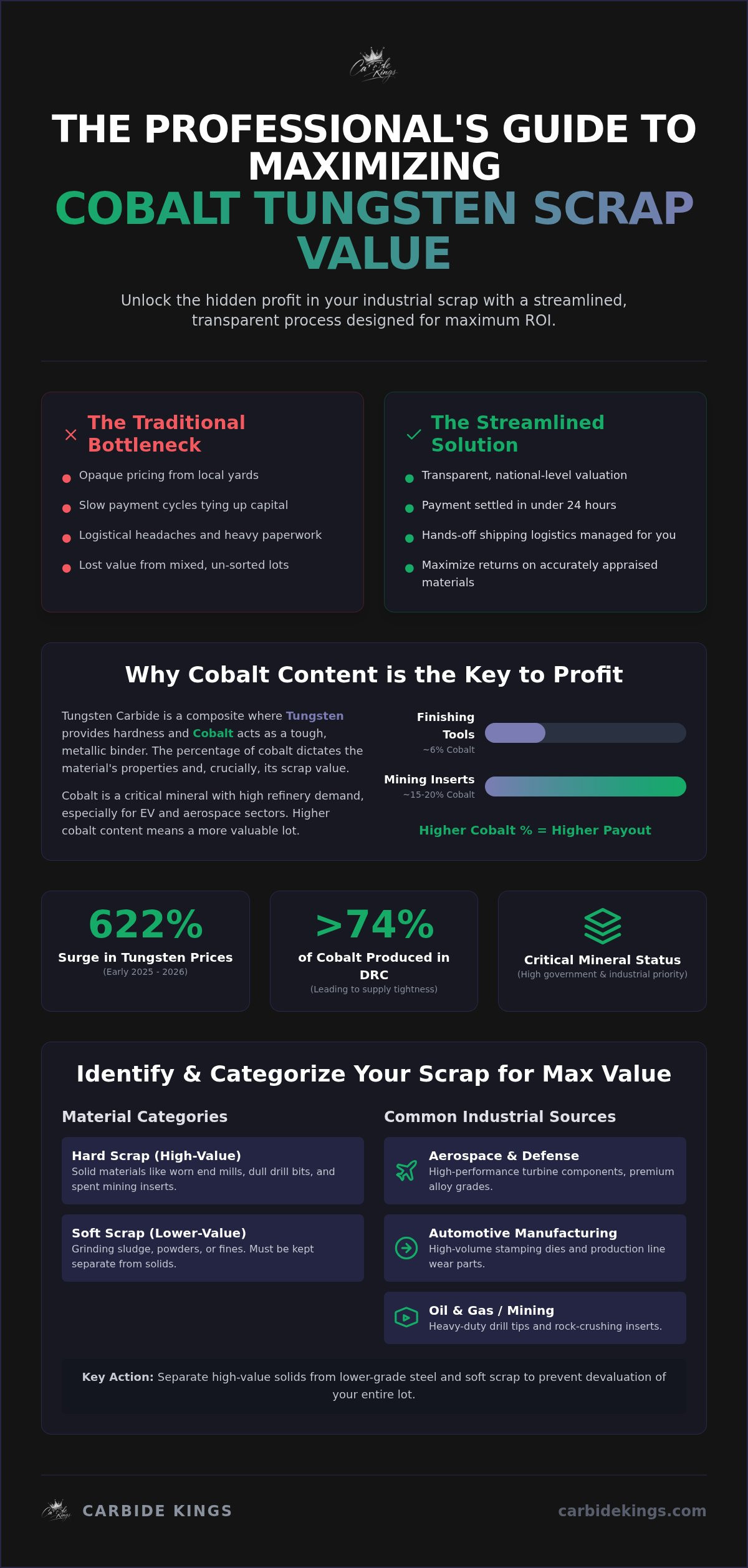
Varying the cobalt percentage, typically between 3% and 20%, allows engineers to tailor the material's properties for specific tasks. A 6% cobalt mix might be used for precision finishing tools, while a 15% mix is better suited for heavy impact mining tools. Understanding these ratios helps in accurately valuing your scrap lot before you ship it for processing.
Common Industrial Applications and Waste Streams
Different sectors generate distinct types of scrap, each with unique value profiles and physical forms. It's helpful to recognize where these materials originate in your facility:
- Aerospace and defense: This stream produces high-performance turbine components and airframe machining scrap that often contains premium alloy grades in high demand for 2026 aerospace production.
- Automotive manufacturing: High-volume production lines generate large quantities of stamping dies and wear parts that require consistent, high-speed recycling cycles.
- Oil and gas: This sector is a major source of heavy duty drill tips and rock-crushing inserts designed for maximum impact resistance.
Identifying these sources within your facility is the first step toward a more lucrative recycling program. It's vital to distinguish between hard scrap, like solid inserts, and soft scrap, such as grinding sludge or fines. Categorizing your waste streams effectively ensures that high-value materials aren't mixed with lower-grade steel, which helps you sell cobalt tungsten scrap at its highest potential value.
Why Cobalt Content Increases Your Scrap Value
Cobalt is the hidden profit driver in your carbide bin. While tungsten provides the bulk of the weight, the cobalt binder often determines the final industrial valuation. Government research, such as the Assessment of Critical Metals, classifies cobalt as a high-priority resource due to its limited global supply and essential role in modern technology. When you prepare to sell cobalt tungsten scrap, you're essentially trading a dual-commodity asset. The market value reflects the combined demand for both rare metals.
Machine shop managers often overlook the premium potential of high-binder materials. Tools designed for high-impact environments, like mining inserts or heavy-duty stamping dies, can contain up to 20% cobalt. These lots command higher rates than standard machine shop scrap because the recovery yield is significantly better. Understanding the dual-commodity nature of selling tungsten alloys allows you to negotiate from a position of authority. You're getting paid for the hardness of the tungsten and the toughness of the cobalt binder simultaneously.
Refinery Demand for Cobalt Recovery
Refineries utilize complex chemical leaching and the zinc process to reclaim cobalt from sintered carbide. This recovered metal is prized for its high purity, which is mandatory for the EV battery and aerospace sectors. Processed scrap often reaches the refinery floor with fewer impurities than raw ore, making it a preferred feedstock. This high demand translates directly into the offer you receive for your industrial lot. To ensure you're capturing this value, partnering with a specialist buyer can help you identify which parts of your inventory have the highest recovery potential.
Market Drivers for Cobalt in 2026
The 2026 market is defined by extreme supply tightness. Global constraints, including export quotas from the Democratic Republic of Congo and new U.S. domestic retention rules, have made recycled cobalt a strategic necessity. Industrial manufacturers are rapidly adopting circular economy models to secure their own supply chains. Recycling domestic scrap is faster and more reliable than navigating the volatility of international ore markets. When you sell cobalt tungsten scrap in 2026, you aren't just cleaning out a warehouse; you're supplying a critical link in the domestic manufacturing chain. By keeping these minerals in the U.S. through professional recycling, your operation supports a more resilient manufacturing base while maximizing its own financial returns.
Identifying and Categorizing Cobalt-Tungsten Materials
Properly sorting your inventory is the first step toward a high-yield return. When you prepare to sell cobalt tungsten scrap, understanding the physical differences between your waste streams prevents "downgrading" by the buyer. Traditional scrap yards often lump carbide with high-speed steel (HSS), which significantly reduces your payout. You can identify cobalt-rich carbide by its weight; it is nearly twice as dense as standard steel. Use the magnet test with precision. While HSS is strongly magnetic, carbide with a cobalt binder will exhibit a slight, noticeable pull that distinguishes it from non-magnetic heavy alloys.
According to USGS tungsten data, secondary recovery from scrap accounts for a significant portion of domestic supply, making your accurate sorting essential for industrial sustainability. Categorize your materials into hard and soft streams before requesting a quote to ensure the most transparent valuation.
Hard Scrap: Solids and Inserts
Hard scrap consists of solid pieces like indexable inserts, end mills, and router bits. These items are the backbone of most machine shop recycling programs. You'll encounter both coated and uncoated varieties. While coatings like Titanium Nitride (TiN) are thin and don't change the core value, they confirm the material is high-performance carbide. Be careful with brazed tools. These pieces have carbide tips joined to steel shanks. Because they require additional processing to separate the two metals, they are usually valued differently than solid carbide lots. Separate these early to keep your high-value solids pure.
Soft Scrap: Grinding Sludge and Swarf
Soft scrap includes the grinding sludge and swarf generated during tool sharpening or manufacturing. This material is often overlooked, but it is highly lucrative. Because the cobalt binder is softer than the tungsten grains, it often wears down more during the grinding process, leading to higher cobalt concentrations in the sludge. You should consult with specialized tungsten soft scrap buyers to handle this material correctly. Soft scrap requires specific containment to prevent leaks and environmental issues. Always ensure your sludge is dried as much as possible and sealed in leak-proof drums before shipping. Proper containment protects your profit by ensuring the weight you ship is the weight the refinery receives.
Maximizing ROI: Best Practices for Selling Your Industrial Lots
To maximize your return when you sell cobalt tungsten scrap, you must treat your scrap bin like an inventory asset rather than waste. The most common mistake industrial sellers make is mixing material grades. If you combine high-cobalt mining inserts with standard machine shop scrap, the buyer will often "down-grade" the entire lot to the lowest value. Sorting materials by grade ensures you capture the premium pricing your high-quality alloys deserve. It's the difference between a standard payout and a high-yield industrial return.
Contamination is another ROI killer. You should remove all non-carbide materials, including steel shanks from brazed tools, plastic storage cases, and ceramic inserts. While these items might seem insignificant, they skew weight readings and require extra labor at the refinery. A clean lot is a profitable lot. Understanding the carbide scrap recycling process helps you see why preparation matters. When the refinery receives a pure, sorted lot, they can process it faster and offer you a more competitive rate. Efficiency on the shop floor translates directly to your bottom line.
Logistics and Preparation for Bulk Shipments
Industrial scrap is incredibly dense. A small container can easily exceed weight limits for standard shipping pallets. Use heavy-duty steel drums or reinforced crates to prevent structural failure during transit. Clearly label every container with the material type and an estimated weight. This clarity speeds up the intake process at the receiving facility and prevents administrative delays. Working with a buyer who provides national freight support is a major advantage. It removes the burden of coordinating complex shipping schedules and lowers your freight costs per pound through negotiated carrier rates.
Administrative Efficiency and Payment Cycles
Don't let your capital sit in a buyer's account for weeks. Many local yards operate on slow 30-day payment cycles or bury you in administrative friction. Prioritize partners who offer fast ACH or wire transfer options, ideally settling within 24 hours of material verification. Professional buyers should provide transparent weight tickets and detailed analysis reports for every lot. This level of transparency ensures you're getting paid for exactly what you shipped. If you're ready to streamline your recycling workflow, request a quote for your industrial scrap lot today. Fast, reliable payment cycles keep your operations fluid and your focus on production.
Carbide Kings: Streamlined National Procurement for Cobalt Tungsten
Carbide Kings operates as the premier national buyer for industrial tungsten alloys. We understand that machine shop managers face enough pressure without fighting local scrap yards over opaque pricing or slow communication. Our business model intentionally eliminates the administrative friction typically associated with industrial recycling. We specialize in high-value cobalt-tungsten materials and bulk procurement; we don't handle residential metals. By focusing exclusively on tungsten hard scrap, soft scrap, and alloys, we provide a level of expertise that generalists simply cannot match. We act as a proactive partner, handling the heavy lifting so your team stays focused on production.
The Carbide Kings Advantage
You gain direct access to industrial-grade pricing when you choose to sell cobalt tungsten scrap through our streamlined network. We remove the middleman to ensure your facility captures the highest possible return on every industrial lot. Our team handles the logistical heavy lifting; we coordinate the national shipping and freight support so you don't have to worry about the headaches of moving heavy metal. Beyond simple weight tickets, we provide expert analysis of complex alloys. This ensures that high-binder materials are appraised at their true industrial worth rather than being lumped in with lower-grade scrap. Our professional, no-nonsense approach means you get clear answers and fast results without the traditional barriers of excessive paperwork.
Get Started with Your Quote
Our procurement process is built for busy professionals who value time, speed, and professional integrity. It's a straightforward four-step workflow designed to be as simple as a basic retail transaction: Contact, Quote, Ship, and Get Paid. We've refined this sequence to minimize administrative hurdles and eliminate the typical waiting periods found elsewhere in the industry. We understand that your warehouse space is valuable and your time is limited. Every step is designed to get the material off your floor and the capital into your account as quickly as possible.
Once your material is verified, we prioritize fast, reliable payment through ACH or wire transfer. We operate on 24-hour payment terms because we know that consistent cash flow is the lifeblood of any manufacturing operation. There's no reason to let thousands of dollars in scrap value sit idle on your shop floor. If you're ready to experience a modern, efficient approach to industrial recycling, contact Carbide Kings for an immediate lot evaluation. We make the work feel as good as done before the truck even leaves your dock.
Secure Your Industrial Returns for 2026
The 2026 market presents a unique opportunity for industrial facilities to turn their metal waste into significant capital. By understanding the dual-commodity value of cobalt binders and maintaining strict sorting protocols, you protect your bottom line from unnecessary downgrades. Transitioning to a professional procurement model eliminates the slow payment cycles and shipping headaches that often plague local recycling efforts. You've worked hard to optimize your production; your recycling process should be just as efficient.
When you're ready to sell cobalt tungsten scrap, you need a partner that understands the metallurgical complexity of your lot and provides the national logistics support to move it efficiently. Carbide Kings offers specialized tungsten alloy expertise and direct industrial buying to ensure you receive a transparent valuation without the middleman. We handle the heavy lifting so you can stay focused on your core manufacturing operations. Get a Professional Quote for Your Cobalt Tungsten Scrap at Carbide Kings and experience a faster, more reliable way to reclaim your facility's value. Take the first step toward a cleaner shop and a stronger cash position today.
Frequently Asked Questions
What is the difference between cobalt tungsten and standard tungsten carbide?
Standard tungsten carbide is a chemical compound, while cobalt tungsten refers to the sintered industrial material where cobalt serves as the essential binder. In your facility, these terms are often used interchangeably to describe the same hard metal tools. The cobalt provides the toughness needed to prevent the brittle tungsten grains from shattering under impact. Distinguishing the binder content is vital when you prepare to sell cobalt tungsten scrap for maximum industrial value.
How much cobalt is typically found in tungsten carbide scrap?
Cobalt binder levels typically range from 3% to 20% by weight depending on the tool's intended application. Precision cutting inserts usually sit at the lower end of that scale to maintain maximum hardness and edge retention. Conversely, heavy-duty mining tips and rock-crushing tools require higher cobalt percentages to absorb extreme shocks. Knowing the typical grade of your specific tool stream helps ensure you receive an accurate valuation for your industrial lot.
Does the cobalt content affect the carbide scrap price per pound?
Cobalt content significantly influences the final valuation because it acts as a high-value secondary commodity within the scrap. Refineries prioritize high-binder lots for the recovery of critical minerals needed in the aerospace and green energy sectors. When you sell cobalt tungsten scrap, materials with higher cobalt percentages often command premium rates compared to standard grades. Proper sorting by tool type ensures you capture this hidden value rather than accepting a generic flat rate.
Can I sell cobalt tungsten grinding sludge or just solid tools?
You can sell both solid tools and grinding byproducts through our national procurement process. We specialize in tungsten hard scrap, which includes inserts and end mills, as well as tungsten soft scrap like grinding sludge and swarf. Sludge often contains higher concentrations of cobalt binder due to the way tools wear during the sharpening process. Ensure your soft scrap is properly contained in leak-proof drums to maintain its weight and value during transit.
Why do refineries want cobalt extracted from tungsten carbide?
Refineries extract cobalt because it is a high-purity critical mineral essential for manufacturing EV batteries and high-performance aerospace components. Recycled cobalt is often more valuable than raw ore because it requires less energy to process and arrives with fewer geological impurities. By reclaiming this binder from your carbide waste, refineries secure a stable domestic supply chain. This high demand directly supports the competitive offers we provide for your industrial-grade scrap lots.
Is cobalt tungsten scrap considered hazardous for shipping?
Solid cobalt tungsten scrap is generally not classified as hazardous for standard industrial shipping. However, soft scrap like grinding sludge requires specific handling due to the presence of residual coolants or moisture. We recommend using reinforced steel drums and clear labeling to meet national logistics standards. Our team provides the necessary shipping support to ensure your bulk lots are moved safely and efficiently from your facility to our processing center without administrative friction.
How do I know if my scrap is carbide or just high-speed steel?
You can distinguish carbide from high-speed steel (HSS) by checking density, magnetism, and spark patterns. Carbide is roughly twice as heavy as HSS, making it feel significantly denser in your hand. While HSS is strongly magnetic, the cobalt binder in carbide creates only a slight, weak pull. If you use a grinder, carbide produces short, orange sparks, whereas HSS creates long, white or yellow sparks. These simple tests prevent lower-value steel from contaminating your carbide lots.
What is the minimum amount of cobalt tungsten scrap I can sell?
We focus on bulk procurement to maximize the efficiency of our national logistics and shipping support. While we evaluate lots of various sizes, larger industrial volumes allow us to offer the most competitive pricing per pound. Our process is designed for machine shops and manufacturing facilities that generate consistent waste streams of tungsten hard and soft scrap. Contact us with your estimated weight and material type to receive a professional quote tailored to your specific industrial inventory.


