
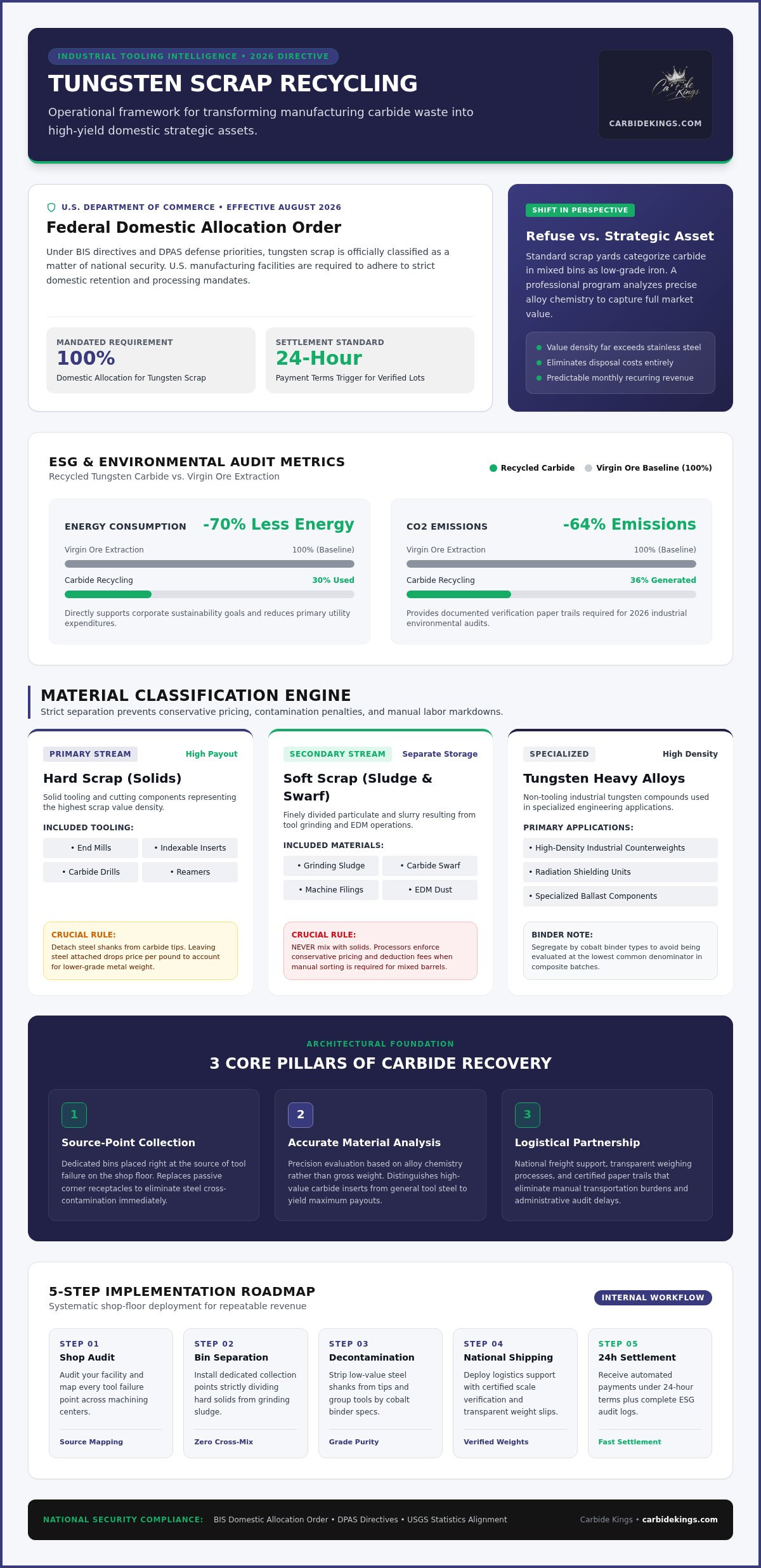
Every pound of carbide sitting on your shop floor is now a matter of national security. As of August 2026, the U.S. Department of Commerce requires a 100 percent domestic allocation for tungsten scrap, making your waste more valuable than ever. You already know that managing heavy metals is usually a logistical nightmare. Between shipping heavy loads and waiting weeks for opaque payments, it often feels easier to let the bin sit in the corner. However, implementing a professional tungsten scrap recycling program changes the equation immediately. It transforms your manufacturing waste into a predictable, high-yield revenue stream while keeping your facility organized.
This guide shows you how to master the 2026 landscape. You'll learn how to distinguish high-value carbide from tool steel, navigate the latest DPAS directives, and simplify your shipping logistics. We'll walk through the process of setting up a recurring revenue operation that satisfies sustainability audits and triggers 24-hour payment terms. It's time to stop treating your scrap like trash. Start managing it like the strategic asset it's become. We provide the roadmap to clear your floor and boost your bottom line without the administrative hurdles.
Key Takeaways
- Learn how to turn your shop's carbide waste into a high-yield revenue stream by implementing a professional tungsten scrap recycling program.
- Identify the critical differences between hard scrap like end mills and soft scrap like grinding sludge to maximize your total payout.
- Discover a five-step framework for auditing your facility and setting up dedicated collection points right at the source of tool failure.
- Streamline your logistics with national shipping support and transparent weighing processes that eliminate the typical headaches of metal disposal.
- Secure your supply chain documentation for 2026 sustainability audits while maintaining a clean, organized machine shop floor.
What is an Industrial Tungsten Scrap Recycling Program?
A professional tungsten scrap recycling program is a systematic workflow designed to identify, capture, and monetize carbide waste throughout your manufacturing process. It's not a passive bin in the corner. It's a proactive strategy for collecting spent tools, inserts, and grinding sludge. This program replaces the "trash it and forget it" mentality with a structured approach that ensures high-value materials never end up in a landfill or mixed with low-value steel. In 2026, with federal mandates like the BIS Domestic Allocation Order in effect, your scrap is no longer just waste; it's a strategic domestic asset. A successful program relies on three core pillars: dedicated source-point collection, accurate material analysis, and a reliable logistical partnership that handles the heavy lifting for you.
The Financial Logic of Carbide Recovery
The math behind carbide recovery is simple but powerful. The value density of tungsten carbide far exceeds that of common ferrous metals like stainless steel. While standard scrap yards might treat your mixed bins as low-grade iron, a dedicated tungsten scrap recycling program identifies the specific chemistry of your alloys to pay you accurately. This shift turns a traditional disposal cost into a recurring revenue stream that hits your bottom line every month. To maximize ROI, you must stay informed about the tungsten carbide scrap price drivers, including global supply quotas and domestic demand surges. When you treat your scrap as a product rather than refuse, you capture the full market value of your spent tooling.
Environmental and Compliance Benefits
Your recycling efforts do more than just generate cash. They significantly reduce your plant's environmental impact. Recycling tungsten carbide uses approximately 70 percent less energy and generates 64 percent fewer CO2 emissions compared to mining virgin ore. These figures are critical for manufacturing plants aiming to meet corporate ESG goals. A structured program also simplifies your administrative burden. It provides the necessary documentation for industrial waste management compliance and sustainability audits. You get a clean, organized shop floor and a documented paper trail that proves your facility operates at the highest level of environmental responsibility. It's a straightforward way to boost your reputation while clearing out your facility.
Categorizing Materials: Hard Scrap vs. Soft Scrap
Categorization is the engine that drives a high-yield tungsten scrap recycling program. Throwing everything into one bin is a profit killer. To maximize your return, you must distinguish between the two primary streams of material generated in a machine shop. Hard scrap consists of solid pieces like indexable inserts and end mills. Soft scrap includes the powders, swarf, and sludge generated during tool grinding. According to USGS tungsten commodity reports, secondary scrap recycling is vital for securing domestic supply chains, especially as import reliance remains high. Mixing these categories forces processors to perform manual labor to separate them, which inevitably lowers your overall payout. When a processor receives a mixed barrel, they have to account for the risk of hidden contaminants. This leads to conservative pricing. Keep your solids separate from your sludge to ensure you get the full market value for each material grade.
- Hard Scrap: Solid carbide inserts, end mills, reamers, and drills.
- Soft Scrap: Grinding sludge, swarf, filings, and EDM dust.
- Tungsten Alloys: High-density materials used in counterweights or radiation shielding.
Maximizing Value in Hard Scrap Solids
Solid carbide is the gold standard of recycling. However, many shops make the mistake of leaving steel shanks attached to carbide tips. This contamination significantly reduces the price per pound because the processor must account for the weight of the lower-value steel. You should also sort by tool type where possible. End mills and drills typically have different cobalt binders than indexable inserts or saw tips. Separating these ensures you aren't penalized for the lowest common denominator in the batch. For a deeper dive into preparation, see our 2026 industrial buying guide for solids.
Recovering Value from Grinding Sludge
Soft scrap is often overlooked, but it's a massive revenue opportunity. Grinding sludge and EDM dust contain significant amounts of tungsten that can be chemically recovered. The key is containment and purity. Wet sludge should be stored in sealed, leak-proof drums to prevent oxidation and environmental hazards. You must prevent contamination from tramp oils or other machine shop fluids, as high hydrocarbon levels can make the material unprocessable. Most tungsten soft scrap buyers require a specific purity level to offer top-tier pricing. Organizing your tungsten scrap recycling program to capture these fines is the fastest way to scale your revenue. If you aren't sure how to grade your current inventory, partnering with a specialist at Carbide Kings can help you categorize your lot for maximum return.
Evaluating a National Carbide Recycling Partner
Choosing a partner for your tungsten scrap recycling program isn't just about finding a buyer. It's about finding a specialist that understands the unique density and strategic value of industrial carbide. Many general scrap yards lack the specialized equipment needed to analyze tungsten alloys accurately. They often down-grade your material to general tool steel, which costs you money. Demand transparent material analysis using X-ray fluorescence (XRF) technology. This ensures you're paid for the actual tungsten content, not a rough estimate. A high-quality program removes the guesswork and replaces it with documented, verifiable data.
The "No-Nonsense" factor is equally critical. Don't settle for a partner that forces you through mountains of administrative hurdles. Professional buyers prioritize speed and clarity. They eliminate unnecessary paperwork to get you from initial contact to final payment as quickly as possible. This streamlined approach allows your team to stay focused on production while your waste stream handles itself. Reliability means knowing exactly when your material will be picked up and exactly when you'll see the revenue.
Logistics and Shipping Support
Shipping hundreds of pounds of dense metal requires specialized logistics. When evaluating a tungsten scrap buyer in the USA, ask about their freight coordination. Do they handle LTL (Less Than Truckload) pickups for bulk lots? Can they provide heavy-duty containers that won't fail during transit? A national partner should offer comprehensive shipping support across all 50 states. They should make the physical movement of material feel as simple as a basic retail transaction. We handle the heavy lifting so you don't have to worry about the logistics of moving heavy metals.
Financial Reliability and Speed
Manufacturing cash flow depends on speed. While industry averages for settlement can stretch into weeks, top-tier partners offer 24-hour payment terms. This rapid turnaround is only possible when you bypass the "middleman" trap. Local general scrap yards often act as aggregators; they buy your carbide and sell it to specialists. Selling direct to an industrial buyer ensures you capture the maximum margin. According to the U.S. Geological Survey tungsten statistics and recycling reports, secondary tungsten demand is a cornerstone of the domestic industrial economy. Partnering with a direct buyer secures your place in this supply chain while providing the immediate liquidity your shop needs to grow.
5 Steps to Implement Your Internal Carbide Recovery Program
Implementing a tungsten scrap recycling program requires a tactical shift in how your team handles production waste. It's not a secondary janitorial task; it's a core part of your shop's financial workflow. To turn your floor into a high-yield recovery zone, you must map the physical movement of tools from the crib to the scrap bin. If you're looking to optimize how these heavy items move through your facility, you can check out Quintec Conveyors for industrial material handling solutions. This structure eliminates the "bin overflow" problem and ensures that every ounce of valuable material is accounted for. Follow these five steps to build a self-sustaining system:
Effective Shop Floor Organization
Visual cues are your best defense against contamination. Label every bin clearly at eye level so operators don't have to guess where spent inserts go. Use color-coding to make sorting intuitive, even in a fast-paced environment. If a tool's material is in question, the "Spark Test" remains a reliable field method: high-speed steel produces long, bushy orange sparks, while tungsten carbide creates short, thin red or white sparks. This simple check prevents lower-value metals from diluting your batch and lowering your settlement. Clear organization is the fastest way to reduce contamination and maximize your payout.
Securing Your High-Value Assets
Tungsten is one of the most valuable secondary metals in your facility. Its extreme density makes it easy to transport in small, heavy quantities, which unfortunately makes it a primary target for theft. You should track your scrap weight against your new tool procurement to identify any discrepancies in your recovery rate. Integrating the carbide scrap recycling process into your standard operating procedures ensures that your recovery program survives personnel changes. By treating your scrap like currency, you protect your revenue and maintain a professional, audit-ready workspace. If you're ready to automate your recovery, get a custom logistics plan from our team today.
Scaling Your Revenue with Carbide Kings
Carbide Kings operates as a direct, results-oriented partner for manufacturers across the United States. We don't just buy your metal; we provide the infrastructure for a high-performing tungsten scrap recycling program that runs on autopilot. Our process eliminates the administrative friction that traditionally slows down industrial procurement. By focusing exclusively on tungsten hard scrap, soft scrap, and alloys, we've refined our valuation and logistics to a level of precision general scrap yards can't match. You get the expertise of a seasoned veteran combined with the speed of a modern industrial partner. We handle the heavy lifting so you can stay focused on your core operations.
National Reach, Personal Service
We support the entire spectrum of the American manufacturing sector. Whether you're running a small tool-and-die shop or managing a massive aerospace plant, our logistical support is tailored to your specific monthly volume. We provide customized logistics plans that account for the unique weight and density of your materials. Our national reach means we can coordinate freight from any state, ensuring your facility stays clear of waste regardless of your location. Because we focus exclusively on industrial-grade tungsten and carbide, we understand the specific chemistry and market drivers that impact your lot's value. This specialization allows us to offer more competitive terms than broad-spectrum recyclers who don't understand the nuances of refractory metals.
Start Your Program Today
The transition from waste to revenue is a linear, straightforward workflow. It starts with a simple evaluation of your current scrap lot and ends with a fast settlement. We've removed the hurdles of traditional scrap dealing to provide a no-nonsense experience that respects your time. Our 24-hour payment promise is a cornerstone of our service; once your material is processed and verified, we issue payment immediately. This speed supports your manufacturing cash flow and provides the financial relief of a cleared shop floor.
To begin, contact our team for a bulk lot evaluation. We'll guide you through the initial weighing and shipping process, providing the containers and freight coordination necessary to move your material safely and in compliance with 2026 shipping standards. Take the final step in your procurement strategy and turn your retired tooling into a liquid asset. Request your evaluation today and see how a professional partnership simplifies your industrial waste management. Our process is designed to be fast, fair, and final, leaving you with a clean floor and a stronger bottom line.
Secure Your Strategic Advantage
A professional tungsten scrap recycling program is no longer just about cleaning up the shop floor. It's a high-yield financial strategy that secures your facility's place in the 2026 domestic supply chain. By accurately categorizing your hard and soft scrap and securing these assets at the source, you transform a disposal cost into a predictable revenue stream. You've seen how internal organization and the right logistical partnership eliminate the traditional headaches of heavy metal recycling. Now it's time to act on those insights and capture the full value of your manufacturing waste.
We're here to handle the heavy lifting for you. As a direct industrial buyer, we eliminate middlemen to ensure you get the most competitive return on your carbide. Our national logistics support and 24-hour payment settlement provide the speed and reliability your business demands. Don't let your valuable material sit idle in a bin. Get a Fast Quote for Your Tungsten Scrap today and turn your retired tooling into immediate liquidity. We're ready to help you streamline your process and boost your bottom line with professional efficiency.
Frequently Asked Questions
How do I know if my scrap is tungsten carbide or tool steel?
You can identify tungsten carbide by its extreme density; it's nearly twice as heavy as common tool steel. In the field, use the spark test: carbide produces short, dark red or white sparks, while tool steel creates long, bushy orange sparks. If you're still unsure, our team uses XRF chemical analysis to verify the exact metallurgical composition of your lot. This ensures your tungsten scrap recycling program captures every dollar of value.
Is there a minimum weight requirement for your recycling program?
Our program is designed to handle industrial-scale volumes to ensure the logistics remain profitable for your facility. While we focus on bulk procurement, we recommend consolidating at least 50 pounds for small parcel shipping or several hundred pounds for LTL freight. This volume allows us to absorb shipping costs and maintain the high-speed settlement terms our clients expect. We work with you to determine the most efficient pickup schedule for your specific scrap generation rate.
How does the shipping process work for heavy tungsten solids?
We provide comprehensive national logistics support to move heavy tungsten solids safely across the country. For smaller lots, we provide heavy-duty shipping kits that withstand the extreme density of carbide. For bulk industrial loads, we coordinate Less-Than-Truckload (LTL) freight pickups directly from your loading dock. Our team handles all the paperwork and scheduling, removing the administrative burden from your procurement staff and ensuring a smooth, transparent transition from your floor to our facility.
Can you recycle tungsten carbide grinding sludge and swarf?
Yes, we actively buy and process tungsten soft scrap, including grinding sludge, swarf, and EDM dust. These materials require specialized handling because they often contain moisture or coolants. To maximize your return, store your sludge in sealed, leak-proof containers to prevent oxidation and environmental contamination. We analyze the net dry tungsten content of your soft scrap to provide a fair, transparent valuation based on current 2026 market benchmarks.
How quickly will I receive payment for my scrap carbide lot?
You will receive payment within 24 hours of material verification at our facility. We prioritize fast transactions because we understand that manufacturing cash flow is critical to your operations. Unlike general scrap yards that may take weeks to settle accounts, our direct-to-buyer model eliminates middlemen and administrative delays. Once your lot is weighed and analyzed, we finalize the settlement immediately, providing the liquidity you need to reinvest in new tooling or floor operations. For facilities operating heavy processing machinery, having dependable support such as mobile hydraulic repair Cleburne TX ensures that critical equipment remains operational without costly downtime.
Do you provide collection bins for our manufacturing facility?
We provide specialized, heavy-duty containers and logistics kits designed specifically for the extreme weight of tungsten and carbide scrap. These containers ensure your material remains secure during transit and meets all national shipping safety regulations. By providing the right containment solutions, we help you maintain an organized shop floor and prevent the contamination that often occurs in generic scrap bins. Our goal is to make your internal recovery process as clean and efficient as possible.
What factors influence the price per pound of carbide scrap in 2026?
Several key factors influence 2026 pricing, including global export quotas and the U.S. Department of Commerce's domestic allocation mandates. The purity of your lot and the absence of contaminants like steel shanks or brazing material also play a major role in your final payout. Because we are a direct industrial buyer, we track these market drivers daily to ensure our pricing remains competitive. Your tungsten scrap recycling program benefits from our transparent, data-driven approach to valuation.
Does your program cover all 50 states in the USA?
Yes, our industrial procurement program provides full coverage across all 50 states in the USA. We operate as a national buyer, utilizing a robust logistics network to reach manufacturing plants from the Pacific Northwest to the East Coast. Whether you are a single-site machine shop or a multi-state aerospace contractor, we provide the same high-speed 24-hour payment terms and professional freight coordination. We focus exclusively on the domestic market to ensure compliance with current federal supply chain regulations.


