

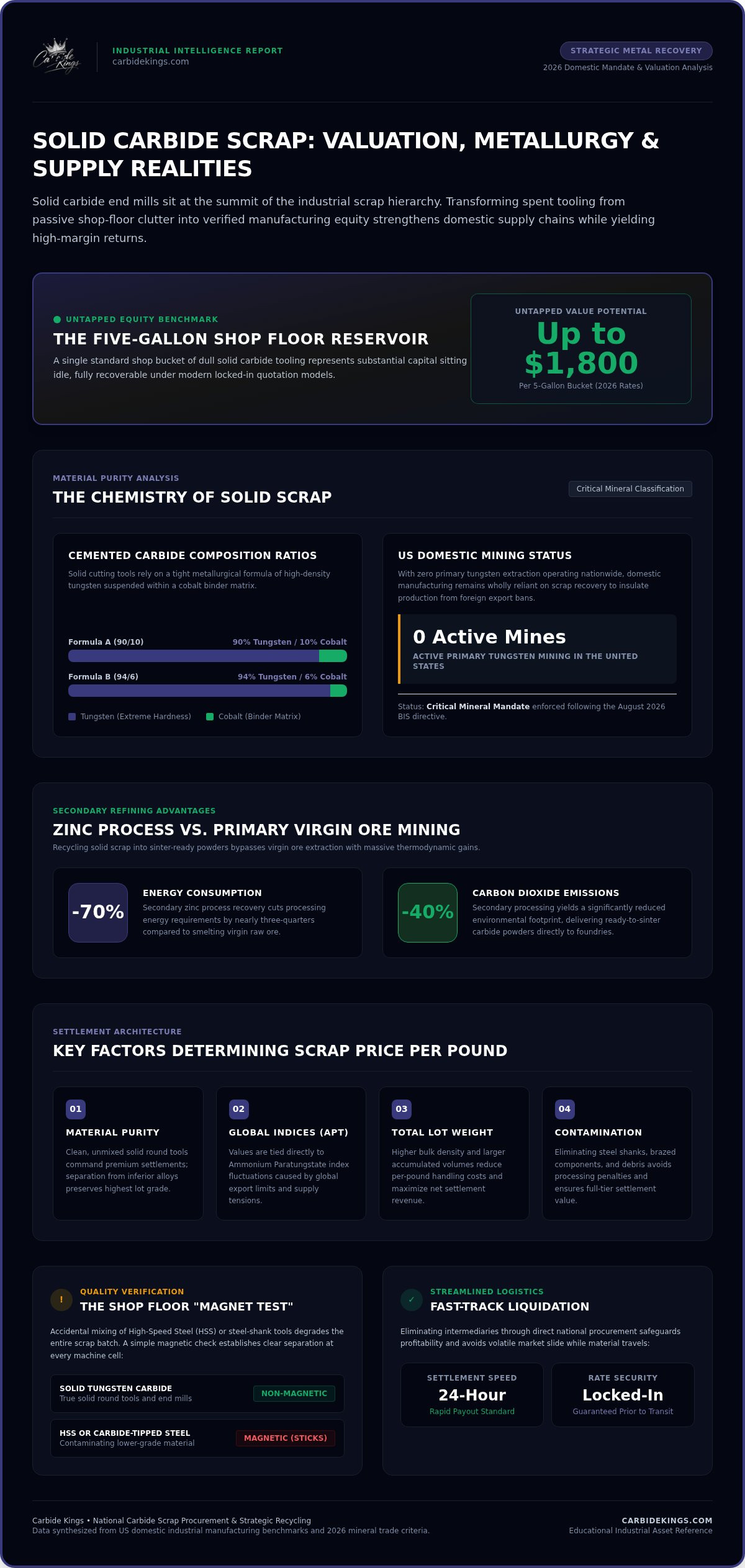
That dusty five-gallon bucket of dull tooling in the corner of your shop isn't just taking up space. It represents up to $1,800 in untapped equity at 2026 market rates. You've likely watched those bins overflow because the logistics of carbide end mill recycling feel like more trouble than they're worth. It's frustrating to see high-value tungsten sit idle while global supply chains tighten and market rates hit record highs.
We understand that your priority is production, not paperwork. This guide shows you how to turn that logistical bottleneck into a streamlined revenue stream. You'll learn how professional scrap management can clear your floor and pad your procurement budget with minimal administrative friction. We'll break down the impact of the August 2026 domestic mandates, how to secure the best price per pound, and how to leverage national logistics for 24-hour payouts. It's time to stop treating your spent tooling like trash and start managing it like the strategic asset it is.
Key Takeaways
- Recognize the strategic value of tungsten and cobalt density in your solid carbide scrap.
- Maximize your revenue by mastering the factors that influence carbide end mill recycling market rates.
- Determine the optimal point to recycle tools rather than recondition them to maintain machining precision.
- Eliminate material contamination with a dedicated collection system that secures your highest price per pound.
- Bypass slow-moving intermediaries by using streamlined national logistics for faster payouts and simplified shipping.
Understanding the Industrial Value of Scrap Carbide End Mills
Carbide end mill recycling is the specialized process of recovering tungsten and cobalt from spent solid tooling. It's a mistake to treat these tools like standard shop floor waste. Unlike aluminum or steel, which are high-volume but low-value commodities, carbide is a high-density industrial asset. Solid carbide end mills sit at the top of the industrial "Hard Scrap" hierarchy. They contain concentrated amounts of rare elements that are increasingly difficult to source. Because of their weight and purity, they offer a significantly higher return on investment than almost any other material in your scrap bin. This process ensures that high-value minerals stay within the production cycle rather than ending up in a landfill.
The Chemistry of Your Scrap: Tungsten and Cobalt
Most high-performance cemented carbide cutting tools follow a specific metallurgical formula. They typically feature a 90/10 or 94/6 ratio of tungsten to cobalt. The tungsten provides the extreme hardness required for high-speed CNC machining; the cobalt acts as the binder matrix that holds the structure together. These specific elements drive the high price per pound you receive during settlement. It's the concentration of these materials that makes your scrap so valuable.
Tungsten carbide is officially classified as a critical mineral for US manufacturing, meaning its domestic recovery is essential for national industrial security. When you recycle these tools, you're returning a strategic resource to the market. This is especially vital given that global supply chains face increasing disruption risks. By recovering tungsten domestically, you reduce the industry's reliance on foreign mining operations and strengthen the local manufacturing base.
Why Manufacturers Prefer Recycled Carbide
Secondary tungsten production is far more efficient than primary mining. Manufacturing new tools from recycled solids using the zinc process requires 70% less energy than refining virgin ore. It also results in roughly 40% lower carbon dioxide emissions. Foundries and toolmakers prioritize "sinter-ready" powders derived from recycled scrap because they offer consistent quality with a smaller environmental footprint. These powders are ready to be pressed and sintered into new inserts or round tools immediately.
For American machine shops, participating in carbide end mill recycling isn't just about the immediate payout. It's a method of stabilizing the domestic supply chain against volatile global markets and export restrictions. Following the August 2026 BIS mandate, keeping these materials within the U.S. has become a regulatory priority. You're turning a potential waste stream into a reliable source of raw material for the next generation of tooling while maintaining a cleaner, more profitable shop floor.
Key Factors Determining Your Carbide Scrap Price Per Pound
Maximizing your return on carbide end mill recycling requires total transparency. Not all scrap is created equal. Your settlement is determined by four primary variables: material purity, global market indices, total lot weight, and the presence of contaminants. Understanding these factors allows you to prepare your shipments for the highest possible payout. When you know exactly what the buyer is looking for, you can stop leaving money on the table.
Tungsten Market Volatility in 2026
The value of your scrap is directly tied to the global price of Ammonium Paratungstate (APT). Geopolitical shifts in early 2026, including strict export controls from major global suppliers, have caused domestic tungsten demand to spike. Because the U.S. currently has no active primary tungsten mines, recycled scrap has become the lifeblood of domestic tool production. You can track these trends through USGS tungsten statistics and information to see how supply risks influence the daily price per pound.
Market rates can fluctuate daily. This volatility makes "locked-in" quotes essential for protecting your shop's revenue. A quote that floats until the material arrives puts your profit at risk. Demand for high-quality solids remains high, but you must partner with a buyer who offers price protection from the moment you initiate the transaction. You can get a transparent, real-time quote to secure your rate before shipping.
Identifying High-Value Solids vs. Low-Grade Scraps
Clean, solid carbide end mills command a premium price because they are essentially pure tungsten carbide and cobalt. Many shops lose value by mixing these with low-grade materials like carbide-tipped steel tools or high-speed steel (HSS). These contaminants require extra processing, which lowers your final settlement. Separation is the simplest way to boost your ROI. Use the "Magnet Test" at every collection station. Solid carbide is non-magnetic; if the tool sticks to a magnet, it contains steel and should be binned separately.
Volume also plays a critical role in your valuation. While small batches are accepted, bulk lots typically qualify for higher pricing tiers due to reduced logistics costs per pound. Aim to consolidate your scrap into 50-pound increments, which is roughly half a standard five-gallon bucket. Clean, sorted, and high-volume shipments minimize administrative friction and ensure you receive the top-tier market rate for your material.
Recycling vs. Reconditioning: Which Yields Better ROI?
Every machine shop faces the same dilemma: do you regrind a worn tool or send it to the scrap bin? While reconditioning appears to save money upfront, it often carries hidden costs that erode your profit margins. You must identify the "scrap threshold." This is the point where a tool's value as a raw tungsten asset exceeds its utility as a cutting instrument. Once a tool has suffered significant flute loss or has undergone multiple regrind cycles, it's time to transition to carbide end mill recycling. This strategy ensures you maintain high machining standards while recouping maximum material equity.
The Diminishing Returns of Tool Re-sharpening
Reconditioning isn't free. Beyond the service fee, you're dealing with reduced tool diameters that complicate your CAM programming. Each regrind typically reduces the outer diameter by 0.20 mm or more. This forces your operators to adjust offsets and increases the risk of tolerance errors on high-precision parts. You also have to manage the logistics of shipping tools to a grinding house and waiting for their return. These delays create "dead inventory" in your tool crib. High-performance shops often find that fresh carbide provides more predictable tool life and superior surface finishes compared to reground alternatives.
Cash Flow Benefits of Immediate Scrap Liquidation
Choosing carbide end mill recycling over excessive reconditioning provides immediate working capital. Instead of letting hundreds of pounds of dull tools sit in drawers, you can convert them into cash within 24 hours of verification. This liquidity allows you to reinvest in 2026-grade high-efficiency tooling that improves your cycle times and reduces per-part costs. It also eliminates the administrative burden of tracking how many times a specific end mill has been sharpened.
A structured recycling program supports industrial efficiency by returning strategic minerals to the domestic supply chain. You can learn more about the broader impact via this EPA resource conservation and recycling benefits guide. By liquidating your scrap regularly, you maintain a leaner shop floor and a more agile procurement budget. Stop managing a cemetery of old tools. Start funding your next tooling upgrade with the equity already sitting in your bins.
Steps to Optimize Your Shop’s Carbide Recycling Program
Efficiency starts at the machine. Don't wait until the end of the shift to sort your scrap. Implement a dedicated "Carbide Only" collection system at every CNC station. Small, labeled bins at each workstation prevent the accidental mixing of materials before they even reach the central tool crib. This simple step eliminates hours of manual sorting later and ensures your carbide end mill recycling process remains profitable and friction-free.
Training your staff is the next critical move. Machinists must be able to distinguish between solid carbide and high-speed steel (HSS) by sight and weight. Solid carbide feels significantly heavier for its size. Instruct your team to remove all non-carbide attachments, such as steel screws, shanks, or tool holders, before tossing tools into the bin. Removing these foreign objects protects the purity of your lot and prevents unnecessary price downgrades during settlement.
Sorting and Contamination Control
Purity is everything. A single steel bolt or a few HSS drills can downgrade an entire lot of carbide, costing you significant revenue. If you're dealing with wet scrap, take the time to clean grinding sludge or excess coolant from your solids. For shops that generate significant swarf, check out this guide for Tungsten Soft Scrap Buyers to handle your sludge correctly. Clean, dry solids always fetch the highest market rate from industrial buyers.
Logistics and Safe Storage
Tungsten is incredibly dense. A standard five-gallon bucket of solid carbide can easily weigh 100 pounds. Use heavy-duty, reinforced containers that won't fail during transport or handling. Clearly label every bin to meet industrial scrap transport requirements and prevent confusion at the loading dock. It's also vital to maintain accurate weight documentation for every container before you schedule a pickup to ensure transparency during the payment process.
Accumulating bulk weights gives you more leverage. While we handle smaller shipments, consolidating your scrap into larger lots lowers your overall shipping costs and maximizes your return per pound. Once your bins are full, schedule your national freight pickup to start the 24-hour settlement process. Professional logistics turn your shop floor waste into a streamlined, high-yield revenue stream that supports your bottom line.
Carbide Kings: Streamlined National Carbide Procurement
Carbide Kings acts as your direct industrial partner. We bypass the slow-moving local scrap yards that lack the specialized equipment to value tungsten accurately. By working directly with a refinery-tier buyer, you ensure your shop receives the full market value of its hard scrap. We've refined our process to eliminate the friction that usually accompanies industrial metal sales. It's about professional efficiency. For those looking to optimize their wider facility operations with advanced material handling solutions, visit Jealco International, Inc. to explore their specialized industrial components. We understand that your time is better spent on production than on chasing down scrap payments. You need a partner who values your material as much as you value your machine uptime.
Cash flow drives your business. That's why we've established a 24-hour payment process once your material is verified at our facility. We provide competitive tungsten carbide scrap prices based on real-time market data. Our valuation is transparent; we weigh and grade every lot with precision. This no-nonsense approach builds long-term trust and turns your recycling program into a predictable revenue stream. Our quote-to-cash workflow is designed for speed. You won't find any hidden fees or complicated paperwork here. We prioritize clarity so you can see the direct impact on your procurement budget immediately.
National Shipping and Logistics Support
Shipping heavy scrap shouldn't be your headache. We handle the heavy lifting by providing comprehensive logistical support for manufacturers across the United States. Whether you have a single bucket or several pallets of bulk lots, we coordinate the transport. Our national reach means you get the same professional service regardless of your location. We provide digital shipping labels for smaller shipments and arrange commercial freight for high-volume transactions. We've perfected the movement of high-density materials to keep your floor clear and your operations running smoothly. Our team manages the details so you don't have to.
Reliable carbide end mill recycling requires a partner who understands the industrial scale of your operations. We don't just buy your scrap; we manage the entire logistical chain so you can stay focused on your CNC machines. It's a proactive partnership that removes the administrative burden from your team. We've built our reputation on being a seasoned veteran of the industrial sector. We're proud of the reliability we offer to the manufacturing community. Get a quote for your carbide end mills today and experience a faster, simpler way to monetize your shop's waste. The work is as good as done.
Maximize Your Shop’s Revenue with Strategic Scrap Management
Turning your spent tooling into a consistent revenue stream is no longer a logistical hurdle. By implementing a dedicated "Carbide Only" system and understanding the scrap threshold, you ensure that every ounce of tungsten stays working for your bottom line. Professional carbide end mill recycling allows you to bypass slow-moving local yards and tap directly into refinery-tier pricing. You've seen how easy it is to clear shop floor space while padding your procurement budget with high-yield returns.
It's time to stop letting valuable assets gather dust in the tool crib. We provide national industrial logistics support and 24-hour payment terms to make the process as fast as a standard retail transaction. You can focus on production while we handle the heavy lifting of material verification and transport. Turn your spent carbide end mills into cash with Carbide Kings today. Your shop is already sitting on the equity; we just help you unlock it.
Frequently Asked Questions
Is it worth recycling carbide end mills in small quantities?
Yes, every pound of tungsten represents significant value, but consolidating your scrap into 50-pound lots maximizes your return. While we accept smaller batches, bulk shipments reduce the logistical costs per pound. A standard five-gallon bucket usually holds between 80 and 100 pounds of solid tooling. By accumulating larger quantities, you gain more leverage and ensure shipping costs don't eat into your final settlement. It's about optimizing the efficiency of your carbide end mill recycling program.
How do I tell the difference between carbide and high-speed steel (HSS)?
You can identify solid carbide by its weight and magnetic properties. Carbide is roughly 2.5 times denser than steel, so it feels significantly heavier in your hand. Most high-speed steel (HSS) is magnetic, whereas solid carbide is not. Use a simple magnet at each CNC station to verify the material. If the tool sticks, it's steel or a brazed hybrid. Keeping these materials separate protects the purity of your high-value tungsten scrap and ensures a higher payout.
What is the current scrap carbide price per pound in 2026?
Scrap carbide prices in 2026 are driven by global supply constraints and the August 2026 BIS export mandates. Rates fluctuate daily based on the Ammonium Paratungstate (APT) index and the total volume of your shipment. Because tungsten is a critical mineral with no active primary mines in the U.S., recycled solids command top-tier market value. We provide real-time quotes based on current industrial demand to ensure you receive a fair, transparent settlement for your hard scrap without the guesswork.
Do you buy carbide end mills with coatings like TiAlN or AlTiN?
Yes, we buy carbide end mills regardless of their TiAlN, AlTiN, or other PVD/CVD coatings. These microscopic layers don't interfere with the metallurgical recovery of the tungsten carbide and cobalt core. You don't need to strip or treat the tools before shipping them. As long as the substrate is solid tungsten carbide, the coating won't negatively impact your price per pound or the verification process at our facility. We focus on the high-value core material.
How should I package my carbide scrap for national shipping?
Package your scrap in reinforced, heavy-duty containers like five-gallon plastic buckets or steel drums. Tungsten is extremely dense; a full bucket can weigh over 100 pounds, which can cause standard cardboard boxes to fail during transport. Secure the lids with heavy-duty tape and clearly label each container with the weight and material type. For national shipping, we provide digital labels or coordinate commercial freight pickups to ensure your high-density materials arrive safely for processing and prompt payment.
What happens if my carbide scrap is contaminated with steel?
Contamination with steel shanks, screws, or HSS tooling results in a price downgrade for the entire lot. Refineries require pure tungsten carbide to produce high-quality powders; separating steel requires additional labor and processing energy. To secure the highest payout, instruct your team to remove all steel attachments and maintain strict machine-side separation. A clean lot of solid carbide end mills always receives a premium rate compared to mixed or contaminated bins. Separation is the easiest way to protect your ROI.
How fast does Carbide Kings pay for scrap tool shipments?
We offer 24-hour payment terms once your material is received and verified at our facility. Our streamlined quote-to-cash workflow is designed to provide immediate liquidity for your machine shop. Once the weight and purity of your carbide scrap are confirmed, we initiate the settlement process. This rapid turnaround helps you turn dead inventory into working capital quickly, allowing you to reinvest in new high-performance tooling without administrative delays or long waiting periods. We value your time and cash flow.
Can I sell carbide grinding sludge along with my solid end mills?
Yes, you can sell carbide grinding swarf and sludge alongside your solid tooling. We specialize in both tungsten hard scrap and tungsten soft scrap, providing a complete solution for industrial waste management. However, you must package these materials separately to avoid contaminating your solid end mills. Sludge typically requires different processing methods at the refinery. By shipping both streams, you maximize the total recovery value from your manufacturing processes while simplifying your shop's logistics and floor space management.


