

Paying virgin-metal premiums won't protect your vacuum induction melting campaigns from chemistry failures; disciplined charge qualification will. If you operate a high-spec melt shop, you already know the anxiety behind secondary feedstocks. A fraction of a part-per-million of bismuth, lead, or braze residue can destroy an entire superalloy heat, while unverified lots risk violent bath reactions under vacuum. Sticking purely to primary additions drains your operating margins, but running contaminated scrap ruins crucibles. Mastering bulk tungsten hard scrap sourcing for vacuum induction melting solves this dilemma by delivering aerospace-grade purity without virgin price volatility.
You shouldn't have to choose between tight melt chemistry and sustainable acquisition costs. In this guide, you'll master the metallurgical specifications, tramp element thresholds, and sourcing strategies needed to procure high-purity tungsten hard scrap for vacuum induction melting. We'll walk through dissolution mechanics, critical contamination limits, and the practical controls required to lock down certified, production-ready secondary charge material.
Key Takeaways
- Streamline your melt chemistry by adopting bulk tungsten hard scrap sourcing for vacuum induction melting, pairing refractory density with reliable mass-diffusion dissolution.
- Protect high-spec superalloy ingots by enforcing strict ceiling thresholds on volatile tramp elements like lead and bismuth while locking out braze contaminants.
- Dramatically cut charge material costs and bypass virgin supply volatility without introducing dusting losses or violent furnace outgassing.
- Standardize a four-stage receiving workflow spanning lot audits, sampling, contaminant removal, and proper crucible staging.
- Stabilize furnace run schedules by partnering with nationwide suppliers like Carbide Kings for dependable inventories of clean, production-ready solids.
The Role of Bulk Tungsten Hard Scrap in Vacuum Induction Melting
Precision melting operations demand refractory feedstocks that hold up to extreme thermal environments. In advanced metallurgy, vacuum induction melting (VIM) serves as the primary route for formulating nickel-, cobalt-, and iron-based superalloys used across commercial aerospace turbines and power generation components. Bulk tungsten hard scrap is dense secondary refractory metal comprised of solid tooling, bar cut-offs, and clean carbide components that provide elemental tungsten additions during alloying. Transitioning to dedicated secondary feedstocks reduces raw material acquisition costs significantly compared to virgin pellets, but only when melt facilities control physical forms and charging behavior from the start.
Executing successful bulk tungsten hard scrap sourcing for vacuum induction melting requires matching scrap morphology to crucible dynamics. If charge materials fail to meet physical density standards, melt shops face reduced packing density, prolonged heat cycles, and erratic bath recoveries.
Understanding Hard Scrap Classifications for Foundries
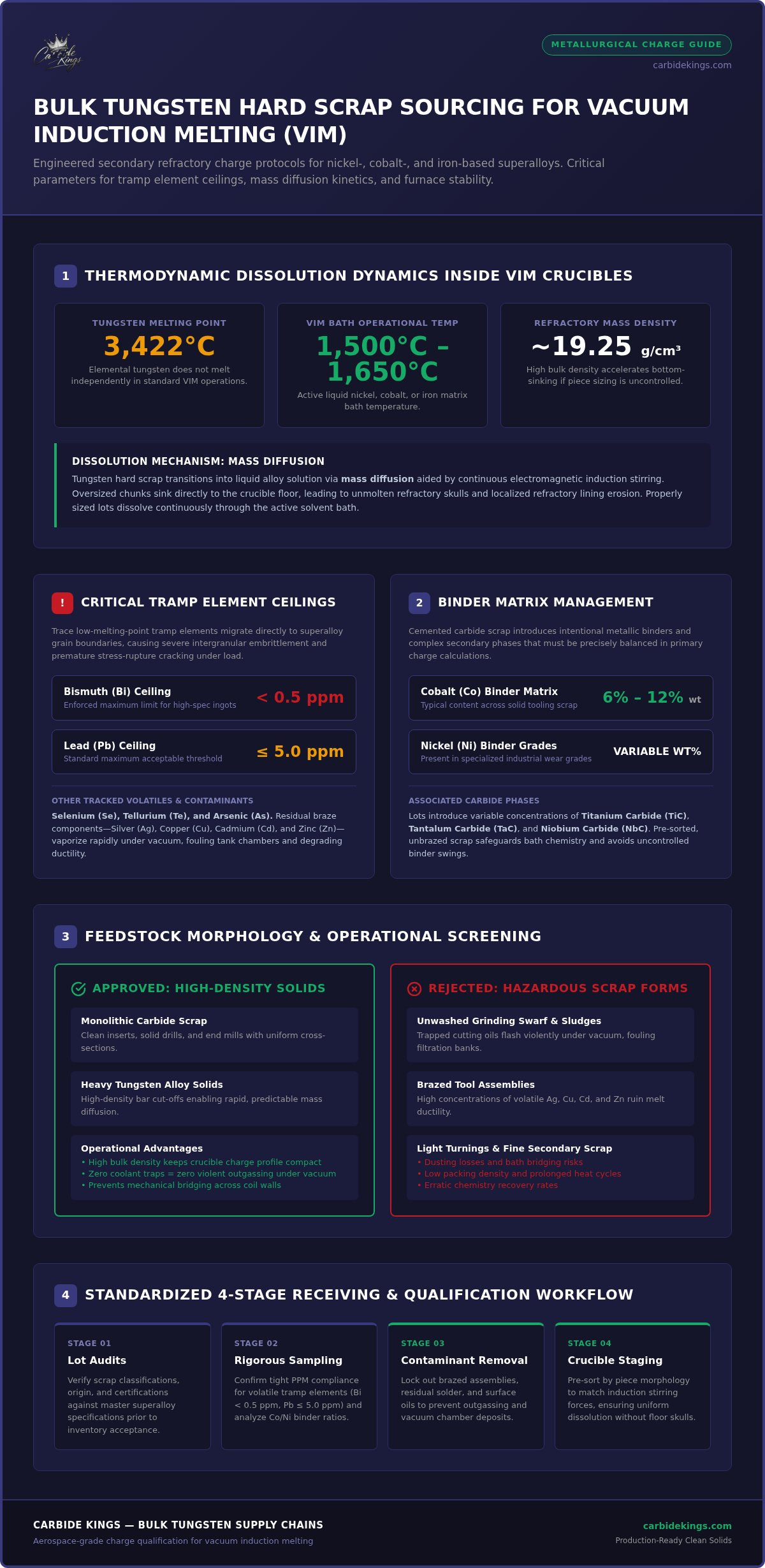
Foundries must draw a hard operational line between monolithic hard solids and fine secondary scrap. Solid carbide tooling, rod cut-offs, and monolithic wear components deliver high bulk density, keeping charge profiles compact inside the induction coil. In contrast, grinding swarf and oily sludges trap residual coolants that flash violently under vacuum, fouling filtration banks. Bulk solids eliminate these outgassing hazards while preventing mechanical bridging across the crucible walls.
- Monolithic Carbide Scrap: Clean inserts, solid drills, and end mills featuring uniform cross-sections.
- Heavy Tungsten Alloy Solids: High-density bar cut-offs offering rapid, predictable mass diffusion.
- Rejected Secondary Materials: Unwashed grinding sludges, brazed tool holders, and light turnings that induce bath bridging.
Thermal and Metallurgical Dynamics Inside the Vacuum Crucible
Charging refractory metals under vacuum involves unique thermodynamic realities. Elemental tungsten melts at 3,422°C; standard VIM bath temperatures hover closer to 1,500°C to 1,650°C. Tungsten does not liquefy on its own during a heat. Instead, it dissolves into liquid nickel, cobalt, or iron solvent baths via mass diffusion, aided by continuous electromagnetic stirring.
Piece sizing directly governs this dissolution rate. Oversized scrap chunks plunge directly to the crucible floor due to their high density (around 19.25 g/cm³), where they freeze into refractory skulls or trigger localized crucible erosion. Properly sized charge lots sink predictably through the active bath, dissolving completely while high-vacuum systems strip out dissolved gases. Mastering bulk tungsten hard scrap sourcing for vacuum induction melting protects your furnace refractories while locking down repeatable ingot compositions.
Critical Metallurgical Specifications: Chemistry, Tramp Elements, and Outgassing
Superalloy heats won't tolerate guessing games. When melting rotating components for aerospace turbines, even microscopic levels of low-melting-point tramp elements trigger severe intergranular embrittlement at elevated temperatures. Trace amounts of bismuth, lead, selenium, tellurium, and arsenic migrate directly to grain boundaries, causing premature stress-rupture cracking under load. High-performance melt programs enforce strict elemental ceilings; bismuth often carries a hard ceiling below 0.5 ppm, while lead limits rarely exceed 5.0 ppm. Securing dependable chemistries makes disciplined bulk tungsten hard scrap sourcing for vacuum induction melting non-negotiable for critical casting applications.
Managing Binder Phases and Trace Alloying Elements
Secondary cemented carbide scrap isn't pure elemental tungsten; it brings an intentional binder matrix along with it. Most solid tooling scrap carries between 6% and 12% cobalt by weight, while specialized wear grades introduce nickel binders. Charge calculations must balance these binder additions to prevent bath chemistry swings. Scrap lots also introduce variable concentrations of titanium, tantalum, and niobium carbides. Braze alloys represent an even greater operational hazard. Residual silver, copper, cadmium, or zinc from tool assemblies quickly vaporize, foul chamber walls, or ruin melt ductility. Sourcing pre-sorted, unbrazed lots of clean tungsten hard scrap protects your final ingot chemistry before charging begins.
Controlling Interstitial Contaminants and Volatile Compounds
Outgassing under deep vacuum poses severe operational risks. According to USGS tungsten statistics and recycling data, secondary scrap recovery remains central to domestic supply chains, but secondary charge materials require strict surface cleanliness. Surface oxides, cutting fluids, and organic lubricants flash violently inside sub-atmospheric chambers, blowing molten metal onto furnace coils and blinding optical pyrometers. Dissolved interstitial gases degrade final ingot properties: oxygen targets must stay below 10 ppm, while hydrogen limits must remain below 1 ppm. Oxygen and hydrogen contamination limits dictate vacuum charge qualification across every certified melt. Charge materials must undergo thermal baking or chemical degreasing prior to staging. Maintaining rigorous bulk tungsten hard scrap sourcing for vacuum induction melting ensures secondary additions perform cleanly without disrupting production cycles.
Feedstock Comparison: Tungsten Hard Scrap vs. Virgin Tungsten for VIM Heats
Melt shop margins often hinge on feedstock selection. Virgin tungsten additions provide certified purity, yet primary pellets and powders tie up working capital while exposing procurement teams to extreme lead times and geopolitical supply crunches. Virgin powders also create physical operating hurdles under vacuum; fine particles get pulled into furnace vacuum filtration lines, generating substantial dusting losses. In contrast, prepared secondary solids deliver substantial procurement savings while offering superior physical density inside the crucible. Implementing disciplined bulk tungsten hard scrap sourcing for vacuum induction melting allows foundries to capture these commercial advantages without compromising casting integrity.
Melt Economics and Yield Consistency
Charging secondary solids transforms melt campaign economics across multi-ton production runs. Sintered pellets command premium price structures that compound across high-volume schedules. Dense hard scrap solids optimize packing fractions within the crucible coil, maximizing the charge weight per cycle and cutting down overall tap-to-tap duration. Because dense tungsten pieces dissolve predictably during inductive heating, melt shops avoid extended holding periods that erode alumina or zirconia refractory linings. To understand how secondary refractory streams are classified and processed commercially, review The Complete Guide to Tungsten Hard Scrap Recycling in 2026.
| Operational Parameter | Prepared Bulk Hard Scrap | Virgin Pellets / Sintered Metal |
|---|---|---|
| Crucible Bulk Density | High; compact charge profile prevents bridging | High; uniform pellets but loose packing volume |
| Dusting & Vacuum Loss | Zero; solid mass remains in the solvent bath | Low to moderate; powder fines can enter pumps |
| Acquisition Lead Times | Short; dependable domestic inventory availability | Extended; subject to global trade quotas and shipping delays |
| Raw Material Cost Impact | Substantial savings per pound of contained metal | High raw material premium tied to primary refining |
Overcoming Perceived Operational Risks of Secondary Feedstock
Melters sometimes hesitate to use secondary feedstocks due to fear of erratic chemistry. Modern secondary sorting programs resolve this issue through lot segregation, verifying composition before scrap reaches your staging floor. Foundational research detailed in this NASA technical report on vacuum melting and casting proves that controlled vacuum degas phases strip out minor volatile residuals when charge solids are physically clean. For an in-depth breakdown of scrap grade properties and binder matrix balances, consult Tungsten Carbide: The Ultimate Industrial Reference and Recycling Guide. Dependable bulk tungsten hard scrap sourcing for vacuum induction melting bridges the gap between low raw material costs and uncompromising melt quality.
Best Practices for Sourcing, Inspecting, and Preparing Bulk Tungsten Scrap Lots
Receiving docks serve as the primary defense against bath contamination. Without standardized quality gates, melt shops inherit unvetted tooling scrap containing entrapped cutting fluids, brazing remnants, or inconsistent chemistries. Foundries must replace casual spot-checks with a disciplined, four-stage intake framework: audit, sampling, cleaning, and staging. Setting uncompromising receiving protocols ensures that bulk tungsten hard scrap sourcing for vacuum induction melting translates directly into high-yield, aerospace-compliant ingots.
- Audit: Review origin paperwork and segregation certifications before breaking pallet seals.
- Sampling: Conduct multi-point dimensional inspections and confirm baseline bulk density.
- Cleaning: Strip surface organics and oils through high-temperature wash cycles or mechanical blasting.
- Staging: Pre-bake verified pieces to drive out moisture, then store them in climate-controlled charge cells.
Receiving Protocols and Raw Material Verification
Intake screening begins the moment scrap arrives on site. First, inspect physical lot consistency. Tooling pieces should show uniform geometry, high bulk density, and zero trace of steel shanks or braze filler lines. Next, pull representative cross-lot samples for destructive chemical analysis to confirm trace elements conform to your technical melt ceilings. Always demand certified supplier documentation establishing metal segregation history. To align your technical intake metrics with national commercial grading standards, review Selling Tungsten Hard Scrap: The 2026 Industrial Buying Guide.
Pre-Melting Charge Preparation and Handling
Never charge raw secondary scrap directly into an active furnace. Surface coolants, synthetic lubricants, and environmental moisture flash violently under vacuum, creating violent bath turbulence. Run all hard solids through industrial ultrasonic wash tanks or mechanical shot-blasting units to strip residual hydrocarbons. Once cleaned, transfer pieces to holding ovens set between 150°C and 250°C to eliminate all surface moisture prior to vacuum airlock staging.
Store prepared lots in low-humidity holding areas to eliminate oxidation risks between melt campaigns. For a complete overview of domestic transport frameworks and scrap logistics, read How to Sell Tungsten Scrap in the USA: The 2026 Industrial Guide. When your melt schedules require dependable charge stock without processing headaches, source bulk tungsten hard scrap directly to keep your furnace cycles running efficiently.
Securing Reliable Bulk Tungsten Supply Chains with Carbide Kings
Downtime in a vacuum induction melting facility erodes profitability by the minute. When furnace operators wait on unverified secondary shipments, entire melt campaigns grind to an abrupt halt. Sourcing scrap from fragmented local dealers often leaves melt shops sorting through mixed, inconsistent boxes that risk bath contamination. Carbide Kings solves this supply chain bottleneck by supplying industrial operations with dependable, high-density tungsten hard scrap lots scaled specifically for commercial melt schedules. With consistent nationwide availability, foundries can lock down reliable raw materials without the administrative headaches or unpredictability typical of traditional scrap channels.
Stabilizing your furnace runs requires proactive logistical alignment. Integrating Carbide Kings into your strategy for bulk tungsten hard scrap sourcing for vacuum induction melting transforms an unpredictable scrap procurement routine into a structured, highly predictable raw material pipeline.
Industrial Scale and Consistent Lot Availability
Maintaining continuous furnace production requires reliable access to heavy refractory inventory. Carbide Kings maintains consistent inventories of heavy tungsten solids, carbide scrap, and specialty tungsten alloys ready for nationwide dispatch. Instead of hunting down sporadic regional lots, melting operations can secure production volumes of solid indexable tooling, end mills, and heavy alloy cut-offs. Shipment packaging can be configured to match your charge buckets and crucible throat dimensions, eliminating in-house sorting, cutting, or handling delays before staging.
- Nationwide Distribution Reach: Direct freight delivery straight to receiving docks across all fifty states.
- Segregated Bulk Lots: Clean, monolithic solids segregated to prevent tramp element cross-contamination.
- Campaign-Ready Volumes: Reliable inventory reserves that protect your shop floor against sudden raw material deficits.
Frictionless B2B Purchasing and Supply Partnerships
Administrative friction slows down production cycles just as quickly as shipping bottlenecks. Carbide Kings simplifies purchasing through direct, peer-to-peer communication with industrial specialists who recognize the strict purity requirements of superalloy melting. Rapid fulfillment workflows eliminate bureaucratic delays, moving orders swiftly from initial inquiry to final freight coordination. That means shorter transit intervals, fewer scheduling gaps, and immediate operational relief for your plant managers.
Procuring secondary charge material should never compromise melt reliability. Partner with experienced industrial suppliers who understand vacuum metallurgical standards. Connect directly with the team at Carbide Kings to secure clean bulk tungsten hard scrap, soft scrap, and alloy inventories tailored to your upcoming melt campaigns.
Upgrade Your Vacuum Melting Operations with Dependable Refractory Solids
Precision vacuum induction melting leaves no room for chemistry gambles or delivery delays. Achieving the balance between tight tramp element limits and sustainable margins comes down to disciplined feedstock qualification. When you integrate clean, monolithic scrap solids through a structured receiving protocol, you protect crucible refractories, eliminate violent outgassing risks, and drive down per-heat alloy costs.
Streamlining your approach to bulk tungsten hard scrap sourcing for vacuum induction melting is simple when you work with a dedicated domestic partner. Carbide Kings maintains a comprehensive inventory of tungsten hard scrap and heavy alloys, paired with nationwide shipping logistics tailored for large-volume industrial foundries. Our team eliminates administrative friction to ensure fast, straightforward transactions that keep your production line fully stocked. Take control of your melt campaigns and secure certified bulk tungsten hard scrap from Carbide Kings today.
Frequently Asked Questions
What makes tungsten hard scrap suitable for vacuum induction melting compared to soft scrap?
Monolithic tungsten hard scrap offers superior bulk density and minimal surface area compared to soft sludges or grinding swarf. Soft scrap traps moisture, drawing oils, and coolant emulsions that flash violently into gas under deep vacuum, choking filtration systems. Solid hard scrap like drill rods or indexable tooling remains chemically stable in the vacuum lock, eliminating dusting losses and crucible bridging while optimizing bulk tungsten hard scrap sourcing for vacuum induction melting campaigns.
Which tramp elements in tungsten scrap pose the highest risk to superalloy melts?
Bismuth, lead, selenium, tellurium, and arsenic represent the most destructive tramp elements in high-temperature superalloys. These low-melting-point elements segregate directly to alloy grain boundaries, drastically reducing stress-rupture ductility and inducing hot tearing. Bismuth is especially lethal, requiring limits under 0.5 ppm. Scrap containing silver, zinc, or copper braze filler metal will also vaporize unpredictably, degrading furnace interiors and failing strict aerospace alloy casting qualifications.
Can cemented carbide inserts with cobalt binders be charged directly into a VIM furnace?
Yes, cemented carbide inserts can be charged directly, provided their binder composition is factored into your melt charge calculations. Tungsten carbide tooling generally contains between 6% and 12% metallic cobalt binder by weight. Melters must balance this cobalt against target ingot chemistry. You must also account for carbon reactions, as dissolved carbon acts as an active deoxidizer under vacuum, generating carbon monoxide gas that helps scrub dissolved oxygen before refining finishes.
How should melt shops clean oily or contaminated tungsten hard scrap before vacuum charging?
Melt shops should clean hard scrap using a sequential process of solvent degreasing, ultrasonic washing, and high-temperature thermal baking. First, submerge solids in industrial aqueous or ultrasonic degreasing baths to dissolve stubborn cutting fluids and synthetic coolants. Next, rinse and dry the metal thoroughly. Finally, transfer the scrap into thermal ovens heated between 150°C and 250°C. This baking stage evaporates lingering interstitial moisture, preventing dangerous bath spatters inside vacuum chambers.
Why is tungsten scrap density critical during vacuum induction melting operations?
High scrap density is essential because tungsten melts at 3,422°C, meaning it doesn't melt on its own but must dissolve into liquid bath elements via mass diffusion. Tungsten's natural density of roughly 19.25 g/cm³ allows hard scrap pieces to sink through liquid nickel or cobalt baths smoothly. Proper piece density and sizing ensure electromagnetic induction fields distribute dissolved metal evenly, preventing dense scrap from resting at the crucible bottom to form un-dissolved refractory skulls.
Does Carbide Kings deliver bulk tungsten hard scrap to foundries nationwide?
Yes, Carbide Kings coordinates direct freight deliveries of bulk tungsten hard scrap, soft scrap, and tungsten alloys to facilities across the entire United States. Industrial melt operations receive consistent, pre-segregated bulk lots configured to fit their specific charging buckets and furnace throat dimensions. By eliminating intermediate handling delays and administrative hurdles, Carbide Kings streamlines bulk tungsten hard scrap sourcing for vacuum induction melting so commercial casting teams maintain reliable, uninterrupted furnace schedules.


