

General scrap yards routinely undervalue fine refractory wire, treating premium material like low-value mixed metal. If your facility generates spent spools, you already understand the operational headache. Tangled spools clutter valuable floor space, separating clean filament from support pins wastes shop labor, and standard local yards lack the testing capabilities to verify refractory purity. Specialized tungsten wire scrap recycling eliminates this guesswork, transforming challenging industrial waste into a reliable revenue stream.
You don't have to accept downgraded lot classifications or cumbersome freight hurdles. This 2026 industrial guide provides a direct roadmap to identify, collect, and monetize industrial tungsten wire scrap efficiently through specialized nationwide metallurgical recycling. We'll show you how to distinguish high-purity refractory grades from common alloys, establish clean in-plant sorting systems that preserve metal value, and partner directly with national buyers for streamlined shipping and rapid commercial settlement.
Key Takeaways
- Streamline in-plant sorting by isolating high-melting-point refractory wire from copper leads, support pins, and steel mandrels.
- Maximize commercial yields through specialized tungsten wire scrap recycling that categorizes lots by pure, doped, and alloyed compositions.
- Learn how global Ammonium Paratungstate (APT) pricing benchmarks and laboratory assay verification establish true lot value.
- Prevent downgraded classifications by packing fine spools and loose wire bundles using high-density freight preparation standards.
- Partner directly with specialized national buyers to access transparent lot verification, nationwide shipping programs, and rapid payment turnaround.
What Is Tungsten Wire Scrap and Where Does It Originate?
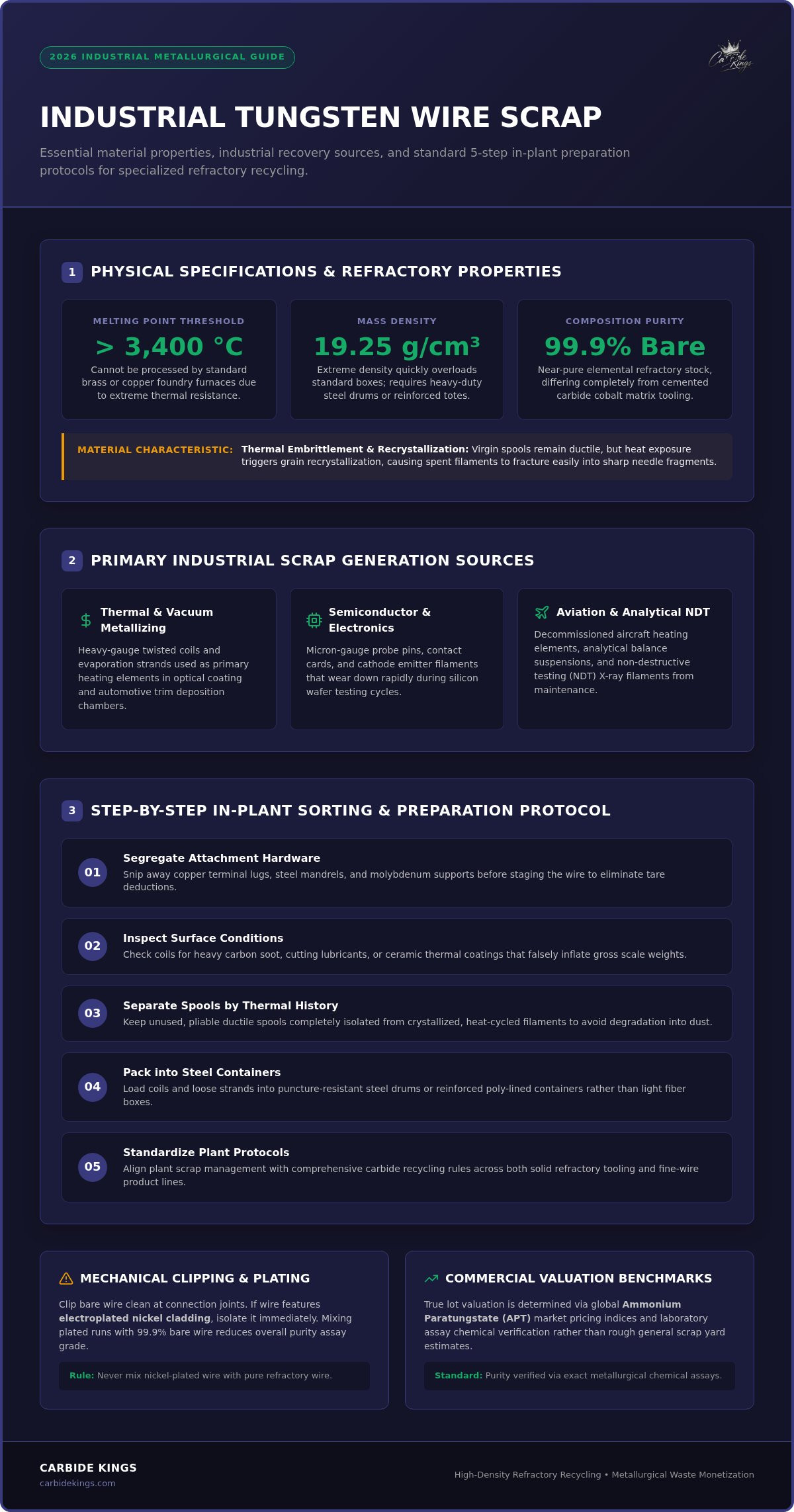
Tungsten wire scrap consists of high-purity refractory metal generated from decommissioned thermal systems, electronics manufacturing, and specialized vapor deposition operations. Unlike cemented carbide tooling, which blends carbide grains within a cobalt matrix, industrial wire represents near-pure elemental refractory stock. Standard scrap yards routinely misclassify fine wire spools as generic stainless or low-value nickel alloys because their handheld analyzers fail on fine filament geometries. Dedicated tungsten recycling processes are necessary to separate these clean refractory streams and preserve their metallurgical integrity for downstream re-refining.
Primary Industrial Sources of Tungsten Wire Scrap
Spent wire accumulates across several specialized manufacturing sectors:
- Vacuum metallizing and thermal furnaces: Heavy-gauge twisted coils and evaporation strands serve as primary heating elements in optical coating and automotive trim deposition chambers.
- Semiconductor and electronics production: Micron-gauge probe pins, contact cards, and cathode emitter filaments wear down rapidly during wafer testing cycles.
- Aviation and analytical equipment: Decommissioned aircraft heating elements, analytical balance suspensions, and non-destructive testing (NDT) X-ray filaments generate reliable scrap volumes during scheduled maintenance overhauls.
Material Characteristics and Physical Specifications
Refractory wire behaves differently from standard industrial metals, dictating specific shop-floor handling:
- Extreme thermal resistance: Tungsten boasts a melting point exceeding 3,400 degrees Celsius. It won't melt down in standard brass or copper foundry furnaces, making conventional yard processing impossible.
- High mass density: At 19.25 grams per cubic centimeter, small volumes quickly overload standard cardboard boxes or light containers. Facilities must store collected spools in reinforced steel drums or heavy-duty totes.
- Thermal embrittlement: Virgin spools remain pliable, but operational heat exposure triggers grain recrystallization. Used filaments fracture easily into sharp needle fragments, requiring careful containment to prevent material loss and puncture hazards.
Establishing proper sorting protocols for tungsten wire scrap recycling keeps this dense material isolated from shop trash, securing maximum value before lot shipping.
Step-by-Step Tungsten Wire Scrap Sorting and Preparation
Maximizing revenue from tungsten wire scrap recycling requires clean physical separation at the machine level. Contaminants quickly trigger lot deductions or reclassifications at the assay stage. Follow this five-step preparation workflow to keep your refractory metal pure and ready for commercial processing:
- Step 1: Segregate attachment hardware: Snip away copper terminal lugs, steel mandrels, and molybdenum supports before staging the wire.
- Step 2: Inspect surface conditions: Check coils for heavy carbon soot, cutting lubricants, or thick ceramic thermal coatings that skew gross scale weights.
- Step 3: Separate spools by thermal history: Keep unused, ductile spools apart from crystallized, heat-cycled filaments to prevent clean material from degrading into loose dust.
- Step 4: Pack into steel containers: Load coils and loose strands into puncture-resistant steel drums or reinforced poly-lined containers rather than light fiber boxes.
- Step 5: Align plant protocols: Review the overarching carbide scrap recycling process to standardize sorting rules across both solid refractory tooling and fine-wire product lines.
De-brazing and Removing Foreign Attachment Metals
Mechanical clipping is the fastest way to strip foreign attachments. Industrial heating assemblies often join tungsten filaments to copper leads, nickel-plated lugs, or ceramic isolation rings. When operators leave heavy non-tungsten brackets on the wire, the gross lot weight incurs heavy tare penalties. Clip bare wire clean at the connection joint. If the tungsten wire features electroplated nickel cladding, store it in an isolated bin; mixing plated runs with 99.9% bare wire pulls down the overall purity grade during chemical assay verification.
Safe Handling and Containment for Brittle Wire
Crystallized wire behaves like tempered glass. Operators should wear puncture-resistant gloves and load broken fragments into heavy-gauge, lined steel drums. Keep your collection bins far away from central machining bays. Stray iron shavings, aluminum fines, or coolants destroy scrap value instantly. Documented U.S. Geological Survey tungsten statistics highlight that domestic supply relies heavily on scrap recovery, meaning clean, unpolluted refractory streams command premium processing priority. Clearly label each container with estimated gauge, alloy type, and plant origin so material flows smoothly into testing. If you are accumulating volume and want to verify container requirements, Carbide Kings provides straightforward guidance on container staging and bulk freight coordination.
Tungsten Wire Scrap Grades: Clean, Doped, and Thoriated Alloys
Every alloy classification carries distinct melting characteristics, processing requirements, and commercial thresholds. Lumping different compositions together drags down the valuation of an entire shipment. Successful tungsten wire scrap recycling hinges on separating pure refractory strands from modified or doped grades before shipping lots out for chemical conversion.
| Grade Category | Purity / Alloy Composition | Common Industrial Uses | Recycling Valuation Impact |
|---|---|---|---|
| Ultra-Pure (Grade 1A) | 99.95%+ Elemental W | Vacuum metallizing coils, optical coating strands, semiconductor leads | Highest commercial tier; zero penalty deductions for elemental dilution |
| Non-Sag / Doped (Grade 1B) | 99.9% W + trace K, Si, Al (sub-100 ppm) | High-temperature furnace elements, vibration-resistant structural wires | Near-pure valuation; acceptable in bulk refractory melt batches |
| Thoriated Tungsten | 98% W + 1% to 2% Thorium Oxide (ThO2) | TIG welding coils, EDM wire, specialized discharge electrodes | Requires strict radiation disclosure; handled through licensed secondary channels |
| Plated / Clad Wire | Varies (Ni, Au, or Pt over W core) | Hermetic glass-to-metal seals, electronic leads | Requires secondary stripping or separate chemical reclamation routing |
Evaluating Ultra-Pure Versus Non-Sag Filaments
Downstream powder metallurgy re-refiners require precise chemistry. Virgin, pure tungsten wire (99.95%+) melts cleanly into chemical digestions without altering subsequent alloy batches. Non-sag wire contains micro-additions of potassium silicate to lock grain boundaries under intense heat. While these trace dopants don't harm broad refractory melting, mixing them into closed-loop semiconductor reclaim batches causes assay rejections. Surface state matters too. Polished or chemically etched bare wire processes immediately, while heavily oxidized or graphite-lubricated drawing wire may incur minor tare cleaning deductions.
Regulatory Awareness for Thoriated Tungsten Scraps
Thoriated wire contains low-level radioactive thorium oxide, demanding strict shop isolation. Look for distinctive red or yellow manufacturing color bands on factory-spooled lines and welding remnants. Federal guidance regarding the environmental and health effects of tungsten and related heavy mineral dust mandates controlled storage away from general plant waste. Never crush thoriated strands into loose airborne powder. Direct refractory buyers require advance declaration before receiving radioactive lots to ensure transport compliance and designated furnace segregation. For broader criteria on evaluating facility intake protocols, consult our guide on where to recycle tungsten carbide and refractory scrap safely.
Evaluating Commercial Valuation and Market Drivers in 2026
Commercial scrap values trace directly to global Ammonium Paratungstate (APT) price benchmarks. APT serves as the universal index for upstream tungsten raw materials. As primary production faces supply bottlenecks and tightening trade controls, secondary refractory reclaim fills critical industrial pipelines. Clean wire scrap holds an advantage over soft grinding swarf or chemical sludge. It doesn't require costly de-watering or complex chemical leaches, preserving the baseline value of the metal. Assay purity and dry net weight serve as your primary commercial multipliers. For broader market trends and index pricing mechanisms, consult our tungsten carbide scrap price guide.
The Role of Global Refractory Demand
Aerospace propulsion, defense hardware, and semiconductor manufacturing continue to accelerate demand for refractory metals. Re-refining secondary scrap requires a fraction of the energy consumed by processing virgin tungsten ore. Industrial operations rely on closed-loop scrap recovery to safeguard plant inventory against global supply volatility. Because tungsten wire scrap recycling feeds directly back into master alloy batches and pure powder synthesis, high-grade wire lots retain exceptional commercial liquidity across the industrial sector.
Assay Methods and Moisture Deductions
When a wire shipment arrives at a specialized processing facility, metallurgical technicians run benchtop X-ray fluorescence (XRF) analyzers to verify baseline chemical composition. Purity readings directly dictate your commercial payout. Foreign residues such as drawing lubricants, graphite coatings, cutting oils, and ceramic insulators trigger tare weight deductions. Cleaning and stripping these attachments before shipping protects your final return.
Freight consolidation plays an equally decisive role in net profitability. Tungsten wire is exceptionally heavy, meaning small footprints accumulate substantial mass fast. Shipping small parcel boxes repeatedly runs up freight bills that erode lot profits. Consolidate spools into bulk lots on reinforced skids to secure lower commercial shipping rates. When you are ready to monetize your staging drums, ship your industrial tungsten scrap to Carbide Kings for rapid lot verification and prompt commercial settlement.
Partnering with National Buyers for Industrial Logistics and Fast Payouts
Local scrap yards focus on high-volume base metals like structural steel, aluminum, and copper. When you haul dense spools of refractory wire to a municipal yard, operators routinely dump it into low-value mixed alloy bins because they lack the equipment to evaluate refractory purity. Selling directly to a specialized national buyer changes the equation entirely. Refractory scrap buyers understand industrial metallurgy, verify chemistry rapidly, and provide nationwide freight support that turns shop-floor waste into immediate working capital.
Nationwide Freight and Drum Consolidation Programs
Coordinating freight for dense refractory lots is straightforward when structured properly. Because tungsten wire scrap recycling involves exceptional mass in compact spaces, consolidation optimizes net payouts:
- Drum staging: Load coils, clipped strands, and spent spools into heavy-duty steel drums to build maximum density per shipping footprint.
- Pallet securing: Band drums directly to heat-treated hardwood pallets using high-tensile steel strapping to prevent load shifting during transit.
- Carrier coordination: National buyers provide straightforward bills of lading (BOL) and arrange scheduled less-than-truckload (LTL) pickups right at your loading dock.
Upon delivery at the receiving hub, certified industrial scales record gross, tare, and net weights with complete transparency.
The Carbide Kings Advantage for Industrial Sellers
Carbide Kings eliminates the administrative lag that plagues conventional metal salvaging. With national scrap procurement coverage across the United States, our operations focus exclusively on industrial refractory metals, carbide scrap, and specialty alloys. This direct focus ensures your wire lots receive accurate valuation without third-party broker markdowns or downgraded scrap classifications.
Our rapid intake and testing protocols keep your operating cash flow moving. Once your drums arrive at our receiving facility, our team verifies lot weight and chemical specifications quickly, issuing prompt payment settlements without administrative runaround. To see how seamless industrial refractory logistics can be, review our comprehensive walkthrough on how to sell tungsten scrap in the USA and turn your plant's refractory inventory into capital.
Transform Your Spent Refractory Wire into Working Capital
Managing dense refractory scrap doesn't have to strain your plant floor or tie up operational capital. Clean mechanical segregation at the machine level protects your baseline purity. Staging spools in puncture-resistant steel drums prevents avoidable tare deductions. Most importantly, bypassing general salvagers ensures your material receives accurate commercial valuation based on certified elemental content rather than downgraded mixed-metal classifications.
Efficient tungsten wire scrap recycling relies on partnering with specialists who understand refractory metallurgy. Carbide Kings delivers nationwide procurement coverage across the United States, backed by specialized expertise in high-temperature refractory metals and tungsten alloys. We eliminate traditional scrap yard friction with streamlined freight coordination, prompt assay turnaround, and rapid payment settlement terms designed around industrial cash flow needs. When you're ready to optimize plant recovery and maximize commercial returns, request an industrial scrap valuation from Carbide Kings today.
Frequently Asked Questions
How does tungsten wire scrap differ from standard tungsten carbide tooling scrap?
Tungsten wire consists of near-pure elemental refractory metal, whereas standard carbide tooling is a composite material blending tungsten carbide powder with a cobalt or nickel binder. Tooling scrap exhibits extreme hardness and resistance to abrasion. In contrast, wire delivers exceptional melting thresholds and thermal conductivity. Because the metallurgy differs completely, wire feeds into specialized chemical digestion and refractory remelt processes rather than standard carbide crushing lines.
Can I recycle fine-gauge tungsten wire that has been burnt or oxidized?
Yes, oxidized and heat-stressed wire remains valuable for secondary metallurgical reclamation. High temperatures form a brittle surface oxide layer, but the underlying refractory metal core retains its elemental integrity. While severe oxidation or graphite lubricant residue might trigger a minor tare deduction during weight verification, specialized processors easily strip these surface layers during chemical digestion. Staging oxidized spools in sealed steel drums prevents material crumbling before shipment.
What is the most effective way to store tungsten wire scrap prior to shipment?
Store loose coils, clipped leads, and spent spools inside dedicated, puncture-resistant steel drums or reinforced poly-lined containers. Because crystallized wire shatters into needle-sharp fragments, standard cardboard boxes tear easily during handling. Keep your containers in a dry staging area away from central machine shop bays to prevent contamination from coolants, grinding swarf, or iron chips. Pure segregation protects your commercial return when managing tungsten wire scrap recycling.
Are thoriated tungsten wire scraps accepted by specialty recyclers?
Specialty recyclers accept thoriated wire, but you must disclose its presence prior to pickup. Thoriated wire contains roughly 1% to 2% thorium oxide, an alpha-emitting radioactive element common in specialized welding and EDM operations. Because transport regulations and furnace intake thresholds mandate dedicated segregation, you can't mix thoriated lots with clean, non-sag wire. Always keep these red- or yellow-banded materials isolated in sealed, labeled industrial drums.
Why do local scrap yards often undervalue industrial tungsten wire?
Most general scrap yards focus primarily on high-volume base metals like aluminum, copper, and carbon steel. Their staff rarely possess benchtop assay tools calibrated for refractory materials, and handheld analyzers often struggle to identify fine wire geometries accurately. As a result, local operators classify unverified coils as cheap mixed stainless or nickel iron alloys. Specialized national buyers eliminate this markdown by using lab-grade testing to pay true elemental market value.
What minimum quantity is recommended for commercial freight recycling shipments?
While small quantities can travel through standard parcel carriers, accumulating at least a standard drum or a full pallet of refractory scrap yields the best net return. Tungsten's exceptional mass means even a compact footprint holds significant weight. Consolidating volume into less-than-truckload (LTL) shipments lowers your shipping cost per pound. This consolidation ensures that freight charges don't erode your commercial payout during tungsten wire scrap recycling programs.
How is the metallic purity of tungsten wire verified upon arrival?
Receiving facilities verify purity using calibrated laboratory X-ray fluorescence (XRF) analyzers and wet chemical assay techniques immediately after intake. Technicians draw representative wire samples from each drum, checking for baseline elemental concentration and identifying potential contaminants like copper, molybdenum, or nickel plating. Once certified industrial scales confirm gross, tare, and net weights, the assay percentage directly establishes your final commercial lot payout without unnecessary paperwork delays.


