

A vacuum furnace doesn’t mean every stage should run under vacuum. During furnace atmosphere control during vacuum induction melting of carbide scrap, the right choice depends on the feedstock, process stage, and required result. Treating vacuum or inert gas as a universal setting can overlook the risks you’re trying to manage.
It’s reasonable to be concerned about oxidation, carbon changes, and contamination, especially when scrap arrives in mixed forms or its cleanliness is uncertain. Atmosphere control is one part of the process. It can’t compensate for unknown feedstock or a recipe chosen without material-specific validation.
This article explains the purpose of atmosphere control at each stage and compares vacuum operation with inert-gas backfilling, without prescribing unsupported universal setpoints. You’ll learn which furnace and material variables to monitor, what to check when evaluating scrap, and when testing or specialist metallurgical review is needed before processing. Clear feedstock identification and separation help processors define requirements. Carbide Kings supplies industrial tungsten and carbide scrap for buyers evaluating suitable materials.
Key Takeaways
- Choose atmosphere settings to suit the feedstock and process stage, not a one-size-fits-all furnace recipe.
- Compare vacuum, inert-gas backfill, and pressure changes by their purpose, limitations, and equipment-specific monitoring needs.
- Before selecting a route, identify the scrap type and assess binders, coatings, moisture, residues, and whether the lot is mixed or consistent.
- Use approved procedures and furnace-manufacturer limits to guide each stage, from pre-run checks through post-run verification.
- Reliable furnace atmosphere control during vacuum induction melting of carbide scrap starts with a clear material specification and documented lot segregation.
Why Furnace Atmosphere Control During Vacuum Induction Melting of Carbide Scrap Matters
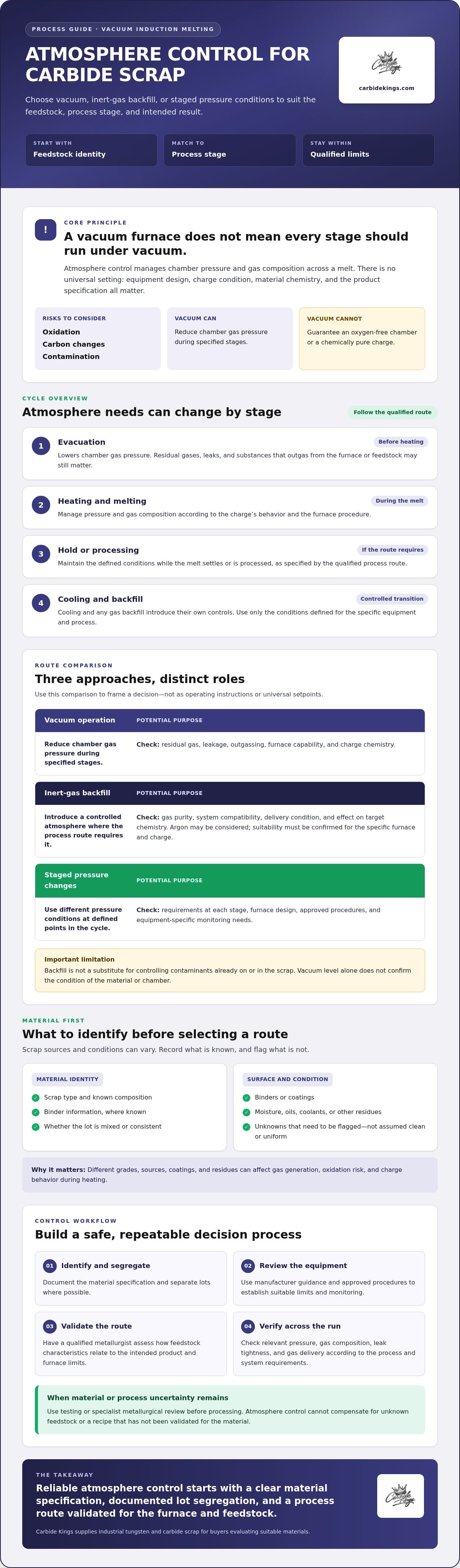
Atmosphere control means managing chamber pressure and gas composition throughout a melt, rather than selecting one condition and holding it for the entire run. In vacuum induction melting (VIM), those choices should match the charge, furnace, and intended product. Oxygen and moisture exposure can affect oxidation-sensitive constituents, but the degree and consequences depend on the material and process conditions.
Separate the goals by stage. Evacuation reduces chamber gas pressure before heating. During melting, operators manage pressure and gas composition according to the charge’s behavior and the furnace procedure. A hold may require maintaining defined conditions while the melt settles or is processed. Cooling and any backfill introduce their own controls. The acceptable limits at each step must come from the qualified process route, not a universal recipe.
What vacuum does, and does not, control in a VIM furnace
Evacuation removes much of the gas from the chamber, but it doesn’t guarantee an oxygen-free environment or a chemically pure charge. Residual gases may remain, leaks can admit outside air, and moisture or other substances can outgas from the furnace or feedstock as it heats. Backfill gas is another input to control. Vacuum level alone can’t confirm the condition of the material or the chamber.
Don’t apply one vacuum target to every furnace and carbide lot. Equipment design, leak tightness, material condition, and product specification all affect suitable operating limits. Use the furnace manufacturer’s guidance and approved procedures to define settings and monitoring for the specific system.
Why carbide scrap needs material-specific process thinking
Cemented carbide commonly combines tungsten carbide with a metallic binder. Different grades and scrap sources can vary in composition, while coatings, oils, coolants, and other residues may add uncertain inputs. Mixed inserts can also combine materials or surface conditions that shouldn’t be assumed equivalent. These differences can affect gas generation, oxidation risk, and charge behavior during heating.
Before setting atmosphere requirements, identify and segregate lots where possible. Record what’s known about scrap identity, binder, coatings, moisture, and contamination. Flag unknowns rather than treating them as clean or uniform. Then have a qualified metallurgist validate how those characteristics relate to the intended product and furnace limits. The right furnace atmosphere control during vacuum induction melting of carbide scrap starts with knowing what is entering the chamber.
How Vacuum, Inert Gas, and Pressure Changes Shape the Melting Cycle
Vacuum, inert-gas backfill, and staged pressure changes serve different purposes. Evacuation lowers chamber pressure, a controlled backfill introduces gas for a defined process need, and a staged approach combines conditions across the cycle. None is automatically right for every carbide charge. For furnace atmosphere control during vacuum induction melting of carbide scrap, select an approach based on feedstock chemistry, the target product, and the furnace’s design and approved operating limits.
Vacuum and inert-gas backfill: different roles in one cycle
A process may evacuate the chamber before heating, then use a controlled inert-gas backfill at a later stage if the qualified route calls for it. Argon is commonly considered, but its suitability, purity, and delivery requirements must be confirmed for the specific furnace and charge. Check the system for leaks and verify the gas supply and delivery components. Backfill is not a substitute for controlling contaminants already on or in the scrap.
Use this comparison to frame the decision, not as a set of operating instructions:
| Approach | Potential purpose | Key checks and limitations |
|---|---|---|
| Vacuum operation | Reduce chamber gas pressure during specified stages. | Consider residual gas, leakage, outgassing, furnace capability, and charge chemistry. |
| Inert-gas backfill | Introduce a controlled atmosphere where the process route requires it. | Confirm gas purity, system compatibility, delivery condition, and the effect on the target chemistry. |
| Staged pressure changes | Use different pressure conditions at defined points in the cycle. | Requires validated stage transitions, suitable controls, and monitoring for the specific equipment and material. |
Furnace design and charge chemistry determine whether a staged approach is appropriate. A pressure change that suits one system or material may not transfer safely or reliably to another.
When atmosphere comparisons need testing, not assumptions
Compare candidate routes against the same criteria: oxidation risk for the actual feedstock, the intended product chemistry, and what the furnace can control and measure. If a lot contains mixed or uncertain scrap, don’t assume results from a well-characterized charge will apply. Document the material and process conditions used for any evaluation.
Before changing production conditions, require a controlled trial or review by a qualified metallurgist, with procedures approved for the furnace. Reactive or reducing gases, including hydrogen, are not default alternatives to vacuum or argon. Their use requires engineered safeguards and validated procedures, and shouldn’t be inferred from general guidance. Clear identification of carbide scrap can help a processor define material requirements before selecting a route. Industrial buyers sourcing carbide scrap can review Carbide Kings’ carbide scrap supply.
Which Feedstock and Furnace Variables Should Guide Atmosphere Selection?
Start with the material record, then confirm the furnace can support the proposed process. Atmosphere decisions depend on what the scrap contains and how consistently it is prepared. Record the scrap identity, known binder composition, coatings, moisture, and residues such as oil or coolant. If details are uncertain, mark them as unknown rather than treating the lot as uniform. This information helps a qualified processor set process requirements and decide whether further evaluation is needed.
Feedstock condition: composition, coatings, and contamination
Look for differences in form and condition before combining material. Solid hard scrap, fine particles, sludge, and swarf can behave differently during handling and processing. Unknown coatings or shop residues may introduce variables that aren’t apparent from appearance alone. Keep distinct materials segregated, and document the basis for each lot classification.
If composition is uncertain, arrange representative sampling and qualified analysis through an appropriate provider. Carbide Kings supplies industrial carbide scrap and tungsten hard and soft scrap, but does not provide on-site analysis. For broader process context, see the industrial carbide scrap recycling process guide. If a lot includes sludge or swarf, consult tungsten soft scrap recovery guidance rather than assuming it can follow the same route as solid scrap.
Furnace capability and process monitoring
Confirm that the proposed cycle fits the actual equipment. Review pressure measurement, chamber seals and leak-check procedures, pumping capability, gas controls, and temperature measurement. Sensor placement and condition matter: a reading only represents what the instrument can reliably measure at its location. Calibration status and equipment maintenance also affect how operators interpret data.
Use the furnace documentation and process qualification to define which readings to record and what acceptance limits apply. Don’t transfer limits from a different furnace or feedstock without review. Before setting atmosphere requirements, match these inputs:
- Material: identity, composition information, physical form, coatings, and known residues.
- Lot consistency: whether the scrap is homogeneous, mixed, or insufficiently characterized.
- Equipment: available pressure and gas controls, measurement capability, and documented operating limits.
- Validation: sampling or specialist review needed to support the proposed route.
This disciplined assessment gives furnace atmosphere control during vacuum induction melting of carbide scrap a sound basis: traceable feedstock information matched to verified furnace capability, not assumptions about a material or system.
How to Build a Safe, Repeatable Atmosphere-Control Workflow
Repeatability starts before the chamber is sealed. Use an approved procedure for the specific furnace and charge, and follow the manufacturer’s operating limits. The checklist below is a planning framework, not a substitute for qualified operating instructions or process approval.
Pre-run checks and stage-by-stage workflow
Before a run, confirm the material identity, condition, lot separation, and documented process objective. Check maintenance status, chamber integrity, gas supply, and calibrated instrumentation. Trained personnel should approve both the charge and the process plan before operation.
- Pre-run: Verify the charge against its identification and process records. Resolve mismatches or unknowns before loading.
- Evacuation: Follow the approved evacuation sequence and compare pressure behavior with qualified limits. Investigate unexpected readings or suspected leakage.
- Melting: Record pressure, temperature, gas conditions, alarms, and relevant stage transitions as required by site procedures.
- Hold: Maintain only the conditions specified by the qualified process. Review deviations before moving to the next stage.
- Backfill: Use the approved gas and sequence, if the process requires backfill. Confirm the delivery system is operating as specified.
- Post-run: Record the cycle outcome and complete required sample checks or product acceptance reviews.
Monitor, document, and verify
Use consistent records so operators can compare the actual cycle with qualified process limits. Document instrument readings and alarms at the points defined in the procedure. Pressure and temperature values are useful only when the equipment is maintained, sensors are calibrated, and readings are interpreted in context.
Stop and seek review if pressure behaves unexpectedly, leakage is suspected, an alarm occurs, or the material doesn’t match the approved charge. Don’t improvise a correction or continue by assumption. Follow the site’s stop-work and escalation procedure, then resume only after authorized personnel determine the next step. Where the process specification calls for it, retain sample results and confirm product acceptance criteria against that specification.
Validated feedstock and equipment limits govern atmosphere settings, not a universal recipe.
This disciplined sequence makes furnace atmosphere control during vacuum induction melting of carbide scrap easier to review and repeat without confusing a successful cycle with a transferable setpoint. For industrial buyers preparing a clearly identified charge, review industrial carbide scrap supply from Carbide Kings.
Connect Process Requirements to the Right Carbide Scrap Supply
Once a qualified process route is established, turn its material requirements into a clear sourcing specification. This helps align procurement decisions with the charge the processor has evaluated. State which material category is needed, and distinguish requirements for carbide scrap from those for tungsten hard scrap, tungsten soft scrap, or tungsten alloys.
Share material requirements before sourcing carbide scrap
Give suppliers practical details they can use to identify a suitable lot, and explain what information you need before accepting it. Include the known material category, physical form, lot size, condition, segregation needs, and documentation requirements. If composition, coatings, or residues are uncertain, say so. Don’t treat an unknown characteristic as confirmed simply to complete a specification.
Ask what product information the supplier can provide, but don’t assume material analysis or processing guidance is included. Keep hard scrap, soft scrap, and alloys distinct when their downstream requirements differ. Clear lot identity and separation make it easier for the receiving processor to evaluate material against the qualified route. For category context, review this tungsten hard scrap recycling guide.
Next steps for industrial scrap procurement
Before contacting a supplier, confirm the intended material category and what your process team needs to know about a lot. For hard scrap, the 2026 tungsten hard scrap buying guide offers additional procurement context. Use that preparation to ask focused questions about category, form, condition, and available material information.
Carbide Kings supplies industrial tungsten hard scrap, tungsten soft scrap, carbide scrap, and tungsten alloys. It is a material supplier, not a furnace processor or technical consultant. Keep atmosphere selection and process qualification with the qualified processing team, then source against the resulting material specification. This separation keeps responsibilities clear and helps prevent sourcing assumptions from becoming process assumptions.
If you’re identifying a category for industrial procurement, you can discuss available industrial scrap categories with Carbide Kings. Share the material type you’re seeking and the lot information your team needs to evaluate.
Put a Clear Material Plan in Place
Reliable melting starts with decisions grounded in the actual charge and furnace. The key lesson of furnace atmosphere control during vacuum induction melting of carbide scrap is to match atmosphere conditions to each process stage, the identified feedstock, and qualified equipment limits. Avoid universal settings. Use documented procedures, and have a qualified metallurgical specialist validate changes when material or process conditions are uncertain.
Carry that clarity into procurement. Define the material category, form, condition, and information your team needs before requesting or accepting a lot. Carbide Kings specializes in industrial tungsten and carbide scrap, including tungsten hard scrap, tungsten soft scrap, carbide scrap, and tungsten alloys. It supplies material, not furnace processing or technical consulting.
Ready to discuss your sourcing needs? Discuss your industrial tungsten and carbide scrap sourcing needs with Carbide Kings. A clear specification is a practical next step toward an informed evaluation.
Frequently Asked Questions
What atmosphere is used in vacuum induction melting?
Vacuum is commonly used during defined stages of vacuum induction melting, but the chamber may not remain under vacuum for the entire cycle. Depending on the furnace, charge, and process objective, an approved route may include controlled inert-gas backfill, often using argon. There isn’t one atmosphere setting for every carbide charge. The qualified process and furnace documentation should specify the required conditions and how operators verify them.
Why is argon used in induction melting?
Argon is considered because it’s an inert gas that can provide a controlled atmosphere when a process calls for backfill. In some VIM operations, backfilling can help manage vigorous boiling of certain elements, but that doesn’t make argon suitable for every carbide charge or furnace. Confirm gas purity, delivery-system condition, and compatibility with the process. Use only the gas and procedure approved for the specific equipment and material.
Can carbide scrap be melted under vacuum?
Carbide scrap may be processed in a vacuum induction melting route only when the specific material, furnace, and intended product have been evaluated for compatibility. “Under vacuum” doesn’t establish that the charge itself will melt or behave as required. Scrap may contain tungsten carbide, binder metals, coatings, or residues, each relevant to process selection. A qualified metallurgist and the furnace documentation should guide route approval and limits.
How does oxygen affect tungsten carbide scrap during melting?
Oxygen exposure can oxidize susceptible constituents, but the effect depends on scrap composition, surface condition, and process conditions. Moisture and residues can also contribute unwanted gases or impurities during heating. Don’t assume every lot responds the same way, or that reducing chamber pressure guarantees an oxygen-free charge. Identify and segregate material, then have qualified personnel assess oxidation risks against the target chemistry and the furnace’s validated operating procedure.
What should be checked before melting mixed carbide scrap?
Before processing mixed carbide scrap, document what is known about material identity, binder composition, physical form, coatings, moisture, and shop residues. Separate distinct or uncertain lots where practical, and don’t classify unknown material as uniform. Representative sampling and qualified analysis may be appropriate when composition is unclear. The processor should compare those findings with the intended product requirements and furnace capability before approving a process route or charge.
Does vacuum induction melting remove contamination from carbide scrap?
No. Vacuum induction melting shouldn’t be treated as a general cleaning step. Some volatile substances may outgas under process conditions, but vacuum doesn’t guarantee removal of coatings, oils, coolants, or other contaminants, and those materials may affect the melt or furnace. Identify and manage surface residues before processing according to approved procedures. If contamination or its effect is uncertain, pause for evaluation rather than assuming the furnace will eliminate it.
How do you monitor atmosphere conditions in a vacuum induction furnace?
Monitor conditions using the furnace’s approved instruments and site procedures. Depending on the system, records may include chamber pressure, temperature, gas conditions, alarms, and transitions between process stages. Check instrument calibration and equipment condition, and interpret readings in light of sensor placement and the qualified process limits. Investigate unexpected pressure behavior or suspected leakage before proceeding. The furnace manual and process qualification determine which readings and acceptance criteria apply.


