

Keeping ownership of your tungsten scrap may not be the simplest option. With toll conversion, you retain the material and pay for processing. With an outright purchase, you sell the scrap and transfer ownership under the agreed terms. The choice between toll conversion agreements and outright purchase of secondary tungsten scrap depends on how you want value, responsibility, and recovered material handled.
Both approaches turn secondary tungsten scrap into a commercial transaction, but they work differently. The return matters, but so do the timing of payment, responsibility for shipping, and ownership during and after processing.
This comparison covers pricing, payment, purchase terms, shipping, and transfer of title. It explains when toll conversion may suit a lot you want returned as processed material, and when an outright sale offers a more direct way to transfer scrap and receive payment.
Key Takeaways
- Choose toll conversion when retaining ownership and receiving processed material matter more than a direct sale.
- Compare how each arrangement calculates value, deducts processing costs, and schedules payment before agreeing to terms.
- Clarify who arranges shipment and when title transfers so responsibility for the scrap is clear at each stage.
- Match the transaction structure to the material’s condition, processing needs, and your intended use for the recovered tungsten.
Tungsten recycling and secondary supply sources
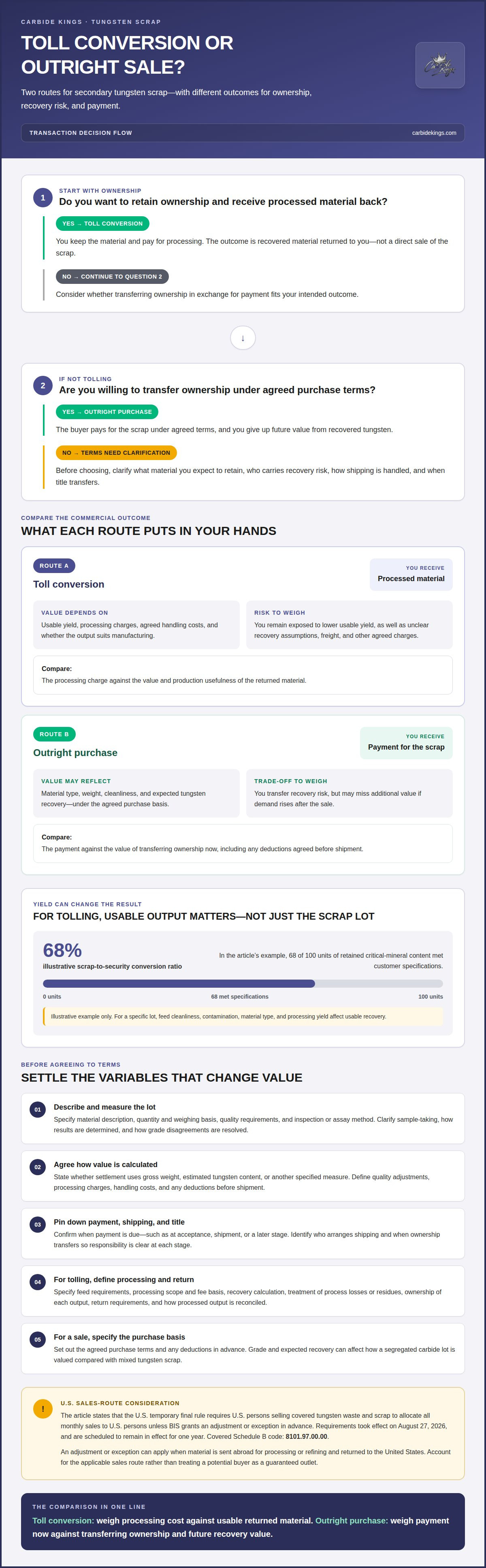
Secondary tungsten comes from production residues and used products, but retained metal isn’t automatically usable supply. Soft scrap can include powder and carbide sludge, sometimes called swarf. Hard scrap includes carbide tri-cones, trencher tools, and fixed cutter matrix bits. In a toll arrangement, recovery depends on feed cleanliness. An illustrative example shows 68 of 100 units of retained critical-mineral content meeting customer specifications, a 68% scrap-to-security conversion ratio.
Recycling also matters at the global supply level. Recycled materials account for approximately 25-30% of global tungsten supply, while global secondary supply is approximately 21,000 tons annually. Global tungsten supply is approximately 106,000 tons. These figures describe different measures of supply, so they shouldn’t be treated as interchangeable. For a specific lot, material type, contamination, and processing yield shape how much recovered tungsten can return to manufacturing.
Forecasts connect scrap sources to manufacturing arrangements. A buyer’s forecast can set expected material needs and delivery timing; the supplier then plans quantities and production. One agreement states that the supplier must provide requested information within five (5) business days after receiving the buyer’s forecast. For a toll conversion, the arrangement can define processing and the return of material. An outright sale instead transfers the scrap to the buyer under agreed purchase terms.
For U.S. transactions, tax and environmental treatment should be considered alongside whether the material is sold or retained for processing. The U.S. temporary final rule requires U.S. persons selling tungsten waste and scrap to allocate all monthly sales to U.S. persons unless BIS grants an adjustment or exception in advance. Its allocation requirements took effect on August 27, 2026, and are scheduled to remain in effect for one year. The covered tungsten waste and scrap Schedule B code is 8101.97.00.00. An adjustment or exception can apply when material is sent abroad for processing or refining and returned to the United States.
Pricing and payment
Compare the net outcome, not just the quoted amount. In toll conversion, the scrap owner pays a processing fee and receives recovered material. The value depends on usable yield, processing charges, and whether the output suits manufacturing. In an outright sale, the buyer pays for the scrap under agreed terms, and the seller gives up any future value from recovered tungsten. A comparison of toll conversion agreements vs outright purchase of secondary tungsten scrap starts with these different outcomes.
For an outright purchase, the proposed value may reflect material type, weight, cleanliness, and expected tungsten recovery. A mixed or contaminated carbide lot may be valued differently from clean, sorted material. For tolling, estimate recoverable output, subtract processing and agreed handling costs, then assess whether the returned material supports production. No single price captures the full comparison.
Key risks and costs include unclear recovery assumptions, processing or freight charges, and unsettled payment timing or deductions. Tolling also leaves the owner exposed to a lower usable yield. An outright sale transfers that recovery risk, but the seller may miss out if demand rises after the sale.
Choosing between toll conversion agreements vs outright purchase of secondary tungsten scrap requires clear terms for each transaction. Specify the material description, basis for weighing, quality requirements, and how processing results affect settlement. Confirm when payment is due, such as at acceptance, shipment, or a later stage. For tolling, define the processing charge and how returned material is calculated. For a sale, establish the purchase basis and any deductions before shipment.
- Toll conversion: compare the processing charge with the value of usable returned material.
- Outright purchase: compare payment with the value of transferring ownership now.
- Both: account for shipment, handling, quality adjustments, and payment timing.
Restrictions can also affect a seller’s options. Under the U.S. temporary final rule, all monthly sales of covered tungsten waste and scrap must be allocated to U.S. persons unless BIS grants an adjustment or exception in advance. Include the applicable sales route in your transaction calculations, rather than treating a potential buyer as a guaranteed outlet.
Purchase terms
An outright purchase turns scrap into a sale: the buyer evaluates the material, offers terms, and pays when the agreement’s conditions are met. The seller transfers ownership under the contract instead of retaining the material for processing and return. For example, a buyer may assess a segregated carbide lot separately from mixed tungsten scrap because grade and expected recovery affect value.
Grade, assay, and payable tungsten content depend on the agreed evaluation method. Contract terms should state how samples are taken and results determined, and how the parties resolve differences between the stated grade and test results. They should also clarify whether settlement is based on gross weight, estimated tungsten content, or another specified measure. Without these details, the same lot can produce different settlement calculations.
A toll conversion agreement should define feed specifications, processing scope, fee basis, and returned-material requirements. It should also explain how recovery is calculated, how process losses or residues are handled, and who owns each output. These terms connect processing capacity with production needs, whether the material supports domestic manufacturing or a specific defense supply arrangement.
Structure the purchase terms around the transaction sequence. First, set out the material description and quantity basis. Then specify inspection or assay, acceptance, payment timing, shipping responsibility, and when title transfers. For tolling, add the return schedule and method for reconciling processed output. For an outright sale, clarify final-settlement conditions and any quality adjustment.
Government demand can shape potential purchase opportunities, but an information request is not a contract. The Defense Logistics Agency sought information about a potential future acquisition of up to 200 tonnes of tungsten hard scrap. That request did not guarantee a future tender. Its effect is practical: suppliers can distinguish market planning from a binding purchase, and avoid treating a stated capacity inquiry as committed demand. Put the buyer, seller, material, settlement basis, and delivery obligations in the signed agreement.
Shipment and transfer of title
Shipment terms should account for each movement of tungsten scrap, from dispatch through receipt and return. In a toll arrangement, the owner sends material for processing and expects recovered output back. The agreement should identify who arranges and pays for freight and insurance, records weights, and handles loss or damage in transit. For example, specify whether the receiving weight or shipping weight governs reconciliation.
Ownership and market exposure are related but distinct. Under tolling, the scrap owner generally retains title as the material moves through processing, while the contract defines ownership of recovered metals and residues. The owner therefore remains exposed to price movements on retained material, subject to the agreement’s recovery and settlement terms. With an outright purchase, title transfers as agreed, and the buyer typically bears subsequent market movements after that transfer.
State the transfer point clearly. It may be tied to delivery, acceptance, payment, or another specified event. Define who bears the risk of loss at each stage, including loading, transit, receipt, processing, and return shipment. Also explain how the parties handle a shipment that arrives with a different weight or condition from what the shipping documents state. Clear terms prevent confusion about ownership and transport responsibility.
- Before dispatch: identify the material, packaging, carrier, shipping documents, and responsibility for freight.
- At receipt: record arrival condition and weight, then apply the contract’s inspection and discrepancy process.
- After processing: document the returned metals, residues, and title status for each output.
Shipment planning may also intersect with regulatory controls. The U.S. temporary allocation rule allows an adjustment or exception when tungsten waste and scrap is sent abroad for processing or refining and returned to the United States. A battery-scrap provision is separate, so don’t assume it applies to tungsten. Align the route, purpose, and return movement with the applicable terms. Mining supply, recycling, and metal recovery all depend on clear custody records.
Set the shipment and title clauses before dispatch, then review tungsten scrap options for your material needs.
Carbide Kings
Carbide Kings is a useful next step when you need industrial tungsten or carbide scrap materials. The comparison above can help clarify whether you want to retain material for processing or sell it outright. For manufacturing supply, Carbide Kings offers Tungsten Hard Scrap, Tungsten Soft Scrap, carbide scrap, and Tungsten Alloys. Match the material category to your production needs, then consider its form and intended use in your supply plan. Carbide Kings focuses on these industrial scrap materials, making it relevant when you’re building a secondary supply stream rather than arranging toll conversion. Contact Carbide Kings to discuss your material needs.
Set Up Your Next Tungsten Decision
Use your next procurement cycle to decide what role secondary tungsten should play in production. Choosing between toll conversion agreements and an outright purchase of secondary tungsten scrap depends on whether you want to retain material for processing or acquire scrap directly. Once that goal is clear, align your sourcing plan with the material and its intended use. A consistent approach makes future purchasing decisions easier to assess and manage.
For manufacturing needs, Carbide Kings offers Tungsten Hard Scrap, Tungsten Soft Scrap, and carbide scrap. These offerings can support businesses sourcing industrial materials for production. If you’re ready to discuss your tungsten scrap needs, contact Carbide Kings about tungsten scrap. Take the next step with a clear view of your material requirements and sourcing priorities.
Frequently Asked Questions
What is a toll conversion agreement for secondary tungsten scrap?
Toll conversion is an arrangement in which a processor treats scrap for a fee and returns processed material instead of buying the scrap outright. For example, a manufacturer with recurring tungsten production residues might use tolling to retain material for its own supply needs. The agreement should link each incoming batch to its resulting output, so separate lots are not confused during processing or reconciliation.
How do toll processing fees compare with outright purchase prices for tungsten scrap?
They measure different things: a toll fee covers processing, while an outright purchase price pays for transferring scrap to a buyer. Compare the usable value of returned material after conversion and related charges with the payment offered for an outright sale. A written comparison should use the same lot description and quality assumptions, so the difference reflects the transaction structure rather than mismatched material estimates.
What steps are involved in selling or toll-processing secondary tungsten scrap in the United States?
Start by identifying the scrap type, separating different materials, and recording the lot’s available weight and description. Decide whether to sell the lot or retain it for conversion, then document acceptance criteria, settlement terms, shipping responsibility, and title transfer. Keep shipment and receipt records with the agreement. For tolling, track returned output against the original batch. For a sale, retain the purchase and payment records.


