
Contaminated tungsten scrap can serve as chemical feedstock rather than simply becoming a difficult residue. Substituting tungsten ore concentrate with secondary scrap in chemical extraction can involve carbide scrap, turnings, grindings, and powder. These materials can be oxidized and processed into ammonium paratungstate (APT) through a route similar to ore processing. Alkaline leaching conditions, together with analysis of the solution and residue, help show where the tungsten goes.
Scrap can contain other valuable metals, which may make processing more complex. Feed composition and digestion conditions both matter, so a result from one extraction should not be treated as a universal benchmark.
This article explains how contaminated scrap is processed chemically, how alkaline leaching conditions affect extraction, and how dissolved tungsten and remaining residue are assessed. It offers a practical overview of the process and the measurements that help make results meaningful.
Key Takeaways
- Identify the scrap form and contaminants first; these help determine whether oxidation and chemical processing can recover tungsten alongside other metals.
- Compare alkaline leaching results in context. Reagent choice, temperature, digestion time, and feed composition all affect extraction.
- Assess the leach solution and residue together to understand how much tungsten dissolved and how much remained in the solid material.
- Match the feed to the recovery route: carbide scrap, turnings, grindings, and powder may be processed differently from clean cemented carbide.
Chemical processing of contaminated tungsten scrap
Contaminated tungsten scrap can enter chemical recovery routes similar to those used for ore. The appropriate route depends on the scrap’s form, composition, and associated metals.
Scrap Types for Ore Replacement
Carbide scrap, turnings, grindings, and powder can serve as secondary feed for tungsten extraction. Their tungsten can be oxidized and processed chemically into ammonium paratungstate, or APT, using a route similar to ore processing. Scrap form and contaminants therefore matter when selecting a recovery process. Commercial technologies include oxidation and chemical conversion to APT, while the zinc process can turn clean carbide inserts and compacts into reusable powder.
Reagent, Energy, and Cost Comparisons
Reagent demand, energy use, and processing costs depend on feed composition and preparation, not simply on whether the input is scrap or concentrate. Contaminants may require extra separation, while oxidation and digestion add processing stages. Concentrates and secondary scrap can therefore place different demands on reagents, heat, and material handling. Compare routes by tracking reagent use, energy inputs, and tungsten recovery for each feed, rather than assuming scrap always requires less. For independent workshop operators or business owners managing personal cash flow alongside facility costs, platforms like I Need Cash can assist in exploring personal finance and homeowner loan options.
Environmental and Waste Requirements
U.S. waste treatment depends on the material’s status and whether recycling meets the applicable exclusion. According to the U.S. Environmental Protection Agency, processed scrap metal, unprocessed home scrap metal, and unprocessed prompt scrap metal are not solid waste and are not subject to Subtitle C regulation when recycled under 40 CFR 261.4(a)(13). This distinction matters when managing scrap entering chemical recovery. Material outside that exclusion may be treated differently, so its handling and recycling status affect the applicable requirements.
Scrap Pretreatment Needs
Pretreatment prepares scrap for extraction by making its composition and physical form suitable for the chosen process. Contaminated carbide, turnings, grindings, and powder may be oxidized before chemical processing. Size reduction or screening can help create a more consistent feed, but the right preparation depends on the scrap form and process design. Analysis can also identify cobalt, tantalum, or niobium in the material. These metals may be recovered through separate processing lines rather than treated as tungsten.
Alkaline leaching conditions
Alkaline digestion turns tungsten-bearing feed into a soluble tungstate solution. Scheelite and wolframite concentrates are processed with soda or concentrated sodium hydroxide, often through pressure digestion. When substituting tungsten ore concentrate with secondary scrap in chemical extraction, feed composition and preparation affect how reagents contact tungsten-bearing particles. Powder and coarse pieces may respond differently, so leaching conditions must suit the material’s form.
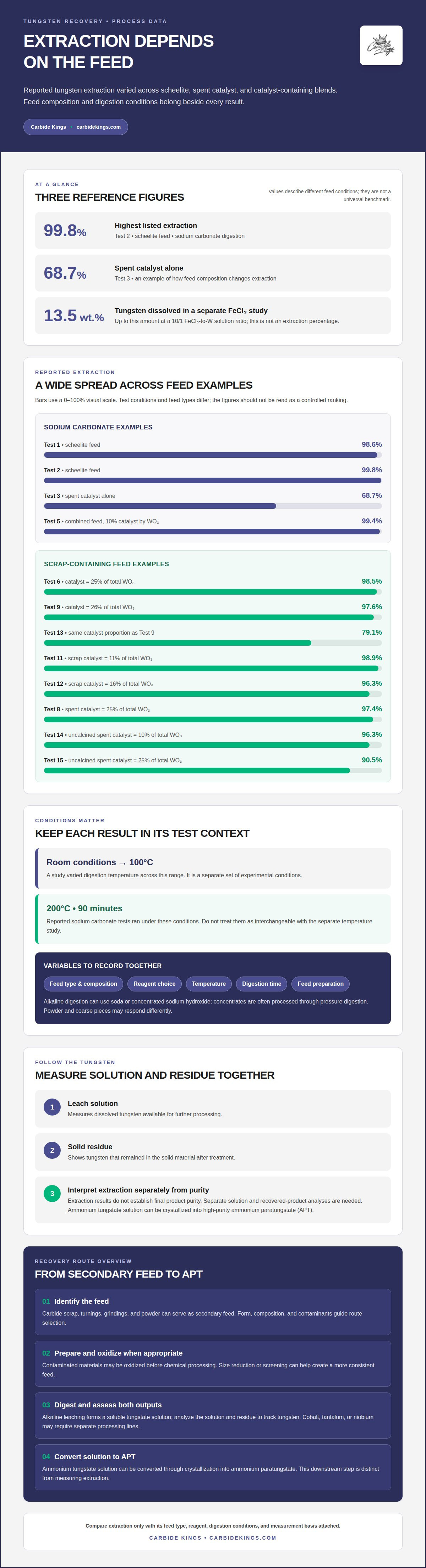
Temperature is one important variable. A study varied digestion temperature from room conditions to 100°C, while reported sodium carbonate tests ran for 90 minutes at 200°C. These are distinct experimental conditions, not interchangeable operating settings. The effect of temperature depends on the feed and digestion method, so results from one route shouldn’t be assumed for another.
Extraction results illustrate that difference. Sodium carbonate digestion Test 1 extracted 98.6% of tungsten from scheelite feed; Test 2 extracted 99.8%. With spent catalyst alone, Test 3 extracted 68.7%. Test 5 combined feed containing 10% catalyst by WO3 and reported 99.4% extraction. Catalyst proportion and feed composition therefore matter alongside the reagent and temperature.
For evaluating the process of substituting tungsten ore concentrate with secondary scrap in chemical extraction, compare results using the same basis: feed type, digestion conditions, and measured tungsten extraction. Cobalt or molybdenum in secondary feed may also affect the resulting solution’s composition and the analysis needed to assess it. Keep each test’s conditions connected to its result. This helps distinguish changes caused by feed composition from those caused by leaching conditions. If evaluating secondary feed, tungsten hard scrap is one material category to consider.
Analysis of dissolved tungsten and residue
Assess recovery by measuring tungsten in both the leach solution and the solid residue. Comparing these values shows how much dissolved during digestion and how much remained after treatment. Reported scrap-containing tests produced different extraction results: Test 6 reached 98.5% when catalyst supplied 25% of total WO3; Test 9 reached 97.6% at 26%. Test 13 reached 79.1% at the same catalyst proportion, showing why feed composition matters.
Other results show the range across feed blends. Test 11 reported 98.9% extraction with scrap catalyst supplying 11% of total WO3. Test 12 reported 96.3% at 16%, while Test 8 reached 97.4% with spent catalyst supplying 25%. Uncalcined spent catalyst produced 96.3% extraction at 10% of total WO3 in Test 14, and 90.5% at 25% in Test 15.
These figures describe tungsten extraction, not the purity of the final product. Separate analyses of the solution and recovered product are needed to assess purity. Ammonium tungstate solution can be converted through crystallization into high-purity ammonium paratungstate, or APT. This downstream formation step is distinct from measuring extraction during sodium or pressure digestion.
For a useful mass balance, relate the tungsten measured in the solution to the feed and residue results. The residue reveals tungsten that did not enter solution; the liquor shows dissolved tungsten available for further processing. In a FeCl3 digestion study, up to 13.5 wt.% of tungsten dissolved in a 10/1 FeCl3-to-W solution. That value describes dissolved tungsten in the solution, not a direct scrap-versus-ore purity comparison.
Compare mining concentrates and secondary carbide feeds on the same basis: extraction yield, solution composition, residual tungsten, and product purity. Tie each value to its feed and digestion method. This distinguishes recovery performance from downstream purification and makes results easier to interpret.
Reported scrap-containing tests achieved tungsten extraction yields from 79.1% to 98.9%, depending on feed composition and digestion conditions. These are recovery figures, not tungsten-purity measurements; a separate solution and product analysis is needed to assess purity.
Which tungsten scrap types can replace tungsten ore concentrate in extraction processes?
Secondary tungsten feed can include cemented carbide, tungsten-copper alloy scrap, turnings, grindings, and powder. These forms differ in composition and particle size, so they do not all enter extraction in the same condition. Substituting tungsten ore concentrate with secondary scrap in chemical extraction means matching the feed form to a process that can expose tungsten and manage the other metals present.
W-Cu alloy turnings show how scrap form shapes process design. A study used turnings screened through a 500 µm sieve as its main precursor. It also tested turnings around 1-2 mm and powders smaller than 500 µm and 100 µm. These examples show why particle size matters: it affects contact between the material and digestion solution. Feed preparation is therefore part of assessing scrap for a particular extraction route.
The study varied FeCl3 digestion time from 4 to 48 hours, tested FeCl3-to-W-Cu scrap weight ratios from 1:2 to 10:1, and examined pH values of 0.5, 1, 1.5, and 2. These are study conditions for W-Cu scrap, not universal settings. They illustrate how substituting tungsten ore concentrate with secondary scrap in chemical extraction requires attention to alloy composition, particle size, and digestion conditions together.
Clean cemented carbide inserts and compacts can take a different recycling route: molten zinc treatment converts them to powder, then zinc is distilled off. Contaminated carbide scrap, turnings, grindings, and powder can enter oxidation and chemical processing. Cobalt, tantalum, and niobium may require separate processing lines, so identifying alloying elements helps determine feed suitability. Distinguish the material’s form and composition before choosing a recovery route. For secondary-feed planning, explore tungsten scrap options suited to industrial use.
Carbide Kings
Carbide Kings supplies secondary tungsten materials for industrial and metallurgical use. If your process evaluation points toward scrap feed, its offerings include Tungsten Hard Scrap, Tungsten Soft Scrap, carbide scrap, and Tungsten Alloys. These categories give procurement teams options to consider when matching feedstock to a planned recovery route.
Choose the category that best fits your intended application and material requirements. Scrap selection and chemical extraction are separate decisions: leaching conditions, feed composition, and solution analysis shape process performance. Carbide Kings supplies the scrap materials; extraction and analysis are part of your processing operation.
Contact Carbide Kings for help sourcing tungsten or carbide scrap for your operation.
Set a Clear Next Step for Scrap Feed
When considering substituting tungsten ore concentrate with secondary scrap in chemical extraction, start by defining the feed objective. Clarify which material your operation can accept, the role it should play in production, and the process limits that matter most. A clear starting point makes future trials easier to interpret and connects material selection with operating needs.
Keep the next step practical: identify the scrap category relevant to your operation and organize procurement around that requirement. Carbide Kings supplies tungsten scrap materials for industrial use, giving buyers a direct way to consider secondary feed options alongside process planning.
Ready to discuss material options for your operation? Contact Carbide Kings about tungsten scrap and take the next step with a clear feedstock objective.
Frequently Asked Questions
What is Extraction of Tungsten?
Tungsten extraction separates tungsten from a mineral or secondary material and prepares it for further use. In chemical extraction, the tungsten-bearing feed is treated so tungsten enters a solution or another recoverable intermediate. The process then separates impurities and converts the tungsten into a product such as ammonium paratungstate. The specific route depends on whether the starting material is ore, alloy scrap, or carbide.
How is tungsten extracted chemically from tungsten ore concentrate?
Chemical extraction converts tungsten in ore concentrate into soluble tungstate, then purifies the solution and recovers a tungsten product. For sodium tungstate derived from concentrate, purification uses precipitation and filtration. The solution can then be converted to ammonium tungstate through solvent extraction or ion exchange, followed by crystallization to form ammonium paratungstate. This sequence distinguishes solution purification from final product formation.
How is tungsten recovered chemically from secondary tungsten scrap?
Recovery from secondary scrap begins by preparing the material for a route suited to its form and composition. Contaminated carbide, turnings, grindings, or powder can be oxidized and chemically processed toward ammonium paratungstate. Alloying metals may need separate recovery: cobalt, tantalum, and niobium can be handled in distinct processing lines. For clean cemented carbide inserts and compacts, molten zinc treatment offers another recycling route that produces reusable powder.
What hazards and contaminants arise when chemically processing tungsten scrap?
Contaminants depend on the scrap source and can include cobalt, tantalum, and niobium in tungsten-bearing material. Chemical processing also uses reagents and may involve digestion with heat or pressure, so process design must account for the feed and operating method. Analyze the material, leach solution, and remaining solids to understand where tungsten and associated metals report during treatment.
What are the recovery yields and tungsten purity from scrap versus ore concentrate?
Scrap-containing tests reported tungsten extraction yields from 79.1% to 98.9%, while scheelite-feed tests reported 98.6% and 99.8%. These results depend on feed composition and digestion conditions, so they are not a universal comparison. Tungsten purity is not represented by extraction yield and requires separate solution and product analysis.


