

A lower purchase price alone doesn’t make a tungsten supply strategy more resilient. For U.S. manufacturers, switching from imported Chinese tungsten intermediates to domestic secondary scrap is a way to diversify feedstock and manage exposure, not an automatic cost reduction. China’s tungsten exports fell 22% year over year from January to June 2026, and the country replaced export quotas with case-by-case licensing in February 2025.
Supply uncertainty makes it reasonable to reassess where tungsten comes from and what it costs to process into usable material. This article explains how export controls, scrap recovery, regional supply shifts, and raw material costs affect the decision. You’ll learn what to weigh when comparing imported intermediates with domestic secondary scrap, and why the right choice depends on material suitability as well as procurement cost.
Key Takeaways
- Build export-control exposure into tungsten sourcing decisions, not just the quoted material cost.
- Assess whether recovered tungsten can provide a practical secondary feedstock for your production needs.
- Track regional supply shifts to understand how material availability and sourcing options are changing.
- Compare total procurement and processing costs before shifting from imported intermediates to scrap.
Chinese export controls and supply disruption
China’s tungsten export framework has shifted from quotas to transaction-specific licensing. In February 2025, China replaced export quotas with case-by-case licensing. In December 2025, export privileges were restricted to fifteen state-approved firms. This makes access more dependent on approved exporters and individual export decisions.
On January 6, 2026, China announced controls prohibiting exports of dual-use tungsten items to Japanese military-related end-users and for military applications. The measure concerns those specified end-users and uses, not every U.S. tungsten purchase. Still, the broader licensing system can make intermediate supply less predictable.
Trade figures show the disruption’s scale. China’s tungsten exports fell 22% year over year from January to June 2026, while tungsten powder exports totaled 422 tonnes during that period. China exported 0.8 tonnes of ammonium paratungstate in June 2026. These are Chinese export totals, not U.S. import volumes.
For U.S. imports, tariff treatment depends on product classification and origin, so intermediates and scrap should not be assumed to share a rate. Import controls also depend on the item and its end use; assess the applicable U.S. requirements for each shipment.
Chinese tungsten intermediates include ammonium paratungstate, powder, and metal. The figures above describe Chinese exports across destinations, not quantities imported into the United States. They show supply movement, but do not establish U.S.-specific volumes.
Environmental, hazardous-material, and transport requirements depend on the material and activity involved. The Agency for Toxic Substances and Disease Registry notes that EPA regulates effluent discharge of tungsten at primary tungsten facilities, and tungsten or cobalt at secondary facilities processing tungsten or tungsten carbide scrap. Material classification and shipment details also affect handling requirements.
Supplier qualification and production testing have no single fixed duration. The process typically involves reviewing material specifications, evaluating a sample, and testing it in the intended application. Switching from imported intermediates to recovered feedstock may require additional process adjustments before routine production.
For procurement planning, separate export exposure from material qualification. Track licensing and shipment changes, then assess whether secondary material suits the required production step. This helps make supply continuity and technical fit clear before a sourcing change reaches production.
Recycled tungsten recovery and resource security
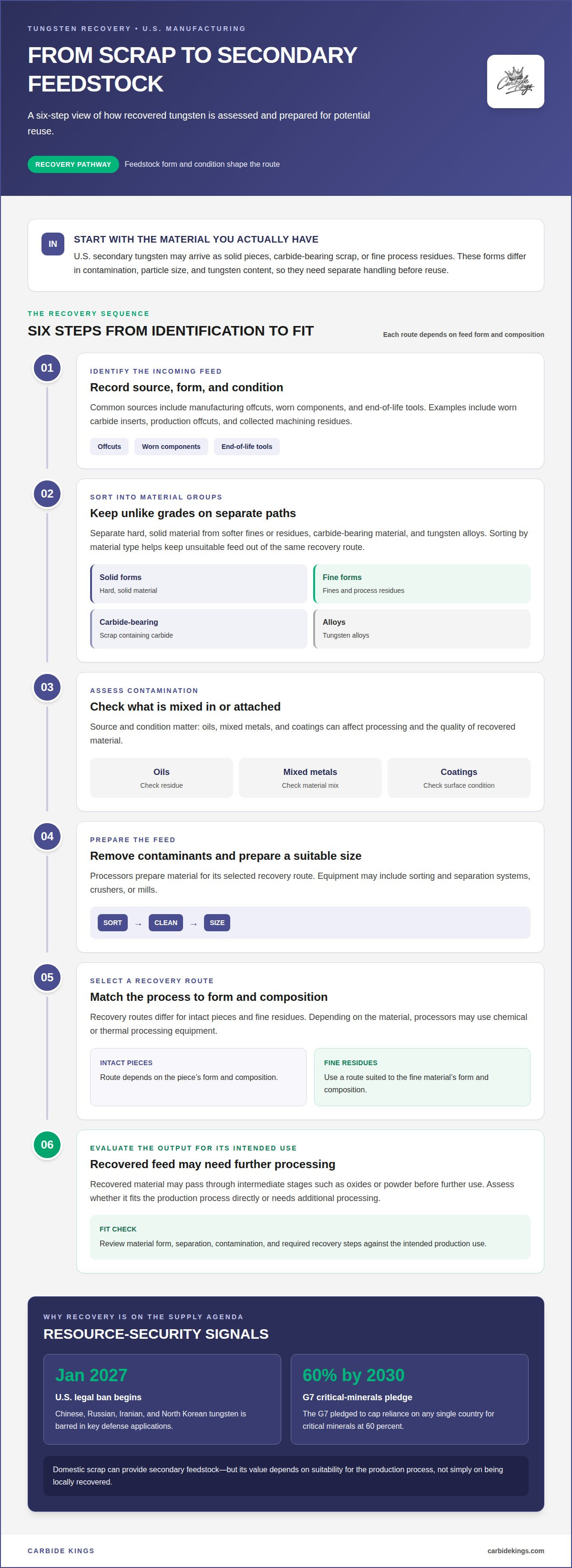
Secondary tungsten can come from manufacturing offcuts, worn components, and end-of-life tools. In the United States, recovered material may arrive as solid pieces, carbide-bearing scrap, or fine process residues. These forms differ in contamination, particle size, and tungsten content, so they need separate handling before reuse. Sorting by material type helps prevent unsuitable feed from entering the same recovery route.
Available scrap grades include hard, solid material and softer forms such as fines or residues, as well as carbide-bearing material and tungsten alloys. Examples include worn carbide inserts, production offcuts, and collected machining residues. Source and condition matter: oils, mixed metals, and coatings can affect processing and the quality of recovered material.
Recovery starts by identifying and sorting the feedstock. Processors then remove contaminants, prepare the material to a suitable size, and choose a recovery route based on its form and composition. Equipment may include sorting and separation systems, crushers or mills, and chemical or thermal processing equipment. Recovered material may pass through intermediate stages such as oxides or powder before further use. The route differs for intact pieces and fine residues.
Resource security is one reason to improve recovery. The United States’ legal ban on Chinese, Russian, Iranian, and North Korean tungsten in key defense applications starts in January 2027. The G7 pledged to cap reliance on any single country for critical minerals at 60 percent by 2030. According to SMM, China’s tungsten industry will need to strengthen recycled tungsten recovery over the medium to long term to safeguard industrial chain security.
For manufacturers, domestic scrap can provide secondary feedstock, but its value depends on how well it fits the production process. Review the material from source to intended use: identify its form, separate mixed grades, assess contamination, and determine the recovery steps required. This clarifies whether recovered feed can replace an imported intermediate directly or needs further processing.
Explore domestic tungsten scrap materials as one potential feedstock for a recovery strategy.
Regional restructuring of tungsten supply chains
Trade flows are shifting across the United States, Japan, China, and Vietnam. U.S. tungsten scrap exports to Japan increased twenty-fourfold in the first quarter of 2026. That movement shows recovered material entering regional trade, rather than remaining within its country of origin. For U.S. buyers, it also means domestic scrap availability can be affected by overseas demand.
Japan’s exposure to Chinese supply helps explain the change. Japanese manufacturers sourced roughly 30 percent of their raw tungsten from China. In April 2026, Japan’s imports of Chinese tungsten products dropped 50 percent from the 2025 monthly average and 63 percent year over year. Those declines create pressure to diversify, while competing buyers may seek material from other sources.
China’s own import pattern adds another layer. It imported 7,972 tonnes of tungsten, calculated by metal content, from January to June 2026. Tungsten concentrate accounted for 7,680 tonnes in the first half of 2026. These figures show that Chinese supply chains also depend on incoming material, so regional flows do not move in one direction only.
Vietnam is another part of the evolving map. In mid-2026, Masan High-Tech Materials announced an expansion unlocking 115 million tons of polymetallic resources. That announcement points to resource development, not an immediate volume of tungsten available to U.S. buyers. New capacity and material still need to move through processing and supply networks.
For domestic scrap buyers, the risks are practical. Regional demand can affect availability, while mixed alloys, coatings, oils, or residues can complicate sorting and recovery. Scrap values can also move with broader tungsten markets, and qualification takes time because each feedstock must suit its intended process. Treat regional sourcing as a portfolio: compare origin, consistency, processing needs, and qualification status before changing purchasing plans.
Industrial strategies responding to raw material costs
Compare tungsten intermediates and scrap on a delivered, usable-material basis. These assessments use different delivery terms and dates, so they are not direct comparisons.
Those APT figures do not establish whether domestic scrap costs less. When switching from imported Chinese tungsten intermediates to domestic secondary scrap, compare the usable tungsten each material can yield. Scrap and intermediates differ in form, recovery yield, processing needs, and delivered condition. A lower purchase price may not mean a lower cost per usable unit.
Build a consistent comparison for each candidate feedstock. Include material cost, transport, preparation, processing, and the effects of contamination or mixed grades. Then account for qualification work and production adjustments. Treat switching from imported Chinese tungsten intermediates to domestic secondary scrap as a staged procurement decision, not simply a change in quoted material price.
Use a staged purchasing plan to manage exposure:
- Keep established intermediate supply in place while evaluating a scrap sample.
- Record material composition, preparation needs, and usable output from production trials.
- Compare the resulting cost per usable tungsten unit, then adjust purchasing shares.
Test sensitivity to market movement before switching from imported Chinese tungsten intermediates to domestic secondary scrap. These are different products and terms, not scrap benchmarks. Update comparisons using matched grades, delivery terms, and processing assumptions.
For a practical sourcing review, explore domestic tungsten scrap options alongside your current intermediate specifications.
The quoted APT assessments do not establish that domestic scrap is cheaper than imported Chinese intermediates. Compare full costs per usable tungsten unit, accounting for recovery yield, transport, preparation, processing, and material condition.
Carbide Kings
Carbide Kings supplies industrial buyers assessing domestic scrap as a secondary tungsten source. Its materials include Tungsten Hard Scrap, Tungsten Soft Scrap, Carbide scrap, and Tungsten Alloys. These categories give buyers options to consider alongside imported intermediates.
Use the criteria from this review to identify what best fits your production needs: material form, intended use, and processing requirements. Carbide Kings is a practical next step when you’re ready to consider scrap materials as part of a more diversified supply strategy.
Contact Carbide Kings to discuss your tungsten scrap needs.
Turn Sourcing Goals Into a Practical Next Step
Make your next move a sourcing decision you can put into practice. Define the role domestic scrap should play in your purchasing plan, then set clear criteria for material form, production fit, and procurement review. A focused decision gives your team a workable path without requiring an all-at-once change.
When switching from imported Chinese tungsten intermediates to domestic secondary scrap, start by identifying where secondary feedstock could fit alongside existing materials. This connects the transition to actual production needs and gives procurement a clear basis for evaluating options.
Carbide Kings offers Tungsten Hard Scrap, Tungsten Soft Scrap, and Carbide scrap for industrial buyers considering scrap materials in their sourcing plans.
Take the next step at your pace. Contact Carbide Kings to discuss tungsten scrap for your sourcing needs.
Frequently Asked Questions
What recovery yields and quality specifications can U.S. tungsten recyclers achieve?
Recovery yield and final quality depend on the scrap’s composition, condition, contamination, and processing route. Clean, segregated carbide scrap differs from mixed residues or material containing oils and coatings. For a useful comparison, define the required output form and composition, then evaluate how the proposed feedstock performs in your process. A trial batch can reveal handling needs and production fit before you adjust regular purchasing.
Which U.S. suppliers, recyclers, and processors can provide domestic secondary tungsten material?
Carbide Kings supplies U.S. industrial buyers with Tungsten Hard Scrap, Tungsten Soft Scrap, Carbide scrap, and Tungsten Alloys. Match the material category to your intended use and purchasing specifications. If you need material converted into a specific intermediate, distinguish that processing requirement from scrap supply: the right source depends on the form your operation can receive and use. Share those requirements when discussing sourcing options.
How do prices for domestic tungsten scrap compare with imported Chinese tungsten intermediates?
Compare scrap and intermediates by usable tungsten yield, including transport, preparation, processing, contamination, qualification, and production adjustments.
What U.S. tariffs, import restrictions, and trade rules apply to Chinese tungsten intermediates and scrap?
U.S. tariff treatment depends on product classification and origin, so intermediates and scrap should not be assumed to have the same rate. Import controls depend on the item and its end use, and requirements should be assessed for each shipment. Chinese exports are subject to case-by-case licensing, restricted to approved exporters, and specific controls on certain dual-use exports to Japanese military end users and applications.
What environmental, hazardous-material, and transport regulations apply to tungsten scrap processing in the United States?
Requirements depend on the material and activity. EPA regulates effluent discharge of tungsten at primary tungsten facilities, and tungsten or cobalt at secondary facilities processing tungsten or tungsten carbide scrap. Material classification and shipment details also shape handling requirements.
How long does supplier qualification and production testing take when replacing imported tungsten intermediates with recycled material?
There is no single fixed duration. Qualification typically involves reviewing specifications, evaluating a sample, and testing it in the intended process. Recovered feedstock may also require process adjustments before routine production.


