

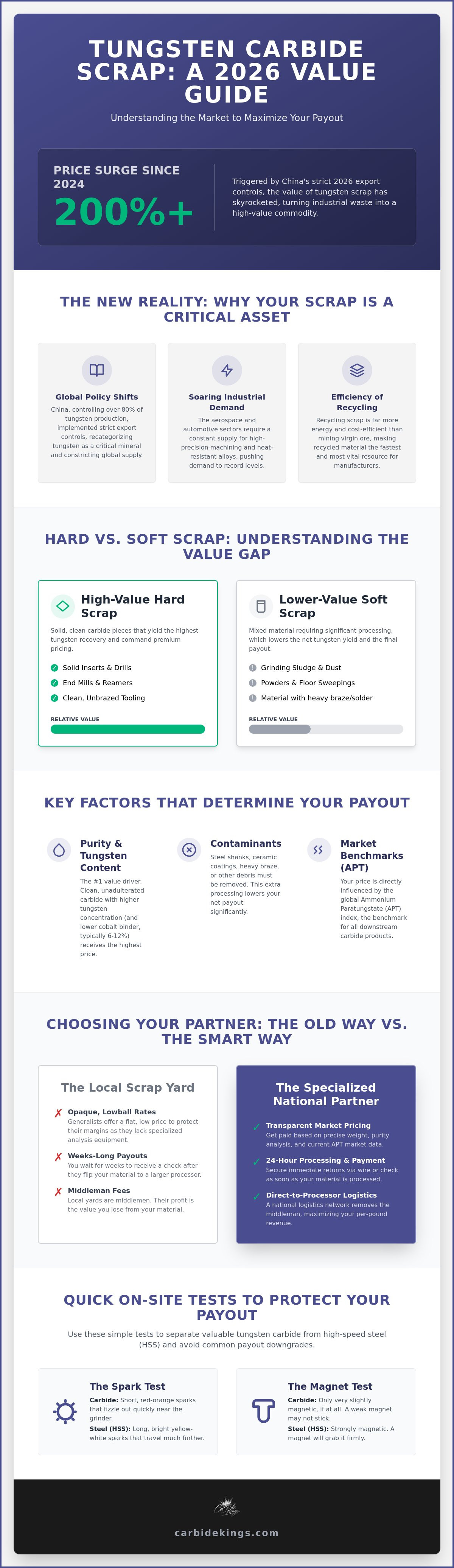
Did you know that tungsten carbide scrap prices have surged by over 200% since early 2024? Following China's strict January 2026 export controls on dual-use items, your worn-out tooling has become more valuable than many precious metals. However, capturing the full tungsten carbide scrap price per pound is difficult when local yards offer opaque rates and leave you waiting weeks for a check. You need a solution that prioritizes transparency and speed over traditional middleman friction.
You've likely realized that general recycling models aren't built for the density and specialized nature of tungsten alloys. We understand the frustration of high shipping costs and the administrative burden of moving heavy industrial waste. This guide will show you how to maximize your per-pound revenue by leveraging specialized national logistics and transparent market data. We will break down current global supply shifts, the critical value difference between hard and soft scrap, and the exact steps to ensure your material is processed and paid for via wire or check with professional efficiency.
Key Takeaways
- Understand how global Ammonium Paratungstate (APT) benchmarks and material purity directly influence the tungsten carbide scrap price per pound you receive.
- Distinguish between high-value hard scrap, like solid inserts and drills, and lower-value soft scrap such as grinding sludge and dust.
- Learn how to use the spark test and magnet test to separate carbide from high-speed steel and avoid common payout downgrades.
- Secure faster returns by utilizing a national logistics partner that offers 24-hour processing and immediate payment via wire or check.
Current Trends in Tungsten Carbide Scrap Prices per Pound
The market for industrial waste changed forever in early 2026. China's decision to implement strict export controls on tungsten through its Catalogue of Dual-Use Items sent ripples through every machine shop in the country. Since early 2024, the tungsten carbide scrap price per pound has climbed by over 200%. This isn't just a minor fluctuation; it is a fundamental shift in how businesses value their worn tooling. If you are still treating your carbide like standard steel, you are losing money on every shipment.
Global Tungsten Demand and 2026 Market Drivers
Global supply chains are currently struggling to keep pace with soaring demand from the aerospace and automotive sectors. Because China controls over 80% of global production, their policy shifts dictate the national rates you see today. Tungsten is now officially categorized as a critical mineral in most Western economies. This status ensures that prices remain high as manufacturers scramble to secure domestic recycling streams. The primary index used to set these rates is Ammonium Paratungstate (APT). Ammonium Paratungstate (APT) is the chemical intermediate produced from tungsten ores that serves as the global pricing benchmark for all downstream carbide products. In 2026, the automotive industry's push for high-precision machining and the aerospace sector's reliance on heat-resistant alloys have pushed demand to record levels. These industries require a constant supply of tungsten, and recycled material is the fastest way to get it back into the production cycle.
Why Carbide Prices Beat General Scrap Metal
Tungsten carbide is an exceptional material. It is nearly twice as dense as steel and significantly rarer than aluminum. While a local yard might treat your inserts like standard ferrous scrap, they are ignoring the massive energy savings found in recycling. It's far more efficient to process scrap than to mine virgin ore. This makes the tungsten carbide scrap price a strategic revenue stream for any high-volume shop. Selling to a general scrap yard is a mistake. Most local yards don't have the equipment to verify purity, so they offer a safe low-ball price to protect their margins. A specialized buyer uses professional-grade analysis to ensure you get the full market value based on the current tungsten carbide scrap price per pound.
Industrial professionals are moving away from mixed-metal yards for several reasons:
- Specialized Expertise: Buyers who focus only on tungsten understand the specific chemistry of hard and soft scrap.
- Direct Logistics: National logistics remove the middleman tax charged by local dealers who just flip your material to a larger processor.
- Precise Valuation: Modern weight and purity analysis lead to higher per-pound payouts compared to rough estimates.
Stop leaving money on the table. Your industrial waste is a high-value commodity that requires a professional approach to maximize returns. When you work with specialists, you bypass the administrative hurdles and get paid faster for the true value of your material.
Factors That Determine Your Specific Scrap Payout
The market benchmark is a useful guide, but your actual payout depends on the physical and chemical properties of your material. To secure the best tungsten carbide scrap price per pound, you need to understand how buyers evaluate your specific lot. It isn't just about the weight on the scale. It's about the net recovery of tungsten after processing. If your material is cluttered with attachments or contaminants, your bottom line will reflect the extra labor required to clean it.
Material Purity and Tungsten Content
Purity is the most significant driver of value. Most industrial carbide uses a cobalt binder, typically ranging from 6% to 12%. A lower cobalt percentage means a higher concentration of tungsten, which naturally commands a higher price. Clean material that is free from steel shanks, ceramic coatings, or plastic debris always receives a premium. Contaminants force the processor to perform additional separation steps, which eats into your profit. According to the Tungsten Statistics and Information provided by the USGS, domestic consumption remains high, making high-purity recycled material a vital resource. Use this checklist to identify high-purity hard scrap carbide before you ship:
- Check for high density; carbide is significantly heavier than steel.
- Verify the absence of heavy braze or silver solder.
- Ensure no high-speed steel (HSS) tools are mixed into the batch.
Volume and Weight Considerations for Bulk Sellers
Volume changes the math of your transaction. While we process smaller batches, bulk shipments often trigger preferential tier pricing. This happens because shipping a full pallet is more cost-effective than handling dozens of small boxes. National buyers often provide logistics subsidies or better rates when you hit specific weight thresholds, typically starting at 300 pounds. Your lot size directly influences the buyer's refining overhead because larger batches allow for more efficient chemical processing and administrative handling.
The form of your material also matters. Solids like inserts and end mills are "hard scrap" and require less energy to recycle. Powders, sludge, and grinding swarf are "soft scrap." These byproduct materials often contain moisture or oils that must be removed before refining, which increases processing costs and lowers the initial quote. If you want to see how your current inventory stacks up, you can request a fast valuation from a specialist who understands these nuances. By separating your materials by form and purity, you ensure that every ounce of your waste contributes to a higher tungsten carbide scrap price per pound. Don't let attachments like steel shanks drag down your average rate. Remove them when possible to keep your payout as high as the market allows.
Hard Scrap vs. Soft Scrap: Understanding the Value Gap
Not all materials in your recycling bin carry the same weight in the industrial market. The physical state of your waste creates a significant "value gap" that dictates your final quote. Hard scrap refers to solid carbide objects like inserts and end mills, while soft scrap encompasses byproducts like grinding sludge, swarf, and dust. Because solid pieces are easier to weigh, test, and melt, the tungsten carbide scrap price per pound for hard scrap is consistently higher than for soft varieties. You have solids; you have sludge. The difference between them is your net profit.
Refining soft scrap "mud" into usable tungsten is an energy-intensive process. It requires specialized chemical leaching and filtration equipment that general scrap yards simply don't own. This overhead is a primary reason why soft scrap prices lag behind solid tooling. In the 2026 market, where global supply remains constrained, even byproduct waste has gained value, but the processing friction remains a constant factor in your payout.
Valuing Hard Scrap: Inserts, End Mills, and Tooling
Solid carbide tooling is the gold standard for industrial recycling. These items are nearly pure carbide and require minimal preparation before they enter the furnace. This simplicity allows buyers to offer a premium tungsten carbide scrap price per pound for these lots. High-value items typically include indexable inserts, PCB drills, and heavy wear parts from mining or construction equipment. These tools are dense, easy to identify, and provide the highest recovery rates for the refiner. If you aren't sure what you have in your bin, you should check our guide on how to identify tungsten carbide scrap to ensure you aren't accidentally downgrading your lot with high-speed steel.
Pricing Soft Scrap: Sludge, Swarf, and Grinding Dust
Soft scrap presents a different set of logistical challenges. This material is a byproduct of precision grinding and is frequently contaminated with water, oil, or synthetic coolants. This moisture content adds weight that isn't actually tungsten. To determine a fair price, a buyer must perform a lab analysis to find the actual tungsten percentage within the sludge. According to USGS tungsten market data, recycled material is a vital component of the domestic supply chain, yet soft scrap recovery remains technically complex. You shouldn't trust this material to a generalist. Working with experienced tungsten soft scrap buyers is the only way to ensure your grinding waste is valued based on its actual mineral content rather than a rough estimate. Proper containment is also key; keep your sludge in sealed drums to prevent further contamination and preserve its recovery value.
How to Maximize Your Return on Carbide Scrap
Preparation is the difference between a standard payout and a premium one. You've identified your material; now you must prepare it for the refinery. Don't let a few pounds of low-value steel drag down your entire lot's value. Proactive sorting is the fastest way to increase your net tungsten carbide scrap price per pound. If you hand over a mixed bin, the buyer must account for the labor of sorting it, which inevitably reduces your final check. Do the work upfront to keep that revenue in your pocket.
Sorting and Cleaning for Higher Quotes
Start by separating your solids from your tipped tools. Many industrial tools consist of a tungsten carbide tip brazed onto a steel shank. Shipping these as-is results in a "downgrade" because the buyer must process the steel out. To maximize your return, follow these steps:
- Remove Steel Shanks: Use a torch to melt the braze or a hydraulic press to snap the carbide tips off. Pure carbide tips fetch a much higher rate than brazed assemblies.
- Separate by Grade: Keep your PCB drills, indexable inserts, and wear parts in distinct containers. Refiners prefer uniform lots.
- Verify with the Magnet Test: The magnet test is the simplest way to distinguish carbide from steel; carbide will have a very weak pull, while steel will snap to the magnet instantly.
- Perform a Spark Test: If you're unsure about a tool, touch it to a grinder. Carbide produces short, orange sparks that don't travel far. Steel produces long, bright white or yellow sparks that "explode" at the ends.
Timing Your Sale with Market Fluctuations
The 2026 market is volatile. China's export controls mean prices can shift weekly. Instead of selling during an urgent liquidation, monitor the market to identify selling windows. While it's tempting to hold scrap indefinitely, remember that industrial storage has its own costs. A "fast-turn" recycling strategy often yields better annual results than waiting for a perfect peak that may never come. Relying on a transparent recycling process ensures you receive a fair market value based on the day your material is processed.
Accumulating larger lots also improves your net return. Shipping 50 pounds via standard post is expensive per unit. Once you hit the 300-pound threshold, you can leverage palletized freight rates. This reduces your shipping overhead and increases the net tungsten carbide scrap price per pound you actually take home. If you have a batch ready for valuation, request a quote from our team to see how your preparation has paid off. Professional sorting shows the buyer you know the value of your material, which often leads to more favorable long-term pricing agreements.
Streamlined National Recycling with Carbide Kings
Local scrap yards often lack the specialized equipment to value tungsten accurately. They treat it like standard steel, which costs you money on every transaction. Carbide Kings operates differently. We focus exclusively on tungsten hard scrap, soft scrap, and alloys. Our national procurement model removes the middleman, ensuring you receive a competitive tungsten carbide scrap price per pound regardless of your shop's location. We've stripped away the administrative friction that slows down traditional recycling. You ship your material, we process it, and you get paid. It's that simple.
Our 24-Hour Processing and Rapid Payment System
Cash flow is the lifeblood of your industrial operation. We've refined our internal workflow to a strict 24-hour window to ensure you aren't waiting for your revenue. Once your material arrives at our facility, it immediately enters our methodical verification process. We use precision scales and digital documentation to provide a transparent audit trail for every lot. You won't have to wonder about the final weight or the grade of your material. This system ensures accuracy and provides the fast liquidity industrial partners need to maintain their bottom line.
Transparency is built into every step of our process. You receive a clear breakdown of your shipment's value based on current market benchmarks. After the weight and purity are finalized, we offer flexible payment options to suit your business needs. You can choose rapid wire transfers for maximum speed or traditional checks for your records. Our goal is to make the financial side of recycling as efficient as your own production line.
National Logistics: Shipping Your Scrap Hassle-Free
Shipping heavy industrial waste shouldn't be a burden on your team. We handle the logistical heavy lifting so you can stay focused on your core operations. Whether you have a small bucket of carbide inserts or several pallets of grinding sludge, we provide the support you need to move it safely. For bulk lots, we coordinate freight and provide the necessary documentation to streamline the pickup. We've eliminated the need for you to hunt for better rates or deal with the opaque pricing of local dealers.
Simply package your material according to our security guidelines and we take care of the rest. We specialize in national logistics, meaning we have the infrastructure to move heavy scrap from any state with professional efficiency. You can start the process today by securing an online carbide scrap quote. Our team is ready to show you how a specialized partner can improve your net tungsten carbide scrap price per pound while removing every traditional barrier in your way. Your work is as good as done the moment your shipment is scheduled.
Secure Your Industrial Revenue in the 2026 Market
The 2026 market offers a unique opportunity for machine shops to turn waste into a significant revenue stream. Global supply shifts and trade policies have pushed the tungsten carbide scrap price per pound to historic levels. You've learned that material purity and proper sorting are essential to capturing this value. Don't let local yards undervalue your specialized alloys or solid tooling inserts through guesswork or opaque pricing. It's time to treat your scrap like the high-value commodity it is.
You need a partner that moves as fast as your business. Carbide Kings removes the traditional barriers of industrial recycling. We provide comprehensive National Logistics Support to handle the heavy lifting of your shipment. With our 24-Hour Processing Guarantee, your material is weighed and verified the moment it arrives at our facility. You can expect Fast Wire Transfer Payments that put your money back to work immediately. We handle the complexity so you can stay focused on your production floor.
Get Your Instant Carbide Scrap Quote Now and see how simple professional recycling can be. Your industrial waste is a high-value asset; it's time you were paid accordingly. We look forward to streamlining your next shipment.
Frequently Asked Questions
How is the price of tungsten carbide scrap calculated?
The price is calculated by cross-referencing the weight and purity of your material against the global Ammonium Paratungstate (APT) index. We analyze the cobalt binder percentage and check for the presence of any contaminants. This data determines the net tungsten carbide scrap price per pound for your specific lot. By focusing on the actual mineral content, we provide a valuation that reflects the true industrial demand of the 2026 market.
What is the current average price per pound for carbide scrap in 2026?
Market rates for carbide have surged significantly in 2026 due to international export restrictions and increased industrial demand. While the tungsten carbide scrap price per pound fluctuates weekly, clean solid inserts and end mills consistently command the highest market premiums. Byproducts like sludge or tipped tools are typically valued lower due to higher refining overhead. We recommend requesting a real-time quote to capture the most accurate valuation based on current global supply constraints.
Do you buy carbide grinding sludge or just solid tools?
We buy a comprehensive range of materials including tungsten hard scrap and tungsten soft scrap. This includes solid tooling like drills and inserts, as well as byproduct materials like grinding sludge, swarf, and dust. While solid tools are easier to process, our facility is equipped to handle the complex chemical extraction required for soft scrap. We provide a fair valuation for these materials after a precise lab analysis of their tungsten content.
How do I distinguish tungsten carbide from high-speed steel?
Density and magnetic properties are your best indicators. Tungsten carbide is nearly twice as heavy as steel and has a very weak magnetic pull. You can also perform a spark test. Carbide produces short, dull orange sparks that stay close to the wheel. High-speed steel (HSS) creates long, bright yellow sparks that branch out. Proper identification ensures you receive the correct rate for your high-value materials.
Is there a minimum weight requirement for national shipping?
There is no mandatory minimum weight to sell your scrap. However, shipping efficiency plays a major role in your net profit. We recommend accumulating at least 300 pounds to take advantage of palletized freight and our national logistics support. For smaller batches, USPS flat-rate boxes are a cost-effective way to move heavy material without the high price of traditional courier services.
How quickly will I receive payment after my scrap arrives?
Speed is our priority. We provide a 24-hour processing window from the moment your shipment arrives at our facility. Once the weight and purity are verified, we finalize the transaction. You can choose between a fast wire transfer for immediate liquidity or a traditional check for your records. This streamlined workflow ensures you aren't left waiting for the capital tied up in your industrial waste.
Do I need to clean the oil or coolant off my carbide inserts before selling?
You don't need to perform a deep clean, but removing excessive contaminants is beneficial. For solid inserts, a quick wipe to remove heavy grease is sufficient. In the case of soft scrap like sludge, minimizing oil and water content is more important because moisture adds weight that doesn't contain tungsten. Reducing these impurities helps ensure your weight-based quote reflects the actual value of the metal being recycled.
Can I sell carbide-tipped tools that are still attached to steel shanks?
You can sell carbide-tipped tools, but they are often downgraded due to the steel content. The steel shanks and silver solder are considered contaminants that must be removed during the refining process. To maximize your return, we suggest removing the carbide tips from the steel shanks before shipping. This simple preparation step allows us to pay the full premium rate for pure carbide rather than a mixed-metal price.


