

Tungsten carbide scrap prices have surged over 200% since early 2024, yet many shops still treat their worn tooling like basic trash. If you are currently tossing broken end mills into the same bin as your steel turnings, you are effectively throwing away a high-margin revenue stream. Selling scrap carbide from CNC machining has evolved from a casual side task into a critical financial strategy for modern machine shops in 2026.
You work hard to maintain tight tolerances and lean operations, so it's frustrating when the value of your spent tools is lost to poor sorting or low-ball offers from local "bucket buyers." You deserve a transparent process that reflects the true market value of your materials. We understand that complex shipping logistics and shifting federal regulations can make recycling feel like a burden rather than a benefit.
This article provides a systematic checklist to help you reclaim your ROI. You will learn how to organize your shop floor for maximum recovery, navigate new 2026 export rules, and partner with a reliable national buyer. We are breaking down the process into clear, actionable steps so you can focus on production while your waste pays for your next tool order.
Key Takeaways
- Transform your shop's waste into a high-margin revenue stream by implementing a formal carbide recovery strategy.
- Ensure maximum payout by strictly separating tungsten carbide from low-value high-speed steel (HSS) tools.
- Streamline your floor operations with a repeatable checklist designed for selling scrap carbide from CNC machining.
- Secure better pricing and transparency by bypassing local general yards in favor of direct-to-refinery industrial buyers.
- Eliminate logistical headaches with a national recovery partner that handles the heavy lifting of bulk scrap transport.
Why Your CNC Shop Needs a Dedicated Carbide Recovery Strategy
Most machine shops treat scrap as a nuisance. They view it as a pile of waste that needs to be hauled away to clear floor space. This mindset is a costly mistake. In 2026, tungsten carbide is no longer just a commodity; it's a strategic industrial asset. Establishing a formal carbide recovery strategy means moving beyond haphazard collection. It's a systematic approach to capturing the return on investment (ROI) from your initial tool spend. When you focus on selling scrap carbide from CNC machining, you aren't just cleaning up; you're funding your next production run.
A formal strategy also serves as a vital internal control. High-value inserts and end mills are small, portable, and easily "misplaced." Without a tracked recovery system, shops often suffer from shrinkage, where valuable material disappears into pockets or general trash bins. By implementing a dedicated process, you create accountability on the shop floor. You ensure that every gram of material you paid for eventually returns value to your bottom line.
The Economics of Tool Life Cycles
The financial math of a modern CNC shop is changing. As the costs of premium tooling continue to rise, the only way to maintain healthy margins is to look at the full life cycle of the tool. Tungsten carbide is a high-density alloy primarily composed of tungsten and cobalt, making it significantly more valuable than standard high-speed steel (HSS). While HSS scrap might pay pennies, carbide scrap represents a substantial portion of the tool's original purchase price. Effective recycling revenue can directly offset the rising cost of new CNC tooling, effectively lowering your cost-per-part and giving you a competitive edge in bidding.
Environmental Compliance and Corporate Responsibility
The industrial landscape in 2026 demands higher standards of transparency. Many Tier 1 aerospace and medical customers now require their suppliers to meet specific ISO standards for industrial waste management. Documented recycling isn't just a "feel-good" initiative; it's a requirement for staying in the supply chain. Tungsten is a critical mineral, and with global supply constraints, recycling plays a vital role in the circular economy of US manufacturing. By selling scrap carbide from CNC machining to a domestic partner, you reduce the carbon footprint of your operations and help secure the domestic supply of critical materials. It's a rare scenario where the most profitable choice is also the most responsible one.
Identifying and Segregating High-Value Carbide Scrap
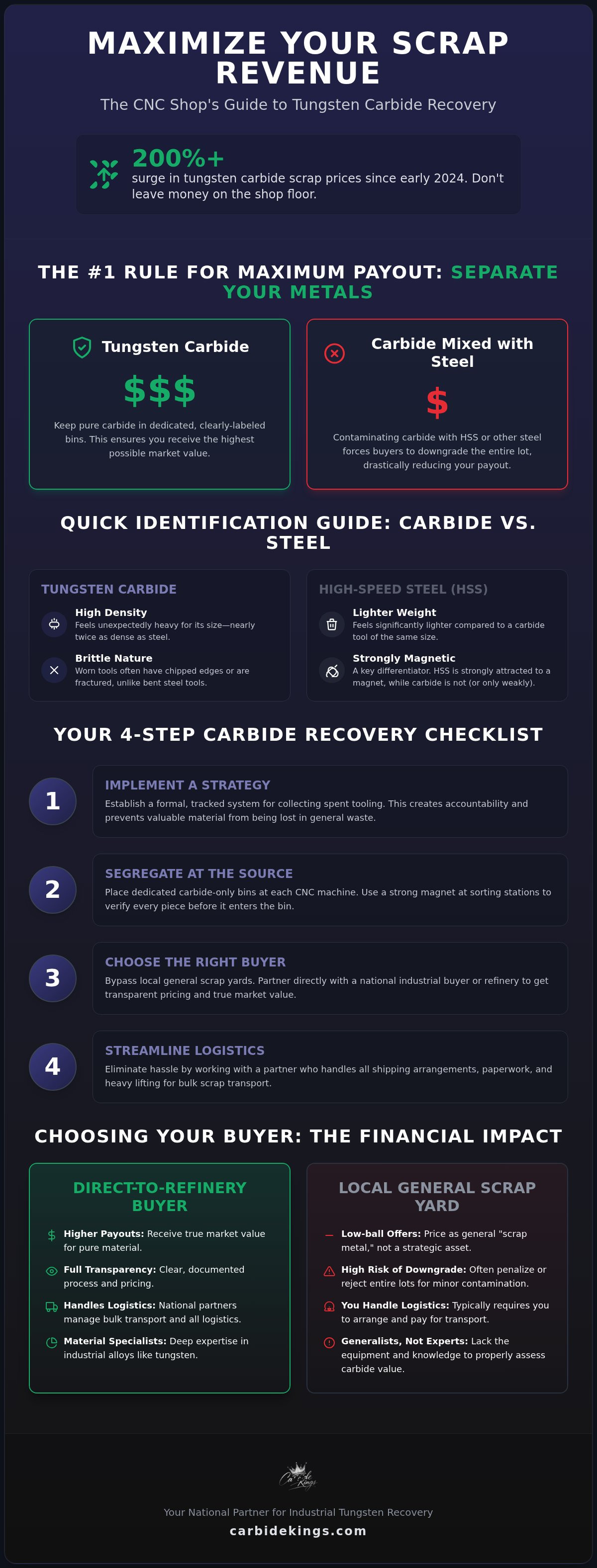
The first step toward a successful recovery program is mastering the Golden Rule: never mix carbide with high-speed steel (HSS). Mixing these materials is the fastest way to devalue your collection. Refineries require high purity levels to process tungsten efficiently. When you contaminate a batch of carbide with lower-value steel, you force the buyer to down-grade the entire lot. Selling scrap carbide from CNC machining requires discipline on the shop floor to ensure every bin contains only high-value alloys.
Identification is straightforward if you know what to look for. Tungsten is a critical material in key sectors, and its physical properties are distinct. Carbide is nearly twice as heavy as steel. If a tool feels unexpectedly dense for its size, it is likely carbide. You should also use a magnet. Standard tool steel is strongly magnetic. Most tungsten carbide is non-magnetic or only very weakly magnetic due to the cobalt binder. Keep a strong magnet at every sorting station to verify materials before they hit the bin.
Hard Scrap: Solids and Inserts
Hard scrap is the most common form of carbide found in CNC environments. This category includes indexable inserts, solid end mills, and broken drill bits. Even small saw tips and specialty wear parts qualify. When you are ready for tungsten hard scrap pickup, ensure these items are free of steel shanks or brazed attachments. Don't worry about coatings like TiN or AlTiN. These thin layers are only microns thick and do not significantly impact the base scrap value. Focus on the weight of the solid material. If you have questions about a specific tool grade, consult with a specialist to ensure you are categorizing it correctly.
Soft Scrap: Sludge, Swarf, and Fines
Don't ignore the byproduct of your grinding operations. CNC swarf and grinding sludge are often overlooked, but they contain significant amounts of tungsten. This "soft scrap" requires more careful management than solids. You must prevent contamination from floor sweepings or other metal chips. Use dedicated coolant filtration systems to capture these fines effectively. Check out our tungsten carbide swarf buyers guide for advanced recovery techniques. Proper storage is also essential. Keep tungsten carbide grinding sludge in sealed, leak-proof containers to maintain its integrity and value until you are ready to ship.
The Ultimate Machine Shop Metal Recycling Checklist
Turning your shop waste into profit requires a physical system, not just a verbal policy. If your operators don't have a specific place to put worn inserts, those tools will end up in the general scrap bin or the trash. Selling scrap carbide from CNC machining is most effective when it follows a repeatable, five-step checklist designed for the industrial floor.
- Step 1: Designate color-coded, labeled bins specifically for tungsten carbide. Use a high-visibility color like yellow or orange to distinguish them from standard steel bins.
- Step 2: Train operators on the visual and tactile differences between carbide and HSS. Weight and magnet tests should be standard operating procedures at every machine.
- Step 3: Implement a "clean bin" policy. Contamination from coolant, shop rags, or floor sweepings can lead to weight deductions or lower price offers from refineries.
- Step 4: Establish a monthly weigh-in and inventory check. Tracking your accumulation helps you predict revenue and ensures that valuable material isn't "leaking" out of your facility.
- Step 5: Partner with a national buyer for consistent, bulk pickups. The United States Cutting Tool Institute (USCTI) has highlighted the critical need for robust domestic recovery paths, and working with a specialist ensures your material stays in the high-value supply chain.
Setting Up Your Collection Stations
Placement is the biggest factor in operator compliance. Position your small, labeled bins directly at tool-change stations or inside the CNC cabinet itself if space allows. For high-volume shops, a 5-gallon bucket is often the ideal size; it's heavy enough to stay put but easy enough to move when full. Because carbide is highly valuable, store your consolidated bulk containers in a secure, monitored area once they leave the machine side. This prevents external theft and internal shrinkage.
Training and Documentation
Don't assume everyone knows the difference between a coated HSS drill and a solid carbide one. Post a simple visual guide at every station. A well-maintained logbook is also essential. Record the weight of every batch before it hits the central storage area. This documentation provides a clear audit trail for ISO compliance and helps you verify the weights reported by your buyer. Standardizing the cleanout process during routine machine maintenance ensures that no swarf or sludge is left behind, maximizing the efficiency of selling scrap carbide from CNC machining across your entire operation.
Evaluating Buyers: National Refineries vs. Local Scrap Yards
Choosing the right partner is just as critical as your shop's internal sorting process. Many shop owners settle for the convenience of a local scrap yard, but this convenience often comes at a steep financial price. When selling scrap carbide from CNC machining, you are dealing with a specialized industrial alloy, not common residential metals like aluminum or copper. Local yards usually lack the downstream connections to pay you what the material is truly worth. They function as middlemen, taking a significant cut before passing the material to a specialist.
Transparency is the foundation of a professional recovery program. You need a partner who provides a clear audit trail, including detailed weight certificates and assay reports. This level of documentation is rarely available at the local level. National industrial buyers use a direct-to-refinery model. This approach bypasses local markups and ensures your payout reflects current global market trends. Professional partners also handle the "heavy lifting" of logistics, providing streamlined freight solutions for heavy, high-density loads.
The Pitfalls of Local Cash Buyers
General scrap yards operate on volume and simplicity. They rarely invest in the specialized XRF testing equipment required to verify tungsten purity on the spot. To protect their own margins, they offer "safe" low-ball prices that significantly undervalue your tools. You will often encounter hidden fees or arbitrary "dirt" deductions for coolant residue that a refinery would handle as part of a standard process. Furthermore, there is a compliance risk. Without formal documentation, you have no proof that your industrial waste was handled according to federal environmental regulations, leaving your shop vulnerable during an audit.
Benefits of National Industrial Partners
A national industrial partner acts as a supportive guide through the entire recycling lifecycle. They offer professional logistics support, managing the complex shipping requirements for bulk tungsten sludge or heavy solids. This is a massive relief for shop managers who don't have the time to coordinate freight. These partners provide consistent pricing that doesn't fluctuate based on a local yard's current inventory levels. For organizations with multiple facilities, a national partner offers a scalable solution. You can implement a uniform recovery system across every location, ensuring maximum ROI regardless of where your shop is situated. If you want to maximize your returns, get a professional quote today and see the difference a specialist makes.
Streamlining Your Logistics with Carbide Kings
Carbide Kings is built to remove the administrative hurdles that often stall industrial recycling programs. We know you're busy running a shop, so we've refined our process to be as fast as a standard retail transaction. Selling scrap carbide from CNC machining doesn't have to be a logistical nightmare of paperwork and vague promises. We act as your proactive partner, managing the complex details so you can stay focused on your core machining operations. Our national reach across the United States means we can support your facility regardless of its location, providing the same high level of service to small-to-mid-sized shops that was once reserved only for massive industrial conglomerates.
Getting Your Bulk Quote
Starting the process is simple and direct. To provide an accurate valuation, we just need a few details: the type of material, an estimated total weight, and clear photos of the lot. Whether you're dealing with tungsten soft scrap like grinding sludge or high-value hard solids, our experts evaluate your specific tungsten alloys and wear parts with precision. We don't use the "one-price-fits-all" approach of general scrap yards. Instead, we offer competitive pricing based on the actual purity and market value of your specific materials. Our team understands the nuances of different carbide grades, ensuring that specialty tools like indexable inserts and solid end mills are priced correctly. Request a quote today to lock in current market rates and protect your margins from global market volatility.
Shipping and Final Settlement
Once you approve your quote, we move into the logistical phase. Shipping heavy metal requires specialized handling, and we guide you through every step. We provide standardized packaging requirements to ensure your carbide arrives safely and meets all domestic freight regulations. This removes the burden of shipping logistics from your staff. After your shipment reaches our facility, we begin the verification process immediately. We weigh and verify your materials using professional-grade equipment to ensure you get every cent you're owed. Finalizing the transaction is the best part of the experience. We understand that industrial cash flow is the lifeblood of your business, so we process your payment within 24 to 48 hours of final settlement. We've refined every step of selling scrap carbide from CNC machining to ensure it's the easiest part of your month.
Maximize Your Shop Floor ROI Today
Implementing a dedicated recovery strategy is the final step in closing your tool life cycle loop. By maintaining strict segregation and following a repeatable shop-floor checklist, you ensure that no high-value material is ever lost to a general scrap bin. Selling scrap carbide from CNC machining should be a transparent, high-margin part of your business operations rather than an administrative burden. You've seen how professional sorting and the right industrial partner can transform your bottom line.
Carbide Kings is ready to handle the heavy lifting for your facility. We provide specialized tungsten and carbide expertise, direct industrial buyer pricing, and full national US logistics support to simplify every shipment. You focus on precision machining; we'll focus on turning your waste into a consistent revenue stream. Get a Professional Quote for Your CNC Carbide Scrap and start reclaiming your tooling investment today. It's time to treat your spent inserts as the strategic assets they really are. Your shop's profitability depends on every detail, including the ones in your scrap bin.
Frequently Asked Questions
Can I mix different types of carbide inserts in the same scrap bin?
Yes, you can mix various grades of tungsten carbide inserts in a single collection bin. Most refineries process these together as long as they are all carbide based. However, the critical rule is to avoid contamination from other metals like high-speed steel or aluminum. Keeping your inserts pure ensures the highest possible payout when selling scrap carbide from CNC machining without requiring the buyer to perform manual sorting.
What is the minimum weight required to sell scrap carbide to a national buyer?
While requirements vary, national buyers usually prefer bulk shipments of at least 50 to 100 pounds to optimize freight costs. Smaller amounts are often not cost effective to ship across the country. Accumulating a full 5-gallon bucket is a common internal benchmark for many shops. Larger shipments typically command better pricing because the logistical overhead is spread across a greater volume of material, maximizing your total return on investment.
How do I know if my end mills are solid carbide or just carbide-tipped?
You can identify solid carbide tools by their weight and magnetic properties. Solid carbide is nearly twice as heavy as steel and is generally non-magnetic. If the shank of your end mill is attracted to a magnet, it is likely a carbide-tipped tool with a steel body. For maximum value, you should remove the steel shanks or categorize them separately; refineries pay the highest rates for pure, solid tungsten materials.
Is grinding sludge worth as much as solid carbide inserts?
No, grinding sludge is generally worth less than solid carbide inserts due to the presence of moisture and coolants. While the tungsten content remains valuable, the refinery must account for the weight of non-metallic fluids and the extra processing required to dry the material. However, capturing this sludge is still a vital part of selling scrap carbide from CNC machining because it turns a waste disposal cost into revenue.
How does the current price of tungsten affect my scrap carbide value?
The value of your scrap is directly linked to the global tungsten market. Tungsten is a strategic mineral with volatile supply chains, so when global demand increases or mining output decreases, your scrap value rises accordingly. Monitoring these market trends helps you time your bulk sales for maximum profit. Professional buyers track these indices daily to ensure your quote reflects the most current industrial value for your specific tungsten alloys.
Do I need to clean the coolant off my carbide scrap before selling?
You do not need to chemically clean your carbide scrap, but you should drain as much coolant as possible. Excess liquid adds dead weight that does not contain actual metal, which can lead to deductions during the assay process at the refinery. A simple mesh strainer or a perforated bin can help remove the majority of the fluid. Providing dry material ensures a faster verification process and more transparent final settlement.
What is the difference between tungsten hard scrap and soft scrap?
Tungsten hard scrap refers to solid items like worn end mills, broken drills, and indexable inserts. Soft scrap includes byproducts such as grinding sludge, swarf, and fine powders. Hard scrap is easier to handle and typically has a higher yield. Soft scrap requires specialized containers to prevent leaks and contamination during transport. Both categories are valuable, but they are processed differently by industrial refineries to reclaim the raw tungsten and cobalt.
How should I package heavy carbide scrap for national shipping?
Packaging for national shipping requires heavy-duty containers like reinforced plastic buckets or steel drums. Because tungsten is extremely dense, a small volume can quickly exceed weight limits for standard boxes. Secure your containers to a pallet using high-tensile strapping and shrink wrap to prevent shifting during transit. Proper labeling and a detailed packing slip are essential for ensuring your shipment is tracked and verified quickly upon arrival at the facility.


