

Tungsten prices surged a staggering 622% between January 2025 and April 2026, yet many industrial shops still treat their worn tooling as simple waste. You likely see your bins of dull rotary burrs as a logistical headache rather than a liquid asset. It's frustrating to watch valuable material sit idle because sorting carbide from steel shanks takes too much time. You need a process that's as efficient as your production line. Effective carbide burr recycling shouldn't be a chore that pulls your team away from their core tasks.
We've refined a system that turns your scrap into a high-yield revenue stream without the typical administrative hurdles. You'll learn how to transform worn rotary burrs into a consistent profit center through precision recycling and national logistics. This guide breaks down the transition from cluttered scrap bins to a streamlined disposal strategy. We'll cover everything from market-based payouts to the impact of the 2026 Recycled Materials Attribution Act; this ensures you maximize every pound of your industrial tungsten scrap.
Key Takeaways
- Recognize how recycled tungsten secures your industrial supply chain against 2026 market fluctuations and supply constraints.
- Learn why separating steel shanks from carbide heads is the most effective way to protect your payout from heavy refinery deductions.
- Understand the role of cobalt binders and tungsten carbide in determining the total market value of your scrap rotary files.
- Establish a high-yield carbide burr recycling process that leverages national logistics to handle heavy bulk disposal with zero friction.
- Transition from cluttered scrap bins to a methodical workflow that turns worn tooling into a predictable and liquid revenue stream.
The Industrial Role and Value of Carbide Burr Recycling
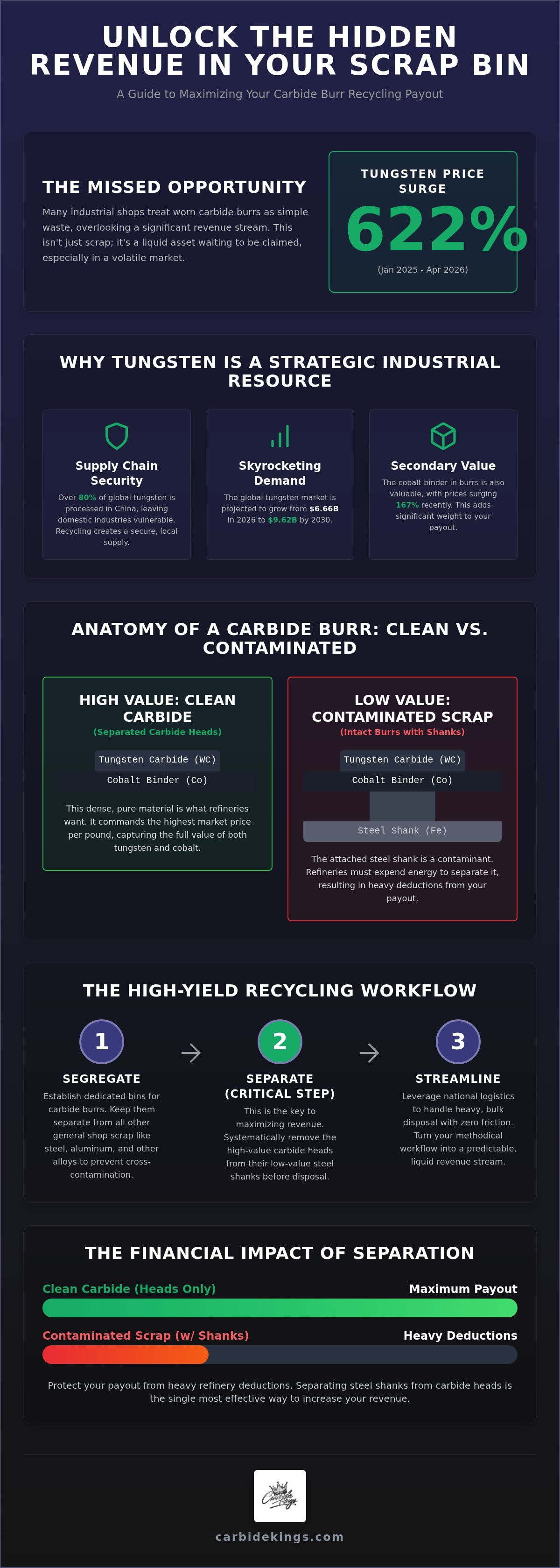
Carbide burr recycling is the systematic recovery of tungsten carbide from worn rotary files and specialized grinding tools. In 2026, this process isn't just a cleanup task; it's a critical industrial strategy. Global supply chains are under immense pressure. China controls over 80% of global tungsten production and processing. This dominance leaves domestic shops vulnerable to export controls and sudden price spikes. Between January 2025 and April 2026, tungsten prices surged by a staggering 622%. If you're tossing these tools into general scrap bins, you're discarding one of the most valuable materials in your facility.
Many machine shops overlook burrs. They focus their recycling efforts on large end mills or carbide inserts. Burrs are smaller and often stay attached to steel shanks. This physical profile makes them look like low-value mixed scrap. However, a dedicated recovery program changes the financial math. It turns a discarded consumable into a high-yield revenue stream that helps offset the rising costs of new tooling. Implementing a streamlined disposal process ensures you capture every cent of value from your tool crib.
Why Tungsten is a Strategic Industrial Resource
Virgin tungsten ore is scarce and expensive to mine. The environmental footprint of extraction is significant, which drives up the cost of raw materials. In contrast, recycled carbide is chemically identical to virgin powder. It retains all the original metallurgical properties required for high-performance tools. Demand is currently skyrocketing in the aerospace, automotive, and defense sectors. The global tungsten market is projected to grow from $6.66 billion in 2026 to $9.62 billion by 2030. Securing a domestic supply through recycling protects your operations from the 25% price increases seen in round tools as of September 2026.
Burrs vs. Other Carbide Scrap: The Revenue Difference
Not all scrap is equal. Industrial burrs are prized for their high density and specific Tungsten carbide composition. Most high-performance burrs utilize a cobalt binder to maintain their structural integrity. This adds significant secondary value to the scrap. Standard cobalt hydroxide prices surged approximately 167% between January 2025 and June 2026. High-volume sectors like aerospace and heavy manufacturing generate massive amounts of burr waste. When you manage these as a distinct scrap category, your payout is substantially higher than general industrial alloys. It pays to separate your high-grade tungsten from the rest of your shop waste.
Understanding the Composition: Tungsten and Cobalt in Rotary Burrs
Industrial carbide burrs are engineered composites, not simple metal castings. Their performance relies on a precise blend of Tungsten Carbide (WC) and Cobalt (Co). The tungsten provides the extreme hardness required to cut through hardened steel, while the cobalt acts as the "glue" that prevents the tool from shattering under pressure. This chemical makeup is exactly what makes carbide burr recycling so lucrative in 2026. Refineries extract these elements to create new powder for the next generation of high-performance industrial tools.
Manufacturers adjust these chemical ratios based on the specific application of the tool. Burrs designed for aluminum often feature a different grain structure to prevent material loading. Tools intended for stainless steel or nickel alloys typically utilize micro-grain carbide for maximum heat resistance. You might also notice gold, charcoal, or purple hues on your tools; these are TiN or TiAlN coatings. While these specialty coatings enhance tool life on the shop floor, they don't negatively impact the recycling value. The core weight of the tungsten remains the primary driver of your scrap revenue.
The Role of the Cobalt Binder
Cobalt is a critical material for high-heat industrial applications. It maintains its structural integrity at temperatures that would melt or deform lesser binders. Recycling centers prioritize burrs with consistent cobalt-to-tungsten ratios because cobalt is a strategic resource with its own high market value. As cobalt prices fluctuate, the binder content in your scrap becomes a significant factor in your total payout. Cobalt-tungsten carbide is a sintered metal composite used for extreme durability.
Identifying High-Value Carbide Grades
Micro-grain carbide formulations offer a denser structure than standard grades. This density translates to a higher weight-per-volume, which is beneficial when you're selling scrap by the pound. You can use basic shop tools to perform a preliminary material check. A simple magnet test is your first line of defense. While tungsten carbide isn't magnetic, the cobalt binder and steel shanks are. If the tool head has a very strong magnetic pull, it's likely a lower-grade alloy or contains high levels of contamination. Understanding these distinctions ensures you get the best price for your Tungsten Hard Scrap lots. Consistent sorting of these grades prevents payout deductions and keeps your recycling program profitable.
The Lifecycle of Recycled Carbide: From Shop Floor to Refinery
The journey of carbide burr recycling starts the moment a tool loses its cutting efficiency on your shop floor. Instead of hitting the trash, these tools enter a sophisticated loop that preserves their strategic value. First, you must collect and sort the scrap. Refineries require a rigorous cleaning phase where oils, coolants, and brazed steel shanks are removed. This preparation is vital. Clean material moves directly into the recovery phase, while contaminated lots face heavy deductions or rejection.
Once prepared, the scrap undergoes either mechanical or chemical processing. These methods transform solid chunks of tool steel back into high-purity powder. This refined tungsten powder is then sold back to manufacturers who press and sinter it into new rotary files, inserts, or end mills. This closed-loop system is essential for maintaining industrial stability in 2026. It reduces the need for environmentally taxing mining and keeps your supply chain resilient against global shortages. Every pound you recycle contributes to a more sustainable and predictable manufacturing environment.
Mechanical vs. Zinc Processing Methods
The cold-stream mechanical process uses high-pressure air to collide scrap particles at supersonic speeds. This shatters the carbide into a fine powder without chemical intervention. However, the zinc process is often preferred for rotary burrs. In this method, scrap is submerged in molten zinc. The zinc reacts with the cobalt binder, causing the composite to expand and crumble. Once the zinc is evaporated and recovered, the result is a high-purity carbide grain that retains its original metallurgical integrity. This method is exceptionally efficient at preserving the quality of the raw materials for immediate reuse in tool production.
Quality Control and Metallurgical Testing
Modern refineries leave nothing to chance. Every incoming lot undergoes rigorous verification to ensure purity levels. Technicians use X-ray fluorescence (XRF) scanning to determine the exact elemental breakdown of the scrap in seconds. This technology identifies the precise percentages of tungsten, cobalt, and any trace contaminants that could weaken a new tool. Carbide Kings emphasizes transparency in this grading process. We provide clear, data-driven valuations so you know exactly what your material is worth. This no-nonsense approach to testing ensures that your bulk shipments are graded fairly and processed with professional efficiency. You get a fast transaction based on the actual metallurgical value of your scrap.
Maximizing Your Payout: Managing Shanks and Contamination
The steel shank is the single biggest value-killer in carbide burr recycling. Most industrial burrs consist of a tungsten carbide head brazed onto a steel shaft. Refineries apply significant price deductions for these "brazed" attachments because the steel acts as a contaminant in the metallurgical recovery process. To get the highest return, you must understand how to prepare your material before it leaves your facility. A lot that's properly sorted and cleaned will always command a premium over mixed shop waste.
Don't overlook the secondary materials generated during tool use. If your facility performs in-house tool sharpening or grinding, you're likely producing grinding swarf and fines. This material is classified as Tungsten Soft Scrap and holds substantial value. Capture these fines in dedicated filtration systems rather than washing them away. When you combine high-grade burr heads with recovered soft scrap, you transform your waste management into a serious profit center. Use this checklist to prepare your bulk lots:
- Verify Material: Use a magnet to ensure no high-speed steel (HSS) tools have slipped into the carbide bin.
- Remove Fluids: Drain all cutting oils and coolants; refineries deduct for excess weight from moisture.
- Separate by Type: Keep solid carbide burrs in a different container than brazed-shank burrs.
- Secure Packaging: Use heavy-duty, reinforced containers to prevent loss during national transit.
The Steel Shank Dilemma: To Cut or Not to Cut?
You must analyze the labor cost of removing steel shanks versus the increased scrap value. For high-volume shops, setting up a mechanical separation station with a dedicated chop saw often pays for itself in a single quarter. Solid carbide burrs are easy to identify because they lack the visible braze seam at the neck of the tool. These solid pieces should be your highest priority for collection. If the labor for separation is too high for your current staffing, simply ensuring that your brazed lots are free of other metals will still protect your baseline payout.
Avoiding Cross-Contamination in the Scrap Bin
Mixing High-Speed Steel (HSS) with carbide is a mistake that ruins the value of an entire lot. Purity is the primary metric refineries use to determine your payout. Implement a strict bin-labeling system and train your staff to recognize the weight difference; carbide is significantly heavier than steel. For a broader look at total shop efficiency, refer to the CNC machine shop’s checklist for selling scrap carbide in 2026. Once your bins are sorted and ready, contact us to arrange a high-yield pickup for your Carbide scrap.
National Logistics: Streamlining Your Bulk Burr Disposal
Many industrial facilities settle for local scrap yards because they assume national shipping is too complex. This mistake often leads to lower payouts from dealers who don't specialize in high-value tungsten alloys. We've removed these traditional barriers by offering a nationwide service that handles the heavy lifting of logistics. In 2026, secure and tracked industrial metal transport is the standard for high-density scrap. You need a partner who understands the regulatory and logistical requirements for moving heavy bulk lots across the country safely and efficiently.
Our approach to carbide burr recycling is built on professional efficiency. We don't just buy your scrap; we provide a comprehensive disposal strategy that fits into your existing workflow. This ensures your team stays focused on production while your worn tooling is converted into liquid capital. By leveraging a national network, we offer a level of reliability and transparency that local general scrappers simply cannot match. We treat your bulk disposal as a professional business transaction, not a side project.
The Carbide Kings Procurement Process
Getting a competitive market quote is straightforward. First, you submit your lot details through our streamlined portal. We prioritize speed and transparency, providing a valuation based on current market data for tungsten and cobalt. Our "no-nonsense" approach eliminates unnecessary paperwork and administrative hurdles that typically stall industrial transactions. We act as a proactive partner, guiding you from the initial contact to the final resolution. This process is designed to be as simple as a basic retail transaction, ensuring you receive your payout without delay. It's a methodical workflow that answers your questions before they're even formed.
Shipping and Handling for Heavy Carbide Lots
Tungsten is exceptionally dense. Even small containers of burrs are incredibly heavy, which can lead to shipping accidents if not handled correctly. Proper palletizing is essential for secure transport. We recommend using reinforced, heavy-duty containers and securing them with steel strapping to a standard pallet. This prevents shifting or container failure during national transit. We handle the logistical coordination for our national clients, removing the burden of arranging freight for heavy metal loads. Our team ensures that your shipment meets all 2026 industrial transport standards for tracking and security. Ready to move your inventory? Contact Carbide Kings for a bulk scrap quote today. We make the transition from cluttered bins to a final payout seamless and professional.
Secure Your Industrial Scrap Revenue for 2026
Transitioning from a cluttered tool crib to a streamlined revenue stream is a logical step for any high-volume facility. You've seen how managing steel shanks and understanding the value of cobalt binders can significantly protect your bottom line. Effective carbide burr recycling isn't just about waste disposal; it's about reclaiming strategic assets in a volatile global market. By focusing on purity and proper sorting, you ensure your shop captures every cent of value from its worn consumables.
We handle the heavy lifting so you don't have to. Our team provides national logistics support for bulk industrial lots and utilizes direct-to-industry transparent grading to ensure you receive a fair, fast transaction. As specialists in high-purity tungsten and cobalt recovery, we've refined our process to eliminate administrative hurdles and logistical friction. It's time to stop letting your scrap sit idle and start putting that capital back into your operations.
Turn your worn carbide burrs into revenue; Request a quote from Carbide Kings. We're ready to help you maximize your industrial scrap value today.
Frequently Asked Questions
Can I recycle carbide burrs that are still attached to steel shanks?
Yes, you can recycle burrs with shanks, but they command a lower price than clean carbide heads. Refineries must separate the steel from the carbide before processing, which adds labor and weight contamination. If you want to maximize your revenue, it's best to cut the heads off. We accept both types, but we apply a transparent deduction for any brazed steel attachments found in the lot.
What is the difference between carbide burr scrap and tungsten soft scrap?
Carbide burr scrap is a form of hard scrap, while soft scrap includes powders and sludge. Hard scrap consists of solid, sintered pieces like rotary files or end mills. Tungsten soft scrap is the byproduct of grinding or sharpening these tools. Both materials are valuable, but they require different handling. Hard scrap is easier to sort, whereas soft scrap must be kept in sealed containers to prevent loss.
How much carbide burr scrap do I need to qualify for bulk shipping?
Bulk shipping is most efficient when you've consolidated several hundred pounds of material. We provide national logistics support for industrial-sized lots to ensure the payout justifies the transport costs. If you aren't sure if your current inventory qualifies, reach out to our team for a consultation. We help you coordinate the move of heavy containers so you don't have to worry about the logistical hurdles of national scrap selling.
Does the coating on the burr (like TiN) affect the recycling price?
No, specialty coatings like Titanium Nitride (TiN) or Titanium Aluminum Nitride (TiAlN) don't negatively impact the scrap value. These coatings are extremely thin and are easily removed during the refinery's cleaning and chemical processing phases. The primary value in carbide burr recycling comes from the weight and purity of the tungsten carbide and cobalt binder. You don't need to strip or treat the tools before shipping; just ensure they're clean.
How do I distinguish between high-speed steel (HSS) and tungsten carbide burrs?
Density is the best way to tell the difference between these materials. Tungsten carbide is much heavier than high-speed steel (HSS). If you hold one of each in your hands, the weight difference is immediate. You can also use a magnet; HSS is strongly magnetic, while the carbide head itself is not. Proper segregation is vital because mixing HSS into your carbide bins will lead to significant purity deductions at the refinery.
What happens to the carbide burrs after they are sold to Carbide Kings?
Once sold, the tools are processed to recover raw tungsten and cobalt. These materials are broken down into fine powders using mechanical or chemical methods like the zinc process. This recycled powder is then used to manufacture new industrial tooling. This cycle supports the 2026 global supply chain by providing a domestic source of high-quality material. Your scrap effectively becomes the raw material for the next generation of high-performance tools.
How are payments handled for national industrial scrap lots?
Payments for national lots are issued following a professional metallurgical verification. After your shipment is received, we use XRF technology to confirm the tungsten and cobalt content. This data provides a transparent basis for your payout. We avoid the administrative hurdles common with traditional dealers, ensuring you receive your funds through secure industrial channels. This streamlined approach to carbide burr recycling ensures your facility remains focused on its core operations while we handle the logistics.
Is there a market for the grinding sludge produced when using carbide burrs?
Grinding sludge is a lucrative form of tungsten soft scrap that shouldn't be thrown away. This byproduct contains concentrated tungsten particles that are highly sought after for metallurgical recovery. By implementing a filtration system to capture this swarf, you turn a disposal cost into a new revenue stream. We specialize in recovering value from both hard and soft scrap, helping you capture every possible cent of revenue from your shop's carbide waste.


