

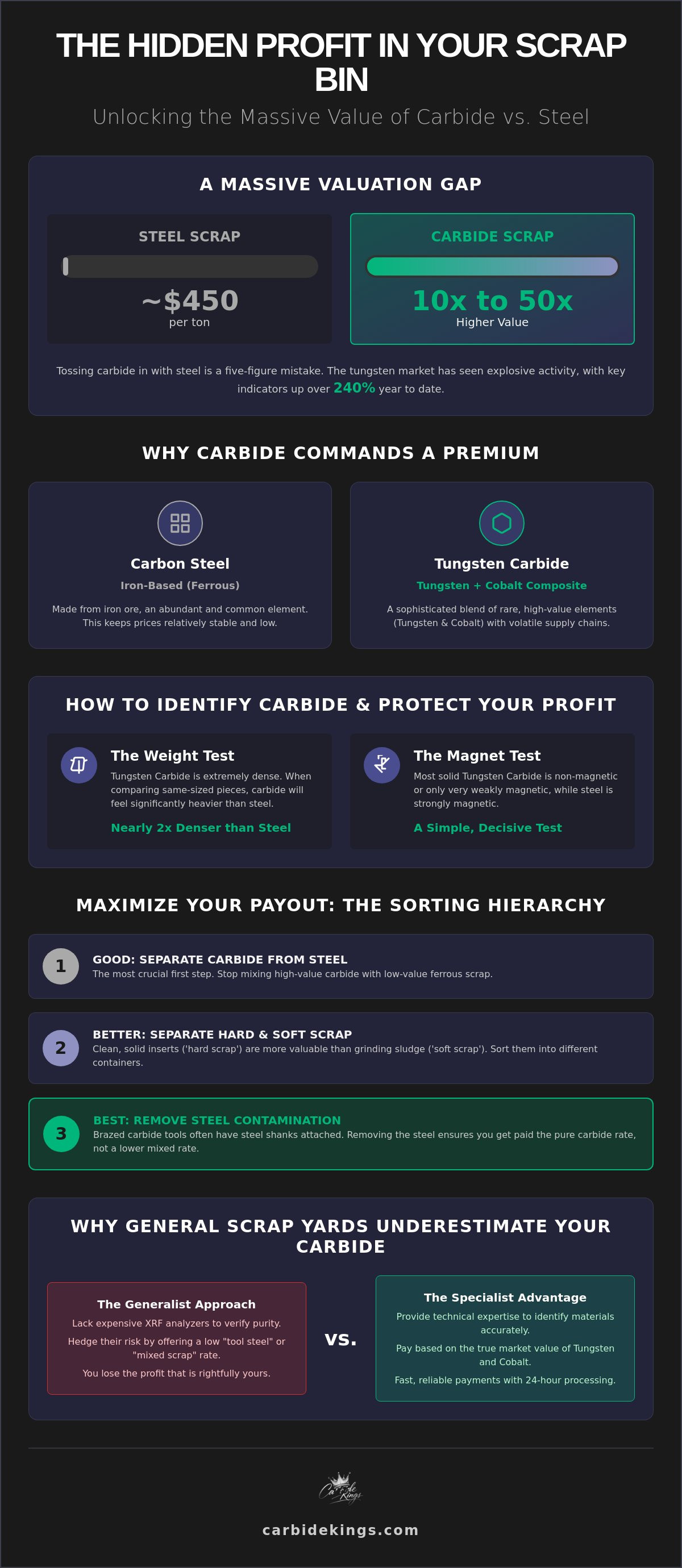
If you are tossing dull inserts into the same bin as your steel turnings, you are effectively throwing away thousands of dollars. The carbide scrap vs steel scrap price difference is not just a minor variance; it is a massive valuation gap that can redefine your shop's annual revenue. While steel prices have shown modest growth in 2026, reaching around $450 per ton, the tungsten market has seen explosive activity with key indicators up over 240% year to date. Selling your tungsten at ferrous metal rates is a five-figure mistake that many high-volume shops make simply because they lack a streamlined sorting process.
It's frustrating to watch potential profit disappear into a local scrap yard's generic bin. We understand that identifying the difference between High-Speed Steel and carbide can be time-consuming when you're focused on production. This guide promises to clear that confusion and show you how to maximize your industrial recycling revenue. You will learn simple identification methods to separate your high-value materials and discover a fast, reliable way to sell bulk carbide nationwide without the administrative hurdles.
Key Takeaways
- Realize the massive 10x to 50x price multiplier that separates tungsten carbide from standard carbon steel.
- Learn how to identify the carbide scrap vs steel scrap price difference by using simple weight and magnet tests to protect your shop's profit margins.
- Maximize your payout by properly separating hard scrap inserts from soft scrap sludge and removing steel shanks before shipping.
- Leverage a streamlined national procurement process that turns industrial scrap into cash with 24-hour processing and fast payments.
Understanding the Massive Price Gap Between Carbide and Steel Scrap
Steel is the backbone of the industrial world, but it is not the most valuable material in your shop. The fundamental carbide scrap vs steel scrap price difference stems from chemistry. Standard steel is iron-based, categorizing it as a ferrous metal. In contrast, tungsten carbide is a dense composite of tungsten and cobalt. This material difference creates a massive valuation gap. While steel scrap often trades for pennies on the pound, carbide can command a 10x to 50x price multiplier. If you treat these two materials the same, you are leaving significant revenue on the table every time you clear your bins.
The scarcity of raw materials in 2026 has pushed this gap even wider. Industrial professionals must recognize that carbide isn't just "harder steel." It is a critical industrial asset. Mixing a few pounds of carbide inserts into a ton of steel scrap won't move the needle at a local yard, but separating that carbide for a specialized buyer can pay for your next tooling order. Efficiency starts with understanding exactly what you are holding.
The Market Value of Tungsten vs. Iron
Supply and demand dictate every transaction in the scrap market. Iron ore is abundant and found globally, which keeps steel prices relatively stable and low. Tungsten is different. It is a rare element primarily sourced from wolframite ore, and its supply chains are often volatile. In 2026, global supply constraints have caused the price of European Ammonium paratungstate (APT) to rise by 240.5% year to date. These Tungsten carbide properties, including extreme density and heat resistance, make it indispensable for high-performance manufacturing.
Cobalt also plays a vital role in this pricing matrix. As the binder that holds tungsten grains together, cobalt is a high-value technology metal. When you sell carbide, you aren't just selling scrap; you are selling a sophisticated blend of rare elements that the global market is desperate to recover.
Why General Scrap Yards Underestimate Carbide
Most local scrap yards are designed to move volume, not precision. They focus on copper, aluminum, and bulk steel. Because many local dealers lack the expensive XRF analyzers needed to verify material purity, they hedge their bets. They will often offer you a "mixed scrap" or "tool steel" rate that is significantly lower than the actual market value of tungsten. They take the profit that should be yours to cover their own risk.
Relying on a generalist results in a lower payout for your hard work. High-volume shops need a partner that understands the specific nuances of tungsten alloys. Specialized procurement through Carbide Kings eliminates the guesswork. We provide the technical expertise to identify your materials accurately, ensuring you receive a quote based on the actual carbide scrap vs steel scrap price difference rather than a local yard's best guess. We handle the heavy lifting so you can focus on production.
Why Tungsten Carbide Commands a Premium Over Carbon Steel
The reason tungsten carbide commands such a high price compared to steel is its extreme performance profile. It's built for environments where carbon steel would simply melt or deform. This physical superiority is why the carbide scrap vs steel scrap price difference remains so wide. Carbide is a sintered material, meaning it's a composite of tungsten particles held together by a cobalt binder. It maintains a razor-sharp edge even at temperatures that would ruin high-speed steel. This makes it the "hard scrap" of choice for high-precision inserts, end mills, and industrial dies.
Recycling this material is a global priority. Mining new tungsten is an energy-intensive process that involves massive environmental footprints. According to U.S. Geological Survey tungsten data, recycling scrap accounts for a significant portion of the total tungsten supply. It's much more efficient to reprocess existing carbide into new tools than to extract ore from the earth. This circular economy keeps demand high and ensures your old tools remain valuable assets rather than waste. Manufacturers often overlook how this density affects the carbide scrap vs steel scrap price difference in their own shipping containers.
Density and Weight: The Physical Value Indicators
One of the most immediate ways to recognize carbide's value is its weight. Tungsten is incredibly dense, possessing a specific gravity that is nearly double that of lead. Specific gravity is the ratio of a material's density to that of water. When you hold a carbide end mill, it feels uncomfortably heavy for its size. This density is a direct indicator of value because most industrial buyers pay by the pound. A small bucket of carbide can easily outweigh a much larger bin of steel, which drastically changes your payout calculations.
Industrial Demand for Recycled Carbide in 2026
In 2026, the demand for recycled tungsten is surging. Aerospace, automotive, and defense sectors require massive amounts of high-performance tooling. Manufacturers increasingly prefer using recycled tungsten powder because it offers consistent quality with a lower carbon footprint. This high demand is why we offer such competitive rates for tungsten hard scrap. If you aren't sure if your current inventory qualifies for these premium rates, you can request a quick material review from our team to see how much your bins are actually worth.
How to Identify Carbide vs. Steel to Protect Your Profit Margins
You can't afford to guess when it comes to your inventory. Identifying your materials correctly is the only way to capitalize on the carbide scrap vs steel scrap price difference. If you send a bin of mixed metals to a buyer, they will grade the entire lot at the lowest common denominator. This costs you money. Use these four field tests to ensure every pound of your high-value material is accounted for.
- The Weight Test: Pick it up. Carbide is nearly twice as heavy as steel. If a small tool feels uncomfortably heavy for its size, it is likely carbide. This "heft" is the most reliable quick indicator in a busy shop environment.
- The Magnet Test: Many people think a magnet only sticks to steel. That is a mistake. While carbon steel has a powerful magnetic pull, tungsten carbide often contains cobalt as a binder. This results in a subtle, weak magnetic attraction. If the tool snaps to the magnet with force, it is steel. If it barely clings or ignores the magnet entirely, you're likely holding high-value carbide.
- The Spark Test: Touch the material to a bench grinder for a split second. Steel produces long, yellow or orange sparks that "bloom" at the end. Carbide produces very short, deep red or orange sparks that don't travel far. It is a fast, visual way to confirm your sorting.
- The Wear Test: Look at the cutting edge. Used steel tools often show rounded, deformed edges caused by heat. Carbide tools are more likely to be chipped or fractured while the remaining edges stay sharp.
Telling the Difference Between HSS and Carbide
High-Speed Steel (HSS) is a common trap for many shops. It is a high-quality alloy, but its scrap value is significantly lower than tungsten carbide. Most HSS tools, such as large drill bits or taps, are clearly stamped with "HSS" on the shank. If you don't see a stamp and the tool passes the weight test, treat it as carbide. Mixing even a small amount of HSS into your carbide bins will lower your total quote. Keep them strictly separated to protect your payout.
Common Industrial Sources of Carbide Scrap
Knowing where to look is half the battle. High-value items include indexable inserts, solid carbide end mills, and tiny PCB drills. You should also check for "hidden" carbide in mining bits or large industrial dies where the carbide is often encased in a steel body. These composite tools require extra attention during the sorting process.
Don't overlook tungsten carbide wear parts like nozzles, seal rings, and waterjet mixing tubes. These components are frequently replaced in high-wear environments. They can accumulate into a significant revenue stream when properly collected. By identifying these sources, you turn routine maintenance into a profitable recovery operation. Every piece of carbide you rescue from the steel bin directly increases your bottom line.
Maximizing Your Return: Sorting and Preparing Carbide for Sale
Maximize your payout by following a methodical preparation process. While the carbide scrap vs steel scrap price difference offers a huge opportunity, you must treat your carbide like the high-value asset it is. Don't let poor preparation erode your profit. Local yards might take your material as-is, but they'll charge you for the convenience by offering a lower rate. Follow these four steps to get every dollar you deserve.
- Step 1: Separate hard scrap from soft scrap. Keep your solid inserts and end mills away from your grinding sludge and swarf. These materials are processed differently and have distinct price points.
- Step 2: Remove steel shanks and braze. If you have brazed tools, the steel portion adds weight but lowers the purity grade of the tungsten. Removing the steel shanks or separating carbide tips from steel bodies increases your price per pound significantly.
- Step 3: Clean off excess oils and coolants. Heavy residue can lead to weight discrepancies during the verification process. A quick degreasing ensures you're paid for the actual metal weight rather than industrial waste.
- Step 4: Consolidate for shipping. Group similar items together. Use heavy-duty, reinforced containers that can handle the extreme density of tungsten without failing.
Taking these steps ensures a transparent and fast transaction. When your material arrives clean and sorted, it moves through the intake process much faster. This allows for quicker quotes and immediate payments. If you're ready to see how these steps impact your bottom line, you can start your high-value shipment today with our streamlined process.
Hard Scrap vs. Soft Scrap Valuation
Solid "hard" scrap, such as retired milling inserts and broken drills, is the gold standard for recycling. It's easier to verify and reprocess, which is why it typically fetches the highest market price. Soft scrap, which includes sludge and floor sweepings, requires more intensive refining to extract the tungsten. You can learn more about the specific pricing for these materials in our tungsten soft scrap buyers guide. Understanding this distinction helps you manage your shop's collection bins more effectively and ensures you're capturing the full carbide scrap vs steel scrap price difference across all your waste streams.
Packaging for Heavy Shipments
Standard cardboard boxes are not built for tungsten. Because carbide is nearly double the density of lead, a small volume of material can easily exceed the burst strength of a typical shipping box. We recommend using 5-gallon plastic buckets with locking lids or reinforced wooden crates for larger loads. If you're using smaller parcels, double-box the material and use heavy-duty tape on all seams. Securing the load prevents shifting during national transit, which protects the integrity of the package and ensures your material arrives safely for weighing.
Why Industrial Professionals Choose Carbide Kings for National Recycling
Industrial professionals don't have time for slow-moving scrap dealers. You need a partner that matches the speed of your production floor and understands the significant carbide scrap vs steel scrap price difference. Local yards often lack the specialized equipment to verify tungsten, while large corporate programs often bury you in paperwork and complex onboarding. Carbide Kings bridges this gap by offering a streamlined, national procurement service designed for speed and transparency. We treat your scrap like the high-value asset it is.
We handle the logistical heavy lifting for machine shops and manufacturers across the United States. Whether you have fifty pounds of indexable inserts or a ton of solid carbide end mills, our process remains the same. It is fast, reliable, and lucrative. We eliminate the administrative hurdles that usually prevent shops from maximizing their recycling revenue. Our goal is to make industrial recycling as simple as a basic retail transaction so you can stay focused on your core operations.
The Carbide Kings 24-Hour Promise
Our internal workflow is built on a simple principle: time is money. Once your shipment arrives at our facility, the clock starts. We process all materials within 24 hours of receipt. Our team performs a verified weight check and material analysis immediately. This rapid turnaround ensures you aren't waiting weeks for a quote or wondering about the status of your shipment. We provide direct access to experts who understand industrial metal, ensuring clear and honest communication at every step.
Contrast this with traditional refineries. Large-scale processors often take weeks to grade a shipment and even longer to issue a payment. We prioritize your cash flow. By using advanced analysis tools, we provide an accurate valuation that reflects the actual carbide scrap vs steel scrap price difference in the 2026 market. This efficiency is why seasoned veterans of the industrial sector choose us as their proactive partner. We handle the heavy lifting so you don't have to.
Getting Your Instant National Quote
Starting the process is straightforward. You don't need to be a metallurgy expert to get a fair price. Provide us with your material details, and we will offer a preliminary estimate based on real-time market data. This removes the guesswork and allows you to plan your shop's budget with confidence. We offer national shipping logistics support to move your material from your floor to our facility without the usual headaches.
The carbide scrap recycling process is designed to be completely frictionless. Once we verify the weight and purity of your tungsten, we issue fast payments via wire transfer or check. This ensures your capital is back in your business where it belongs. Don't let your valuable tungsten sit in a bin or get sold at ferrous steel rates. Get your competitive carbide quote from Carbide Kings today.
Maximize Your Industrial Recovery Revenue Today
Industrial recycling is no longer just about clearing floor space; it's about protecting your margins. You now understand that the carbide scrap vs steel scrap price difference represents a significant revenue stream for your shop. By applying simple identification tests and maintaining strict sorting protocols, you ensure every pound of tungsten is valued correctly. Don't let your high-value assets disappear into a generic steel bin.
Carbide Kings is ready to handle the heavy lifting for you. We provide national logistics support to streamline your shipping and guarantee 24-hour material processing once your shipment arrives. You receive secure wire transfer payments fast, keeping your cash flow moving without typical corporate delays. It's time to stop under-selling your materials and start capturing their full market value.
Turn your carbide scrap into cash with a fast national quote from Carbide Kings. We're here to help you turn your industrial waste into a reliable business asset.
Frequently Asked Questions
How much more is carbide scrap worth than steel scrap?
Carbide scrap is worth significantly more than steel, often fetching between 10 to 50 times the price of ferrous scrap. This valuation exists because tungsten is a rare, critical raw material with volatile global supply chains. While steel is sold by the ton, the carbide scrap vs steel scrap price difference allows you to sell carbide by the pound for a much higher total return.
Why is tungsten carbide so much heavier than standard steel?
Tungsten carbide is heavier because its atomic structure is far denser than iron. It has a specific gravity of approximately 15.6, which is nearly double that of lead and twice that of carbon steel. This density is a primary reason for its industrial value, as it provides the extreme hardness and heat resistance required for high-performance cutting tools.
Can I sell carbide scrap if it is still attached to steel shanks?
Yes, you can sell brazed tools, but they'll likely receive a lower price than solid carbide. The steel shank adds weight that doesn't contain tungsten, so buyers must account for the extra processing required to separate the materials. For the best return, remove the steel shanks yourself or keep them in a separate bin from your solid carbide inserts.
What is the best way to ship heavy carbide scrap nationwide?
The most effective way to ship is using 5-gallon plastic buckets with locking lids or reinforced wooden crates. Because of the density of the material, standard cardboard boxes often fail during transit. We provide national logistics support to help you move bulk loads safely and efficiently from your facility to our processing center without the usual administrative headaches.
How do I tell the difference between High-Speed Steel (HSS) and carbide?
Look for the "HSS" stamp on the tool shank, which is the most common visual cue for High-Speed Steel. If the stamp is missing, use the weight test; carbide will feel much heavier for its size. You can also perform a spark test where carbide produces short, deep red sparks, while HSS creates longer, yellow sparks that bloom at the end.
Does Carbide Kings buy tungsten sludge or just solid inserts?
We buy both tungsten hard scrap and tungsten soft scrap, including grinding sludge, swarf, and powders. While solid inserts are easier to process, we have the specialized equipment needed to refine tungsten from soft scrap materials. Keep these materials in separate containers to ensure you receive the correct market valuation for each specific material type.
How fast will I receive payment for my carbide scrap shipment?
You'll receive payment shortly after your material is verified at our facility. We process all shipments within 24 hours of receipt, which includes weighing and material analysis. Once you accept the final quote, we issue payments via secure wire transfer or check to keep your shop's cash flow moving without the weeks of waiting common at larger refineries.
Is there a minimum weight requirement for selling carbide scrap?
We typically handle bulk industrial shipments, but it's best to contact us directly to discuss your specific inventory. Because the carbide scrap vs steel scrap price difference is so large, even smaller quantities of tungsten are often worth the shipping costs. We work with machine shops of all sizes to provide a streamlined, profitable recycling solution that fits your production schedule.


